alternatives to bridgework
no restoration
denture(s)
implant(s)
holistic tx planning
- Look at the whole mouth
- Not only at a specific tooth
- Plan for retrievability (always have a back-up plan)
- All restorations will eventually fail
- What will be options? Replace like for like? More destructive resort?
- What will the dentition be like in 10-years?
longevity of RBB
80% over 5-10years
longevity of cantilever bridge
80% over 5-10years
longevity of fixed-fixed over 5-10years
90%
collect information when gathering pt history in regards to bridge planning
- History
- Presenting complaint
- Medical and social history
- Past dental history
- attendance, OH
- Clinical examination (Extra- and intra-oral)
- Soft tissues
- Periodontal
- Caries risk assessment
- Occlusion
- Parafunction
- Abutment evaluation
- Remaining tooth structure
- Special tests
- Radiographs
- Occlusion
occlusal information for bridgework planning
- Examine:
- Intra-orally
- Study casts
- Facebow-mounted on semi-adjustable articulator
- Incisal classification (ortho lectures)
- Canine-guided or group function?
- Opposing tooth over-erupted?
- Reducing interocclusal space
- Will bridge interfere with current occlusion?
- Will it be changed when bridge placed?
- Signs of parafunction present?
- Wear facets, attrition etc.
- Bruxism – risk of destroying bridge when placed
- Wear facets, attrition etc.
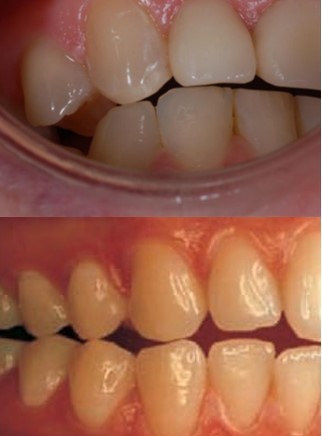
5 considerations for designing and planning bridges
- Minimal preparation or conventional preparation?
- i.e. Conservation of tooth tissue
- Material?
- Abutment evaluation?
- Cleansability
- Bridges will fail if OH isn’t easily performed
- Appearance/Aesthetics
- Confirm that the patient’s expectations are achievable
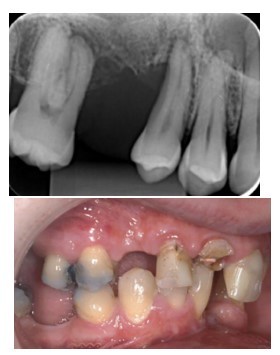
evaluation of potential abutments when designing and planning bridges (8)
- Root configuration
- Big or multi rooted best
- Angulation/rotation of abutment
- Periodontal health – withstand extra occlusal forces
- Surface area for bonding & quality of enamel
- E.g. amelogenesis imperfecta is contraindication for bonding
- Risk of pulpal damage
- Quality of endodontics:
- Re-root canal treatment?
- Need evidence of good endo tx, don’t risk a flare up
- Remaining tooth structure present?
- Enough for good resistance and retention
- May need build ups
- Core
- Remove and rebuild?
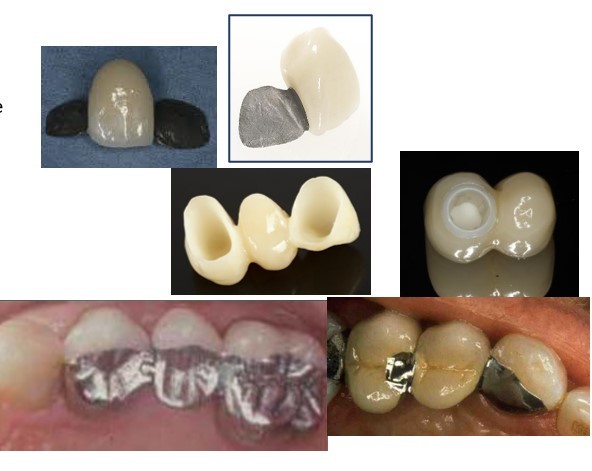
options for bridge design (3 main groups with subgroups)
- Resin-bonded/Resin-retained/Adhesive
- Cantilever
- Fixed-fixed
- “Conventional”
- Cantilever
- Fixed-fixed
- Fixed-moveable
- Hybrid
Compare advantages and disadvantages of each design
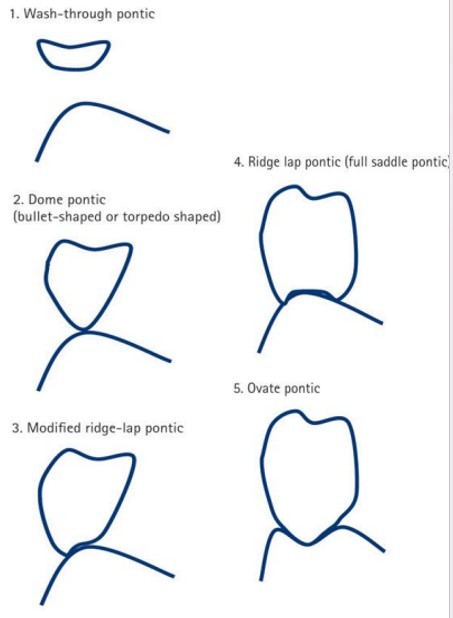
5 points in bridge design planning
- Select abutment teeth
- Judge longevity of adjacent teeth
- Select retainer
- No prep, minimal prep, regular prep? (RBBs)
- Complete crown retainer? (Conventional design)
- Select pontic and connector
- Sanitary/Wash-through pontic
- Dome/Bullet/Torpedo
- Modified ridge lap
- Total ridge lap
- Ovate pontic
- Plan the occlusion
- Prescribe material
3 functions of pontic
restore appearance of missing tooth
stabilise occlusion
improve masticatory function
3 considerations for pontic design
cleansability
appearance
strength
cleansability in pontic design
- Should always be smooth, with highly polished or glazed surface
- Surface should not harbour join of metal and porcelain (if metal-ceramic design used)
- Don’t want shearing off metal due to occlusal force
- Check where occlusal contacts are and ensure lab don’t make join there
- Don’t want shearing off metal due to occlusal force
- Embrasure space smooth and cleansable
appaerance for pontic design
anteriorly - as ‘tooth like’ as possible
posteriorly - may compromise
strength for pontic design
longer the span - greater the thickness required to withstand occlusal forces
4 surfaces of pontic
- Occlusal surface
- Resemble surface of tooth it replaces
- Narrower if possible to enable cleaning
- Should have sufficient occlusal contact so can function
- Need driven down long axis of tooth
- Approximal surface
- Connector: strength (roughly 2 by 2 mm for strength)
- Embrasure: space – floss/interdental, but want to try and reduce for aesthetic
- Buccal & lingual surface
- Ridge surface
wash through pontic design
a.k. hygienic or sanitary
makes no contact with soft tissue
fucntional rather than for appearance
consider in lower molar area
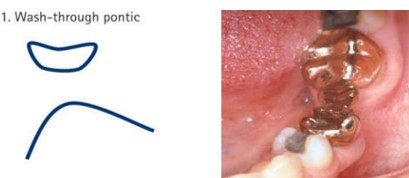
dome shaped pontic design
a.k.a torpedo or bullet shaped
useful in lower incisor, premolar or upper molar areas
acceptable if occlusal 2/3 of buccal surface visible - poor aesthetics if gingival 1/3 of tooth visible
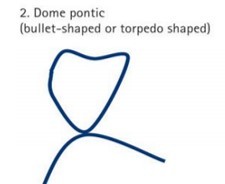
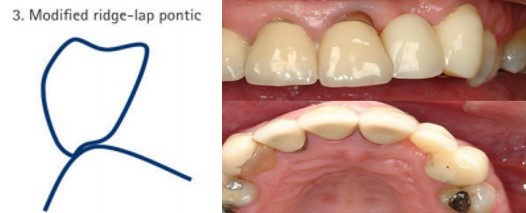
modified ridge lap pontic design
buccal surface looks as much like tooth as possible
lingual surface cut away
line contact with buccal of ridge
problems with food packing on lingual surface of ridge
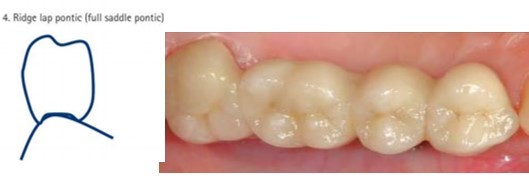
ridge lap/saddle pontic design
greatest contact with soft tissue
if designed carefully: can be cleansed
less food packing than ridge-lap
care taken not to displace soft tissue or cause blanching of tissue
ovate pontic design
good for OH good and want optimal aesthetics
presses on gingivae, makes divet so looks like natural tooth piercing out of ginivae
may place in essix retainer and use that to help make divet, add composite to press more and then move onto final bridge with ovate pontic
materials for conventional bridges
- All metal
- Gold
- Nickel/Cobalt chromium?
- Stainless steal
- Metal ceramic
- All ceramic – more likely to #, but starting to rival MC
- Zirconia – very strong, but less aesthetic than lithium disilicate
- E.g. LAVATM and Procera®
- Lithium disilicate
- e.g. - E.max
- Zirconia – very strong, but less aesthetic than lithium disilicate
- Ceromeric (porcelain with composite), less used
- BelleGlass™
- Vectris®
- Targis® Vectris®
common place for all metal bridges
lower posterior area (gold)






