A 78-year-old woman with a history of hypertension experiences fatigue with minimal
exertion. She complains of shortness of breath which is worst at night and sleeps with her upper body raised to minimise this. She is admitted to hospital for tests. Physical examination reveals a blood pressure of 180/90 mm Hg, increased jugular venous pressure, peripheral oedema, and pulmonary rales. A chest x-ray shows pulmonary oedema. An echocardiogram (below) shows increased thickness of the left ventricular wall, a left ventricular cavity of normal size, left atrial enlargement, and a left ventricular ejection fraction of 70 percent
Fatigue
Orthopnoea
A 78-year-old woman with a history of hypertension experiences fatigue with minimal
exertion. She complains of shortness of breath which is worst at night and sleeps with her upper body raised to minimise this. She is admitted to hospital for tests. Physical examination reveals a blood pressure of 180/90 mm Hg, increased jugular venous pressure, peripheral oedema, and pulmonary rales. A chest x-ray shows pulmonary oedema. An echocardiogram (below) shows increased thickness of the left ventricular wall, a left ventricular cavity of normal size, left atrial enlargement, and a left ventricular ejection fraction of 70 percent
What does the echocardiogram show?
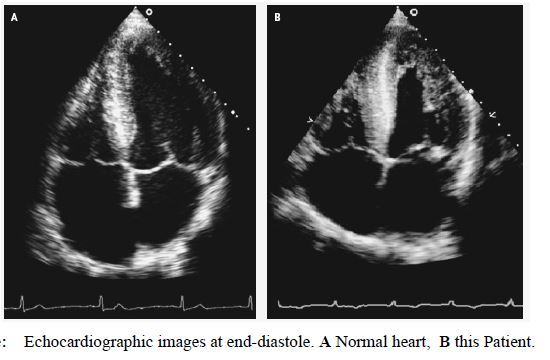
1) Increased thickness of the LV wall
2) LV cavity of normal size
3) Left atrial enlargement
* And LV ejection fraction of = 70%
A 78-year-old woman with a history of hypertension experiences fatigue with minimal
exertion. She complains of shortness of breath which is worst at night and sleeps with her upper body raised to minimise this. She is admitted to hospital for tests. Physical examination reveals a blood pressure of 180/90 mm Hg, increased jugular venous pressure, peripheral oedema, and pulmonary rales. A chest x-ray shows pulmonary oedema.
An echocardiogram (below) shows increased thickness of the left ventricular wall, a left ventricular cavity of normal size, left atrial enlargement, and a left ventricular ejection fraction of 70 percent
What are the important clinical signs?
- BP 180/90
- Increased JVP
- Peripheral Oedema
- Pulmonary rales
- LV hypertrophy
- LA enlargement
- LV EF = 70%
- Pulmonary oedema
A 78-year-old woman with a history of hypertension experiences fatigue with minimal
exertion. She complains of shortness of breath which is worst at night and sleeps with her upper body raised to minimise this. She is admitted to hospital for tests. Physical examination reveals a blood pressure of 180/90 mm Hg, increased jugular venous pressure, peripheral oedema, and pulmonary rales. A chest x-ray shows pulmonary oedema.
An echocardiogram (below) shows increased thickness of the left ventricular wall, a left ventricular cavity of normal size, left atrial enlargement, and a left ventricular ejection fraction of 70 percent
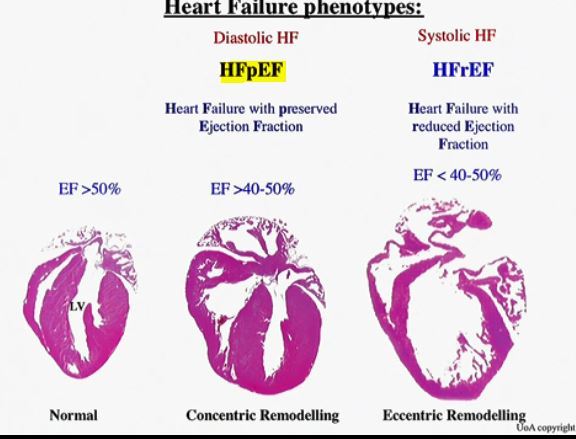
This this Heart Failure when the EF = 70%?
Yes.
Diastolic HF
It is HFpEF (heart failure with preserved EF)
Who is more likely to have HFpEF?
- Older
- Female
- Hypertensive
- Diabetic
- AF
- Chronic Kidney Disease
How can you differentiate between the 2 types of HFpEF based on symptoms?
HFpEF symptoms usually more obvious with exercise rather than at rest
Describe the treatments for HFpEF
There are no effective treatments for HFpEF
Systolic treatments are ineffective for HFpEF
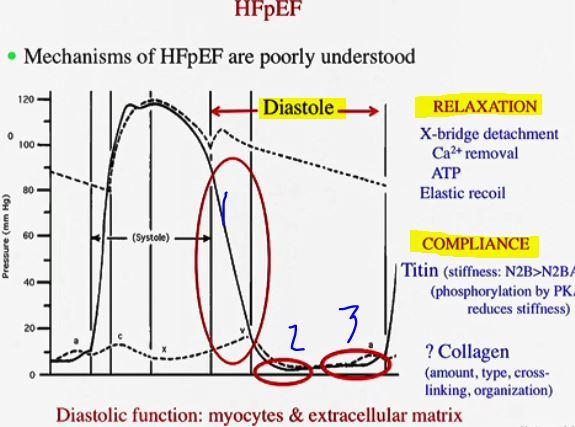
What is occuring during diastole?
What can go wrong to cause HFpEF?
Diastole is an ACTIVE process
- 1) Ventricular Relaxation
- X-bridge detachement
- Tension is released when Ca2+ disassociates from Tn C. Ca2+ decline results in reduced Ca-Tn C binding
- Ca2+ removal
- ATP
- Tension is released when Ca2+ disassociates from Tn C. Ca2+ decline results in reduced Ca-Tn C binding
- Elastic recoil
- X-bridge detachement
- 2) Compliance (chamber stiffness)
- Titin (stiffness: N2B> N2BA)
- Phosphorylation by PKA reduces stiffness)
- Titin constitutes the third myofilament of cardiac muscle, with a single giant polypeptide spanning from Z-disk to the M-band region of the sarcomere
- Phosphorylation by PKA reduces stiffness)
- Collagen
- Amount, type, cross linking, organization
- Titin (stiffness: N2B> N2BA)
- Atrial Contraction
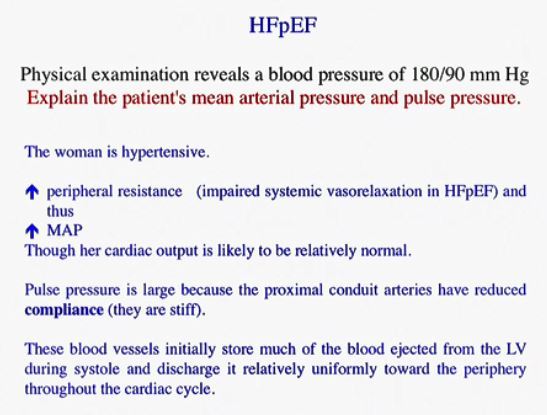
Physical examination reveals a BP of 180/90mmHg
What are the patient’s mean arterial pressure and pulse pressure?
Why are these high/low?
Pulse pressure = Ps-Pd = 90mmHg (normal resting = 40mmHg)
Because of prolonged hypertension, the BV become thicker, stiffer and less compliant.
MAP = Pd + 1/3 (Ps-Pd)
= Pd + 1/3 Pulse pressure
= 90+ 1/3(90)
=120mmHg (normal resting = 90-100mmHg)
High because of peripheral vasocontriction
EXAM
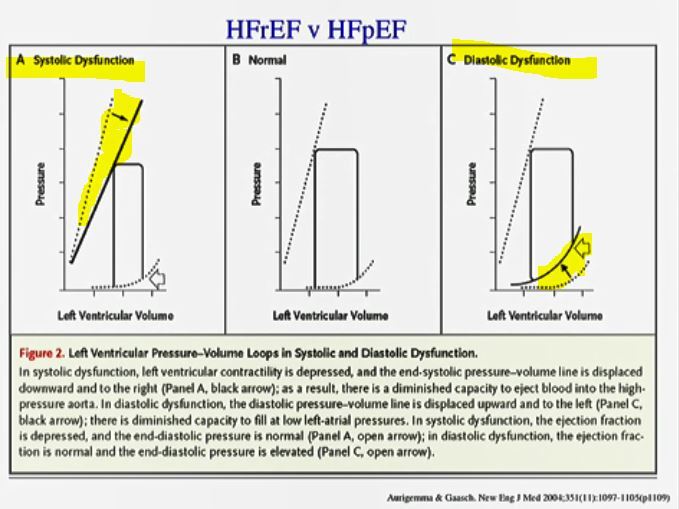
Draw the Pressure-Volume loop of HFrEF vs HFpEF
HFpEF
- SV= normal (maintain CO)
- Bottom curve (diastole) = more steep (in HFpEF)
- Now pressure is higher during diastole
HFrEF
- Top curve (systole) = less steep
- Now less EF, pressure generation
A 78-year-old woman with a history of hypertension experiences fatigue with minimal exertion. She complains of shortness of breath which is worst at night and sleeps with her upper body raised to minimise this. She is admitted to hospital for tests. Physical examination reveals a blood pressure of 180/90 mm Hg, increased jugular venous pressure, peripheral oedema, and pulmonary rales. A chest x-ray shows pulmonary oedema.
An echocardiogram (below) shows increased thickness of the left ventricular wall, a left ventricular cavity of normal size, left atrial enlargement, and a left ventricular ejection fraction of 70 percent
Explain why the patient has pulmonary oedema
Symptoms of Oedema
- Dyspnea, Orthopnea, and Paroxysmal Nocturnal Dyspnea
Cause of oedema
- Increased passive stiffness of the LV leads to an increased Left atrial volume and pressure
- Therefore _BV in the pulmonary circualtion increases a_n pulmonary pressure becomes elevated
- As a result, this leads to pulmonary oedema
A 78-year-old woman with a history of hypertension experiences fatigue with minimal exertion. She complains of shortness of breath which is worst at night and sleeps with her upper body raised to minimise this. She is admitted to hospital for tests. Physical examination reveals a blood pressure of 180/90 mm Hg, increased jugular venous pressure, peripheral oedema, and pulmonary rales. A chest x-ray shows pulmonary oedema.
An echocardiogram (below) shows increased thickness of the left ventricular wall, a left ventricular cavity of normal size, left atrial enlargement, and a left ventricular ejection fraction of 70 percent
Explain why the patient’s shortness of breath is worse at night and why she is more comfortable sleeping with her upper body raised.
Nocturnal dyspnoea and orthoponeoa can occur in HF because at night, effective BV is increased by recumbency
When we are standing
- Blood is stored int he lower extremities
- Superficial veins in these regions dilate when exposed to hydrostatic pressures associated with gravity
When we are horizontal:
- BV is transferred to the central venous compartment
- RH filling is increased
- BV is increased further when recumbent by absorption of intersitital fluid due to the r_eduction in capillary hydrostatic pressures_ in the lower extremitites.
- These processes are exacerbated in HF because ECF volume (intersitital and blood volume) is increased as a result of renal retension of salt and water
- Increased RH filling leads to an i_ncrease in pulmonary volume_ and pressure which cannot be removed in HF
- The resultant engorgement of the pulmonray blood vessel_s and pulmonary congestion r_educes lung compliance and increases the work of breathing
Raising the upper body provides relief by reducing venous return to the right heart.
A 78-year-old woman with a history of hypertension experiences fatigue with minimal exertion. She complains of shortness of breath which is worst at night and sleeps with her upper body raised to minimise this. She is admitted to hospital for tests. Physical examination reveals a blood pressure of 180/90 mm Hg, increased jugular venous pressure, peripheral oedema, and pulmonary rales. A chest x-ray shows pulmonary oedema.
An echocardiogram (below) shows increased thickness of the left ventricular wall, a left ventricular cavity of normal size, left atrial enlargement, and a left ventricular ejection fraction of 70 percent
Speculate on possible treatment for this patient.
- Reduce congestive state
- low salt
- diuretics
- Reduce HR (longer filling times)
- B-blockers
- “Treat” AF if present
- Control hypertension
- Reduce/reverse remodelling
- ACE inhibitors
- AgII blockers
- Spironolactone
A 65-year-old man who had had an anterior-wall myocardial infarction six years previously is admitted to hospital with acute shortness of breath. An echocardiogram demonstrates a left ventricular ejection fraction of 25 percent. Heart failure is diagnosed and he is treated with
frusemide (diuretic), lisinopril (ACE inhibitor), and carvedilol (b-blocker). His condition stabilises and he is discharged to home. However, during a follow-up with his GP three months later, he reports persistent shortness of breath with mild exertion. He is readmitted to a cardiology ward and his admission ECG is shown below
Describe the interesting characteristics of this ECG and propose a diagnosis.
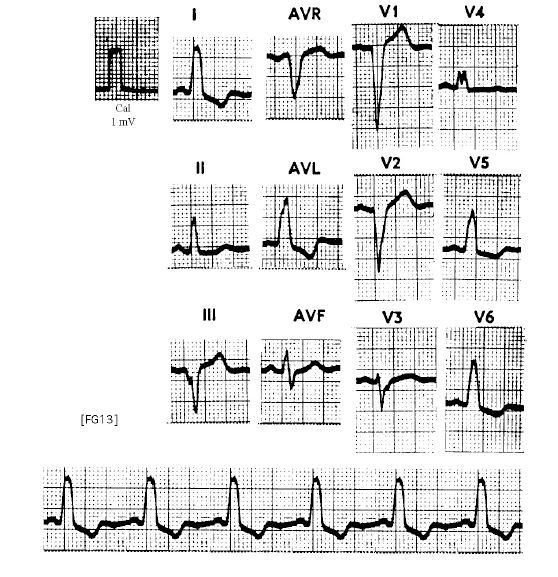
- QRS > 0.12s (prolonged)
- M-shaped or notched QRS in LV leads (I, aVL, V4, V5)
- 1st peak = early, spetal from R to L
- 2nd peak = LV free wall depolarization (late activated)
- R-> L (Left bundle branch block)
A 65-year-old man who had had an anterior-wall myocardial infarction six years previously is admitted to hospital with acute shortness of breath. An echocardiogram demonstrates a left ventricular ejection fraction of 25 percent. Heart failure is diagnosed and he is treated with
frusemide (diuretic), lisinopril (ACE inhibitor), and carvedilol (b-blocker). His condition stabilises and he is discharged to home. However, during a follow-up with his GP three months later, he reports persistent shortness of breath with mild exertion. He is readmitted to a cardiology ward and his admission ECG is shown below
What might be the pathophysiological background to the electrical problem?
- 30-50% of patients with CHF have intraventricular conduction defects
- (In this patient, right side is contracting before the left because of the Left Bundle Branch Block)
- These abnormalities progress over time
- Independent predictor of mortality
- Inflammation/fibrosis in myocardium and conduction system in HF
- Leads to
- Discoordinated conduction
- Leads to
- Dysnchornous contraction and relaxation
- Systolic impairment
- And reduced LV filling rate
- Systolic impairment
A 65-year-old man who had had an anterior-wall myocardial infarction six years previously is admitted to hospital with acute shortness of breath. An echocardiogram demonstrates a left ventricular ejection fraction of 25 percent. Heart failure is diagnosed and he is treated with
frusemide (diuretic), lisinopril (ACE inhibitor), and carvedilol (b-blocker). His condition stabilises and he is discharged to home. However, during a follow-up with his GP three months later, he reports persistent shortness of breath with mild exertion. He is readmitted to a cardiology ward and his admission ECG is shown below
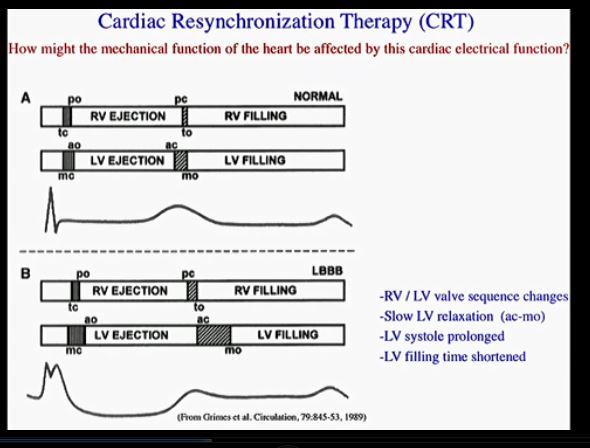
How might the mechanical function of the heart be affected by this cardiac electrical function.
Poor contraction and relaxation
- RV/LV valve sequence changes
- Slow LV relaxation (ac-mo)
- LV systole prolonged
- LV filling time shortened
Cardiac Resynchronization Therapy (CRT)
A 65-year-old man who had had an anterior-wall myocardial infarction six years previously is admitted to hospital with acute shortness of breath. An echocardiogram demonstrates a left ventricular ejection fraction of 25 percent. Heart failure is diagnosed and he is treated with
frusemide (diuretic), lisinopril (ACE inhibitor), and carvedilol (b-blocker). His condition stabilises and he is discharged to home. However, during a follow-up with his GP three months later, he reports persistent shortness of breath with mild exertion. He is readmitted to a cardiology ward and his admission ECG is shown below
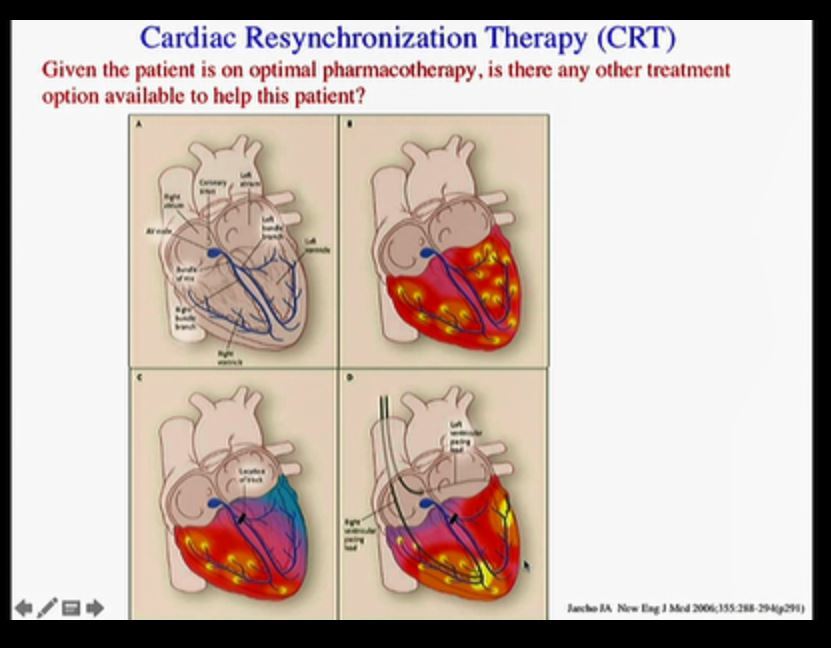
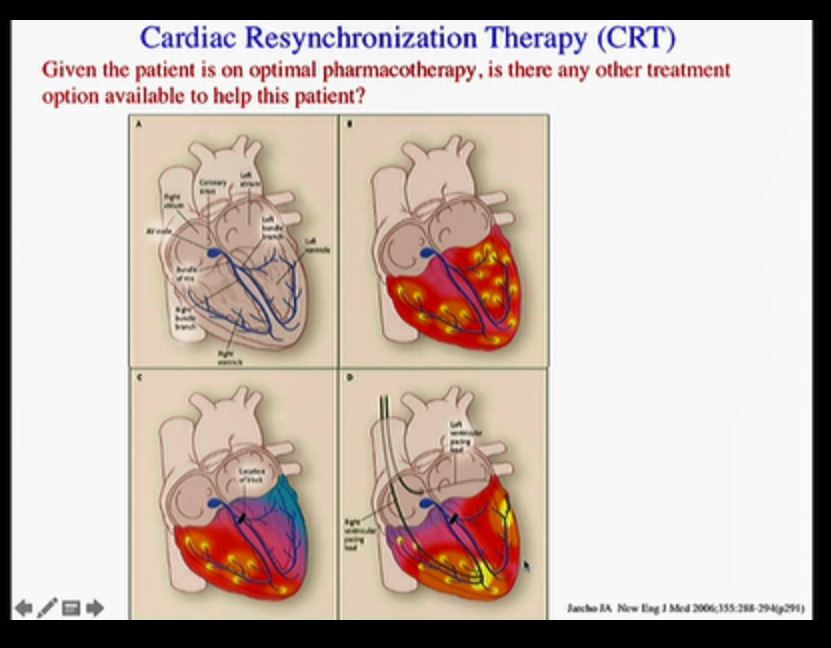
Given the patient is on optimal pharmacotherapy, is there any other treatment option available to help this patient?
- Cardiac Resynchronization Therapy (CRT)
- By using pacing treatment, trying to stop the R->L but to go at the same time.
- Put an endocardial lead into the Right Ventricle
- Cardiac resynchronization therapy (CRT), also known as biventricular pacing or multisite ventricular pacing, involves simultaneous pacing of the right ventricle (RV) and the left ventricle (LV). In addition to a conventional RV endocardial lead (with or without a right atrial [RA] lead), CRT involves an additional coronary sinus lead placed for LV pacing.*
- The procedure involves implanting a half-dollar sized pacemaker, usually just below the collarbone. Three wires (leads) connected to the device monitor the heart rate to detect heart rate irregularities and emit tiny pulses of electricity to correct them. In effect, it is “resynchronizing” the heart.
Benefits of CRT
Because CRT improves the heart’s efficiency and increases blood flow, patients have reported alleviations of some heart failure symptoms - such as shortness of breath. Clinical studies also suggest decreases in hospitalization and morbidity as well as improvements in quality of life.*
Who will be helped by CRT?
Cardiac Resynchronization Therapy
- QRS > 150ms
- LVEF < 30-40%
- But debate on limiting values
- People with Right Bundle Branch Block won’t benefit.
- Already on optimal medical therapy
What are the positives for CRT?
Cardiac Resynchronization Therapy (CRT)
- Something for nothing?
- No extra energy/O2 demand (unlike dobutamine)
- May even lower energy/O2 demand
- Improves EF symptoms, quality of life and survival
- Reverse remodelling in patients with moderate to severe HF

-
Cardiovascular Homeostasis (LeGrice)9
-
Respiratory Pathophysiology 1 and 2 (Kolbe)37
-
Regulation of Vascular Function 1 and 2 (Ramchandra)29
-
Anticoagulant Drugs (Dawes)33
-
Renal Failure (Zoysa)28
-
Respiratory Problems (Clinical Problems) (Kolbe)22
-
ACE Inhibitors (Dawes)24
-
Cardiac Rhythm (LeGrice)35
-
Cardiac Rhythm (Clinical Problems) (LeGrice)31
-
Vascular Problems (Clinical Problems) (Ramchandra & M Dawes)38
-
Regulation of Cardiac Function (LeGrice)31
-
Renal Physiology: Salt and Water (Zoysa)21
-
Ischaemic Heart Disease (Clinical)20
-
Cardiovascular Control System (Ramchandra)18
-
Alpha Blockers & Calcium Channel Blockers (Dawes)29
-
Cardiac Function 1 (Clinical Problems)19
-
Renal Physiology: Potassium & Magnesium (Zoysa)28
-
Beta Blockers (Dawes)18
-
Antihypertensive Drugs (Dawes)24
-
Renal Problems (Clinical Problems) (Zoysa)34
-
Cardiovascular Regulation (B Smaill & R Ramchandra)18
-
Inotropic Drugs (Dawes)31
-
Cardiac Function 2 (Clinical Problems)49
-
Clinical Endocrinology (Gunn)24
-
Endocrinology Problem (Gunn)27
-
Drugs & Arrhythmia (Lever)25
-
GI Problems 1 (Clinical) (Ow)60
-
Lipid Lowering Therapy (Dawes)15
-
Gut Problems 2 (Clinical) (Ow)36
-
Gut Problems 3 (Clinical) (Ow)41
-
Acid/Base Physiology 1 (Gunn)14
-
Drugs & Blood Pressure (Clinical) (Dawes)21
-
Acid/Base Physiology 2 (Gunn)13
-
Acid/Base Physiology 3 and Clinical Lectures (Gunn)13
-
RCT (Jackson)4
-
Body Fluids Problems (Clinical) (Small & Ramchandra)25



