A 17 year old is brought into the ED after becoming suddenly short of breath. He came off the hockey field after about 10 mins complaining of SOB and coughing.
What would you ask him?
What might you expect in a clinical examination?
- Has this happened before? Once last winter when playing hockey but not as bad
- Does he have any allergies? Hayfever in summer, when first goes to family bach
- Is there past medical history of allergies or asthma? How about family history? No family history of heart disease.
- Is his breathing wheezy or noisy? Wheeze.
- How short of breath is him? SOB due to increased work (breath through narrow tube). Look at how much he speaks (words, sentences, paragraph). He presents with one word at a time.
- How long did it last? Self-resolving over 10-15min
- Are there any other symptoms (systemic enquiry)? Patient has cough, sputum, wheeze, chest tightness (not chest pain)
Clinical Examination Findings (Might Expect)
- Afebrile;
- BP normal;
- HR 100bpm;
- RR 16;
- O2 saturation 95% (accuracy ±2%)
A 17 year old is brought into the ED after becoming suddenly short of breath. He came off the hockey field after about 10 mins complaining of SOB and coughing.
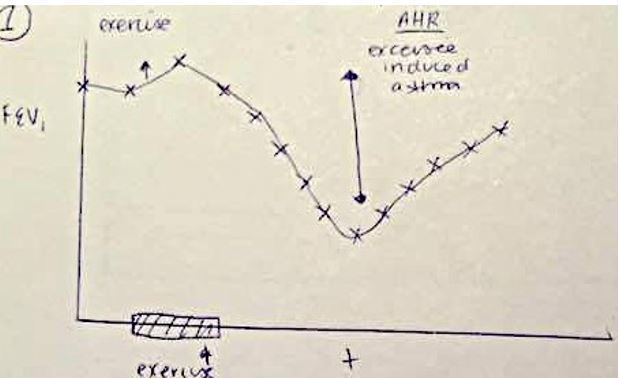
Draw this patient’s FEV1~ Time graph and explain this graph
When he starts to exercise, FEV1 increases due to bronchodilation
- Decreased parasympathetic tone
- Increased sympathetic activity (catecholamine causes bronchodilation)
As he continues exercising, FEV1 decreases due to exercise-induced bronchoconstriction/asthma
- Drying of airway surface-lining fluid ® increased fluid tonicity ® mast cell degranulation ® bronchoactive mediator release
- This is exacerbated when:
- Exercise in cold due to dry air (e.g. winter)
- More intense exercise (reflected by minute ventilation)
Airway hyper-responsiveness (AHR) is reflected by how much EV1 drops, which indicates severity of asthma (controversial causes either (1) intrinsic property of airway smooth muscle; or (2) whole environment that airways reside in
If there are AHR + bronchoactive mediators (histamine, leukotrienes, prostaglandins such as PGD2) -> manifestations of asthma
- Narrowing of smooth muscle
- Oedema of airway mucosa
What is AHR?
Airway hyperresponsiveness is defined by an exaggerated response of the airways to nonspecific stimuli, which results in airway obstruction.
Airway hyper-responsiveness (AHR) is reflected by how much EV1 drops, which indicates severity of asthma (controversial causes either (1) intrinsic property of airway smooth muscle; or (2) whole environment that airways reside in
If there are AHR + bronchoactive mediators (histamine, leukotrienes, prostaglandins such as PGD2) ->manifestations of asthma
Amount of narrowing = AHR + Stimulus
- Narrowing of smooth muscle
- Oedema of airway mucosa
Alevolar pressure = _____ + _____-
Palv = Pip + Pel
(intrapleural/intrathoracic pressure + elastic recoil pressure)
- Palv (alveolar pressure) =0cmH2O, while Patm (atmospheric pressure) =0cmH2O, so no pressure gradient for any air movement
- If Pip (intrapleural/intrathoracic pressure) = -10cmH2O, then Pel (elastic recoil pressure) = +10cmH2O (holding airway open).
Describe the pressure changes in Inspiration
Palv = Pip + Pel
As inspiration starts, both intrapleural and alveolar pressure decrease (more negative). There is air flow from atmosphere to lungs.
- Decrease in Pip is equal to increase in Pel as it inflates.
- Pressure drop along the airway as gas flow from atmosphere (0) to alveoli (negative relative to Patm). Airflow stops when alveolar pressure equalise with atmospheric pressure.
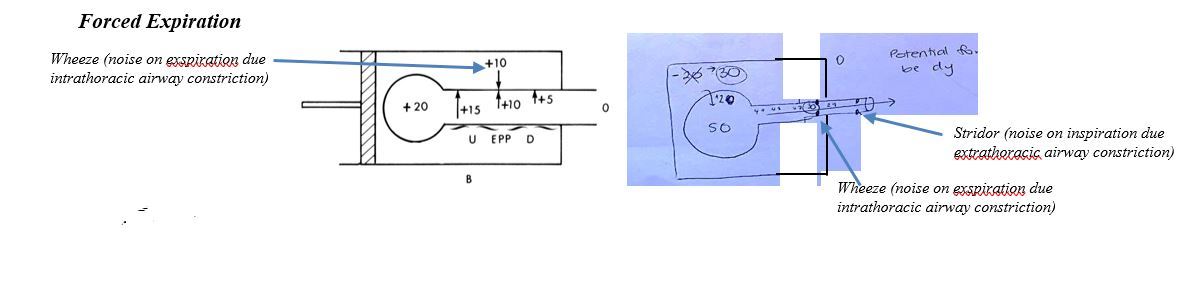
If there is a focal obstruction above level of vocal cord, it produces high-pitched sound called stridor (noise during inspiration).
- This is due to narrowing of extrathoracic airways (uninfluenced by pleural pressure).
- Therefore, increased flow resistance during inspiration (cause turbulent airflow at increased velocity)
Describe the Pressure changes in Forced Expiration
+ Draw diagram
Pre-EPP
In forced expiration, there is generation of positive pleural pressure (Pip).
- Pip increase from -20 to +30cmH2O, while Pel = +20cmH2O
- Palv = 50mmHg, while Patm = 0cmH2O, therefore air will exit lungs due to pressure gradient.
EPP
Pressure drops along the airway as flow begins, so there is equal pressure point (EPP) where Pip = Pairway = +30cmH2O.
Post-EPP
In EPP downstream (towards mouth), Pip > Pairway, thus intrathoracic airways become dynamically compressed.
- This increases flow resistance (limit flow) during forced expiration (than inspiration), hence wheeze on expiration due to constriction of intrathoracic airway!
- Effective driving pressure (transpulmonary pressure) becomes Pel = Palv – Pip
Furthermore, greater expiratory effort (i.e. more positive pleural pressure) increases dynamic compressio_n, therefore i_ncreased resistance with i_ncreased driving pressure_ (i.e. more alveolar pressure).
Eventually, expiratory flow cannot increase any further, and becomes independent of the effort. This is shown by plateau in P-V relationship
Vdot(Flow) = Pel/PU(Pressure Upstream)
Effort Independent Flow
Describe the changes in AIrway resistance as you move down the airway
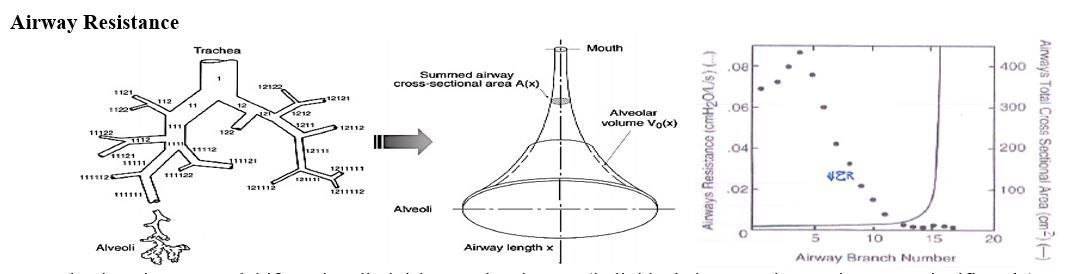
In conducting airways, each bifurcation diminishes total resistance (individual airway resistance increases significantly).
- Because number of branches and combined cross-sectional area increases with each division, summed parallel resistance general decreases with each generation (small airways).
- Major site of airway resistance is estimated to be ~generation 4 (less branches with less cross-sectional area).
Most important and common airway diseases are predominately in/begin in small airways
- Asthma involves bronchoconstriction of small airways
- COPD involves initial impairment in small airways
There is low total resistance in small peripheral airways, therefore big change in resistance is required before lung function tests can pick up. Small airways often referred as “silent zone of lung”.
What are the Advantages and Disadvantages of FEV1?
Advantages
- Reduced variability
- Less effort dependent
- Tight normal range (easier to distinguish between normality and abnormality, depends on age/gender/height/ethnicity)
- Classification of lung disease into obstructive or restrictive disease
Disadvantages
- More difficult
- Expensive
What are the Advantages and Disadvantages of PEF?
Advantages
- Easy
- Cheap
- Use it to monitor an individual over time (rather than comparison with others)
Disadvantages
- Effort-dependent
- Wider normal range (dysanapsis, i.e. big lungs does not necessarily mean large airways, vice versa)
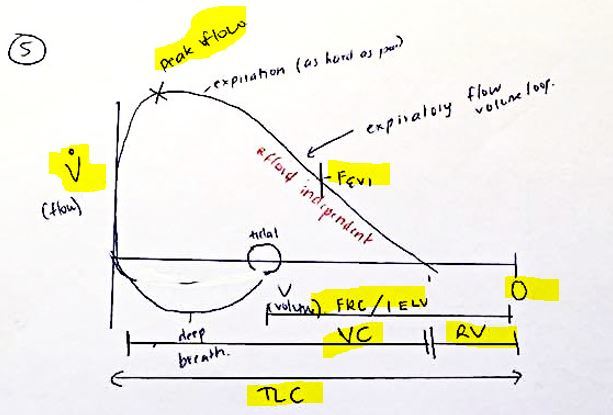
Draw the Maximum Flow Respiratory Volume Loop
(label all the volumes and parts of the curve)
Functional Residual capacity
(forced) Vital Capaicty
Residual Volume
Total Lung Capacity
Peak flow
Time doesn’t feature on F-V loop, therefore cannot intuitively get FEV1 (need a clock to measure on graph, done digitally).
The lower part of the curve: EFFORT INDEPENDENT part of the curve.
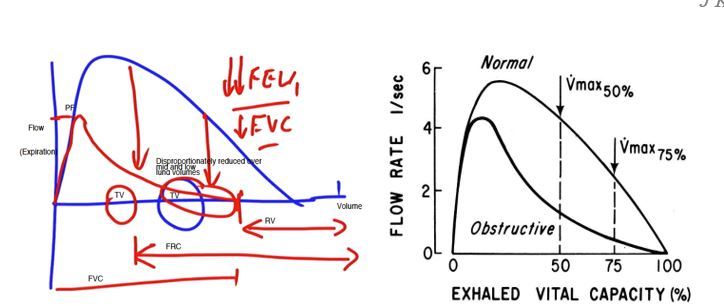
Compare the Flow~ Volume curve between a healthy individual and someone with Asthma
1) FVC is reduced
2) FEV1 is reduced considerably
3) PEF has reduced
4) Total lung capacity is around the same, but there is a marked increase in RV (residual volume)
* Obstructive lung disease is when there is reduced flow at all lung volumes (including peak flow), but flow is disproportionately reduced over mid and low lung volumes, which indicates disease in small airways.*
- Equal pressure point (EPP) moves towards small airways.
- As breath out, flow is determined more by small airways.
There is:
- RV, FRC, therefore breathing at higher lung volumes (superficial breathing reflected by higher FRC, which is uncomfortable, because at higher lung volumes, lung is less compliant)
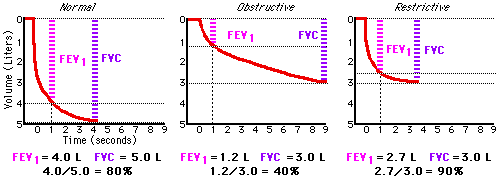
- ¯¯¯FEV1, but ¯FVC (not as much, disproportional), therefore ¯FEV1/FVC ratio
- ¯FVC, but same TLC, therefore RV
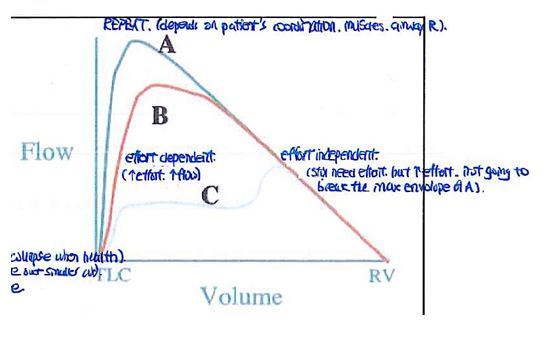
When is flow effort-dependent and when is it independent?
Once limit to flow is reached, further muscular effort cannot increase flow.
- A is maximal forced expiration
- B and C are suboptimal forced expiration
- It reduces peak flow, but still may achieve same FEV1 because there is flow limitation
- This means we cannot exceed flow envelope, with further increased expiratory effort above certain threshold
People with Obtructive Diseases breathe at high lung volumes, what is the advantage of that?
RV, FRC, therefore breathing at higher lung volumes (superficial breathing reflected by higher FRC, which is uncomfortable, because at higher lung volumes, lung is less compliant)
Higher lung volume = more Elastic Pressure = more tension in ‘springs = Dilate airways
- The patient is trying to reduce the total work of breathing by reducing resistive work, and is paying the price by increasing the Pel.
This patient has short of breath (deep and slow breathing) due to increased total respiratory work:
- In obstructive lung disease, there is more resistive work of breathing (breathing through a narrow tube)
- In order to optimise total respiratory work, they breathe same amount of air at higher lung volumes with slower frequency
- This means more elastic work of breathing when breathing deep and slow, since lung is less compliant at high lung volumes (more Pel, cf. more tension on the spring)
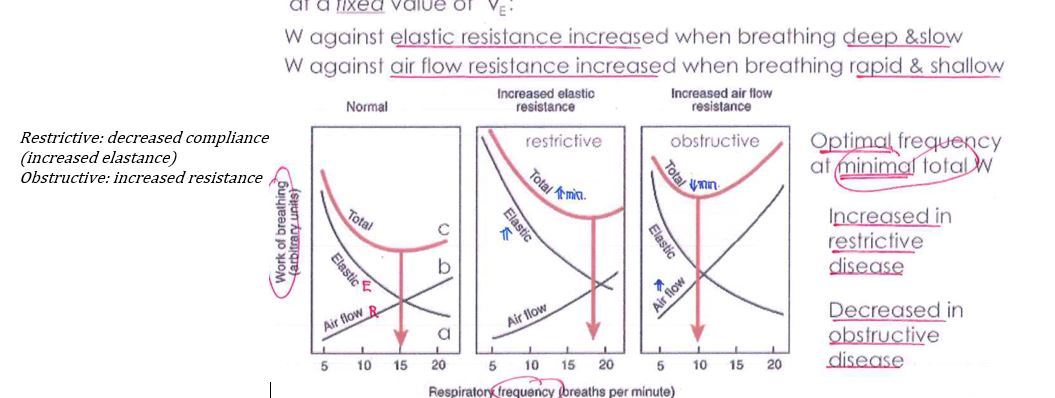
W against elastic resistance increased when breathing is _____and _____
W against air flow resistance increased when breathing is ______and ____
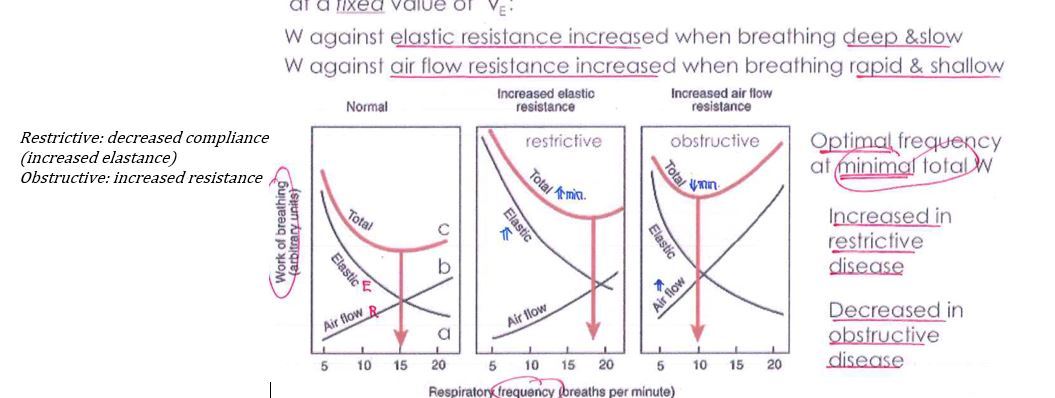
W against elastic resistance increased when breathing is deep and slow
W against air flow resistance increased when breathing is rapid and shallow
Draw the Work~Respiratory frequency graph of
Normal
Increased elastic resistance
Increased airway resistance
Patients
W against elastic resistance increased when breathing is deep and slow
W against air flow resistance increased when breathing is rapid and shallow
Because, at fixed work-load, both R and C (E-1) vary with respiratory frequency, work of breathing also varies:
- Line A shows decrease in elastic work (more compliant) with increasing respiratory frequency (i.e. smaller tidal volume, when minute ventilation is fixed)
- Line B shows increase in resistive work with increasing respiratory frequency (increased resistance at higher bronchi generation, turbulent or disturbed flow requiring greater driving pressures)
- Line C shows the summation of the two contributors to total work
- Pattern of breathing is determined by optimal frequency that produces lowest total respiratory work (elastic and resistive work)
Mr Jones is aged 70 years. He presents with a 3 year history of progressive shortness of breath and dry cough. During his 20s he worked at Wittenoom Gorge in Western Australia. Clinically, he is clubbed and on auscultation has bilateral basal fine late inspiratory crackles.
What does he have?
When you undergo breathing tests, what would you observe?
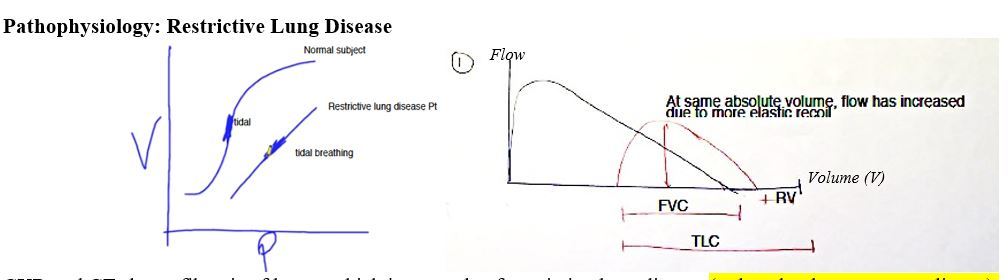
CXR and CT shows fibrosis of lungs, which is example of restrictive lung disease (reduced pulmonary compliance).
- Markedly reduced TLC (definition of restrictive lung disease), reduced RV
- ¯FEV1, and ¯FVC (proportional), therefore n_ormal or increased FEV1/FVC ratio_ (normal is 0.7, lower for young people, higher for elderly people)
At same absolute lung volume, flows are actually increased due to more elastic recoil (greater tension in ‘springs’ of small airways, dragging airways open).
SOB is intimately related to _____
Work of breathing
It is seldom related to hypoxaemia
What happens to the lung in the interstitial lung disease/age
Normal tidal breathing has no basal airway closure (base of lung, small airways). With age:
- Basal airways start to close with tidal breathing,
- But deeper breath generate enough negative pleural pressure to open small airways (do not hear very much sound).
With age and interstitial lung disease:
- Basal airway closure with abnormal stiff (non-compliant) small airways
- In early inspiration, he does not generate enough negative pleural pressure to open those airways
- In late inspiration, he generate enough negative pressure at to open non-compliant airways, they snap open (hear crackle sounds like velcro at base). Therefore, it is called “late inspiratory basal crackles.”
- Medium and fine crackles are just caused by airways snap open (most common)
- Coarse crackles are caused by retained mucus in upper airways
Therefore, pattern of breathing is mainly determined by_______________
Therefore, pattern of breathing is mainly determined by total respiratory work.
Total Respiratory Work (W) = òP.dV
Describe the pattern of breathing of people with Restrictive Lung Diseases
For restrictive lung disease, they have decreased compliance (flatter gradient):
During rest, normal tidal breathing requires more respiratory work (more elastic work) than healthy individual
In restrictive lung disease, there is more _elastic work of breathing_During exercise, patient has short of breath (rapid and shallow breathing) due to increased total respiratory work
- In order to optimise total respiratory work (optimal frequency), they breath smaller volume (VT) with increased frequency
- This means more resistant work of breathing when breathing rapid and shallo
Name som restrictive lung diseases
- Interstitial lung disease, such as idiopathic pulmonary fibrosis
- Sarcoidosis, an autoimmune disease
- Obesity, including obesity hypoventilation syndrome
- Scoliosis
- Neuromuscular disease, such as muscular dystrophy or amyotrophic lateral sclerosis (ALS)
What are some obstructive lung diseases?
- Chronic obstructive pulmonary disease (COPD), which includes emphysema and chronic bronchitis
- Asthma
- Bronchiectasis
- Cystic fibrosis

-
Cardiovascular Homeostasis (LeGrice)9
-
Respiratory Pathophysiology 1 and 2 (Kolbe)37
-
Regulation of Vascular Function 1 and 2 (Ramchandra)29
-
Anticoagulant Drugs (Dawes)33
-
Renal Failure (Zoysa)28
-
Respiratory Problems (Clinical Problems) (Kolbe)22
-
ACE Inhibitors (Dawes)24
-
Cardiac Rhythm (LeGrice)35
-
Cardiac Rhythm (Clinical Problems) (LeGrice)31
-
Vascular Problems (Clinical Problems) (Ramchandra & M Dawes)38
-
Regulation of Cardiac Function (LeGrice)31
-
Renal Physiology: Salt and Water (Zoysa)21
-
Ischaemic Heart Disease (Clinical)20
-
Cardiovascular Control System (Ramchandra)18
-
Alpha Blockers & Calcium Channel Blockers (Dawes)29
-
Cardiac Function 1 (Clinical Problems)19
-
Renal Physiology: Potassium & Magnesium (Zoysa)28
-
Beta Blockers (Dawes)18
-
Antihypertensive Drugs (Dawes)24
-
Renal Problems (Clinical Problems) (Zoysa)34
-
Cardiovascular Regulation (B Smaill & R Ramchandra)18
-
Inotropic Drugs (Dawes)31
-
Cardiac Function 2 (Clinical Problems)49
-
Clinical Endocrinology (Gunn)24
-
Endocrinology Problem (Gunn)27
-
Drugs & Arrhythmia (Lever)25
-
GI Problems 1 (Clinical) (Ow)60
-
Lipid Lowering Therapy (Dawes)15
-
Gut Problems 2 (Clinical) (Ow)36
-
Gut Problems 3 (Clinical) (Ow)41
-
Acid/Base Physiology 1 (Gunn)14
-
Drugs & Blood Pressure (Clinical) (Dawes)21
-
Acid/Base Physiology 2 (Gunn)13
-
Acid/Base Physiology 3 and Clinical Lectures (Gunn)13
-
RCT (Jackson)4
-
Body Fluids Problems (Clinical) (Small & Ramchandra)25



