What is Cor Pulmonale?
Pulmonary arterial hypertension resulting from _diseases affecting the structure and/or the function of the lung_s; pulmonary arterial hypertension results in right ventricular enlargement (hypertrophy and/or dilatation) and may lead with time to right heart failure.
A 68 year-old man who has been a life-long smoker has for some time
experienced dyspnoea with exertion. Recently, however, he has begun to feel
tired with very limited exercise.
Physical examination reveals a b_lood pressure
of 120/75 mm Hg, a loud pulmonic component of the 2nd heart sound, neck
vein distension and peripheral oedema._
Chest x-rays show right ventricular
and proximal pulmonary artery enlargement, but no sign of pulmonary
congestion. An echocardiogram shows normal left ventricular wall thickness
and cavity volume. However, the right ventricle is distended and
hypertrophied. The septum appears to be displaced to the left during diastole
Cor pulmonale, or _right-sided heart failur_e, is an enlargement of the right ventricle due to high blood pressure in the lungs usually caused by chronic lung disease.
Physical examination reveals a blood pressure
of 120/75 mm Hg, a loud pulmonic component of the 2nd heart sound, neck
vein distension and peripheral oedema.
Chest x-rays show right ventricular
and proximal pulmonary artery enlargement, but no sign of pulmonary
congestion. An echocardiogram shows normal left ventricular wall thickness
and cavity volume. However, the right ventricle is distended and
hypertrophied. The septum appears to be displaced to the left during diastole
Pulmonary hypertension may be caused by….
- Loss of capillary beds (eg, due to bullous changes in COPD or thrombosis in pulmonary embolism)
- Vasoconstriction caused by hypoxia, hypercapnia, or both
- Increased alveolar pressure (eg, in COPD, during mechanical ventilation)
- Medial hypertrophy in arterioles (often a response to pulmonary hypertension due to other mechanisms)
A 68 year-old man who has been a life-long smoker has for some time
experienced dyspnoea with exertion. Recently, however, he has begun to feel
tired with very limited exercise. Physical examination reveals a blood pressure
of 120/75 mm Hg, a loud pulmonic component of the 2nd heart sound, neck
vein distension, hepatomegaly and peripheral oedema. Chest x-rays show right
ventricular and proximal pulmonary artery enlargement, but no sign of
pulmonary congestion. An echocardiogram shows normal left ventricular wall
thickness and cavity volume. However, the right ventricle is distended and
hypertrophied. The septum appears to be displaced to the left during diastole.
What is the probable cause of the patient’s dyspnoea with exertion?
- The most obvious cause of dyspnoea with exertion is the impaired lung function that occurs as a result of heavy smoking.
- Smoking causes obstructive airways disease, loss of elastin etc all of which i_ncrease the work of breathing._
- This is exacerbated during exercise.
- The patient’s exercise capacity will also be reduced because he is not able to increase cardiac output sufficiently as his right venticular function is impaired.
A 68 year-old man who has been a life-long smoker has for some time
experienced dyspnoea with exertion. Recently, however, he has begun to feel
tired with very limited exercise. Physical examination reveals a blood pressure
of 120/75 mm Hg, a loud pulmonic component of the 2nd heart sound, neck
vein distension, hepatomegaly and peripheral oedema. Chest x-rays show right
ventricular and proximal pulmonary artery enlargement, but no sign of
pulmonary congestion. An echocardiogram shows normal left ventricular wall
thickness and cavity volume. However, the right ventricle is distended and
hypertrophied. The septum appears to be displaced to the left during diastole.
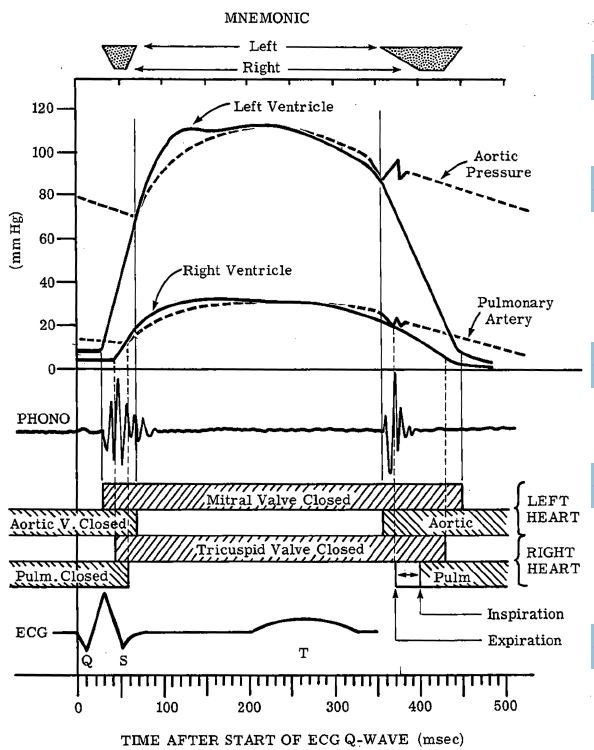
Explain the pulmonic component of the 2nd heart sound in Cor Pulmonale
- The pulmonary valve generally _closes shortly after the aortic valve p_roducing splitting of the second heart sound.
- Since there is an increase in blood volume in the right ventricle during inspiration, the pulmonary valve (P2 component of S2) stays open longer during ventricular systole due to an increase in ventricular emptying time, whereas the aortic valve (A2 component of S2) closes slightly earlier due to a reduction in left ventricular volume and ventricular emptying time.
- Normally splitting of S2 is increased with inspiration and decreased with expiration because the reduced intrathoracic pressures during inspiration lead to increased right heart filling, d_elaying pulmonary closure._
- These effects are reversed during expiration.
- Increased pulmonary arterial pressure leads to f_urther delay_ in closure of the pulmonary valve, and a more vigorous closure.
- Resulting in wider splitting and an accentuated S2.
A 68 year-old man who has been a life-long smoker has for some time
experienced dyspnoea with exertion. Recently, however, he has begun to feel
tired with very limited exercise. Physical examination reveals a blood pressure
of 120/75 mm Hg, a loud pulmonic component of the 2nd heart sound, neck
vein distension, hepatomegaly and peripheral oedema. Chest x-rays show right
ventricular and proximal pulmonary artery enlargement, but no sign of
pulmonary congestion. An echocardiogram shows normal left ventricular wall
thickness and cavity volume. However, the right ventricle is distended and
hypertrophied. The septum appears to be displaced to the left during diastole.
Explain the neck vein distension, hepatomegaly and peripheral oedema.
- The neck vein distension (raised JVP), hepatomegaly and peripheral oedema are due to elevated systemic venous pressures as a result of right heart dysfunction.
- Late in the disease there may also be tricuspid regurgitation as a result of RV dilatation.
A 68 year-old man who has been a life-long smoker has for some time
experienced dyspnoea with exertion. Recently, however, he has begun to feel
tired with very limited exercise. Physical examination reveals a blood pressure
of 120/75 mm Hg, a loud pulmonic component of the 2nd heart sound, neck
vein distension, hepatomegaly and peripheral oedema. Chest x-rays show right
ventricular and proximal pulmonary artery enlargement, but no sign of
pulmonary congestion. An echocardiogram shows normal left ventricular wall
thickness and cavity volume. However, the right ventricle is distended and
hypertrophied. The septum appears to be displaced to the left during diastole.
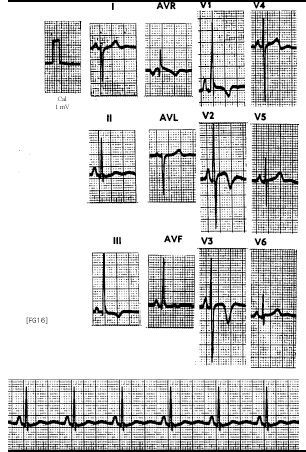
What might be present in a 12 lead ECG?
What direction is the mean QRS axis?
- Signs of RV hypertrophy (revise year II problems)
- V4, V5, V6
- However the expanded chest associated with COPD may reduce the ECG potentials.
- Increased amplitude of QRS
- mean QRS: Right axis deviation
A 68 year-old man who has been a life-long smoker has for some time
experienced dyspnoea with exertion. Recently, however, he has begun to feel
tired with very limited exercise. Physical examination reveals a blood pressure
of 120/75 mm Hg, a loud pulmonic component of the 2nd heart sound, neck
vein distension, hepatomegaly and peripheral oedema. Chest x-rays show right
ventricular and proximal pulmonary artery enlargement, but no sign of
pulmonary congestion. An echocardiogram shows normal left ventricular wall
thickness and cavity volume. However, the right ventricle is distended and
hypertrophied. The septum appears to be displaced to the left during diastole.
Explain why the interventricular septum is displaced leftward during diastole.
- Leftward displacement of the septum is seen in both chronic pulmonary
hypertension and acute pulmonary hypertension (due for instance to
pulmonary embolism). - It can be explained by increased RV diastolic pressures and a pressure
gradient across the interventricular septum during systole that pushes it
into the LV cavity.
What is the main cause of an irregularly irregular heartbeat?
Atrial fribrillation
A 38 year-old woman suffered from rheumatic fever at the age of 11, which left her
with a heart murmur. Over the past four years she has experienced _shortness of
breath with exertio_n and more recently has noticed some irregularity of her heart
beat. She has also noticed that her voice has become somewhat hoarse.
On physical examination, the patient’s blood pressure was found to be 110/80 mmHg. Her heart rhythm was entirely irregular (irregularly irregular), with her heart rate varying between 90 and 160 per minute. She had an accentuated first heart sound with an opening snap shortly after the second heart sound and a prolonged diastolic murmur.
Examination of her larynx revealed paralysis of her left vocal-cord.
A chest X-ray showed an enlarged left atrium, pulmonary artery enlargement a_nd evidence of pulmonary vein congestion. Transthoracic ultrasound demonstrated substantial n_arrowing of the mitral valve orifice and reduced mobility of the mitral valve leaflets.
Do you think the patient’s childhood rheumatic fever is related to her development of mitral stenosis?
- Absolutely Yes:
- Most cases of mitral stenosis are caused by chronic rheumatic heart disease, although more than 50% of these patients do not have a known history of rheumatic fever.
- Mitral stenosis often develops years after the initial streptococcal infection and symptoms may not develop until many years afterwards.
- This patient’s symptoms are consistent with very severe mitral stenosis.
A 38 year-old woman suffered from rheumatic fever at the age of 11, which left her
with a heart murmur. Over the past four years she has experienced _shortness of
breath with exertio_n and more recently has noticed some irregularity of her heart
beat. She has also noticed that her voice has become somewhat hoarse.
On physical examination, the patient’s blood pressure was found to be 110/80 mmHg. Her heart rhythm was entirely irregular (irregularly irregular), with her heart rate varying between 90 and 160 per minute. She had an accentuated first heart sound with an opening snap shortly after the second heart sound and a prolonged diastolic murmur.
Examination of her larynx revealed paralysis of her left vocal-cord.
A chest X-ray showed an enlarged left atrium, pulmonary artery enlargement a_nd evidence of pulmonary vein congestion. Transthoracic ultrasound demonstrated substantial n_arrowing of the mitral valve orifice and reduced mobility of the mitral valve leaflets.
How does P wave shape and ventricular response in the patient’s ECG differ from normal, and what is the explanation for the differences?
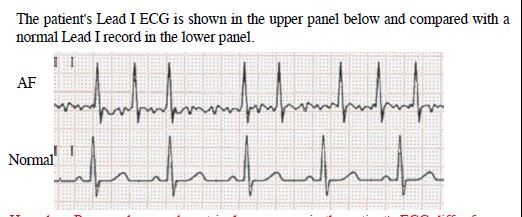
- There are no P waves in this patient’s rhythm strip indicating there is no
evidence of regular organised atrial electrical activity. - Ventricular rhythm is irregularly irregular (as noted above).
- These observations indicate this patient has atrial fibrillation
A 38 year-old woman suffered from rheumatic fever at the age of 11, which left her
with a heart murmur. Over the past four years she has experienced shortness of
breath with exertion and more recently has noticed some irregularity of her heart
beat. She has also noticed that her voice has become somewhat hoarse.
On physical examination, the patient’s blood pressure was found to be 110/80 mmHg. Her heart rhythm was entirely irregular (irregularly irregular), with her heart rate varying between 90 and 160 per minute. She had an accentuated first heart sound with an opening snap shortly after the second heart sound and a prolonged diastolic murmur.
Examination of her larynx revealed paralysis of her left vocal-cord.
A chest X-ray showed an enlarged left atrium, pulmonary artery enlargement and evidence of pulmonary vein congestion. Transthoracic ultrasound demonstrated substantial narrowing of the mitral valve orifice and reduced mobility of the mitral valve leaflets.
Comment of the ventricular activity in the patient’s ECG.
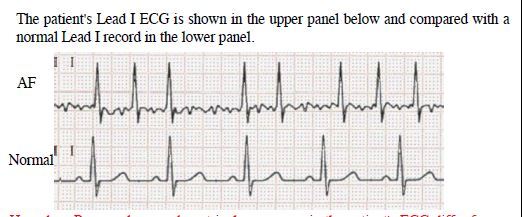
• QRS complexes are irregula_r but are o_therwise normal (indicating that
ventricular activation is occurring via the specialised conduction system).
• In AF, a_trial excitation is disordered_ and occurs very rapidly (350 per minute).
• The ventricular rate is much less (90 to 160 per minute) due to the prolonged
refractory period of the AV node, the ventricles are activated by every second or
every third atrial ‘excitation’ only.
• This accounts for the irregularity of the ventricular response
A 38 year-old woman suffered from rheumatic fever at the age of 11, which left her
with a heart murmur. Over the past four years she has experienced shortness of
breath with exertion and more recently has noticed some irregularity of her heart
beat. She has also noticed that her voice has become somewhat hoarse.
On physical examination, the patient’s blood pressure was found to be 110/80 mmHg. Her heart rhythm was entirely irregular (irregularly irregular), with her heart rate varying between 90 and 160 per minute. She had an accentuated first heart sound with an opening snap shortly after the second heart sound and a prolonged diastolic murmur.
Examination of her larynx revealed paralysis of her left vocal-cord.
A chest X-ray showed an enlarged left atrium, pulmonary artery enlargement and evidence of pulmonary vein congestion. Transthoracic ultrasound demonstrated substantial narrowing of the mitral valve orifice and reduced mobility of the mitral valve leaflets.
What is the pathological progress of the heart damage?
• The stenosis is due to the thickening of the valve leaflets with f_ibrous
obliteration._
• There may be _calcium deposition in the leaflet_s, chordae and the annulus with
commissural and chordal fusion.
• Eventually, a _funnel-shaped mitral valv_e with a fish-mouth orifice may occur.
A 38 year-old woman suffered from rheumatic fever at the age of 11, which left her
with a heart murmur. Over the past four years she has experienced shortness of
breath with exertion and more recently has noticed some irregularity of her heart
beat. She has also noticed that her voice has become somewhat hoarse.
On physical examination, the patient’s blood pressure was found to be 110/80 mmHg. Her heart rhythm was entirely irregular (irregularly irregular), with her heart rate varying between 90 and 160 per minute. She had an accentuated first heart sound with an opening snap shortly after the second heart sound and a prolonged diastolic murmur.
Examination of her larynx revealed paralysis of her left vocal-cord.
A chest X-ray showed an enlarged left atrium, pulmonary artery enlargement and evidence of pulmonary vein congestion. Transthoracic ultrasound demonstrated substantial narrowing of the mitral valve orifice and reduced mobility of the mitral valve leaflets.
Explain the shortness of breath and fatigue with exercise?
• The narrowed mitral orifice results in a build up of ‘back-pressure’ in the
pulmonary vasulature, leading to pulmonary vascular engorgement, _reduced lung
complianc_e and increased work of breathing.
• Also the lack of atrial contraction (atrial fibrillation) leads to reduced ventricular
preload.
• At rest, this may not be a problem, but during exercise, the heart is unable to
increase output sufficiently to meet the increased demand.
A 38 year-old woman suffered from rheumatic fever at the age of 11, which left her
with a heart murmur. Over the past four years she has experienced shortness of
breath with exertion and more recently has noticed some irregularity of her heart
beat. She has also noticed that her voice has become somewhat hoarse.
On physical examination, the patient’s blood pressure was found to be 110/80 mmHg. Her heart rhythm was entirely irregular (irregularly irregular), with her heart rate varying between 90 and 160 per minute. She had an accentuated first heart sound with an opening snap shortly after the second heart sound and a prolonged diastolic murmur.
Examination of her larynx revealed paralysis of her left vocal-cord.
A chest X-ray showed an enlarged left atrium, pulmonary artery enlargement and evidence of pulmonary vein congestion. Transthoracic ultrasound demonstrated substantial narrowing of the mitral valve orifice and reduced mobility of the mitral valve leaflets.
Why is the patient unable to increase her cardiac output with exercise?
• LV filling is impaired at rest as result of the increased resistance of mitral valve.
• The the loss of “the atrial primer pump” and the _reduced (and irregular) diastolic
interva_l also reduces LV function.
• The capacity to achieve a stable increased heart rate in exercise will be
compromised by the atrial fibrillation.
• The pulmonary veins are engorged at rest and this will become worse in
exercise.
• This is an example of left sided heart failure (as a result of impaired filling rather
than cardiomyopathy).
• Pulmonary vascular engorgement is leading to r_educed lung compliance_ and
increased work of breathing.
A 38 year-old woman suffered from rheumatic fever at the age of 11, which left her
with a heart murmur. Over the past four years she has experienced shortness of
breath with exertion and more recently has noticed some irregularity of her heart
beat. She has also noticed that her voice has become somewhat hoarse.
On physical examination, the patient’s blood pressure was found to be 110/80 mmHg. Her heart rhythm was entirely irregular (irregularly irregular), with her heart rate varying between 90 and 160 per minute. She had an accentuated first heart sound with an opening snap shortly after the second heart sound and a prolonged diastolic murmur.
Examination of her larynx revealed paralysis of her left vocal-cord.
A chest X-ray showed an enlarged left atrium, pulmonary artery enlargement and evidence of pulmonary vein congestion. Transthoracic ultrasound demonstrated substantial narrowing of the mitral valve orifice and reduced mobility of the mitral valve leaflets.
Explain the vocal-cord paralysis.
• (rare) Ortner’s syndrome
• Compression of left recurrent laryngeal nerve by enlarged LA or pulmonary
artery.
A 38 year-old woman suffered from rheumatic fever at the age of 11, which left her
with a heart murmur. Over the past four years she has experienced shortness of
breath with exertion and more recently has noticed some irregularity of her heart
beat. She has also noticed that her voice has become somewhat hoarse.
On physical examination, the patient’s blood pressure was found to be 110/80 mmHg. Her heart rhythm was entirely irregular (irregularly irregular), with her heart rate varying between 90 and 160 per minute. She had an accentuated first heart sound with an opening snap shortly after the second heart sound and a prolonged diastolic murmur.
Examination of her larynx revealed paralysis of her left vocal-cord.
A chest X-ray showed an enlarged left atrium, pulmonary artery enlargement and evidence of pulmonary vein congestion. Transthoracic ultrasound demonstrated substantial narrowing of the mitral valve orifice and reduced mobility of the mitral valve leaflets.
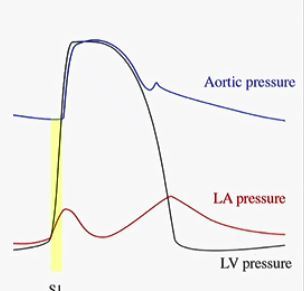
Explain the accentuated first heart
sound.
- A loud S1 is a hallmark of hemodynamically significant mitral stenosis.
- Mobile but stiff mitral leaflets produce a loud S1 unless the leaflets are heavily calcified.
- The loud S1 is due primarily to greater excursion of the leaflets during closure, since elevated LA pressure has kept the leaflets relatively wide apart.
- In addition, _stiff, noncompliant leaflet_s and chordae tendineae appear to resonate with increased amplitude.
A 38 year-old woman suffered from rheumatic fever at the age of 11, which left her
with a heart murmur. Over the past four years she has experienced shortness of
breath with exertion and more recently has noticed some irregularity of her heart
beat. She has also noticed that her voice has become somewhat hoarse.
On physical examination, the patient’s blood pressure was found to be 110/80 mmHg. Her heart rhythm was entirely irregular (irregularly irregular), with her heart rate varying between 90 and 160 per minute. She had an accentuated first heart sound with an opening snap shortly after the second heart sound and a prolonged diastolic murmur.
Examination of her larynx revealed paralysis of her left vocal-cord.
A chest X-ray showed an enlarged left atrium, pulmonary artery enlargement and evidence of pulmonary vein congestion. Transthoracic ultrasound demonstrated substantial narrowing of the mitral valve orifice and reduced mobility of the mitral valve leaflets.
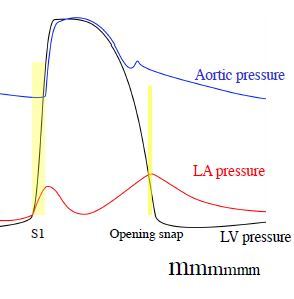
Explain the opening snap
- The opening snap (of the mitral valve) occurs because, under a high pressure gradient the abnormal valves billow into the LV and are rapidly arrested by the chordae, causing sudden vibrations.
- If the valve is significantly calcified the opening snap may not be heard as the stiff valves do not move so freely and rapidly.
A 38 year-old woman suffered from rheumatic fever at the age of 11, which left her
with a heart murmur. Over the past four years she has experienced shortness of
breath with exertion and more recently has noticed some irregularity of her heart
beat. She has also noticed that her voice has become somewhat hoarse.
On physical examination, the patient’s blood pressure was found to be 110/80 mmHg. Her heart rhythm was entirely irregular (irregularly irregular), with her heart rate varying between 90 and 160 per minute. She had an accentuated first heart sound with an opening snap shortly after the second heart sound and a prolonged diastolic murmur.
Examination of her larynx revealed paralysis of her left vocal-cord.
A chest X-ray showed an enlarged left atrium, pulmonary artery enlargement and evidence of pulmonary vein congestion. Transthoracic ultrasound demonstrated substantial narrowing of the mitral valve orifice and reduced mobility of the mitral valve leaflets.
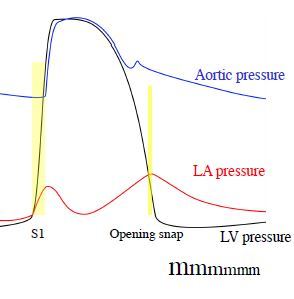
Explain the prolonged diastolic murmur.– Draw the Wiggers Diagram
- The prolonged diastolic murmur is associated with sustained turbulent flow through the narrowed valve (remember year II – turbulence…)
- This indicates that a high velocity of blood flow through the narrowed mitral valve is maintained over a large proportion of diastole.
A 38 year-old woman suffered from rheumatic fever at the age of 11, which left her
with a heart murmur. Over the past four years she has experienced shortness of
breath with exertion and more recently has noticed some irregularity of her heart
beat. She has also noticed that her voice has become somewhat hoarse.
On physical examination, the patient’s blood pressure was found to be 110/80 mmHg. Her heart rhythm was entirely irregular (irregularly irregular), with her heart rate varying between 90 and 160 per minute. She had an accentuated first heart sound with an opening snap shortly after the second heart sound and a prolonged diastolic murmur.
Examination of her larynx revealed paralysis of her left vocal-cord.
A chest X-ray showed an enlarged left atrium, pulmonary artery enlargement and evidence of pulmonary vein congestion. Transthoracic ultrasound demonstrated substantial narrowing of the mitral valve orifice and reduced mobility of the mitral valve leaflets.
Where on the precordium would this (prolonged diastolic murmur) sound be heard best, and would one use the bell or diapragm of the stethoscope to listen for it?
- Apex (mitral sound)
- Low pitch, so use the bell.
A 38 year-old woman suffered from rheumatic fever at the age of 11, which left her
with a heart murmur. Over the past four years she has experienced shortness of
breath with exertion and more recently has noticed some irregularity of her heart
beat. She has also noticed that her voice has become somewhat hoarse.
On physical examination, the patient’s blood pressure was found to be 110/80 mmHg. Her heart rhythm was entirely irregular (irregularly irregular), with her heart rate varying between 90 and 160 per minute. She had an accentuated first heart sound with an opening snap shortly after the second heart sound and a prolonged diastolic murmur.
Examination of her larynx revealed paralysis of her left vocal-cord.
A chest X-ray showed an enlarged left atrium, pulmonary artery enlargement and evidence of pulmonary vein congestion. Transthoracic ultrasound demonstrated substantial narrowing of the mitral valve orifice and reduced mobility of the mitral valve leaflets.
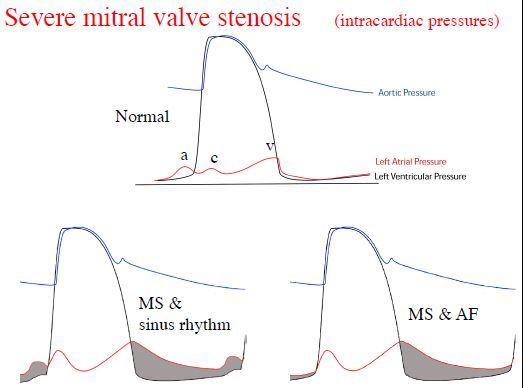
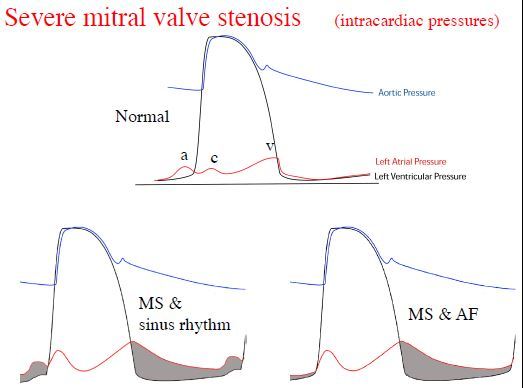
Describe how and why the intracardiac pressures in this patient with mitral
stenosis will typically differ from those in a normal heart.
• Under normal conditions, there is a small pressure gradient between the LA and
LV in early diastole (rapid filling) and during atrial contraction when flow from
LA to LV is greatest.
• During the rest of diastole, flow through the mitral valve is much reduced and
the pressures in LA and LV are the same.
• In mitral stenosi_s there is an i_ncreased diastolic A-V pressure gradient reflecting
the resistance presented by the narrowed mitral valve.
- This is greatest in early filling when the rate of blood flow from atrium to ventricle is maximal.
• In severe mitral stenosis, LA and LV pressure do not equilibrate and LV filling
continues at a relatively uniform rate throughout diastole.
• LA volume and pressure remain elevated throughout the cardiac cycle
A 38 year-old woman suffered from rheumatic fever at the age of 11, which left her
with a heart murmur. Over the past four years she has experienced _shortness of
breath with exertio_n and more recently has noticed some irregularity of her heart
beat. She has also noticed that her voice has become somewhat hoarse.
On physical examination, the patient’s blood pressure was found to be 110/80 mmHg. Her heart rhythm was entirely irregular (irregularly irregular), with her heart rate varying between 90 and 160 per minute. She had an accentuated first heart sound with an opening snap shortly after the second heart sound and a prolonged diastolic murmur.
Examination of her larynx revealed paralysis of her left vocal-cord.
A chest X-ray showed an enlarged left atrium, pulmonary artery enlargement a_nd evidence of pulmonary vein congestion. Transthoracic ultrasound demonstrated substantial n_arrowing of the mitral valve orifice and reduced mobility of the mitral valve leaflets.
Describe how and why the intracardiac pressures in this patient with mitral
stenosis will typically differ from those in a normal heart.
• Because of the substantial reduction in the cross-sectional area of the mitral
valve orifice, the velocity of the blood flowing through the inlet valve is
increased and t_urbulence occurs as a result._
- No a-wave would be observed on the atrial pressure trace because the patient has atrial fibrillation.
- Ventricular peak pressure is reduced with respect to normal and LV end-diastolic pressure will be decreased also, due to the low LV filling as a result of the mitral stenosis. (note patient’s BP = 110/80)
A 38 year-old woman suffered from rheumatic fever at the age of 11, which left her
with a heart murmur. Over the past four years she has experienced _shortness of
breath with exertio_n and more recently has noticed some irregularity of her heart
beat. She has also noticed that her voice has become somewhat hoarse.
On physical examination, the patient’s blood pressure was found to be 110/80 mmHg. Her heart rhythm was entirely irregular (irregularly irregular), with her heart rate varying between 90 and 160 per minute. She had an accentuated first heart sound with an opening snap shortly after the second heart sound and a prolonged diastolic murmur.
Examination of her larynx revealed paralysis of her left vocal-cord.
A chest X-ray showed an enlarged left atrium, pulmonary artery enlargement a_nd evidence of pulmonary vein congestion. Transthoracic ultrasound demonstrated substantial n_arrowing of the mitral valve orifice and reduced mobility of the mitral valve leaflets.
Describe the main difference between the left-sided heart pressures for this patient
compared to one with mitral stenosis but who does not have atrial fibrillation.
What treatments are possible for this patient’s stenosed mitral valve?
The treatment options for mitral stenosis include:
_- percutaneous mitral valvuloplast_y (balloon)
- mitral valve replacement surgery



-
Cardiovascular Homeostasis (LeGrice)9
-
Respiratory Pathophysiology 1 and 2 (Kolbe)37
-
Regulation of Vascular Function 1 and 2 (Ramchandra)29
-
Anticoagulant Drugs (Dawes)33
-
Renal Failure (Zoysa)28
-
Respiratory Problems (Clinical Problems) (Kolbe)22
-
ACE Inhibitors (Dawes)24
-
Cardiac Rhythm (LeGrice)35
-
Cardiac Rhythm (Clinical Problems) (LeGrice)31
-
Vascular Problems (Clinical Problems) (Ramchandra & M Dawes)38
-
Regulation of Cardiac Function (LeGrice)31
-
Renal Physiology: Salt and Water (Zoysa)21
-
Ischaemic Heart Disease (Clinical)20
-
Cardiovascular Control System (Ramchandra)18
-
Alpha Blockers & Calcium Channel Blockers (Dawes)29
-
Cardiac Function 1 (Clinical Problems)19
-
Renal Physiology: Potassium & Magnesium (Zoysa)28
-
Beta Blockers (Dawes)18
-
Antihypertensive Drugs (Dawes)24
-
Renal Problems (Clinical Problems) (Zoysa)34
-
Cardiovascular Regulation (B Smaill & R Ramchandra)18
-
Inotropic Drugs (Dawes)31
-
Cardiac Function 2 (Clinical Problems)49
-
Clinical Endocrinology (Gunn)24
-
Endocrinology Problem (Gunn)27
-
Drugs & Arrhythmia (Lever)25
-
GI Problems 1 (Clinical) (Ow)60
-
Lipid Lowering Therapy (Dawes)15
-
Gut Problems 2 (Clinical) (Ow)36
-
Gut Problems 3 (Clinical) (Ow)41
-
Acid/Base Physiology 1 (Gunn)14
-
Drugs & Blood Pressure (Clinical) (Dawes)21
-
Acid/Base Physiology 2 (Gunn)13
-
Acid/Base Physiology 3 and Clinical Lectures (Gunn)13
-
RCT (Jackson)4
-
Body Fluids Problems (Clinical) (Small & Ramchandra)25



