A 65 year-old woman experiences pain in her left leg during an economy-class _flight from London t_o Auckland. The pain continues and she sees her general practitioner immediately on arrival.
Her l_eg is swollen,_ red and feels hot, and her GP suspects deep vein thrombosis (DVT).
Ultrasound imaging identifies a blood clot in the junction of her left iliac and femoral veins (DVT) (D-dimer blood test can be done but US is definitive diagnosis)
She indicates that there is a family history on her father’s side of venous thrombosis
What are the likely causes of DVT?
1) Virchow’s triad?
- S_tasis,_ endothelium, blood constituents
- Stasis due to long haul flight and ?obese
2) Personal/family history (first degree relatives) of VTE?
- Lupus anticoagulant, antiphospholipid antibodies, protein C & S, antithrombim III, factor V Leiden
- Previous DVT (if you had it once, you’re more likely to have it again)
3) Tumour history?
* Tumour induced DVT need Heparin instead of Wafarin.
4) Drugs?
- In young women, COCP increases risk
- In older women, hormone replacement therapy increases risk
5) Pregnancy? (often a sign of clotting disorders if there’s intrauterine growth retardation or spontaneous miscarriages)
Why is the Leg Swollen in the case of DVT?
Occluded deep limb veins -> impaired venous return -> increased venous hydrostatic pressure -> drives fluid out of capillaries into subcutaneous tissue -> swollen legs
Why is the Leg Red and Hot in the case of DVT?
Venous clot is a dynamic process:
- Increased temperature (especially large clots put metabolic stress)
- Inflammation process
- WBC activation
- Cytokine release
What are the Treatment Options for DVT?
Pain Relief (Analgesia)
- Paracetamol
- Elevate leg
Anticoagulation
This is different to thrombolysis (thrombolysis is contraindicated)!
- Enoxaparin (1mg/kg bd, subcutaneous) (home/inpatient) (LMWH)
- Immediate anticoagulant affect (stabilises thrombus, prevents its propagation).
- Do not thrombolyse clot (body’s own proteases do that)
- Warfarin
- Maintain INR 2-3 (must do INR checks regularly)
- Duration 3-6 months (if first event) (takes a few days for vitamin K dependent factor II, VII, IX, X to break down)
- Reverse by vitamin K or prothrombinex
- Careful of Drug interactions (CP450 metabolism)
- Dabigatran (an alternative to warfarin?) (bd)
- Do not need monitoring
- Reverse with idarucizumab
- Renal excretion, therefore do not use with eGFR <30
- Side effect of indigestion due to tartaric acid in capsule (enhance absorption)
- Thrombin inhibitor
- Renally excreted- so need to be careful in people with renal impairment.
Course normally s_tarts with enoxaparin_ for its instantaneous effect, then _add warfarin/dabigatran as it takes a few days to kick i_n, then stop enoxaparin when warfarin kicks in.
This is l_ifelong treatment if second VTE event occurs._
Describe PE Treatment
PE Treatment (Similar To DVT)
- Drug treatment of LMWH and warfarin (longer duration for 6 months if first event).
- Be aware of interactions (monitor INR)!
- If severe PE, use thrombolysis but have significant side effects, or use surgery to remove thrombus.
76 year old man with atrial fibrillation. Had stroke 5 years ago, which made good recovery. Rate 110bpm. BP 190/100mmHg.
WHat are the treatment issues we need to address?
- Hypertension (BP control)
- Lipid control
- Atrial fibrillation (very strong risk factor for systemic embolization)
- Rate control (target ~80bpm) with beta blocker +/- diltiazem
- Atrial fibrillation predisposes people to tachycardia
- Also at risk of embolism
- Rate control (target ~80bpm) with beta blocker +/- diltiazem
- Anticoagulation (aspirin vs warfarin vs other anticoagulants)
What are the symtpos of PE?
- Common signs and symptoms include:
- Shortness of breath. This symptom typically appears suddenly and always gets worse with exertion.
- Chest pain. You may feel like you’re having a heart attack. The pain may become worse when you breathe deeply (pleurisy), cough, eat, bend or stoop. The pain will get worse with exertion but won’t go away when you rest.
- Cough. The cough may produce bloody or blood-streaked sputum.
- Other signs and symptoms that can occur with pulmonary embolism include:
- Leg pain or swelling, or both, usually in the calf
- Clammy or discolored skin (cyanosis)
- Fever
- Excessive sweating
- Rapid or irregular heartbeat
- Lightheadedness or dizziness
How would you treat this patient?
76 year old man with atrial fibrillation. Had stroke 5 years ago, which made good recovery. Rate 110bpm. BP 190/100mmHg.
1) Rate control
- Betal Blocker
- +/- diltizaen
2) BP control
3) Lipid control
4) Anticoagulation
- Aspirin vs wafarain
- (Depending on AF + Chads-Vas score)
How do you determine if someone with Atrial Fibrillation should be prescribed Wafarin?
CHADS-VAS score = Important scoring system for AF
- Congestive cardiac failure 1
- Hypertension 1
- Age (>75) 2
- Diabetes 1
- Stroke 2
- Vascular disease 1
- Age (>65) 1
- Sex (female) 1
If score is 2 or above, prescribe Wafarin
CHADS-VAS Score and Stroke Risk (%/Year)
Learn these scores!!! These are useful when making decisions about putting AF patients on long-term anti-coagulation.
As CHADS-VAS score increased, stroke risk increased.
If score is ≥2, high risk of thromboembolism, give warfarin!
How do you determine someone’s Bleeding Risk for AF patients- (when considering prescribing anticoagulants)?
HASBLED Score
Bleeding risk for AF patients on anticoagulation is calculated by HASBLED score (each risk factors worth 1 point).
- Hypertension
- Abnormal blood results (creatinine/LFTs)
- Stroke
- Bleeding
- Labile INR (unstable/high)
- Elderly (>65)
- Drug use (alcohol/recreational drugs)
As _HASBLED score is hig_h, bleeding risk increases.
If score is ≥3, don’t give anticoagulant!
What is the timeframe for administrating Anticoagulants?
Anticoagulation Time Frame
In DVT/PE, initiating anticoagulation is urgent
- Usually initially as inpatient commencing with LMWH (enoxaparin)
In AF, Initiating anticoagulation is not so time sensitive
- Usually as outpatient
- No LMWH needed
- Warfarin vs. dabigatran
What is Criteria for Diabetes?
Diabetes diagnosis include:
- Symptomatic
- Random plasma glucose >11.1
- Fasting plasma glucose >7.0 (N<5.6)
- HbA1c ³ 48mmol/mol
- Asymptomatic
- 2 abnormal blood tests
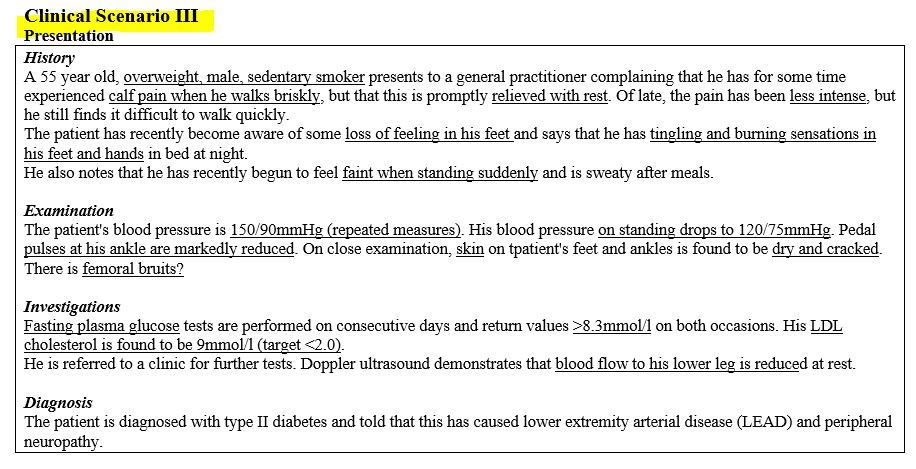
What Is The Cause Of The Intermittent Calf Pain Experienced When Walking? Why Is It Relieved With Rest?
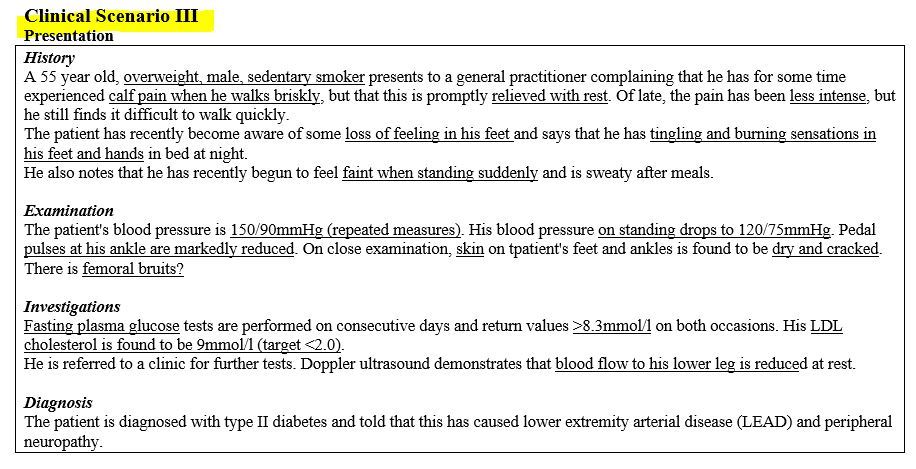
This is intermittent claudication (condition in which cramping pain in the leg is induced by exercise, typically caused by obstruction of the arteries), which is caused by:
- Obstruction ® decreased blood flow ® ischemic muscles ® build-up of lactate/acylcarnitines/inflammation (anaerobic mechanism)
- Collateral development (long term)
- Pre-conditioning (if you give tissue an ischemic insult, this allows muscle to work for longer next time before the next ischaemic insult, e.g. walk ® rest ® walk again, second time you can walk further)
Explain Loss Of Feeling In Patient’s Feet And Tingling And Burning Sensations In Hands And Feet At Night.
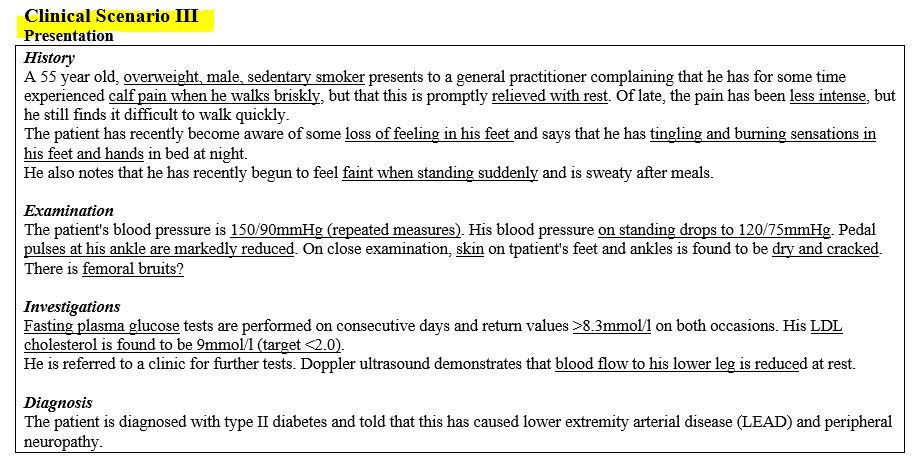
Loss of feeling and tingling/burning is due to diabetic neuropathy (of sensory nerves)
- Chronic neuropathy
- Acute peripheral neuritis
- Ischemia of nerves
These causes glove and stocking numbness.
Explain Why Patient Feels Faint When He Stands Up Suddenly And Why He Is Sweaty After Eating A Meal.
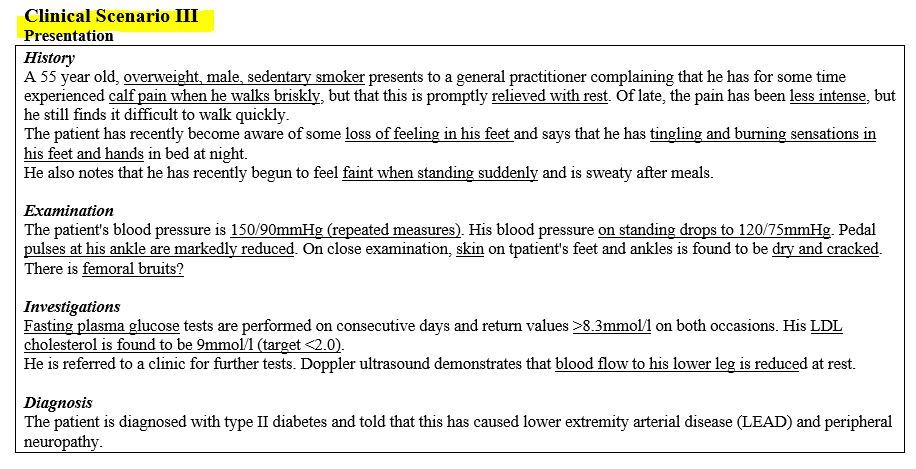
Autonomic neuropathy (neuropathy of the autonomic nerves) results in:
- Impact on SNS response ® BP not maintained when standing up ® postural hypotension ® feeling of faintness
- Damaged ANS nerve ® miscommunication of autonomic nerves with GI system and brain ® bizarre sweating
Explain The Dry And Cracked Appearance Of The Patient’s Hands And Feet. How Does This Add To Risks Associated With LEAD?
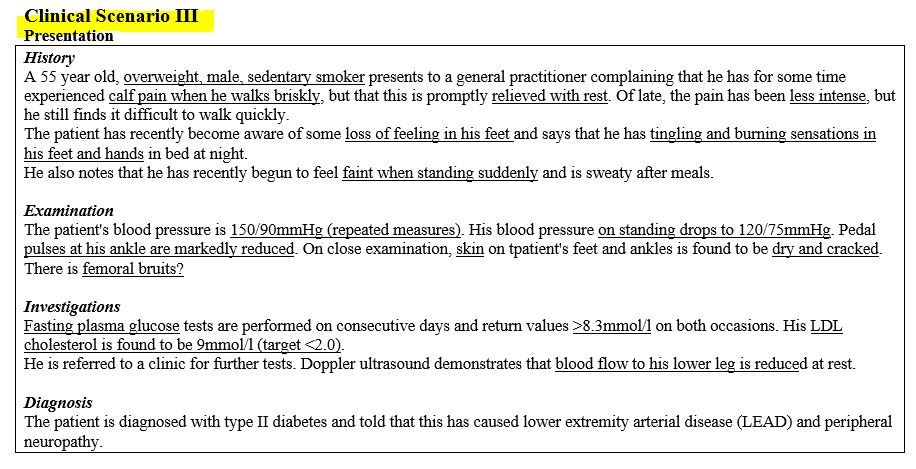
Poor blood flow (ischemia) ® reduced skin metabolism ® reduced skin growth
- ® hairless skin (not enough circulation to provide hair metabolism ® dry skin)
- ® reduced skin growth ® increased risk of infection
- ® reduced peripheral sensation ® increased risk of infection
What Advise Would You Give To The Patient? Speculate On Possible Treatment Options.
- Good glycaemic control
- Vascular risk factor control
- Stop smoking
- Other vascular sites
- Aspirin
- BP and cholesterol management
- Exercise/diet/weight
- Angioplasty/surgery
84 year old woman living in a rest home progressively becomes more pale and listless (lack energy). She complains of feeling faint and of a roaring sound in her ears. There is evidence of _blood in her stoo_l and her pulse is rapid, but full.
She is seen by GP. B_P 130/50mmHg_. HR 130bpm. Systolic murmur.
Low haemoglobin (45g/L (115-165)) upon blood test. Haematocrit is also reduced. She is admitted to hospital with suspected intestinal bleeding
Why Is Patient’s Hb Reduced And What Does This Suggest About The Extent And Time-Course Of Her Blood Loss?
Is it Chronic or Acute? How can you confirm this?
Patient’s haemoglobin is reduced due to chronic GI bleeding
- This indicates chronic bleeding, since fluid translocation with compensated increased volume would result in decreased Hb. (note that acute bleeding decreases blood volume, but not reducing haematocrit)
- History also suggests chronic history (progressively become more pale and listless)
This can be investigated through iron studies:
- In acute blood loss, iron would be normal
- In chronic blood loss, iron would be low
In addition, blood film can be used to investigate MCV:
- If chronic anaemia (weeks/months), there is reduced MCV (microcytic)
- If acute anaemia, there is normal MCV
84 year old woman living in a rest home progressively becomes more pale and listless (lack energy). She complains of feeling faint and of a roaring sound in her ears. There is evidence of blood in her stool and her pulse is rapid, but full.
She is seen by GP. BP 130/50mmHg. HR 130bpm. Systolic murmur.
Low haemoglobin (45g/L (115-165)) upon blood test. She is admitted to hospital with suspected intestinal bleeding
Do You Think That The Patient’s (1) Cardiac Output And (2) Total Peripheral Resistance Are Higher Or Lower Than Normal? What Evidence Supports This View?
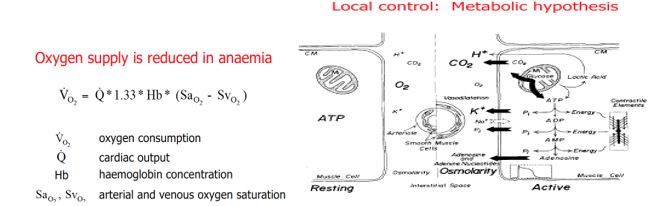
Our system would try and maintain the same amount of oxygen delivery to tissues (maintain VO2)
- Hb reduced - COincreased - Q increased (maintain perfusion -> maintain VO2), also SNS increased - HRincreased- CO increased
- Hb reduced and hypoxia - metabolic vasodilation - TPRreduced -Qincreased (increase perfusion to vital organs)
Even though SNS increased to heart (increase CO), SNS increased to peripheral vascular beds, metabolic vasodilation override SNS effect
Describe the equation of Change in volume (O2) and Cardiact output
V(dot) O2 = Cardiac output x 1/33 x Hb x (SaO2-SVO2)
84 year old woman living in a rest home progressively becomes more pale and listless (lack energy). She complains of feeling faint and of a roaring sound in her ears. There is evidence of blood in her stool and her pulse is rapid, but full.
She is seen by GP. BP 130/50mmHg. HR 130bpm. Systolic murmur.
Low haemoglobin (45g/L (115-165)) upon blood test. She is admitted to hospital with suspected intestinal bleeding
Explain the Murmer
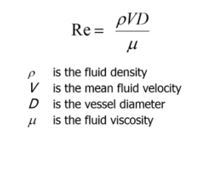
Explain The Murmurs (Reynolds Number)
_Normal laminar flow i_s more likely to become turbulent (Re >2400), resulting in systolic murmurs. This is due to:
- Increased fluid velocity (V)
- Possibly increased vessel diameter (D) due to heart chamber dilatation
- Decrease in viscosity (u) due to Hb decrease
84 year old woman living in a rest home progressively becomes more pale and listless (lack energy). She complains of feeling faint and of a roaring sound in her ears. There is evidence of blood in her stool and her pulse is rapid, but full.
She is seen by GP. BP 130/50mmHg. HR 130bpm. Systolic murmur.
Low haemoglobin (45g/L (115-165)) upon blood test. She is admitted to hospital with suspected intestinal bleeding
Why Is She Pale, Listless (Lacking Energy) And Cold?
This is due to reduced flow to peripheral arteries (maintain perfusion to vital organs!)
84 year old woman living in a rest home progressively becomes more pale and listless (lack energy). She complains of feeling faint and of a roaring sound in her ears. There is evidence of blood in her stool and her pulse is rapid, but full.
She is seen by GP. BP 130/50mmHg. HR 130bpm. Systolic murmur.
Low haemoglobin (45g/L (115-165)) upon blood test. She is admitted to hospital with suspected intestinal bleeding
Speculate On The Appropriate Treatment For This Patient.
- Blood transfusion until Hb increases to 90-100
- Intravenous iron transfusion (due to iron deficiency anaemia), tolerant better than oral iron tablets (very unpleasant)
A young man experiences a compound fracture of the forearm
His bones are set, a rigid cast is placed on his arm and he is held in Accident and Emergency for further observation
More than an hour after treatment, the patient complains of discomfort and loss of feeling in his fingers
There is a palpable radial pulse, but his fingers are pale and cold
Explain Why The Patient’s Fingers Are Pale And Cold
There is reduced blood flow due to build-up of internal tissue pressure (possibly caused by internal bleeding).
rigid fascia + blood leakage -> increase in interstitial tissue pressure -> compress precapillary vessels -> r_educed blood flow_
Compartment syndrome is muscle groups and their blood vessels are compressed due to their surrounding of stiff deep fascia (cannot expand). Examination for compartment syndrome involves 5 P’s:
- Pallor (skin colour)
- Paraesthesia (sensation)
- Pulse deficit
- Paralysis
- Pain (on passive extension of the compartment) and perishing cold (poikilothermia)



-
Cardiovascular Homeostasis (LeGrice)9
-
Respiratory Pathophysiology 1 and 2 (Kolbe)37
-
Regulation of Vascular Function 1 and 2 (Ramchandra)29
-
Anticoagulant Drugs (Dawes)33
-
Renal Failure (Zoysa)28
-
Respiratory Problems (Clinical Problems) (Kolbe)22
-
ACE Inhibitors (Dawes)24
-
Cardiac Rhythm (LeGrice)35
-
Cardiac Rhythm (Clinical Problems) (LeGrice)31
-
Vascular Problems (Clinical Problems) (Ramchandra & M Dawes)38
-
Regulation of Cardiac Function (LeGrice)31
-
Renal Physiology: Salt and Water (Zoysa)21
-
Ischaemic Heart Disease (Clinical)20
-
Cardiovascular Control System (Ramchandra)18
-
Alpha Blockers & Calcium Channel Blockers (Dawes)29
-
Cardiac Function 1 (Clinical Problems)19
-
Renal Physiology: Potassium & Magnesium (Zoysa)28
-
Beta Blockers (Dawes)18
-
Antihypertensive Drugs (Dawes)24
-
Renal Problems (Clinical Problems) (Zoysa)34
-
Cardiovascular Regulation (B Smaill & R Ramchandra)18
-
Inotropic Drugs (Dawes)31
-
Cardiac Function 2 (Clinical Problems)49
-
Clinical Endocrinology (Gunn)24
-
Endocrinology Problem (Gunn)27
-
Drugs & Arrhythmia (Lever)25
-
GI Problems 1 (Clinical) (Ow)60
-
Lipid Lowering Therapy (Dawes)15
-
Gut Problems 2 (Clinical) (Ow)36
-
Gut Problems 3 (Clinical) (Ow)41
-
Acid/Base Physiology 1 (Gunn)14
-
Drugs & Blood Pressure (Clinical) (Dawes)21
-
Acid/Base Physiology 2 (Gunn)13
-
Acid/Base Physiology 3 and Clinical Lectures (Gunn)13
-
RCT (Jackson)4
-
Body Fluids Problems (Clinical) (Small & Ramchandra)25



