Biological lipids defining feature is
their insolubility in water
fatty acids
- are hydrocarbon derivatives
- at about the same low oxidation state (highly reduced) as the hydrocarbons in fossil fuels
- cellular oxidation of fatty acids (to CO2 and H2O) is highly exergonic
- fats and oils used almost universally as stored forms of energy in living organisms
- carboxylic acids with hydrocarbon chains ranging from 4 to 36 carbons long (C4 to C36). In some
- in some this chain is unbranched and fully saturated (contains no double bonds)
- in others the chain contains one or more double bonds
- few contain three-carbon rings, hydroxyl groups, or methyl-group branches
lipid nomenclature
two types
- Standard nomenclature
- chain length and number of double bonds, separated by a colon: 16:0
- number 1 is assigned to the carboxyl carbon (C-1), and α to the carbon next to it
- position of any ═ bond(s) is indi
- cated by Δ followed by a superscript number indicating the lower-numbered carbon in the ═ bond
- polyunsaturated acids
- of special importance in human nutrition.
- physiological role of PUFAs is related to the position of the first ═ bond near the methyl end of the chain, not the carboxyl end
- numbers the carbons in the opposite direction
- assign the number 1 to the methyl carbon at the other end of the chain and this carbon as ω (omega; last letter in the Greek alphabet)
- The positions of the double bonds are indicated relative to the ω carbon
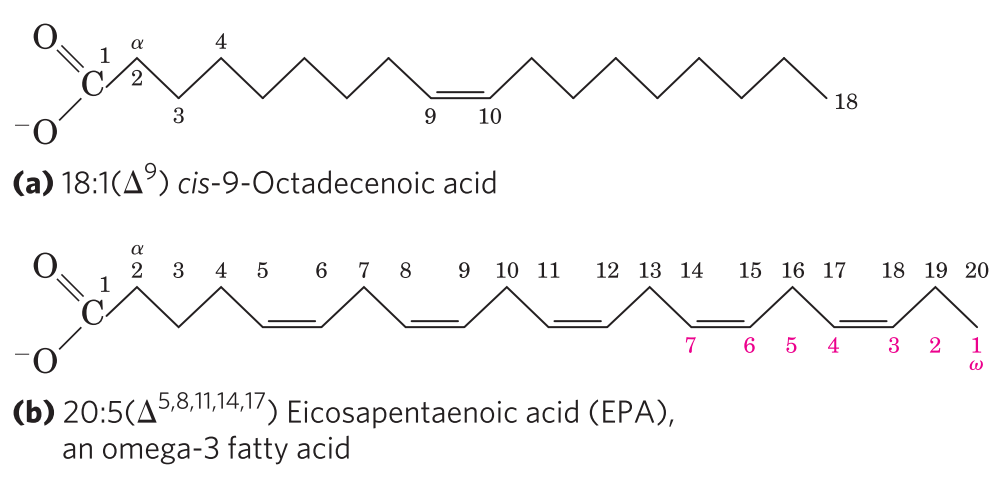
most commonly occurring fatty acids have even numbers of carbon atoms in an unbranched chain of _____ to _____ carbons
- 12
- 24
common pattern in location of double bonds
- in most monounsaturated fatty acids the double bond is between C-9 and C-10 (Δ9)
- double bonds of polyunsaturated fatty acids
- generally D12 and D15
- Arachidonic acid is an exception
- almost never conjugated (alternating single and double bonds
- separated by a methylene group: —CH═CH—CH2—CH═CH—
physical properties of the fatty acids, and of compounds that contain them, are largely determined by the _____ and degree of ______ of the hydrocarbon chain.
- length
- unsaturation
The _____ ______ chain accounts for the poor solubility of fatty acids in water. The _____ the fatty acyl chain and the fewer the ____ _____, the lower is the solubility in water. The _____ _____ ____ is polar (and ionized at neutral pH) and accounts for the slight solubility of short-chain fatty acids in water
- nonpolar hydrocarbon
- longer
- double bonds
- carboxylic acid group
Melting points are also strongly influenced by the ______ and degree of ______ of the hydrocarbon chain. At room temperature (25 °C), the ______ fatty acids from 12:0 to 24:0 have a waxy consistency, whereas ______ fatty acids of these lengths are oily liquids
- length
- unsaturation
- saturated
- unsaturated
Differences in melting points are due to different degrees of packing of the fatty acid molecules. Explain.
Fully saturated compounds
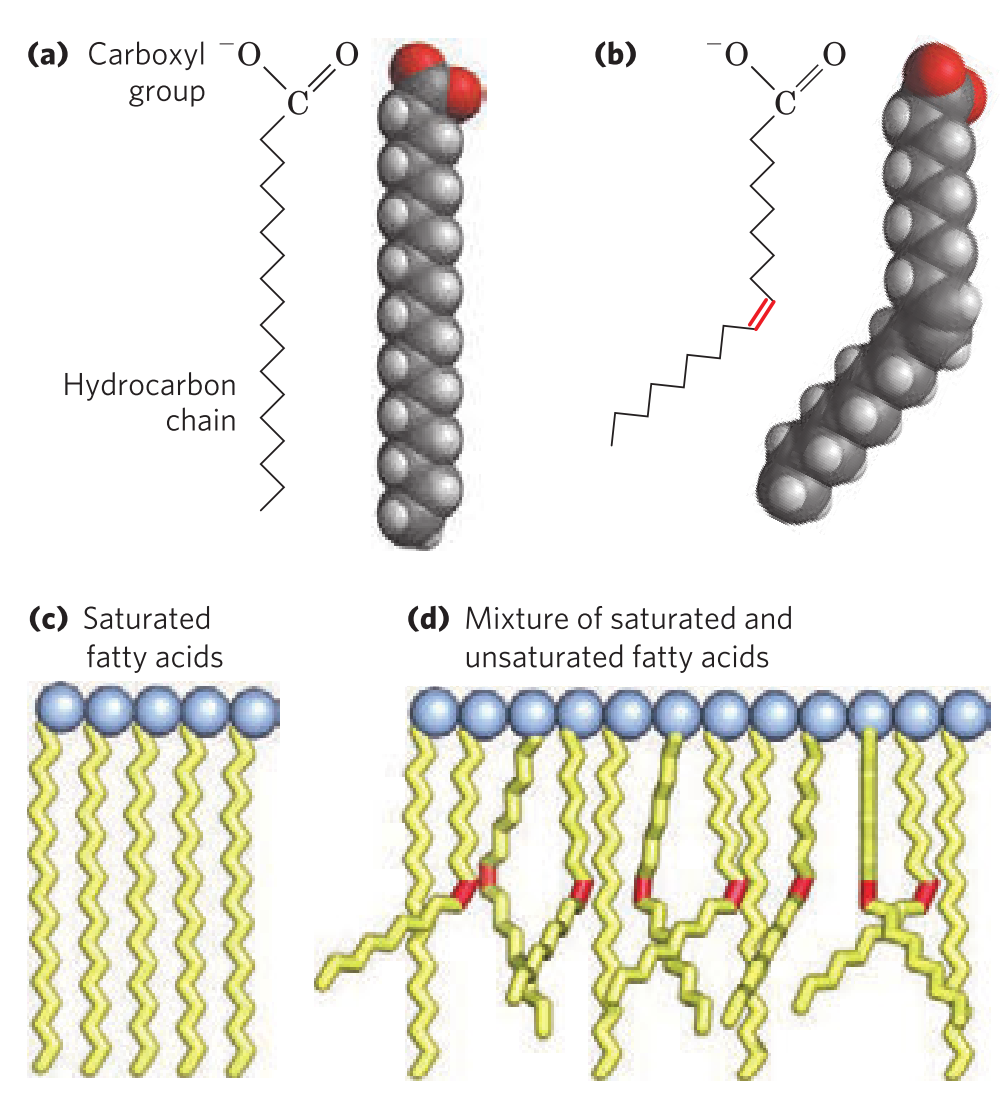
- In fully saturated compounds packing around each C–C bond gives the hydrocarbon flexibility
- The fully free rotation is the stable conformation
- steric hindrance of neighboring atoms is minimized
- can pack together tightly in nearly crystalline arrays, w/atoms along their lengths in van der Waals contact with the atoms of neighboring molecules
Unsaturated fatty acids
- a cis double bond forces a kink in the hydrocarbon chain
- Fatty acids with kinks cannot pack together as tightly as fully saturated fatty acids
- interactions w/each other are weaker
- less thermal energy is needed to disorder these poorly ordered arrays of unsaturated fatty acids = lower melting points
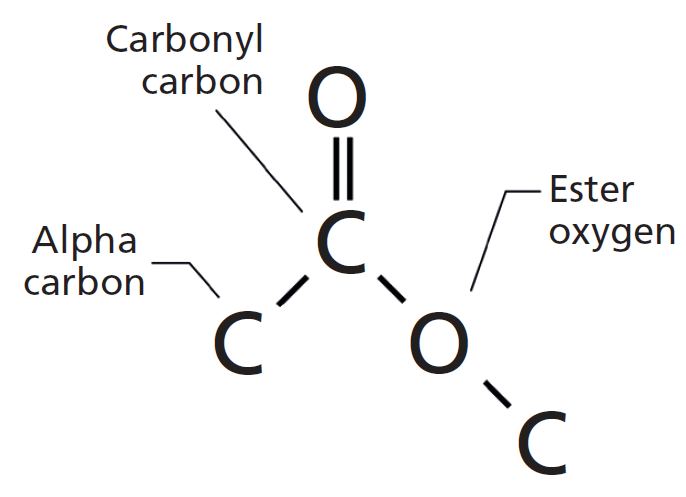
ester functional group
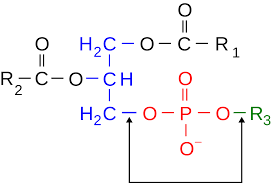
phosphodiester bond
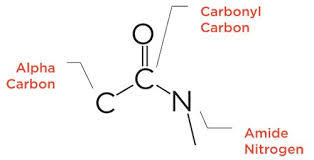
amide
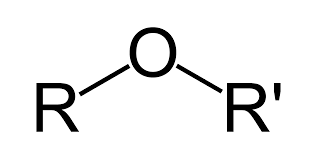
ether
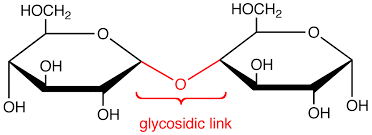
glycosidic link
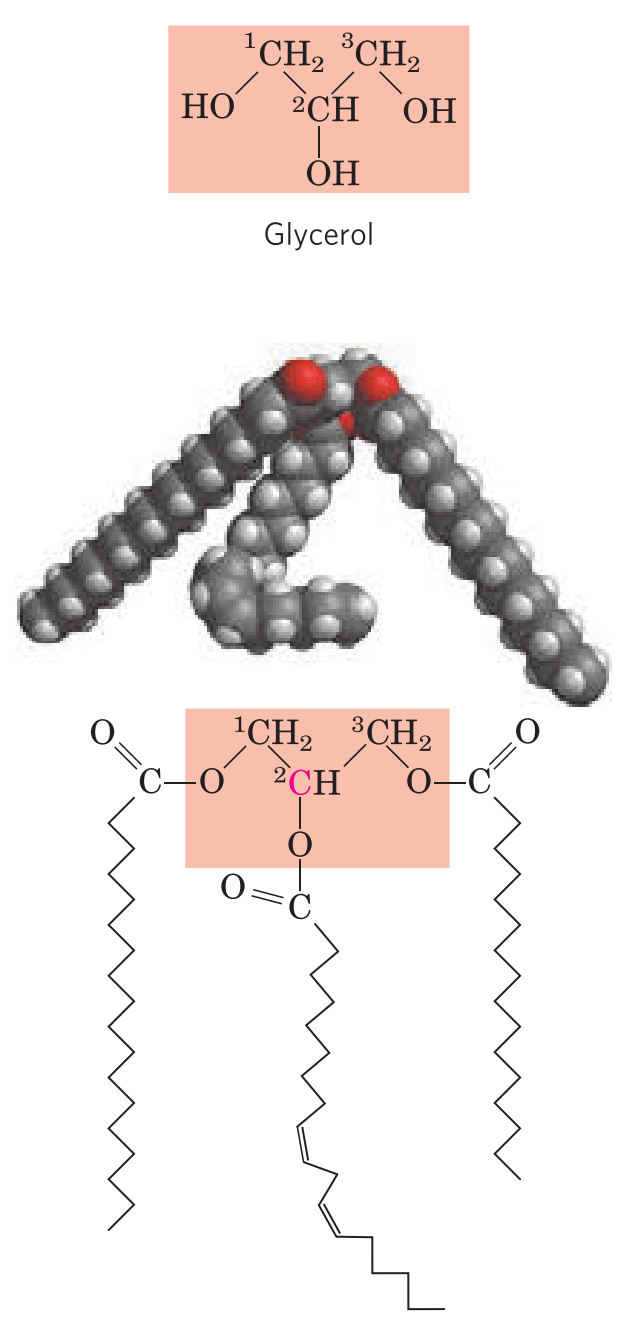
triacylglycerols, triglycerides, fats, or neutral fats
- simplest lipids constructed from fatty acids
- composed of three fatty acids each in ester linkage with a single glycerol
- Those containing the same kind of fatty acid in all three positions are called simple triacylglycerols
- Most naturally occurring triacylglycerols are mixed; they contain two or three different fatty acids
- nonpolar hydrophobic molecules, insoluble in water because the polar hydroxyls of glycerol and the polar carboxylates of the fatty acids are bound in ester linkages
The mixed triacylglycerol shown here has three different fatty acids attached to the glycerol backbone
lipases
enzymes that catalyze the hydrolysis of stored triacylglycerols
There are two significant advantages to using triacylglycerols as stored fuels, rather than polysaccharides such as glycogen and starch:
- carbon atoms of fatty acids are more reduced than those of sugars, and oxidation of triacylglycerols yields more than twice as much energy, gram for gram, as the oxidation of carbohydrates
- because triacylglycerols are hydrophobic and therefore unhydrated, the organism that carries fat as fuel does not have to carry the extra weight of water of hydration that is associated with stored polysaccharides
Vegetable oils such as corn and olive oil are composed largely of triacylglycerols with ______ fatty acids and thus are liquids at room temperature. Triacylglycerols containing only ______ fatty acids, such as tristearin, the major component of beef fat, are white, greasy solids at room temperature.
- unsaturated
- saturated
partial hydrogenation
- process that convert many of the cis double bonds in the fatty acids to single bonds
- increases melting temperature of the oils so that they are more nearly solid at room temperature
partyial hydrogenation has an undesirable effect
- some cis double bonds are converted to trans double bonds
- strong evidence that dietary intake of trans fatty acids (“trans fats”) leads to a higher incidence of cardiovascular disease
- acids raise the level of triacylglycerols and of LDL (“bad”) cholesterol in the blood, and lower the level of HDL (“good”) cholesterol
- increase the body’s inflammatory response
- deleterious effects of trans fats occur at intakes of 2 to 7 g/day
Biological waxes
- esters of long-chain (C14 to C36) saturated and unsaturated fatty acids with long-chain (C16 to C30) alcohols
- melting points (60 to 100 8C) are generally higher than those of triacylglycerols
- water-repellent properties
- firm consistency
- Membrane lipids are ______ : one end of the molecule is hydrophobic, the other hydrophilic.
- Their hydrophobic interactions with each other and their hydrophilic interactions with water direct their packing into sheets called ______ _____
- amphipathic
- membrane bilayers
five general types of membrane lipids:
triacylglycerols
- storage lipids (neutral)
- glycerol backbone (red)
- backbone is attached to one or more longchain alkyl groups (yellow) and a polar head group (blue)
- the alkyl groups are fatty acids in ester linkage
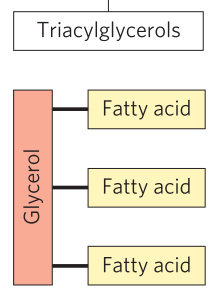
five general types of membrane lipids:
phospholipids
- membrane lipids (polar)
- backbone (red)
- glycerophospholipids: glycerol backbone
- sphingolipids: sphingosine backbone
- backbone is attached to one or more longchain alkyl groups (yellow) and a polar head group (blue)
- the alkyl groups are fatty acids in ester linkage
- the polar head group is joined through a phosphodiester
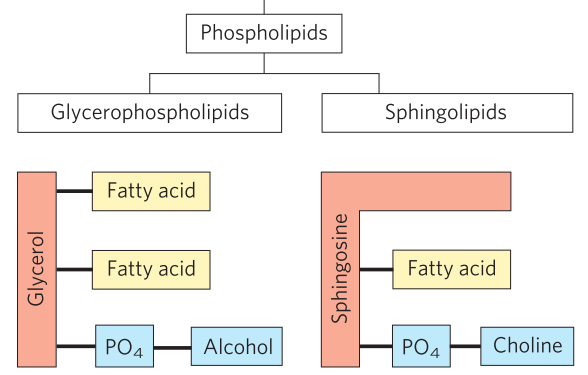



-
Chapter 1: Foundations of Biochemistry59
-
Chapter 2: Water92
-
Chapter 3: Amino Acids, Peptides & Proteins128
-
Exam 1145
-
Chapter 4: The Three-Dimensional Structure of Proteins72
-
Chapter 6: Enzymes127
-
Exam 2202
-
Chapter 10: Lipids64
-
Chapter 11: Biological Membranes and Transport77
-
Exam 3192
-
Chapter 7: Carbohydrates and Glycobiology30
-
Exam 4163



