Oedipus Conflict
a developmental experience in which ta child’s conflicting feelings toward the opposite-sex parent are (usually) resolved by identifiying with the same sex parent
- Experience it during the phallic stage (3-5)
*
Latency Stage
in which the primary focus is on the further development of intellectual, creative, interpersonal, and athletic skills
- ages 5-13
Genital Stage
the time for the coming together of the mature adult personalitiy with a capacity to love, work, and rleate to others in a mutually satisfying and reciprocal manner
- fifth and final stage of personality development
*
Self-Actualizing Tendency
the human motive toward realizing our inner potential
- a major factor in personality
- Examples:
- the pursuit of knowledge
- the expression of one’s creativity
- the quest for spiritual enlightenment
- the deisre to give to society
Existential Approach
Regards personality as governed by an individual’s ongoing choices and decisions in the context of the realities of life and death
- angst can arise as we find meaning in life and death and take responsibility for making free choices
- one must deal with issues head-on instead of using defenses
Social Cognitive Approach
Views personality in terms of how the person thinks about the situations encountered in daily life and behaves in response to them
- how people are thinking/behaving in the world
- focused on interaction between person and situation
Person-Situation Controversy
the question of whether behavior is caused more by personality or by situtational factors
Personal Constructs
Dimensions people use in making sense of their experiences
- for example, different individual’s personal constructs of a clown: one person may see him as a source of fun, another as a tragic figure, and yet another as so frightening that the circus is off-limits
Outcome Expectancies
a person’s assumptions about the likely consequences of a future behavior
Locus of Control
a person’s tendency to percieve the control of rewards as internal to the self or external in the environment
- people whose answers suggest that htey believe they control their own destiny are said to have an internal locus of control
- those who believe that outcomes are random, determined by luck, or controlled by other people are described as having an external locus of control
Self-Concept
a person’s explicit knowledge of his or her own behaviors, traits, and other personal characteristics
- an organized body of knowledge that develops from social experiences and has a profound effect on a person’s behavior throughout life
Self-Verification
the tendency to seek evidence to confirm the self-concept
- People who considered themselves submissive got feedback that they were very dominant and forcefull and they went out of their way to act in an extremely submissive manner
Self-Esteem
the extent to which an individual likes, values, and accepts the self
Self-Serving Bias
shows that people tend to take credit for their successes but downplay responsibility for their failures
Narcissism
a grandiose view of the self combined with a tendency to seek admiration from and exploit others
Personality
an individual’s characteristic style of behaving, thinking, and feeling
- Characteristics, emotions, thoughts, behaviors that are relavitvely stable over time and across circumstances; individual’s characteristic style of behaving, thinking, and feeling
- What makes you who you are
- Why are you unique
- What is the same over time
Self Report
a series of answers to a questionaire that asks people to indicate the extent to which sets of statements or adjectives accurately describe their own behavior or mental state
- most popular way
Minnesota Multiphasic Personality Inventory (MMPI-2)
well-researched, clinical questionaire used to asses personality and psychological problems
Projective Techniques
a standard series of ambiguous stimuli designed to elicit unique responses that reveal inner aspects, of an individual’s personality
- people will project personality factors thatare out of awareness - wishes, concerns, impulses, and ways of seeing the world - onto ambiguous stimuli and will not censor these responses
- example; if you and a friend wre looking at the sky one day and she became upset because one cloud looked to her like a monster, her response might reveal more about her inner life than her answer to a direct question about her fears
Rorschach Inkblot Test
a projective personality test in which individuals interpretations of the meaning of a set of unstructured inkblots are analyzed to identify a respondents innter feelings and interpret his or her personality structure
Thematic Apperception Test (TAT)
a projective personality test in which respondents reveal underlying motives, concerns, and the way they see the social world through the stories they make up about ambiguous pictures of people
Trait
a relatively stable disposition to behave in a particular and consistent way
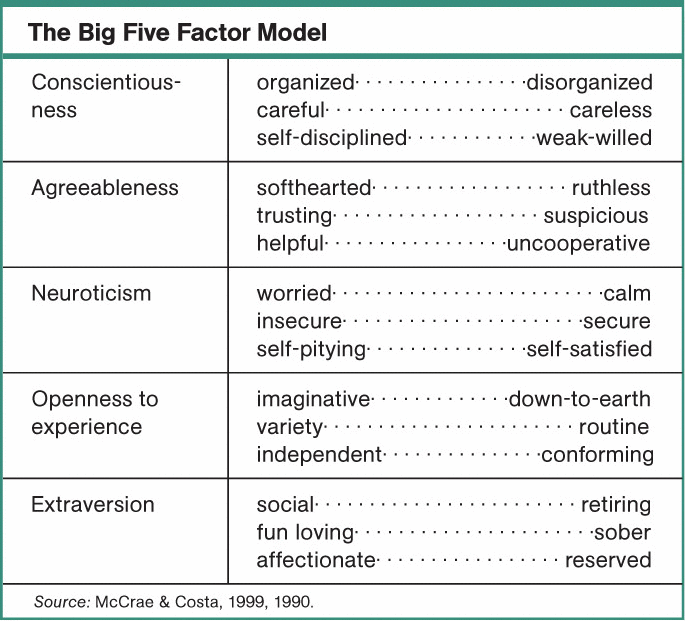
The Big Five
the traits of the five fator model: conscientiousness, agreeableness, neuroticism, openness to experience, and extraversion
- accounts for as much variation in personality as possible while avoiding overlapping traits
- the same five emerged in a large # of studies
- the basic five-facture structure may be universal
Psychodynamic Approach
personality is formed by needs, strivings, and desires largely operating outside of awareness - motives that can produce emtional disorders



-
Chapter 6: Memory68
-
Chapter 7: Learning45
-
Chapter 8: Emotion and Motivation41
-
Chapter 11: Development50
-
Chapter 9: Language and Thought25
-
Chapter 10: Intelligence16
-
Chapter 13: Social Psychology58
-
Chapter 12: Personality50
-
Chapter 14: Psychological Disorders41
-
Chapter 15: Treatment of Psychological Disorders28
-
Chapter 16: Stress and Health26



