Decision Making and the Brain
Pre Frontal Lobe damage
- people with this damage do not show emotional reactions during risky decision making
- Insensitivity to future consequencs
- Greater activation here in healthy individuals
- Similar effects in substance-dependent individuals (addicted to cocaine)
- do not show anticipatory SCR
Theoretical Reasoning
reasoning directed toward arriving at a belief
Sunk-Cost Fallacy
People make decisions about a current situation based on what they have previously invested in the situation
- example: $100 spent on ticket to concert plus waiting in line.
- unwilling to skip the concert even though it is cold and rainy outside and you will be miserable
Belief-Laden Reasoning
topic in which we already ahve an opinion on
- temporal lobe is activated
Insight
- there are brain differences between decciding based on insight compared to deciding based on analytical thinking
- Frontal lobe is important, but there is also a flash of acitivity in the parietal lobe during insight
- people who have a more positive emotional state have a greater insight to figuring out problems
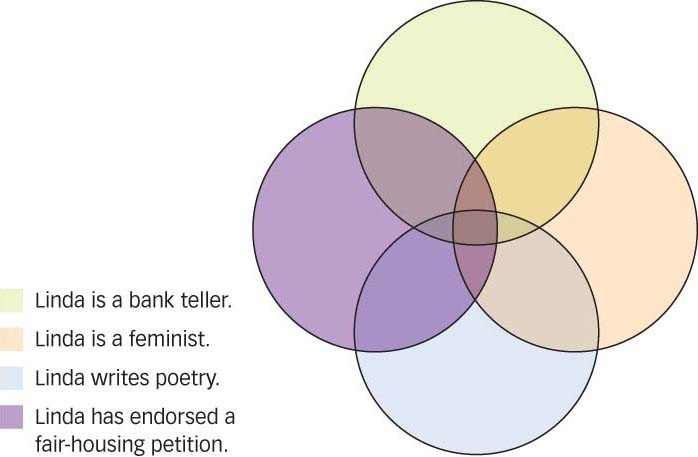
Conjunction Fallacy
people think that two events are more likely to occur together than either individual event
- Is she a bank teller or a bank teller and a women activist?
- If you are just worrying about one thing it is more accurate
Frequency Format Hypothesis
Our minds evolved to notice how frequently things occur, NOT how likely they are to occur
- We make decisions inaccurately if there is more probability
Reasoning
a mental activity that consists of organizing information or beliefs into a series of steps to reach conclusions
Syllogistic Reasoning
whether a conclusion follows from two statements that we assume to be true
Rational Choice Theory
We make decisions by determining how likely something is to happen, judging the value of the outcome, and then multiiplying the two
- ex. Suppose you were asked to choose between a 10% chance of gaining $500 and a 20% chance of gaining $2000. The rational person would choose the second alternative because the expected payoff is $400 ($2000 x 20%), whereas the first offers an expected gain of only $50 ($500 x 10%). Selecting the option with the highest expected value seems so straightforward that many economists accepted the basic ideas in rational choice theory
- ex. good at estimating frequency (10 out of 1000), but not probability (1% of the popuation)
Availability Bias
Items that are more readily available in memory are judged as having occurred more frequently
- ex. the list of names, some of the women were famous, none of the men were, you might have thought there were more women’s names than men’s
Belief Bias
people’s judgments about whether to accept conclusions depend more on how believable the conclusions are than on whether the arguments are logically valid
- less able to see flaws in conclusions if it is something that we already believe
Frequency vs. Probability
people are good at estimating frequency, but not probability
- ex. the doctor example with the mamograms and the cancer risks
Analogical Problem Solving
Solve a problem by finding a similar problem with a known solution and appying that solutino to the current problem
Practical Reasoning
figuring out what to do, or reasoning directed toward action
- Means-ends analysis is one example
- ex. figuring out how to get to a concert across town if you don’t have a car
- We are better at this kind of reasoning
Moral Thinking and Emotion
Bouncing back and forth between the frontal lobe and limbic system when the decision requires complex thought and not just emotion
- Anterior Cingulate
- fairly quickly to an emotional decision that someone needs to make
- helps make touch decisions
- ex. emotion lit up when thought about pushing guy in front of train
Belief-Neutral Reasoning
do not have any beliefs about the topic, just trying to figure out what to think about it
- Parietal lobe is activated
Anticipatory SCR (skin conductance response)
begin to have a response just by thinking about an action without actually performing it
Means-Ends Analysis
A process of searching for the means or steps to reduce the differences between the current situation and the desired
Framing Effects
People give different answers to the same problem dpending on how the problem is phrased (or framed)
- 70% effectiveness rate sounds good
- 30% ineffectivenss rate sounds bad
- How it’s though about and presented to you
Heuristics
fast and efficient strategies that may facilitate decision making but do not guarantee that a solution will be reached
- Mental shortcuts, or “rules of thumb”, that are often, but not always, effective when approaching a problem
- efficient way to organize info
Prospect Theory
people choose to take on risk when evaluating potential losses and avoid risks when evaluating potential gains
- Certainty Effect
- people simplify available information
- Expected Utility
- People choose the prospect with the best value
Algorithm
a well-defined sequence of procedures or rules that guarantees a solution to a problem
- ex. two approaches to constructing a PowerPoint presentation involving features you rarely use, such as inserting movies and complex animations: (1) You try to remember what you did the last time you tried to do a similar presentation; (2) you follow a set of step-by-step directions that you wrote down the last time you didsomething similar, which tells you exactly how to insert movies and build complex animations
Representativeness Heuristic
A probability judgment by comparing an object or event to a prototype of the object or event
- People ignored the fact that there were more engineers interviewed than lawyers and said the third person could be either, when the probability was much higher for that of an engineer.

-
Chapter 6: Memory68
-
Chapter 7: Learning45
-
Chapter 8: Emotion and Motivation41
-
Chapter 11: Development50
-
Chapter 9: Language and Thought25
-
Chapter 10: Intelligence16
-
Chapter 13: Social Psychology58
-
Chapter 12: Personality50
-
Chapter 14: Psychological Disorders41
-
Chapter 15: Treatment of Psychological Disorders28
-
Chapter 16: Stress and Health26



