Memory
The ability to store and retrieve information over time
(constructed not recorded; like a recipe)
Encoding
The process by which we transform what we perceive; think or feel into an enduring memory
(Like typing on a keyboard)
Storage
The process of maintaining information in memory over time
(Save it on a computer: long term memory)
Retrieval
The process of bringing to mind information that has been previously encoded and stored
(Retrieving document ==> goes back in storage)
Semantic Judgments
Requires participants to think about the meaning of the words
(Best way to remember)
Rhyme Judgement
Require participants to think about the sound of the words
(Middle best way to remember something)
Visual Judgement
Require participants to think about the appearance of the word
(“Worst” way to remember something)
Elaborative Encoding
The process of actively relating new information to knowlege that is already in memory
Brain Activity During Activity
Increased activity in lower left part of the frontal lobe and the inner part of the left temporal lobe
- More activity = more more likely memory
Visual imagery encoding
the process of storing new information by converting it into mental pictures
- You relate information to knowledge you already know
Organizational Encoding
The process of categorizing information according to the relationships among a series of items
Survival Recall
Survival recall resulted in high levels of recall them several other non-survial encoding tasks
Sensory Memory
holds sensory information for a few seconds or less
(3 seconds or less)
- unattended information is lost (forgetting)
Iconic Memory
A fast-decaying store of visual information
- Class Definition
- a transduced/encoded visual snapshot or “icon” and lasts <1 second
Echoic Memory
A fast decaying store of auditory information
(Lasts for several seconds)
- Class Definition
- to last for at least several seconds
Short Term Memory
Holds nonsensory information for more than a few seconds, but less than a minute
- Unrehearsed information is lost
- Maintenance rehearsal required
- Also refered to as the Working Memory
- typically holds up to 7 (+/- 2) items for up to 30 seconds
Three Part Working Memory
- Visuospatial sketchpad
- remembering something visually and spatially (taking people’s orders)
- Phonological rehearsal loop
- speech and auditory rehearsal
- Central Executive
- managing all the activites occurring in the STM (managing memory)
Rehearsal
The process of keeping information in short term memory by mentally repeating it
Chunking
Combining small pieces or information into larger clusters or chunks that are more easily held in STM
- helps consolidation of information into the LTM
Working memory
Long Term Memory
Hold information for hours, days, weeks, or years
- hippocampal region of the brain is critical for putting new information into the long term store
- some information may be lost over time
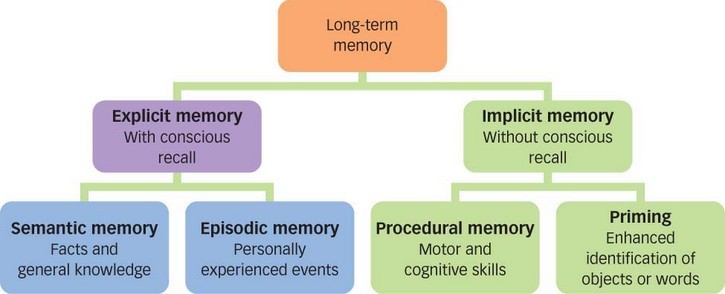
Multiple Forms of Memory
Explicit and implicit memories are distinct from each other. Thus, a person with amnesia may lose explicit memory yet display implicit memory for material that she or he cannot consciously recall learning.
Recall
intentionally bringing explicit information to awarenss (example: flashcards)
Recognition
encoding an input and matching it to a stored representation
(i.e. reading something over and over again)
(typically easier than recall)


-
Chapter 6: Memory68
-
Chapter 7: Learning45
-
Chapter 8: Emotion and Motivation41
-
Chapter 11: Development50
-
Chapter 9: Language and Thought25
-
Chapter 10: Intelligence16
-
Chapter 13: Social Psychology58
-
Chapter 12: Personality50
-
Chapter 14: Psychological Disorders41
-
Chapter 15: Treatment of Psychological Disorders28
-
Chapter 16: Stress and Health26



