spatial behavior
behaviors to guide our bodies through space
topographic memory
the ability to orient oneself to move through space
- derives from idea that movements take place between or in relation to points or objects that are spatially distinct such as the points of a map
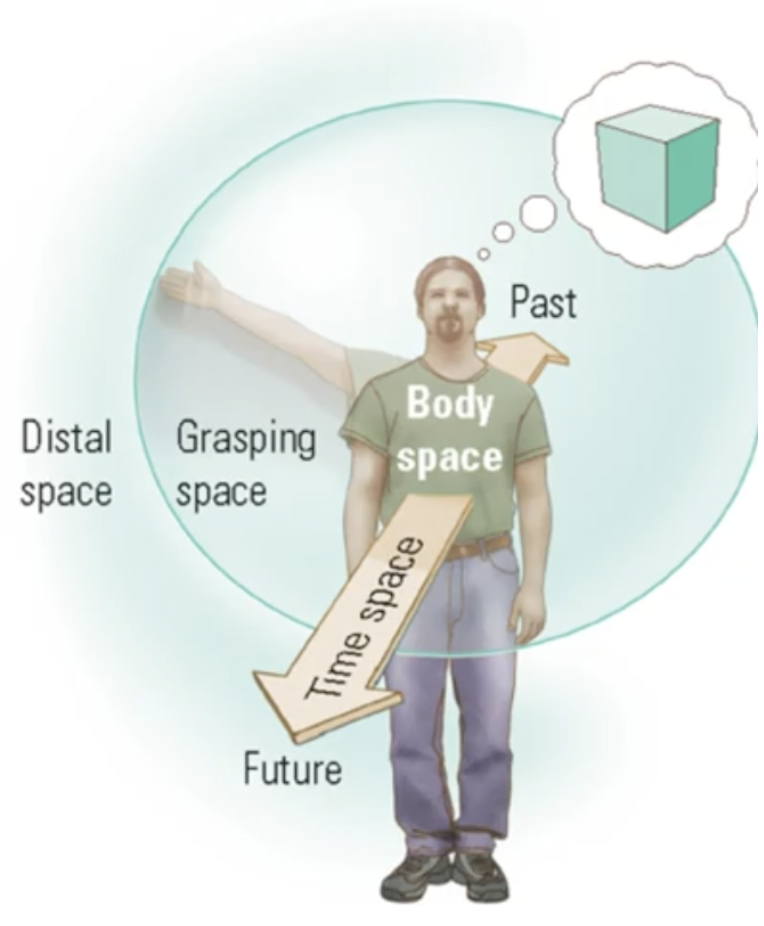
body space
clothes or contact with external objects can be localized
- perceptual impairments - affect body schema causing body disorientation and body neglect
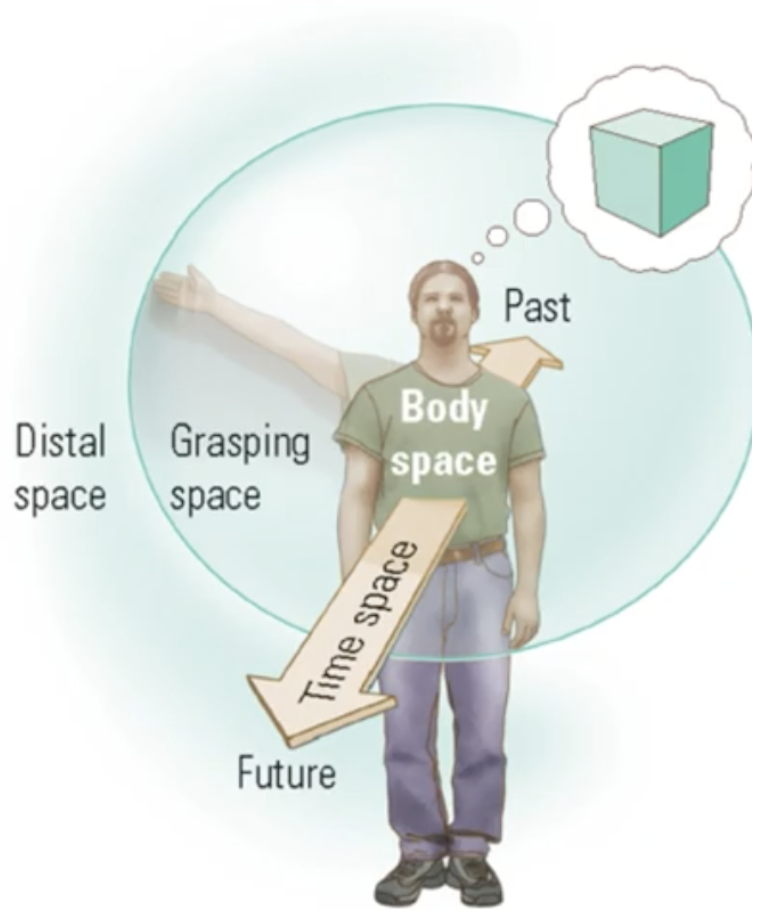
grasping space
surrounding the body, monitored by ventral visual field
distal space
body moves through, monitored by dorsal visual field
time space
alternating awareness - bind together the awareness of oneself as continuous entity through time
Topographic Disorientation
inability to orient oneself in relation to one’s environment, even in environments that are pretty familiar to them before the injury
topographic disorientation
deficits
- fails to recognize previously familiar individual landmarks
- can no longer compute the relationship between landmarks
- impaired in spatial guidance
types of topographic disorientation
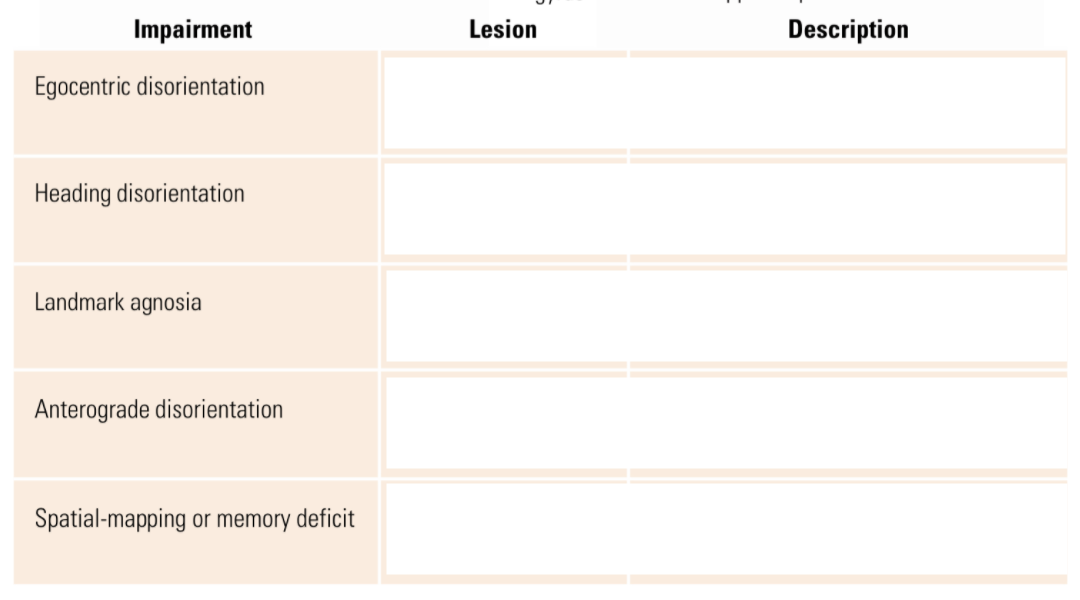
retrograde spatial amnesia, anterograde spatial amnesia, egocentric disorientation, heading disorientation, landmark agnosia, anterograde disorientation, spatial distortion deficits
retrograde spatial amnesia
inability to navigate in environments that were familiar before
anterograde spatial amnesia
- inability to navigate in novel environments
- but can navigate in environments that were familiar before
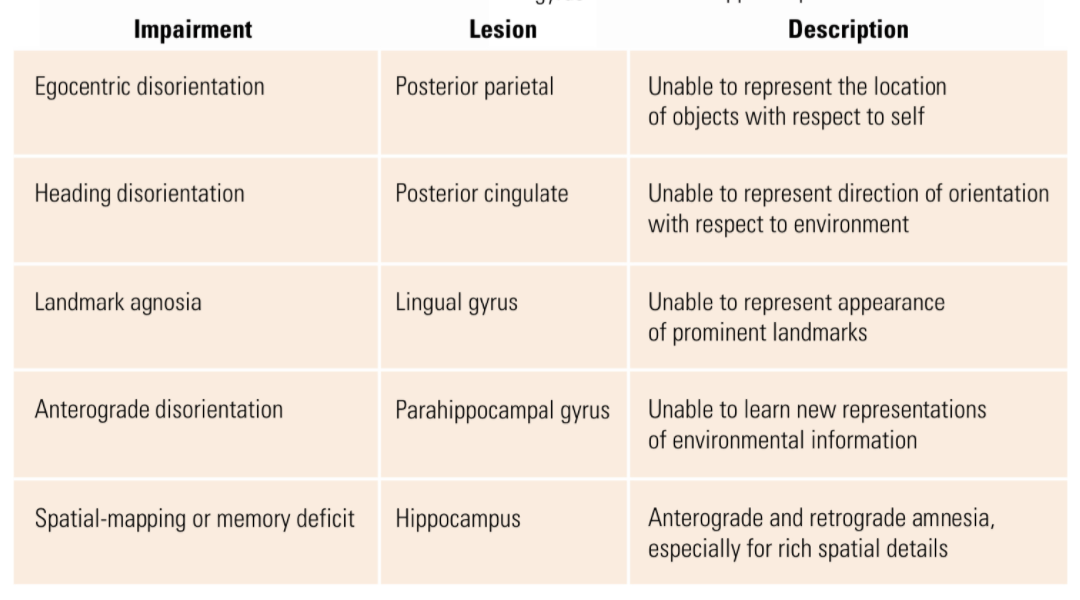
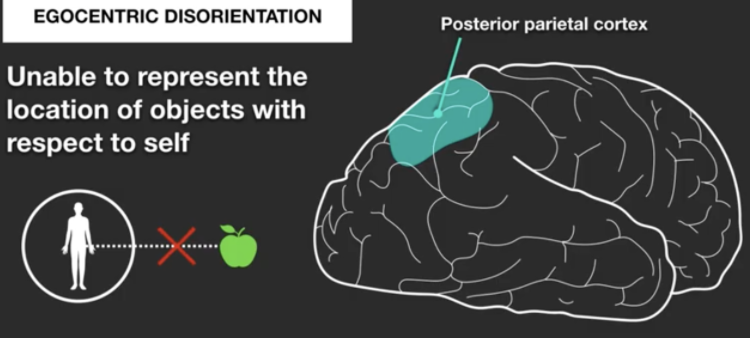
egocentric disorientation
unable to represent the location of objects with respect to self
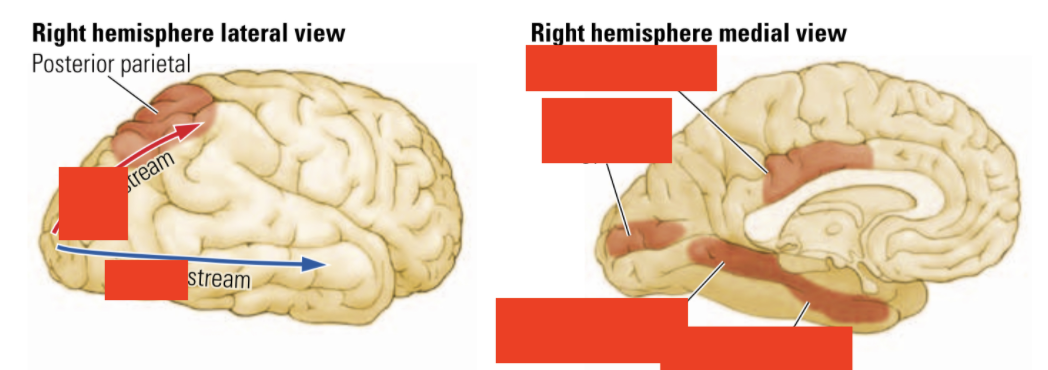
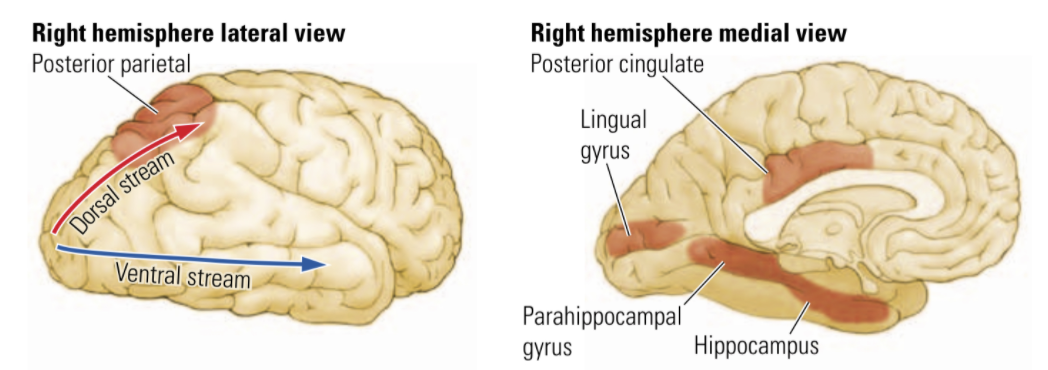
- have either unilateral or bilateral injuries in posterior parietal cortex
- can gesture towards objects as long as their eyes are open → ability is lost when eyes closed
- performance impaired during visual spatial tasks, including mental rotation (ability to visualize appearance of 3D objects from different perspectives) and ability to judge distances between objects
- impaired in wayfinding tasks both in formerly familiar and in novel environments
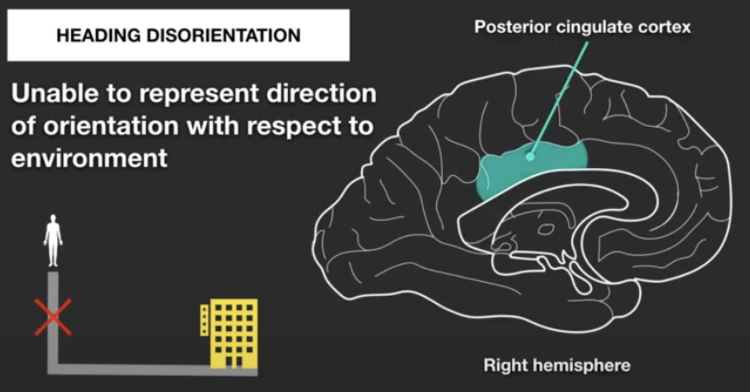
heading disorientation
unable to represent direction of orientation with respect to environment
- unable to set a course to where they want to go
- able to recognize landmarks, to recognize their own location in relation to those landmarks, and to describe where they are
- injury in the right posterior cingulate cortex
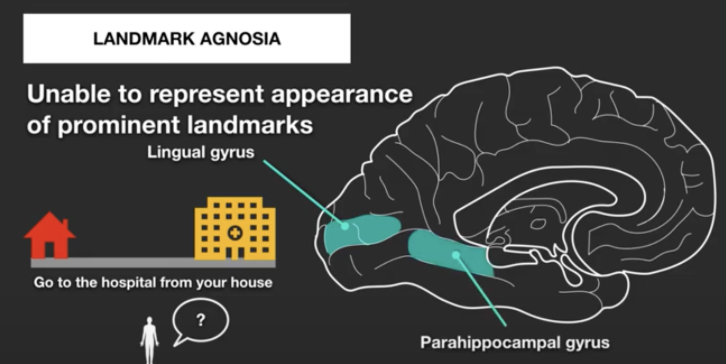
landmark agnosia
unable to use prominent environmental features to orient themselves
- can recognize churches, houses, and other landmarks so they do not have a deficit in perceiving environmental information
- cannot use a particular church or house to guide their movement
- lesion sites either bilateral or solely confined to the right side of the medial aspect of occipital lobe including the lingual and fusiform gyri as well as the parahippocampal gyrus
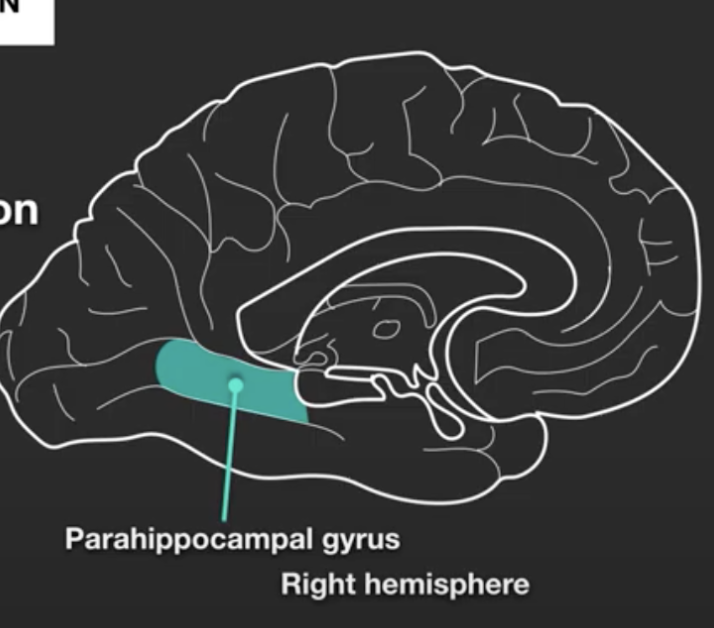
anterograde disorientation
unable to learn new representations of environmental information
- no problem navigating in formerly familiar environments but experience difficulty in novel environments
- inability to learn about unfamiliar objects by looking at them
- If shown a novel object they are not likely to be able to select it from an array of objects a short while later in contrast they are able to recall auditory and tactile information that is novel
- damage in the parahippocampal gyrus of the inferior ventral cortex on the right side
spatial distortion deficits
unable to perceive themselves accurately relative to the environment
- seeing themselves as too small or too large relative to their spatial world
- out-of-body experiences consisting of seeing themselves as occupying space at a distance from their body or imagining that they have more than one body
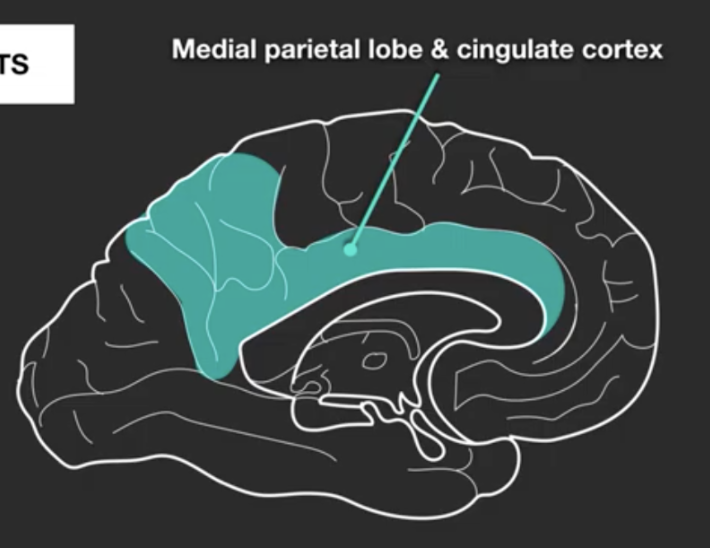
- damage to medial parietal lobe extending to the cingulate cortex
dual-stream theory
- starts in visual cortex
- what pathway: through the temporal lobes, identifies objects
- where pathway: projects through the parietal lobe, guides movement
- frontal lobe: synthesize what and where
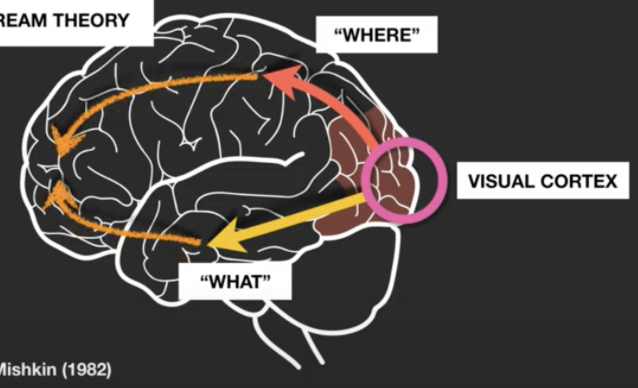
dual stream theory
what pathway
through the temporal lobes, identifies objects
dual stream theory
where pathway
projects through the parietal lobe, guides movement
dual stream theory
frontal lobe
synthesize what and where
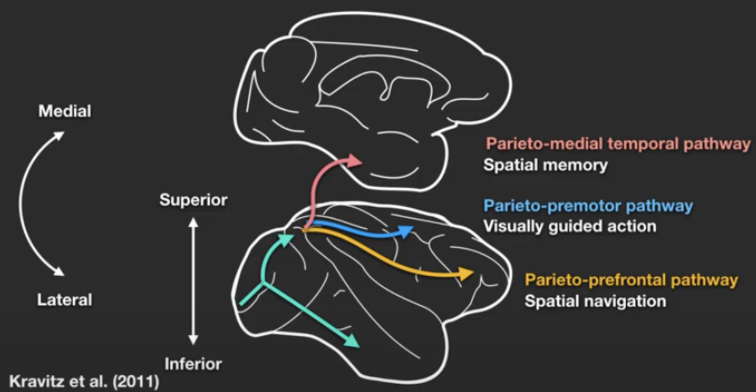
three dorsal stream targets theory
- Visual information enters a domain in parietal cortex that then sends projection to premotor cortex, prefrontal cortex, and the medial temporal lobe
- visually guided action (the premotor cortex)
- spatial navigation (the prefrontal cortex)
- spatial memory (the medial temporal lobe)