Chapter 41 Internal Fixation Flashcards

(69 cards)

1
Q

List 3 key features of headless compression screw

A
  1. Differential thread pitch –> interfragmentary compression
  2. Headless design allows implantation beneath bone surface
  3. Cannulated to allow for precise insertion using guide wire
  • Self-drilling/self-tapping,
  • Comprehensive portfolio: 2.0, 2.5, 3.0, 3.5, 4.0, 4.5, 5.5, 6.5, 7.5 mm
  • Titanium alloy (Ti-6Al-4V ELI)
  • Short and long thread lengths for treating a wide range of anatomical regions
  • Sterile and non-sterile packaging options
  • Color-coded instrumentation
  • Modular sets for flexibility
2
Q

List the 4 forces to be considered in fracture repair

A
  • Compression
  • Tension
  • Bending
  • Rotation
3
Q

List 4 principles of biological osteosynthesis

A
  1. Indirect fracture reduction using limited surgical approaches
  2. Stabilisation using bridgingimplant rather than anatomic reconstruction and rigid fixation
  3. Limited reliance on internal secondary implants (cerclage, lag etc)
  4. Limited (if any) use of bone grafts
4
Q

List primary and secondary fracture fixation implants

A

Primary:

  • Plate
  • IM pin
  • ILN
  • ESF

Secondary:

  • Cerclage
  • K-wires
  • Lag screws
5
Q

What is the formula for tensile strength of a wire?

A

πr2

6
Q

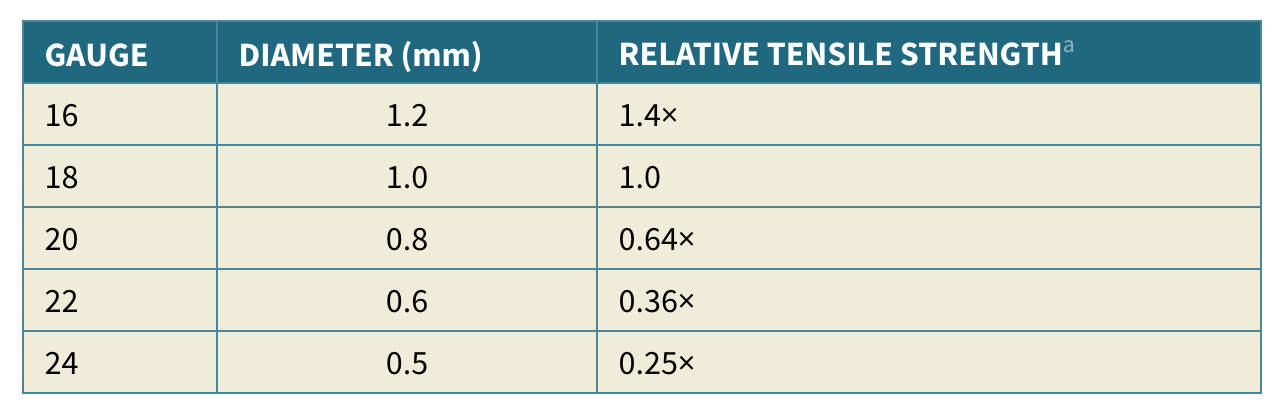
Relative to the tensile strenght of a 1.0mm wire, what is the strength of a 0.8mm wire?

And 1.2?

A
  1. 8mm –> 0.64 x strength of 1.0mm wire
  2. 2mm –> 1.4 x strength of 1.0mm wire
7
Q

Name two techniques for securing cerclage wire oblique to bone axis

A

Skewer pin or notch in cortex

8
Q

What is purpose of hemi-cerclage?

A

Improved alignment (only resists bending in one plane)

9
Q

How many twists must be left on cerclage wire afetr twist knot?

A

1 to maintain tension but advise 3

10
Q

Name 4 cerclage wire ‘configurations’

A
  • Twist
  • Single loop
  • Double loop
  • Cable + crimp cerclage
11
Q

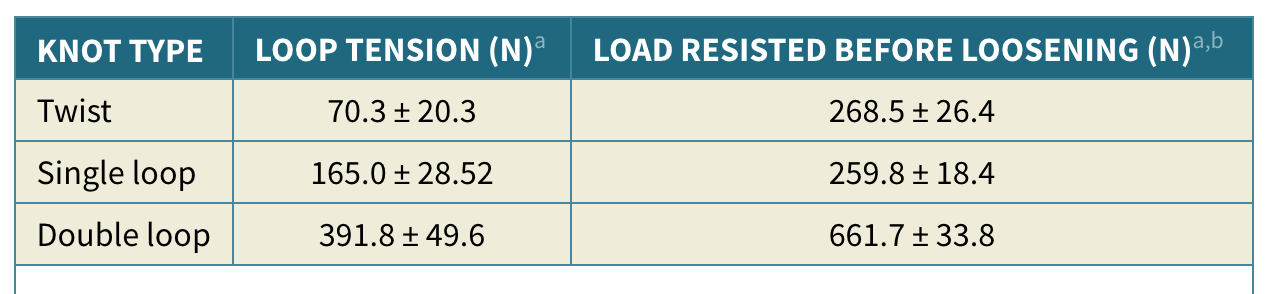
How does load resistance differ between twist, single loop vs double loop cerclage wire?

A
  • Similar load resisted between twist vs single loop (approx 260N), althoguh single loop achieved higher initial tension (165N vs 70N).
  • Double loop –> higher initial tension (390N) and higher load resisted (660N)
12
Q

What % reduction in resting load was noted when cerclage wire twist was bent over?

A

45-90%

i.e. they recommend keep straight and cut short rather than bending

13
Q

What % reduction on bone diameter –> resting tension of cerclage wire <30N?

A

1%!

i.e. if fragments move at all, cerclage becomes ineffective

14
Q

What is recommended fracture legth:bone diameter ration for application of cerclage wire?

A

Fracture x 2.5-3 lenght of bone diameter

15
Q

What is recommended distance between cerclage wires?

A

Half bone diameter

16
Q

Above what diameter are k-wires called steinmann pins

A

1.6mm

17
Q

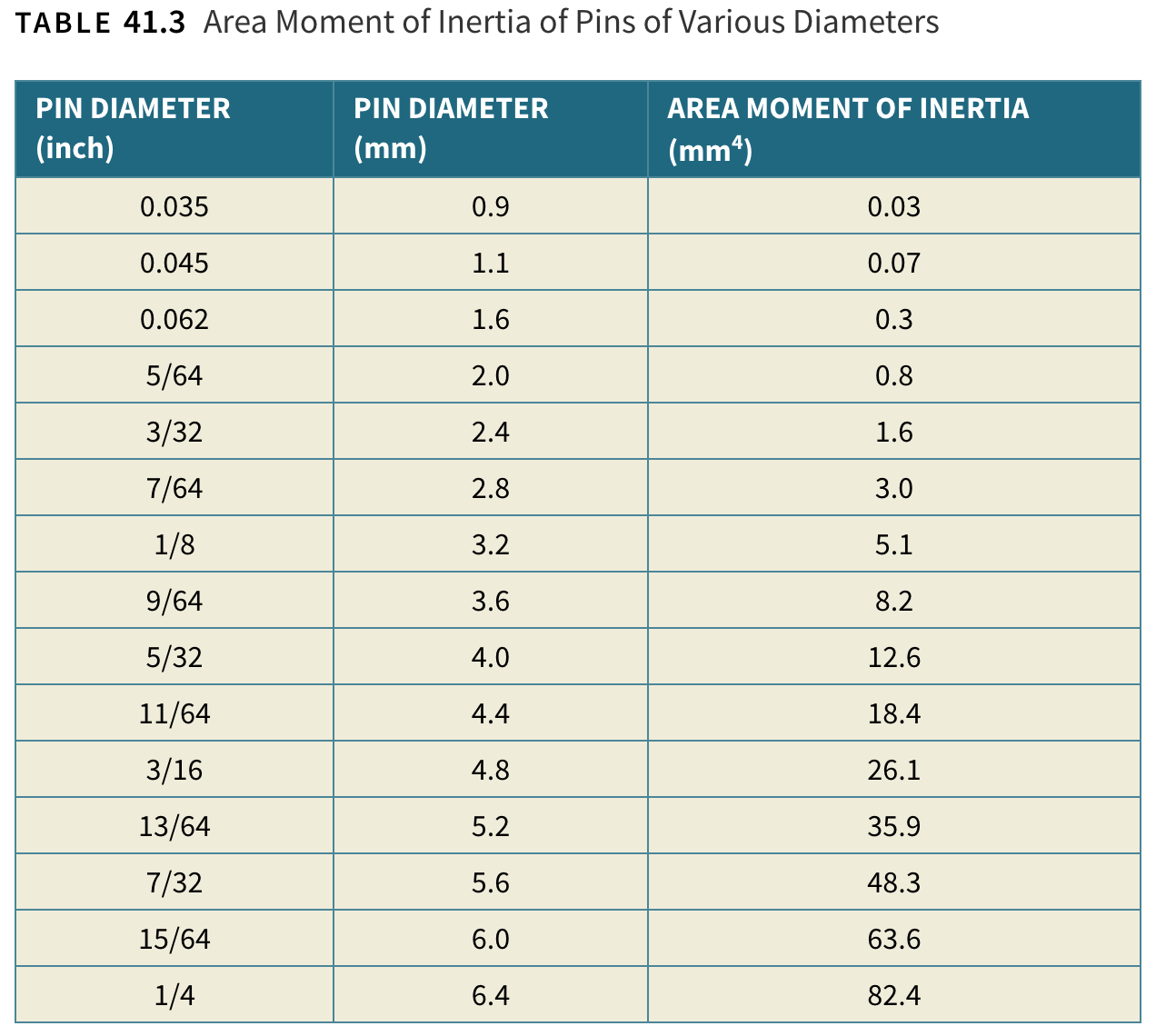
How does area moment of inertia relate to radius of a cylinder?

A

r4

N.B. Uses r4, doesnt equal r4

18
Q

What is area moment of inertia of 1.1mm pin vs 2.0 mm pin?

A
  1. 1 mm = 0.07 mm4
  2. 0 mm = 0.8 mm4
19
Q

When IM pin is only intramedullary device, what is recommeded size?

A

>70% medullary diameter

20
Q

What is more stable rush pins (dynamic crossed pins) or conventional cross pins?

A

Conventional

21
Q

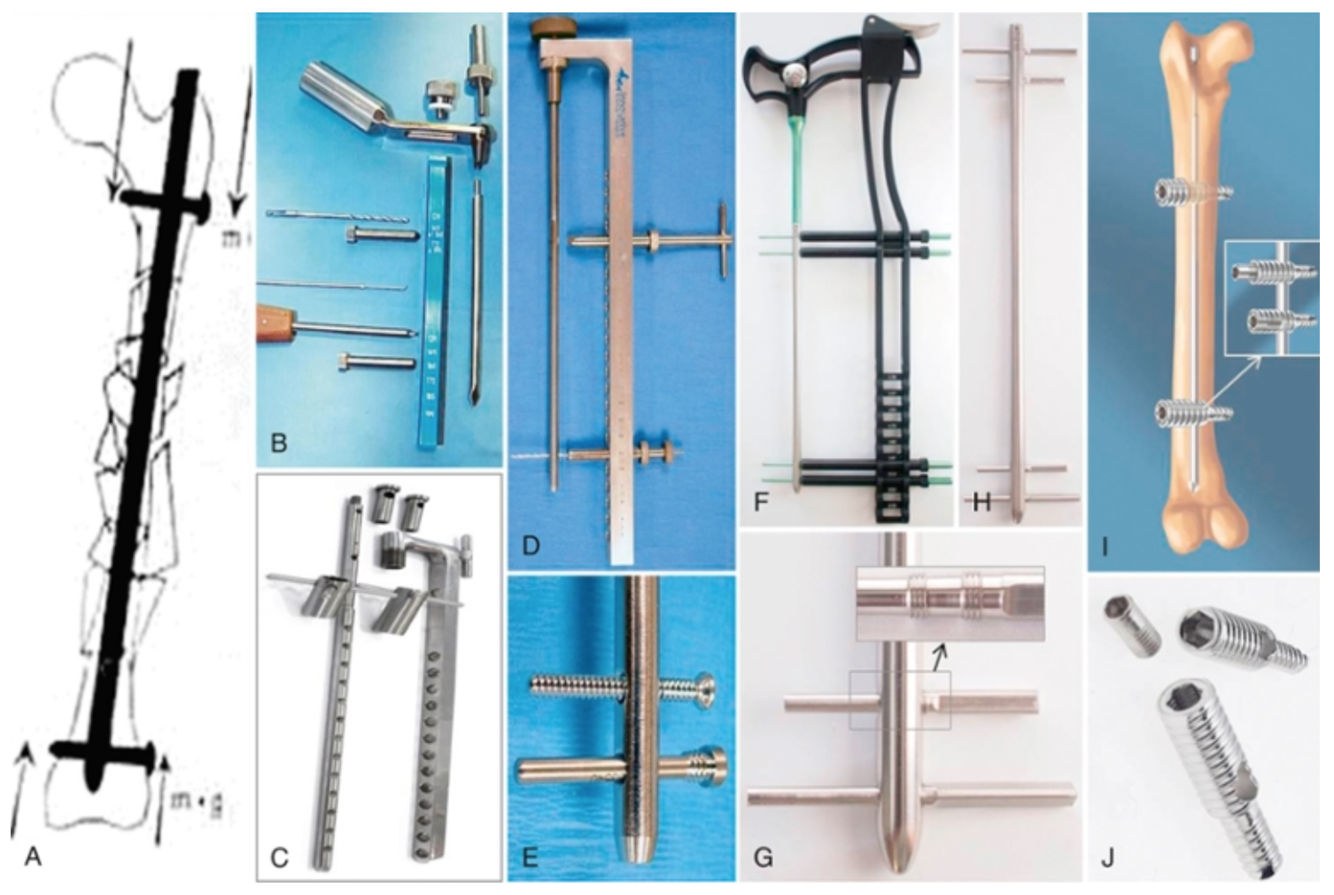
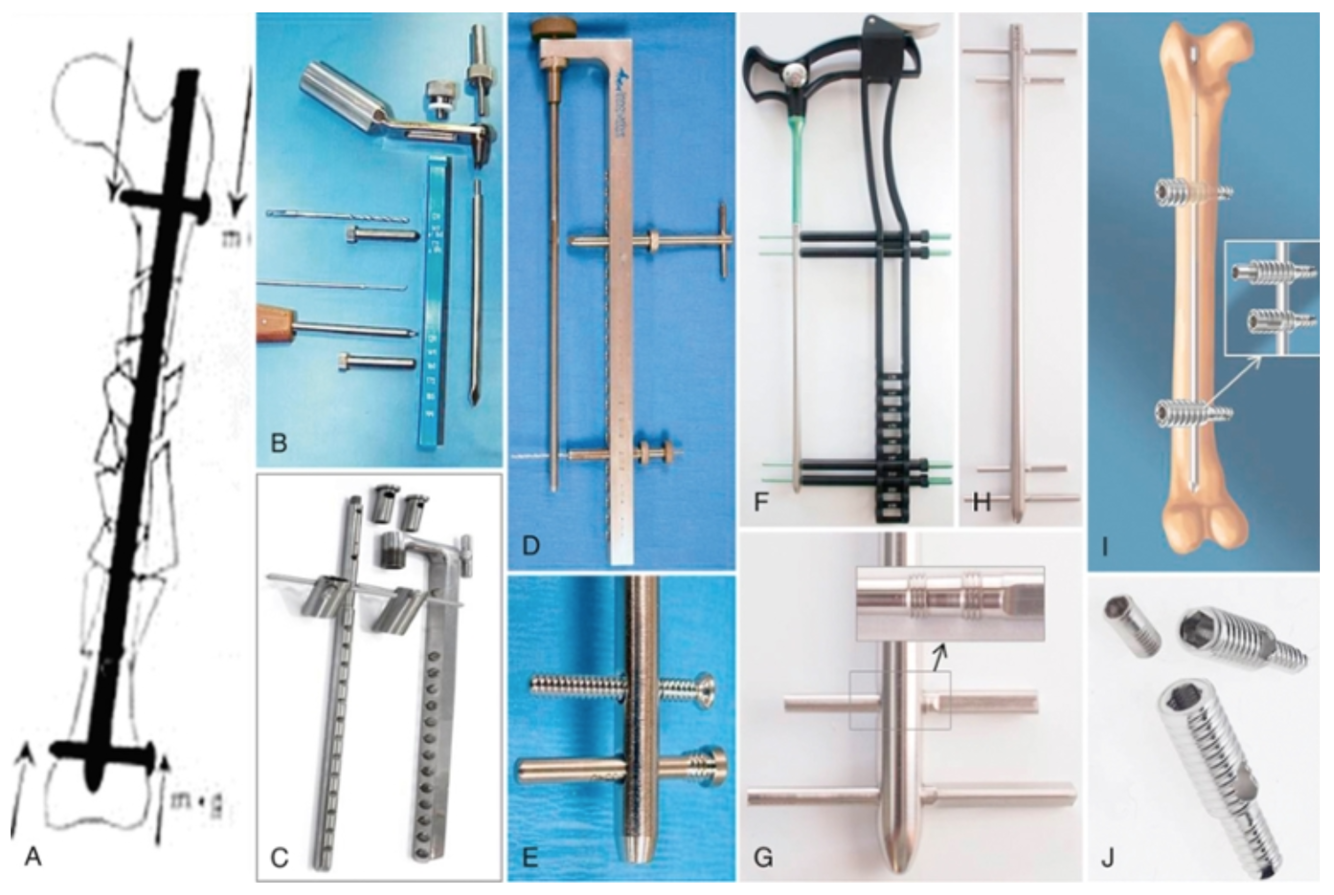
Nme the ILN types:

D + E

F + G

I + J

A

D + E: Regular ILN

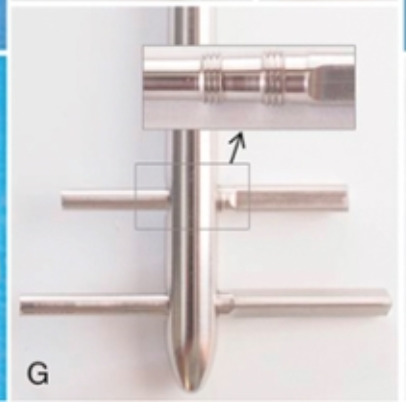
F + G: angle stable ILN (iLoc)

I + J: Inverse ILN (Targon)
22
Q

How is inverse ILN secured?

What is recommended torque?

A

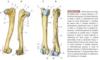
With a ‘set screw”

1.8 Nm torque

23
Q

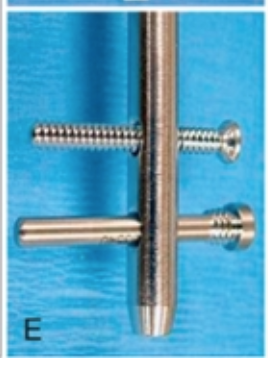
HOw do bolts of regular ILN engage bone?

A

Threaded portion near head of bolt engages cortex

(Image shows regular ILN screw and bolt, bolts recommended)
24
Q

What is the locking mechanism of angle stable ILN/bolts?

A
  • Threaded tapered bolts screw into shape matched threaded cannulations in nail (provides rigid nail/bolt interface so cortical threads abolished)
  • Morse taper locking screws-cone peg
25
List biomechanical advantages of agle stable ILN compared to conventional bone plates
1. Along neutral axis of bone so not subjected to large bending moments 2. Large area moment of inertia (*uses* r4) 3. Locking mechanism provides stability in torsion and compression 4. Im location mens no failure by screw pullout
26
How have ILNs evolved since first generation?
* Smaller cannulation holes to prevent bending of nail * Bolt rather than screw (to reduced risk of screw/bolt bending. Bolt has larger diameter i.e. greater area moment of inertia) * Improved bolt/nail contact --\> better stability
27
What is recommended size of angle-stable ILN?
75% medullary canal width at isthmus (70-90%)
28
How does core screw diameter compare with drill hole for cortex screws? And locking screws?
Core diameter of cortical screw is 0.1mm smaller than drill hole Core diameter of locking screw is 0.1mm larger than drill hole
29
What was the main biomechanical problem with regular ILN? What was it attributed to?
rotational instability i.e **slack** (up to 33º slack) reported with cortical screws + regular ILN Attributed to nail hole/screw diameter mismatch and screw head/nail hole deformation
30
What is reported non-healing rate of second gen regular ILN?
14% attributed to slack
31
List 4 methods used in regular ILN to increase stability
1. Bolts rather than screws 2. Placement of pin in addition to ILN 3. Excessive angling of screws 4. Incorporation of ILN bolts into ESF 5. (at least one bolt placed into metaphyseal bone)
32
In addition to the locking mechanism/angle stable part, name another advantage of angle-stable ILN
* Hourglass shape --\> thicker ends --\> increased area moment of inertia --\> allows placement of larger diameter bolts without risk of nail bending at bolt hole. * Hourglass shape also allows increased vascularity of diaphysis
33
What is the difference between static and dynamic ILN fixation?
Static = locking devices in both fragments Dynamic = locking devise in only one fragment (only do this if fracture configuration allows axial load sharing. Provides minimal resistance to rotation)
34
In experimental ostectomy study of regular ILN vs angle-stable ILN, how did tr=orsional peak torque (post-mortem) compare
Angle stable ILn --\> 77% higher torsional peak torque (lower lameness scores too)
35
In additon to appropriate sizing, what other step increases bending stability ILN?
Embedding in metaphyseal and epiphyseal cancellous bone
36
List 5 basic steps of ILN insertion
1. Pin insertion site created with drill/steinman pin 2. ILN connected to extension piece 3. Controled impaction 4. Alignment guide applied 5. Place proximal locking device first, then distal
37
What is recommended distance from fracture to closest LN bolt?
1 - 2 bone diameters away (if angle stable, x1 bone diameter away ok)
38
To what level should femoral ILn be seated and why?
Not proximal to trochanter to avoid sciatic nerve damage, but protrucing a little to facilitate removal if necessary
39
What is entry point for tibial ILN?
* Just cranial to intermeniscal ligament in sagittalplane * Halfway between tibial tuberosity and medial collateral in frontal plant
40
What consideration re ILN size has to be taken into account for tibia
Sigmoid shape necessitates placement of smaller nail
41
What is ILN entry point in humerus?
At junction of **greater tubercle** and **crest of greater tubercle**
42
List 2 recommendations re ILN placement in proximal humerus
* Distal to greater tubercle * Distal or caudal to tricipital line
43
What was median healing time in small animals treated with ILN?
6 weeks (vs 8 weeks with reconstruction + plates) 5 weeks in angle-stable ILN
44
How did major complication rate of angle stable ILN compare with regular ILN?
* No major complications with angle stable ILN * 17% major complications in regular ILN cases
45
HOw do cortical screws differ from cancellous screws
_Cortical:_ * Smaller pitch * Less thread depth (locking screws even smaller pitch and thread depth --\> less need to resist pull out and greater area moment of inertia --\> increased resistance to bending).
46
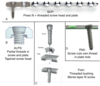
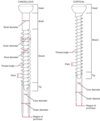
What is the locking machanism of the following screws: LCP SOP ALPS Fixin PAX
* LCP: * Screw heads engage similar pitch in plate * SOP: * Press fit screw head * Partial threads in plate hole * ALPS: * Tapered screw head * Partial threads in plate hole * Fixin: * Threaded titanium bushing * Morse taper fit screw head * PAX: * Ridges in titanium plate. Screw cuts a path into the ridges -- unique feature in that screw does not have to be perpendicular to plate as with othe locking screws - PAX screw can be angled up to 10º
47
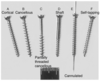
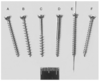
Name the 6 screw types
48
What two factors determine pullout strength of screw
* Outer diameter * Strength of material it is placed in
49
What is optimal screw tightness?
70% of stripping torque
50
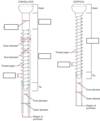
Label the diagram:
51
HOw does 3.5mm broad plate compare to other plate?
Is 4.5mm plate bar stock but smaller screw holes --\> 3.5mm broad stonger as smaller holes --\> more screws/unit length --\> but more difficult to contour
52
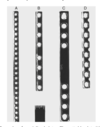
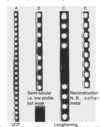
Label the plate types
53
List 2 differences between DCP and LC-DCP
LC-DCP: * Scalloped undersurface * Little stress concentration at screw hole * Reduced periosteal contact --\> improved vascularity * Countouring can be bent across entire length (rather than at screw holes) * Undersurface of each screw hole is more rounded to allow greater degree of screw angulation
54
Biomechanically speaking, why does transcortical coontact with plate fixation reduce likelihood of plate failure
If transcortex is in contact then area moment of inertia of bone and plate *together* is significantly increased and bending forces reduced.
55
Why are cortical screws more susceptible to screw pull-out than locking screws?
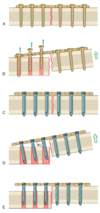
Pull-out of standard screws and locking head screws. A, Fixation with cortex screws. B, With conventional plating, if axial load exceeds the frictional force between the plate and the bone, plate loosening occurs, and **screws are subject to an axial pull-out force and to sequential screw loosening.** C, Fixation with locking head screws. **(Shear stress is converted to compressing stress at screw-bone interface, Cortical bone much more resistant to compressive stress than shear.)** D and E, F**ailure of the locking system requires concurrent axial pull-out of all implants** or compressive failure of the bone surrounding the screws. The force or **load required to cause failure of the bone or of all screws greatly exceeds that required to cause failure in a sequential fashion.** see p. 679 for more detailed description
56
What is the weakest part of cortical screw/plate construct?
Interface between bone and screw.
57
What are the 4 guidelines for bridging plate osteosynthesis
1. Spanning long segements of bone (x3 length of fractured segment) 2. Screw:hole ratio \<0.5 3. Limit distance between plate and bone to ≤2mm 4. Leave at least 2-3 screw holes empty over fracture...debatable as less stiff but less string construct
58
List 3 methods to make a construct stiffer
Remeber compliance formula... Larger plate (or plate with different elastic modulus...) Reduce working length Add implants e.g. Im pin, stacked plates
59
Where is stress riser in LCP construct?
Plate-screw interface (i.e. not bone-screw interface, so locking implants good where quality of bone is poor)
60
How many screws/fragment for maximum axial stiffness? And rotational stability?
3/fragment (one far and one close to fracture) 4 for rotational
61
What is the clinical relevance of stardrive head of LCP locking screw?
Allows 65% greater insertional torque
62
Define a buttress plate
Buttress plating is a term used for plates that are applied to shore up trans-cortical defects within metaphyseal regions (like a retaining wall). **The term buttress plating is reserved for a plate that negates compression and shear forces within the metaphyseal region.** The plate is anchored to the main stable fragment and contoured to the smaller metaphyseal fragment to minimize displacement of the smaller fragment.
63
In what age is elastic plate osteosynthesis an option
\<5-6 months
64
In a cas serioes of elastic plate osteosynthesis, by what time had clinical union occured? And complete union?
4 weeks clinical union 4 months complete union
65
What is most common complication of MIO?
Fracture malalignment
66
How was plate strain affected by increasing size of IM rod?
Each 10% increase in rod size --\> 20% reduced plate strain
67
When used as plate rod construct, what size shoudl IM pin be?
35 - 40% medullary canal at isthmus
68
What is recommended minimum number of screws/fragment when using locking screws?
1 bicortical and 1 monocortical
69
What is the composition of 316L stainless steel?
63% iron 19% chromium 14% nickel 3% sulfur 3% Mylobdenum 3% Manganese LOW CARBON rough values