Name 4 (most common) sites of OCD lesions in dogs and 2 in cats
Dogs:
- Medial humeral condyle
- Humeral head
- Medial and lateral talar ridge (usually medial, Rotties lateral)
- Femoral condyles (med or lat, ?lat more common)
Cats:
- Lateral femoral condyle
- Caudocentral humeral head
OCD sex predisposition?
Male (except talus = female)
What is the proportion of growth from physis vs epiphysis?
75% physis, 25% epiphysis
What are the three stages of OCD?
- Osteochondrosis latens* (early, microscopic lesion)
- Osteochondrosis manifesta* (macroscopically and radiographically apparent)
- Osteochondrosis dissscans* (cartilage flap present, usually clinical signs)
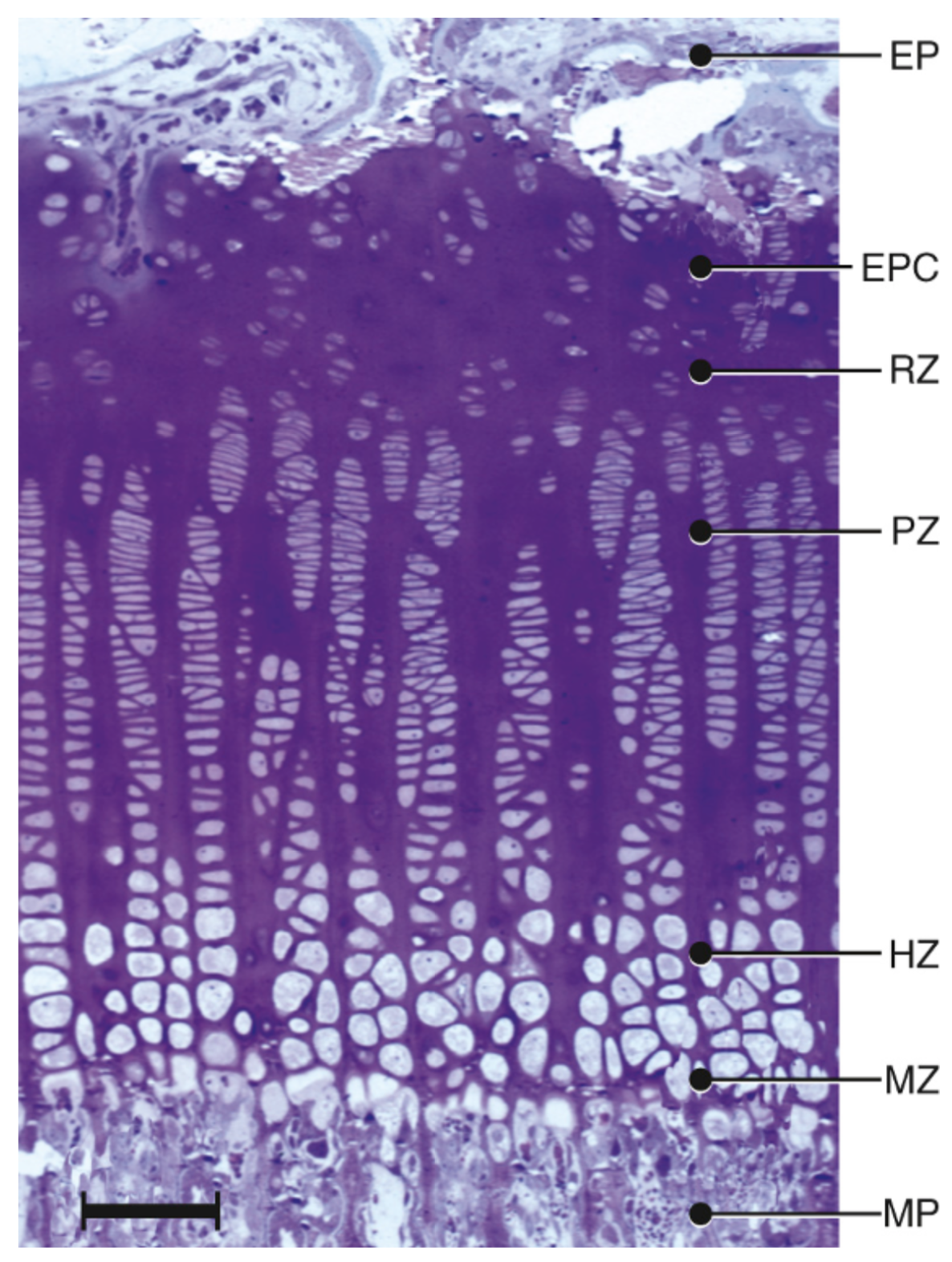
What are the four zones of endochondral ossification?
Resting zone
Proliferation zone
Hypertrophic zone
Mineralisation zone
What is Heuter-Volkman law?
Growth retarded by compression accelerated by reduced loading (ie more growth when recumbent)
Name of “thing” limiting circumferential expansion of growth plate:
Ring of Lacroix
Briefly describe the progression from chondrocytes to mature bone:
- Chondrocytes in mineralization zone secrete/maintain mineralized matrix
- Chondrocytes apoptose, removed by clasts.
- Metaphyseal vasculature and osteoprogenitor cells invade empty lacunae.
- Osteoblasts lay down woven bone (primary spongiosa)
- Calcified cartilage and woven bone replaced by lamellar bone.
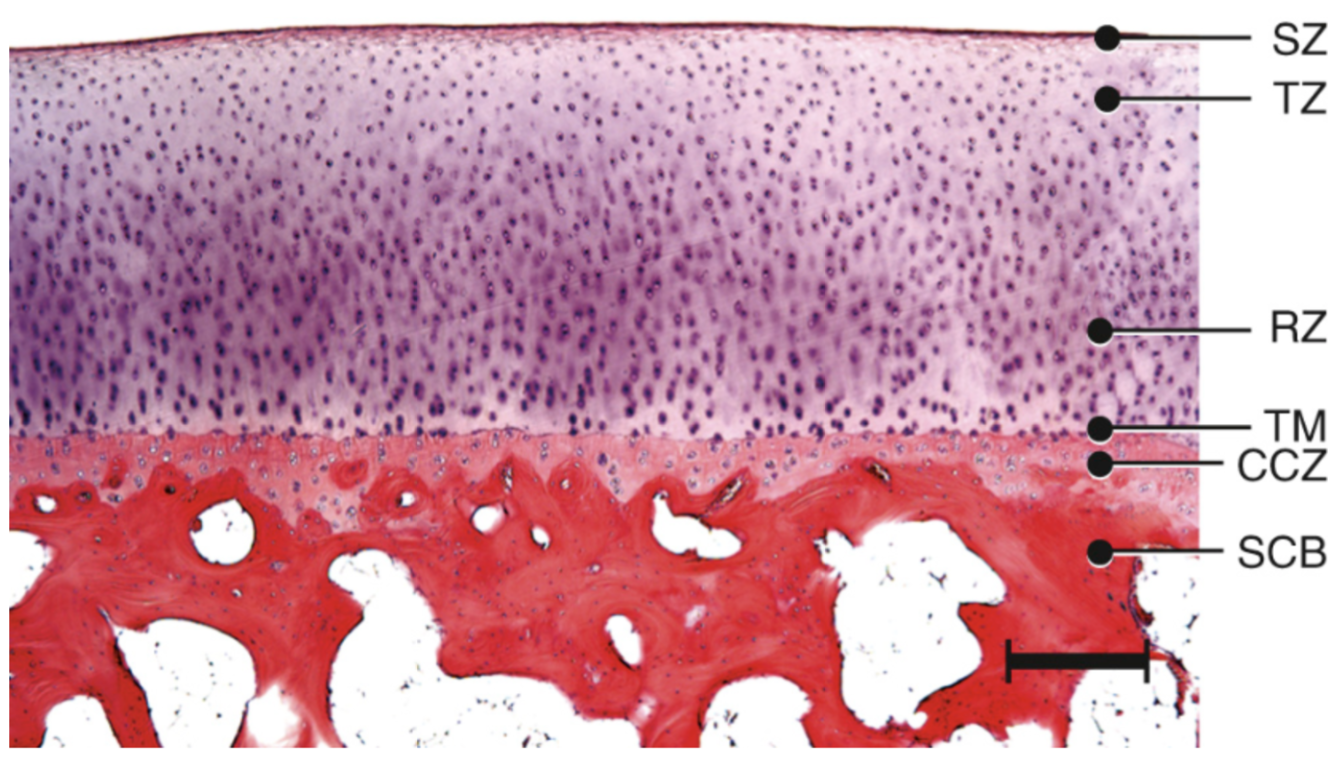
Outline the zones of mature articular cartilage:
- Superficial zone
- Tranzitional zone
- Radial zone
- “Tidemark” (separates uncalcified radial zone and zone of calcified cartilage)
- Calcified cartilage zone
- (Subchondral bone)
List reparative and restorative techniques for OCD
(Palliative = fragment removal + lavage)
Reparative:
- Abrasion
- Curettage
- Micropick
- Forage
- Spongialization
Restorative:
- Fragment re-attachment
- Osteochondral transplant
- Synthetic osteochondral re-surfacing

-
Chapter 38 Tissues of MSK System28
-
Chapter 39 Bone Biomechanics and Fracture Biology38
-
Chapter 40 Open Fractures4
-
Chapter 41 Internal Fixation69
-
Chapter 42 ESF28
-
Chapter 43 Overview of MIO16
-
Chapter 45 Delayed Unions, Non-unions and Malunions5
-
Chapter 46 Principles of Angular Limb Deformity Correction29
-
Chapter 47 Osteomyelitis and Implant-Associated Infections13
-
Chapter 48 Bone Grafts and Substitutes47
-
Chapter 49 Scapula Fractures19
-
Chapter 50 The Shoulder80
-
Chapter 51 Fractures of the Humerus32
-
Chapter 52 Surgical Diseases of the Elbow102
-
Chapter 53 Total Elbow Replacement in Dogs15
-
Chapter 54 Radius and Ulna46
-
Chapter 55 Carpus, Metacarpus and Digits55
-
Chapter 56 Fractures of the Pelvis32
-
Chapter 57 Hip Luxation25
-
Chapter 58 Pathogenesis, Diagnosis, and Control of Canine Hip Dysplasia24
-
Chapter 59 Surgical management of Hip Dysplasia78
-
Chapter 60 Fractures of the Femur86
-
Chapter 61 Stifle STAR WORTHY QUESTIONS ONLY6
-
Chapter 62 Total Knee Replacement in the Dog17
-
Chapter 63 Fractures of Tibia and Fibula19
-
Chapter 64 Tarsus and Metatarsus49
-
Chapter 65 Amputations22
-
Chapter 66 Dentistry for the Surgeon33
-
Chapter 67 Mandibular and Maxillofacial Fractures40
-
Chapter 68 Arthritis42
-
Chapter 69 Misc Ortho Conditions70
-
Chapter 70 Muscle and Tendon Disorders17
-
Chapter 71 Arthroscopy50
-
Chapter 72 Musculoskeletal Neoplasia and Limb Sparing Surgery83
-
Chapter 73 OCD10



