LO: understand the common causes of chronic headache disorder
What are the common causes of chronic headache?
- Migraine
- Tension headache
- Cluster headache
- Trigeminal neuralgia
- Medication/ analgesic headache
- sinusitis
Pathophysiology of migraine?
- Primarily neurogenic rather than vascular basis
- spreading cortical depression - wave of neuronal depolarisation followed by depressed activity that slowly spreads anteriorly across cerebral cortex from occipital region = basis of migraine with aura
- activation of trigeminal pain neurones = basis of headache
- innervation of large intracranial vessels and dura by opthalmic division of trigeminal nerve –> get release of vasoactive peptides that cause painful meningeal inflammation and vasodilation
- sensitisation of trigeminal neurones and brainstem pain pathway makes innocuous sensory stimuli (e.g. head movement/ CSF pulsation) seem painful
Classification of migraine?
- Migraine without aura:
- Typically starts around puberty w increasing prevalence into 4th decase
- Attacks have recognisable core features
- Sufficient severity to prevent ADL’s
- sleep helps, washed out feeling follows attack
- scalp may be tender to touch during episodes (allodynia) and preference is to be in dark quiet environement
- Migrain with aura:
- 25% migraine suffers –> focal neurological symptoms preceding headache
- Aura evolves over 5-20 mins, symptoms changing as wave of neuronal depression spreads
- Visual aura most common –> shimmering, zigzag lines (teichopsia), fragmentation of image, patches of lost vision, can evolve to hemianopia.
- Positive sensory symptoms –> e.g. tingling, dysphasia, rarely loss of motor function
- migraine related dizziness –> can last hours, overlap w a poorly define migraine subtype called basilar migraine that presents with brainstem sx (perioral paraesthesia, diplopia, unsteadiness, reduced conciousness).
- Hemiplegic migraine –> autosomal dominant disorder –> causes hemiparesis/ coma w headache, recovery 24 hrs. May have permanent cerebellar signs –> allelic w episodic ataxia.
Diagnostic criteria for migraine?
Headache lasting 4 hours to 3 days
With at least two of:
- Unilateral pain (may become holocranial later in attack)
- throbbing type pain
- moderate to severe intensity
- motion sensitivity (headache made worse with head movement or physical activity)
- decreased ability to function
At least one of:
- Nausea and vomiting
- Photophobia / phonphobia (senstivity to loud sounds)
- Normal examination and no other cause of headache
What are the risk factors/ triggers of migraine?
- Fhx of migraine –> some autosomal dominant disorder
- high caffiene intake –> increased risk migraine, chronic migraine and chronic daily headache
- female sex –> more likely to have migraines, some experience menstrual migraine –> occurs 2 days prior up to first 3 days of period
- obesity
- stressful life events
- overuse of headache medications
- sleep disorder –> e.g. insomnia, obstructive sleep apnoea, restless legs/ smoring, narcolepsy
- exposure to change in barometric pressure (high altitude and weather changes can cause drop in barometric pressure –> thought to be a trigger for migraines)
What is the management for chronic migraine?
- General –> explanation of migraine, avoidance of triggers and lifestyle modication where possible
- Regular meals/ sleep pattern/ hydration/ regular exercise/ identify and avoid triggers
- Acute attack:
- Analgesia --> high dose aspirin (990mg), paracetamol (1g) or NSAID (250-500mg)
- PLUS antiemetic –> Metoclopramide
- Triptans (5HT 1B/1D agonists ) are specific for migraine
- Sumatriptan
- CGRP antagonists –> telcagepant
- Chronic management: Prophylaxis
- When episodes > 1-2 per month / impact on QOL –> offer migration suppression medication
- Ensure to explain analgesia overuse induced migraines
- Anticonvulsants –> valproate or topiramate most effective (note valproate NOT in women of childbearing age- teratogenic effects!)
- BB –> propanolol (1st line)
- Tricyclics –> amitryptiline (1st line)
- Botulinum toxin – > injections into scalp / neck repeated every 3 months
- Pizotifen (Inhibiting peripheral actions of histamine/5HT, altering pain thresholds)
- In MENSTRUAL migraines –> hormonal therapy to suppress menses, NOTE COCP Contraindicated –> Increased risk of cerebrovascular events
Pathophysiology:
Tension headache?
Key determining features?
- Pathogenesis unclear but overlap with migraine –> thought could represent mild migraine. As w migraine release and activation of inflammatory agents which sensitises peripheral trigeminal afferents + central hypersensitivity.
- In TTH –> though major nociceptor = pericranial musculature (vs migraine where it is blood vessels and meningeal nociceptors)
- Differentiating features:
- Mild - moderate pain (vs severe in migraine)
- bilateral
- Dull and non pulsatile
- Tight band sensations / constricting pain
- pericranial tenderness common
- pressure behind the eyes
- bursting sensations described
- depression common comorbid feature
- No significant nausea, vomiting/ lack of aggravation by routine physical activity
- often worsens throughout the day - frontal and occipital regions most affected
What are the classifications of tension type headaches?
- Episodic Tension type headache –> < 15 days per month
- Chronic—> > 15 days per month (more likely to be medication induced and associated with depression)
MTriggers/ RF’s for tension type headache?
How is diagnosis of TTH made?
- Key risk factors - more common in F and middle age
- Mental tension
- stress
- missing meals
- fatigue
- comorbid anxiety and depression
- overuse of analgesics can cause episodic –> chronic form
- Physical examination may reveal pericranial tenderness (in sternocleidomastoid, trapezius, temporalis, lateral pterygoid, masseter)
- Neurological examination should be normal (otherwise consider secondary causes of headache).
- No imaging needed diagnosis is clinical.
Management of TTH?
- Acute TTH –> Simple analgesia paracetamol/ ibuprofen/aspirin
- If frequency of attacks becomes high limit stronger use –> risk of transformation into chronic headache –> medicine overuse syndrome
- Preventative TX –> Low dose tricylics –> amitryptiline.
- Can try venlafaxine or mirtazapine
- second line if tricyclics not effective –> try muscle relaxants (tizinadine)
What are the key features of Cluster headache?
- Note: much rarer (1/1000)
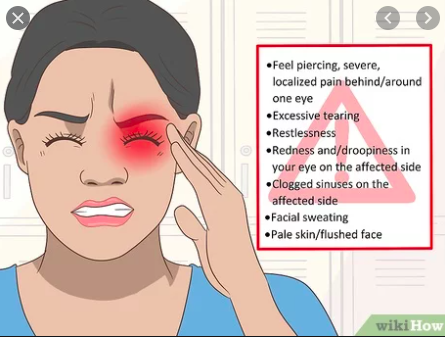
- recurrent bouts (clusters) of excruciating unilateral retroorbital pain with parasympathetic autonomic activation in same eye –> causing
- redness or tearing of the eye (lacrimation)
- nasal congestion (Rhinorrhoea)
- transient horner syndrome (ptosis, miosis, anhidrosis same side)
- Severe pain localised to orbital/supraorbital and or temporal areas
- attacks are shorter, 30-90 mins, may occur several times a day, especially during sleep
- clusters last 1-2 months w attacks most nights, before stopping completely, typically recurring 1 year or more later (often same time of the year)
- attacks occur at same time period for several weeks = cluster period and recurr at the same time of year
- typically 4 attacks per day, max 8
- agitation –> most patients agitated and restless (rock back and forth, bang head on wall)
- N & V also common
- Photophobia and phonophobia (sensitivity to noise)
- Can get aura
What is the pathophysiology of cluster headaches?
Key features:
- Trigeminal distribution of the pain
- Ipsilateral cranial autonomic symptoms
- Circadian pattern of attack
Pathophysiology: Reflex arc: Trigemino-parasympathetic reflex
- Nociceptive information from pain sensitive structures - dura mater/cerebral blood vessels —> carried to brainstem via trigeminal nerve
- Trigeminal fibres synapse in area called trigeminocervical complex in brainstem
- information sent to hypoT, thalamus, and cortex via pain processing pathways
- afferent pain signals arriving in brainstem activate the cranial parasympathetic system
- increased firing of PNS fibres innervating facial structures –> causing autonomic ptosis, miosis, lacrimation, rhinorrhoea etc
What are the risk factors for cluster headaches?
Key hx features for diagnosis?
Risk factors:
- FHx
- male
- head injury
- heavy smoking/ alcohol
Key Hx features for diagnosis:
- Repeated attacks unilateral pain, excruciating pain - lasting 15-180 mins
- At least one of:
- lacrimation/rhinorrhoea/ partial Horner’s syndrome (ptosis and miosis)
- agitation/restlessness –> patients often cannot sit still during attack
- Occuring every 1-2 days up to 8x daily
- Can have:
- N &V
- photophobia and phonophobia
- migranous aura
Management of cluster headaches?
Acute attacks:
- All patients offered TRIPTANS and O2
- Triptans:
- Subcutaneous injection as ORAL intake will be too slow, cluster headaches often come on with no warning and peak rapidly.
- Or NASAL TRIPTANS
- sumatriptan or zolmitriptan
- Note : contraindication for triptans = CAD, Hx of stroke, PVD or uncontrolled HTN
- Oxygen –> 12L / min for 15 mins via non-rebreathe
Transitional therapy –> after acute attack, before long term prophylaxis to work in interim
- Corticosteroids –> Prednisilone
- Greater occipital nerve block
Prophylaxis longterm:
- 1st line –> Verapamil (ECG performed prior)
- 2nd line –> Topiramate, lithium, gabapentin, melatonin
- 3rd –> sodium valproate
What is the definition of a chronic headache?
Headache on >= to 15 days per month for at least 3 months
majority caused by migraine, second most common is medication overuse headache (either analgesics or triptans)
Define trigeminal neuralgia?
- Trigeminal neuralgia = facial pain syndrome in distribution of ≥1 divisions of the trigeminal nerve
- Characterised by sudden attacks of sharp/stabbing/intense pain lasting up to 2 minutes and/or constant component of facial pain w/out neurological deficit
Pathophysiology of trigeminal neuralgia?
- Focal demyelination and resultant conduction abberations
- Chronic myelin loss at the root entry zone often in close proximity to a region of vascular compression
- Vascular compression most common (80-90%) at trigeminal nerve root at the entry zone by abberant vascular loop (often superior cerebellar artery)
- Demyelinating disease –> TN more common in MS patients. Demyelination in the pons where trigeminal nerve root enters
- can be caused by brainstem infarct
Revise: Key anatomy of the trigeminal nerve
What nuclei form the trigeminal nerve and where do they originate in the brain?
What is the anatomical course of the trigeminal nerve?
What are the exit points of the multiple divisions?
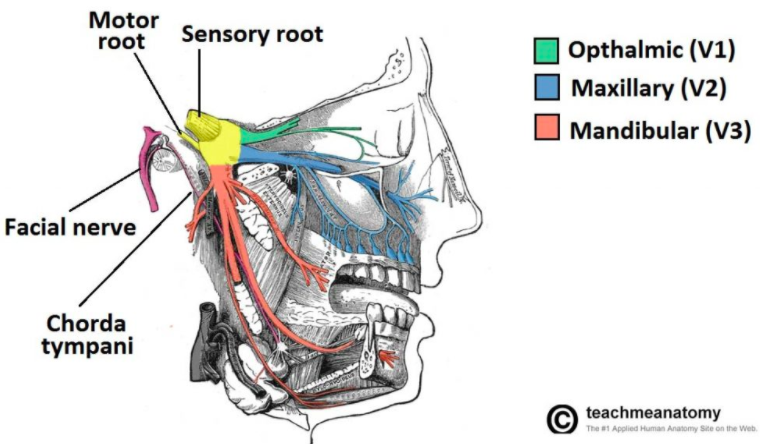
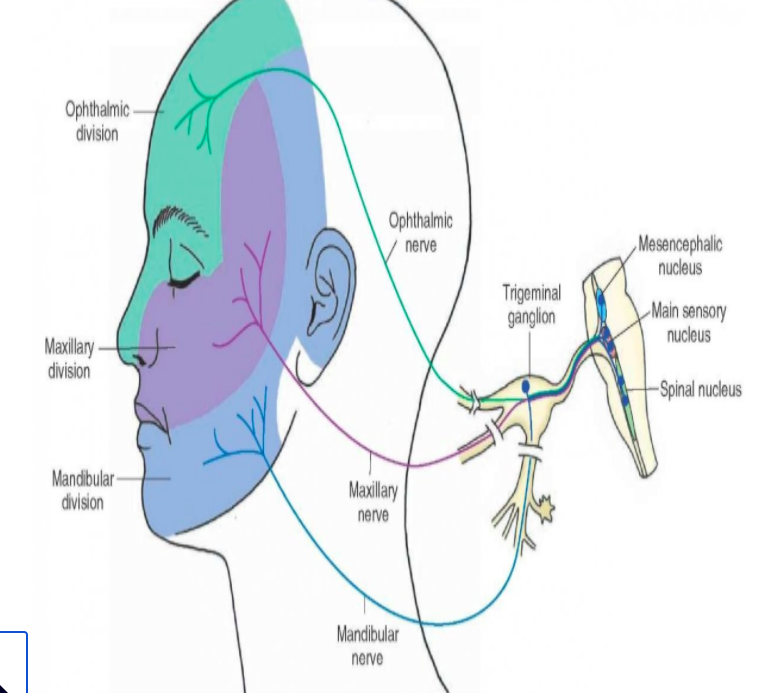
Trigeminal nerve originates from three sensory nuclei - mesencephalic, principal sensory and spinal nuclei plus one motor nucleus. It extends from the midbrain to the medulla.
At the level of the Pons the sensory nuclei merge to form a sensory root, the motor nucleus continues to form a motor root.
In middle cranial fossa, sensory root expands to form TRIGEMINAL GANGLION. Located lateral to the cavernous sinus, in depression of temporal bone - trigeminal cave.
Then gives rise to 1) opthalmic –> exits via superior orbital fissure 2) maxillary –> exits via foramen rotundum 3) mandibular –> exits via foramen ovale into infra-temporal fossa
what are the features of trigeminal neuralgia?
- Sudden, unilateral brief stabbing pain in distribution of at least one branch of the CV V - shock like pain, may have paraesthesia, numbness, usually one side in the cheek/face but can involve the eyes/lips/nose/ scalp
- 5% bilateral
- lasts seconds- minutes many times a day
- remits then rebouts
- may be provoked by light touch to the face/eating/cold/vibrations/brushing teeth
How is the diagnosis of trigeminal neuralgia made?
Key hx?
what investigations could be done?
Diagnosis of trigeminal neuralgia is normally clinical –>
- unilateraly, paroxysmal facial pain lasting secs to mins in distribution of > 1 division of CNV
- pain –> intense, sharp, superficial, stabbing or burning
- Triggers in hx –> tooth brushing/cold/touch
- PMH –> hx of prior oropharyngeal or facial trauma / prior herpetic outbreak (HSV1 can cause TN)
- Other sx –> rash or droop?
- Exam –> Unremarkable neurological exam
Investigations –> MRI if worried about intracranial pathology, intraoral Xray if dental cause suspected.
Management of trigeminal neuralgia?
Medical management:
- Anticonvulsant –> Carbmazepine = 1st line
- Can use TCA’s, lamotrigine and gabapentin
Surgical:
- microvascular decompression in posterior fossa - high long term success
- percutaneous radiofrequency selective ablation of trigeminal ganglion - recurrence may occur after 2 yrs
Define :
Medication overuse headache
Pathophysiology?
Implicated medicines
Medication overuse headache = headache that develops/ worsens with frequent use of analgesics/ triptans in people with tension type headache or migraine. Also known as Rebound headache.
Individuals that use analgesia > 2-3 times / week or more than 10 days a month set of the cycle:
As each dose of medicine wears off the pain returns, causing patient to take even more. This leads to lack of treatment effect with analgesia no longer working and can start causing the headaches.
Implicated: analgesia paracetamol/codeine, triptans, plus caffeine.
Key diagnostic factors for medication overuse headache?
- Headache present > 15 days per month
- developed or markedly worse during medication use
- resolves within 2 months of stopping medication
- Drug Hx: triptans, opiods, ergots or combination for > or equal to 10 days per month OR paracetamol/NSAID or combo > 15 days per month
- Co codamo commonest, opiates, triptans, ergotamine –> thought to increase headache pain receptors stimulated by the medication which relieves headaches
- Presentation: tension like, often daily, pt on analgesia/ triptans
Management of medication overuse headache?
explain and advise - medication being the cause of the headache, that overuse of them can lead a episodic headache to become chronic.
Explain there may be a period of transient rebound worsening of the headache after withdrawal
May start patient on migraine suppression medication if overusing analgesics



-
Acute Central Chest Pain38
-
Abnormal blood sugar: includes ACI clinical diabetes52
-
Abnormal blood sugar presentation48
-
Heart murmurs68
-
Hypertension - includes two AC1 lectures and presentation50
-
Complications of HTN29
-
Proteinuria14
-
Renal failure59
-
Positive HIV serology29
-
Oedema19
-
Chronic headache35
-
Obesity22
-
Cough +/- wheeze29
-
Pleuritic chest pain41
-
Acute upper respiratory symptoms46
-
Neutropenic sepsis18
-
Fever21
-
Central chest pain (Chronic)28
-
Weight loss33
-
Breathlessness - Cardiac48



