LO: understand the physiology of excess protein excretion by the kidneys
What is the anatomy/ physiology of the normal filtration barrier?
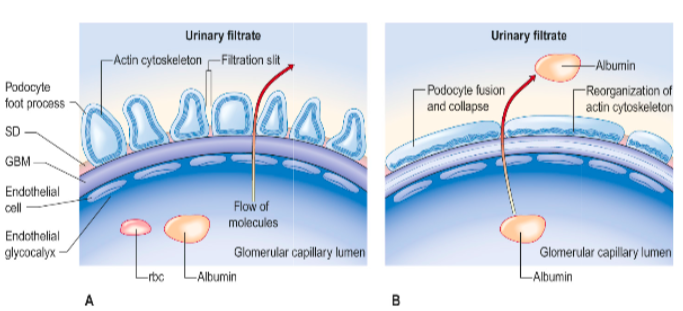
- Normal filtration barrier: formed of 1) endothelial cells of glomerular capillary 2) basement membrane 3) epithelium of bowman’s capsule
- glomerular capillaries are lined by endothelial cells - fenestrated with 60-80 nm pores, covered in charged glycocalyx - allows movement of all except RBC’s
- Glomerular basement membrane (Collagen/laminin/proteoglycans) - separarates endothelium from the podocytes, negatively charged, restricts movement of negatively charged anions
- podocytes anchor onto glomerular basement mebrane via interdigitating foot processes - forms the filtration slit
- narrow filtration slit limits passage of large molecules - albumin.
- Small molecules e.g. glucose freely filtered, whereas albumin unable to cross the barrier. Charge also affects this, negatively charged less able to cross than positive.
LO: understand the physiology involved in excess protein excretion in the kidneys:
How can proteinuria occur?
- 1: Glomerular:
- Glomerulus forms barrier to filtration of large blood proteins into urinary space
- disruption or loss of the glomerular basement membrane or podocyte foot process thinning allows protein to pass from glomerular capillary blood into the urine.
- Albumin = major protein in blood, glomerular proteinuria defined by predominance of albumin.
- [NOTE: proteinuria accompanied by haematuria –> more likely to be glomerular cause, moderate albuminuria also likely glomerular cause. Disease caused by endothelial dysfunction i.e. diabetic nephropathy, cardiovascular disease, disruption glomerular endothelial lining.]
- 2) Tubular:
- low molecular weight proteins are freely filtered and proximal renal tubule metabolises and reabsorbs all protein to prevent renal loss
- tubular dysfunction can lead to loss of protein (plus other factors e.g. glycosuria, phosphaturia)
- 3) Overflow:
- production of abnormal quantities of protein that exceed reabsorptive capacity of proximal tubules e.g. rhabdomyolysis, overproduction of monoclonal light chains in patients with multiple myeloma.
LO: identify common and important causes of proteinuria including renal:
Glomerulonephritis
- Glomerulonephritis - family of diseases involving glomeruli, caused by immune reaction against components within the glomerulus. Also known as nephritic syndrome.
- If inflammation is present = glomerulonephritis
- can involve podocytes, presenting as nephrotic syndrome = proteinuria is often heavy
- can involve endothelial and mesangial cells - presents as glomerulonephritis - where haematuria, proteinuria and HTN often evident
- podocytes, endothelium and mesangial cells may all be involved where a glomerulonephritis presents with heavy proteinuria and nephrotic syndrome.
What are the 4 main types of glomerular syndromes?
- 1) nephrotic syndrome = massive proteinuria (>3.5g/day), hypoalbuminaemia, oedema, lipiuria, hyperlipidaemia. Often caused by podocyte malfunction.
- 2) Glomerulonephritis = nephritic syndrome
- Acute - abrupt onset glomerular haematuria - red blood cell casts, non nephrotic range of proteinuria, oedema, HTN, transient renal imairment
- Rapidly progressive - acute nephritis features, focal necrosis and rapidly progressive renal failure over weeks
- 3) mixed nephrotic/ nephritic syndrome - where glomerulonephritis is part of systemic disease e.g. lupus, henoch-schoelein purpura. Nephritic syndrome associated with nephrotic syndrome.
- 4) Asymptomatic proteinuria, haematuria or both
LO: identify common and important causes of proteinuria including renal:
Diabetes
- In diabetes, there is initial glomerular hyperfiltration and enlargement of the kidney volume as local vasoactive factors increase flow
- Glomerular basement membrane thickens, mesangium expands
- progressive depletion of podocytes from the filtration barrier (either apoptosis or detachment) results in podocyturia
- proteinuria evolves as filtration pressures rise and filter is compromised
- eventually glomerulosclerosis develops - nodule and deposits in glomerular arerioles
LO: identify common and important causes of proteinuria including renal:
What is Amyloidosis?
What proteins are involved?
- Amyloidosis = systemic acquired or inherited disorder of protein folding/protein metabolism in which normally soluble proteins or fragments are deposited extracellularly as abnormal insoluble fibrils - causes progressive organ dysfunction and death
- Amyloid protein consists of B pleated sheets - hence insoluble and resistance to proteolysis.
- Abnormal protein may be derived from light chains or immunoglobulin (AL amyloid) or from serum amyloid A protein (AA amyloid).
LO: identify common and important causes of proteinuria including renal:
Amyloidosis:
What are the different types?
- When protein fibrils are deposited in the kidney –> presents with proteinuria and nephrotic syndrome.
- Classified according to the protein contributing to the amyloid fibril
- AL (amyloid light chain) amyloidosis - immunoglobulin light chain associated, often related to multiple myeloma in which clonal plasma cells in the bone marrow produce immunoglobulins that are amyloidogenic. Get Amyloid light chains excreted in the urine. Affects heart, kidney, peripheral NS, GI tract, respot tract - can present widely.
- Familial amyloidoses - transthyretin associated. Autosomal dominant, mutant protein forms amyloid fibrils. Most common form is transthyretin protein that transports thyroxine and retinol binding protein. Renal disease less prevalent than with AL chain amyloidoses. Transthyretin protein formed in liver, often presents with peripheral neuropathy, cardiomyopathy and nephropathy.
- Reactive/systemic amyloidoses (AA amyloidosis) - amyloid formed from serum amyloid A - acute phase protein. Therefore related to chronic inflammatory disorders and chronic infection (RA/IBD, TB/bronchiectasis/osteomyelitis). Deposits in the kidneys, liver, spleen –> nephrotic syndrome and/or renal dysfunction. Treated with antiinflammatory drugs (antiTNF and antiIL1).
LO: identify common and important causes of proteinuria including renal:
SLE
- Systemic lupus erythematosus presents with glomerulonephritis (in 30% patients).
- Causes membranous nephropathy - nephrotic syndrome spectrum –> immune complexes deposit in the glomerular BM leading to damage and thickening –> proteinuria.
LO: identify common and important causes of proteinuria including renal:
Infection
- Post infectious glomerulonephritis –> recent hx of infection, can occur with any infectious agent but classically post streptococcal, staphylococcus aureus can result in rapid AKI. STI - syphilis.
- Viral infections –> hep B and C, herpes zoster, HIV and Epstein barr virus
- note: pyelonephritis does not cause proteinuria
How can the timing of proteinuria present?
How can transient proteinuria present?
Transient causes?
- Proteinuria can be transient or persistent
- Transient proteinuria occurs in persons with normal renal function and BP, protein excretion less than 1 g/day. Usually disappears on repeat testing and resolves within 24 hours
- transient proteinuria can occur after/ be precipitated by:
- heavy physical exertion
- fever
- during UTI
- orthostatic proteinuria (no proteinuria in morning sample but low grade at end of the day).
- Cold exposure or burns
LO: Identify key features in the history and examination findings relating to proteinuria that support development of differential diagnoses
Key features in the history for the evaluation of proteinuria?
- HPC: onset - is this transient or long standing proteinuria?
- think fever/ vigorous exercise/ cold exposure/ burns/UTI (urgency, pain, foul smell)/ orthostatic proteinuria
- Age - in children and adolescents- normally minimal change disease or orthostatic proteinuria (in tall adolscents)
- sudden onset odema - most likely minimal change disease
- Symptoms: Urine
- Blood? Frothy? Smell?
- polyuria? frequency/ uregency or pain?
- Nephrotic syndrome:
- Oedema present, foamy urine, fatigue and weight gain due to fluid retention.
- Nephritic syndrome:
- Blood in urine, oedema, possibly pain, headache SOB, sx related to underlying cause.
- Pain present? –> Think UTI/ obstruction or stones/ Cystic kidney disease/ rhabdomyolysis
- SLE sx? Rash/ photosensitivity/oral ulcer/ arthritis/serositis?
- recent infection? –> post infetious glomerulonephritis
- pregnancy?
- PMH:
- non renal disease involvement? E.g. cardiac failure
- Risk factors? –> HTN, diabetes, hyperlipidaemia, chronic inflammatory disorders (SLE, RA) –> could be associated with amyloidosis
- Any past infections with TB/Syphilis/ endocarditis/HIV/hepatitis?
- DHx: NSAIDS can be assocaited with minimal change disease, glomerular disease
- FHX: Ethnicity -
- Black - hypertensive nephrosclerosis and focal segmental glomerulosclerosis
- Asian - high incidence IgA nephropathy
- Fhx of kidney disease/ diabetes
LO: Identify key features in the history and examination findings relating to proteinuria that support development of differential diagnoses
Examination signs?
- Elevated temp >38 oC (fever, transient proteinuria), flank pain (pyelonephritis), bladder tenderness
- Oedema - pleural effusion/ ascities/ peripheral oedema –> non specific
- BP –> HTN can cause proteinuria or be related to other cuases
- neurological weakness –> may be hypercalciuria, SLE, diabetic neuropathy, medium-small vessel vasculitis
- high BMI –> think Diabetes, metabolic syndrome
- Rash –> SLE butterfly shaped facial rash or discoid rash with erythematous raised patches, vasculitis - purpuric rash.
Investigations for proteinuria and intepretation
- Urine dipstick - proteinuria, can detect haematuria, nitrites, glucose. Then followed with:
- Spot urine albumin- creatinine ratio, serum creatinine measurement and eGFR
- Albuminura is graded –> less than 30 mg/g normal - mild increase, between 30-300 mg/g moderate increase, over 300 mg/g severely increased.
- can do spot protein-creatinine ratio –> if high level proteinuria, pregnancy or nonalbumin proteinuria suspected
- 24 hour urine collection - alternative to serum creatinine and eGFR - may show normal or decreased creatinine clearance.
- Blood tests:
- CBC –> for anaemia of CKD
- U &E’s, blood glucose (DM), fasting cholesterol (high in nephrotic)
- Can do antinuclear antibodies/antiDSDNA for SLE, serology for HIV/hepBorC, antiglomerular BM antibody (if suspecting goodpasture syndrome).
- MSU –> culture and microscopy for casts/microscopic haematuria
- Imaging:
- Renal USS –> if suspecting obstruction
- Renal biopsy –> for persistent proteinuria and when patient is declining.

Management of proteinuria
- No tx required for transient proteinuria
- Tx will be specific to cause, some non specific treatment applicable irrespective of underlying cause
- low level proteinuria : < 1.5g/day or transient - 6 month -12 months monitoring of BP, dipstick, creatinine
- higher level proteinuria: >1.5g/day refer to renal specialist, control BP
- ACE i and ARB’s –> reduce intraglomerular pressure, inihibit ATii mediated efferent arteriole constriction
- reduce proteinuria and control HTN
- can use in normontensive patients too –> ACEi rarely causes hypotension
- in chronic kidney disease e.g. diabetic nephropathy, can also add mineralocorticoid receptor antagnist e.g. epleronone/spironolactone.
- immunosuppressants for patients with progressive renal dysfunction
- diuretics for fluid overload and dietary salt restriction

-
Acute Central Chest Pain38
-
Abnormal blood sugar: includes ACI clinical diabetes52
-
Abnormal blood sugar presentation48
-
Heart murmurs68
-
Hypertension - includes two AC1 lectures and presentation50
-
Complications of HTN29
-
Proteinuria14
-
Renal failure59
-
Positive HIV serology29
-
Oedema19
-
Chronic headache35
-
Obesity22
-
Cough +/- wheeze29
-
Pleuritic chest pain41
-
Acute upper respiratory symptoms46
-
Neutropenic sepsis18
-
Fever21
-
Central chest pain (Chronic)28
-
Weight loss33
-
Breathlessness - Cardiac48



