Compare the venous drainage of the upper and lower rectum and describe the potential impact on sites of metastatic disease.
- The distal transverse colon, descending colon, and upper rectum drain into the inferior mesenteric vein which then empties into the splenic vein.
- The lower rectum is drained by both the middle and inferior rectal veins. These veins then empty into the internal iliac vein and inferior vena cava.
- The bidirectional venous drainage of the rectum and anal canal account for differences in patterns of metastases that arise from tumors in this region.
Describe histologic and molecular features in rectal cancer associated with a poorer prognosis.
- Definitive staging of rectal cancer is only possible after surgical resection and pathologic evaluation.
- Histologic features associated with a poorer prognosis include poorly differentiated tumors, tumors with a significant mucinous component, and tumors that demonstrate lymphovascular or perineural invasion.
- Other factors associated with poor prognosis include tumors that invade the muscularis propria, peri-rectal tissue, or surrounding organs.
Describe environmental and genetic risk factors for primary colorectal cancer.
- CRC arises in the epithelial lining of the colon (75% of cases) or the rectum (25% of cases).
- The lifetime risk is 5.5% in men and 5.1% in women. The incidence of colorectal cancer increases with age with over 90% of new cases seen in patients over 50.
- Environmental factors: obesity, physical inactivity, red or processed meats, smoking, alcohol
- First-degree relative diagnosed before the age of 60 years.
- Hereditary syndromes: familial adenomatous polyposis (FAP) or hereditary nonpolyposis colon cancer (HNPCC).
Describe the two major genetic pathways for tumor initiation and progression in colorectal cancer (tumorigenesis).
- The adenoma-carcinoma model of colorectal neoplasia is one of the most well-known models. It involves damage to both proto-oncogenes and tumor suppressor genes.
- To advance from normal colonic mucosa to an invasive cancer, colonic epithelial cells no longer progress normally from maturity to cell death but rather, proliferate in an uncontrolled fashion.
- This uncontrolled proliferation leads to cell accumulation on the epithelial surface: a polyp.
- As more proliferation occurs, the cells become increasingly more disorganized and eventually extend through the muscularis mucosae to become invasive carcinoma.
Identify and describe the advantages and disadvantages of different colorectal cancer screening modalities.
- Colonoscopy is currently the gold standard for colon cancer screening techniques as it is highly sensitive and allows for biopsy and removal of abnormal appearing polyps. The disadvantages to colonoscopy include the cost, pre-procedure bowel preparation, and risks of bleeding and colonic perforation.
- Fecal occult blood testing (FOBT) is a yearly screening test that analyzes the stool for microscopic amounts of blood. Although less invasive, this test is significantly less sensitive than colonoscopy.
- Flexible sigmoidoscopy is similar to colonoscopy in that it is an endoscopic examination of the colon. While this test is less expensive than colonoscopy, it only visualizes the lower one third of the colon and thus may miss more proximally located colon cancers.
Independently stratify patients into average, moderate, and high-risk groups for colorectal cancer, and describe recommended screening strategies for each group.
AVERAGE RISK…
- Patients with no identifiable risk factors and no family history of colorectal cancer are considered average risk and have a 5% to 6% lifetime risk.
- Average risk patients should undergo one of the following starting at age 50:
- Annual fecal occult blood test (FOBT)
- Flexible sigmoidoscopy every 5 years
- Flexible sigmoidoscopy every 5 years with an annual FOBT
- Colonoscopy every 10 years
- Double-contrast barium enema every 5 yearss
Independently stratify patients into average, moderate, and high-risk groups for colorectal cancer, and describe recommended screening strategies for each group.
MODERATE RISK…
- 25% of patients are at an increased or moderate risk of developing CRC due to a family history or personal history of colon cancer or adenomatous polyps.
- In patients with a first-degree relative with colon cancer that was diagnosed before the age of 60 years, colonoscopy should begin at either age 40 or at 10 years before the youngest diagnosed family member.
- Repeat colonoscopies should occur every 5 years (normally 10).
- In moderate risk patients who present with three to ten adenomas, one adenoma larger than 1 cm, or with high-grade dysplasia at their initial colonoscopy, repeat examinations should occur every 3 years.
Independently stratify patients into average, moderate, and high-risk groups for colorectal cancer, and describe recommended screening strategies for each group.
HIGH RISK…
- Approximately 6% to 8% of the population is considered to be at high risk of developing colorectal cancer due to hereditary syndromes such as familial adenomatous polyposis (FAP) or hereditary nonpolyposis colon cancer (HNPCC).
- FAP: screening yearly with sigmoidoscopy or colonoscopy starting in childhood (age 10–12) and continued until a total colectomy or proctocolectomy.
- HNPCC: screening colonoscopies every 1 to 2 years beginning at age 20 or 10 years before the youngest immediate family member with colon cancer.
Describe characteristic symptoms of rectal cancer, including symptoms of locally advanced rectal cancer.
- Characteristic symptoms of rectal cancer include changes in bowel function. Patients may describe diarrhea or constipation, the inability to completely empty their bowels, a change in caliber of their stools, and blood in their stool.
- Locally advanced rectal cancer may present with obstructive symptoms, pelvic pain, and urinary symptoms.
- If the rectal cancer has become disseminated, patients may describe more systemic symptoms including fatigue, abdominal pain, loss of appetite, or unintentional weight loss.
Describe the assessment of anal sphincter function using history and physical exam, and explain the impact on potential surgical options for treatment of rectal carcinoma.
- Include questions regarding recent bowel habits and fecal incontinence.
- A digital rectal exam can assess both anal sphincter tone and function.
- The location of the tumor in relation to the anal sphincter complex and preoperative anal sphincter function are both important when determining surgery.
- If a tumor involves the anal sphincter complex (too close to the sphincter to obtain adequate margins) or pt has poor preoperative sphincter control, do APR.
- If the anal sphincter is not involved, less aggressive approaches may be considered.
Given a patient with a rectal mass palpable on digital examination, plan a diagnostic evaluation to confirm rectal carcinoma, and assess for the extent of disease.
- After a rectal mass is found on DRE
- CBC, BMP, LFTs, and a CEA
- Complete colonoscopy for additional tumors within the colon.
- Computerized tomography (CT) of the chest, abdomen, and pelvis for mets.
- EUS or T2-weighted MRI for depth of tumor invasion into the bowel wall.
Describe the TNM classification of colorectal carcinoma and correlate stage with 5-year survival
Staging of colorectal cancer is based on the TNM classification. This system is based upon the depth of invasion, the number of lymph nodes with disease, and distant metastases.
- Stage 0 cancer are still intraepithelial or have invaded only the lamina propria.
- Stage I cancer have invaded the submucosa or the muscularis propria. The cancer has not spread to the lymph nodes and there is no evidence of distant metastases.
- Stage II colorectal cancers have invaded through the muscularis propria and into the pericolorectal tissue, visceral surface of the colon, or surrounding organs. There is no lymph node involvement or distant metastases.
- Stage III cancers are similar to stage II cancers in regards to depth; however, the cancer has now spread to the lymph nodes without evidence of distant metastases.
- Stage IV is when distant metastases are present.
- 5-year survival for colorectal cancer is as follows: 93% for stage I, between 72% and 85% for stage II, between 44% and 83% for stage III, and 8% for stage IV.
Describe the demarcation of the upper, middle, and lower rectum, and correlate each region with surgical options for resection.
- The rectum is typically 12 to 15 cm in length and lacks taeniae coli. It contains three curves or involutions called the valves of Houston which demarcate the upper, middle, and lower rectum
- The upper 1/3 of the rectum is intraperitoneal
- The middle and distal 2/3 of the rectum are extraperitoneal
- Traditionally, cancers in the proximal 1/3 of the rectum recur similarly to colon ca. Partial mesorectal excision is an accepted surgical treatment method.
- Management of cancers in the lower 2/3 of the rectum varies. While proctosigmoidectomy with total mesorectal excision is recommended in most cases, local excision can also be utilized in select cases.
Describe the principles of oncologic resections as it pertains to colorectal cancer, including the minimal number lymph nodes required for staging purposes.
The goal of surgery as it pertains to colorectal cancer is to achieve an appropriate oncologic resection while minimizing patient complications including hemorrhage, infection, and post-operative urinary or sexual dysfunction.
- The involved segment should be completely removed - 2-cm (rectal) to 5-cm margin (colon).
- Any local structures or organs invaded by the primary tumor should be removed en bloc.
- The major vascular pedicle and main lymphatic drainage basin of the involved colonic segment should also be removed.
- A minimum of 12 lymph nodes are required to accurately determine nodal involvement.
In considering margins of resection, describe the evolution of thought regarding what constitutes an adequate distal margin, and describe the significance of a positive radial margin.
- Adequate margins should be obtained both distally and circumferentially in order to decrease the risk of a local recurrence of disease.
- For colon cancers, 5-cm margins are recommended on either side.
- When considering rectal cancer, a distal surgical margin of at least 2 cm is preferred.
- Recent retrospective studies have suggested that in the setting of neoadjuvant chemoradiation and total mesorectal excision, a negative margin of less than 1 cm is adequate for local control in patients undergoing sphincter-preserving surgery.
- With regards to the radial margin, en bloc resection of adjacent structures can be considered if complete R0 resection of the cancer can be achieved.
Describe the technique of total mesorectal excision and the impact of this technique on local recurrence of mid and low rectal cancers.
- Lithotomy position.
- Laparotomy incision to the level of the pubis.
- The sigmoid colon and descending colon are mobilized along the white line of Toldt.
- Divide peritoneum at the R side of mesorectum to fully mobilize the rectosigmoid.
- ID ureters. Divide rectosigmoid junction with a linear stapler.
- The rectum is then retracted anteriorly and the plane between the mesorectum and the pelvic fascia is developed. Dissection within this plane is carried down to the pelvic floor and continued laterally and anteriorly around the rectum. Once the rectum has been adequately mobilized, it is divided.
- If sphincter function is to be preserved, the splenic flexure of the proximal colon is mobilized, and an anastomosis is performed.
- TME results in a lower local recurrence rate of mid and lower rectal tumors and is also associated with a lower rate of permanent colostomy.
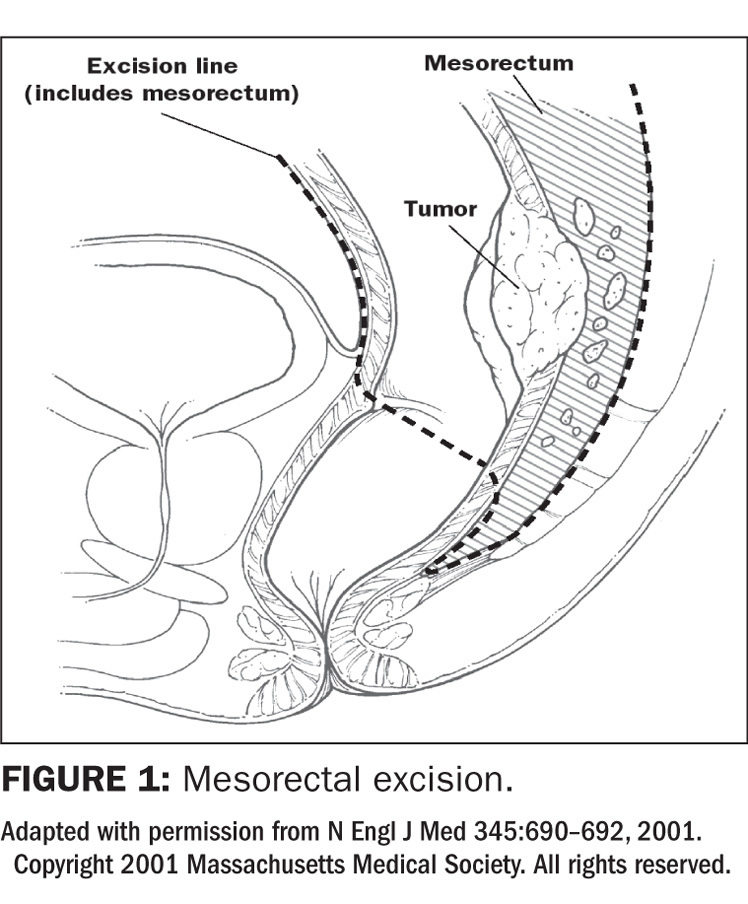
Given a patient with a low rectal carcinoma, describe the potential benefits and disadvantages of transanal excision, and the criteria for considering transanal excision.
- Transanal excision considered for rectal lesions within 8 cm of the anal verge or lesions located at or below the first rectal valve. Lesions that are < 3 cm in size and that occupy < 40% of the rectal circumference should also be considered for transanal excision.
- Transanal excision is a minimally invasive procedure and thus patients recover faster when compared with open surgery. Other benefits include its low risk of morbidity and mortality and a lower risk of long-term functional sequelae.
- Disadvantages of transanal excision include the potential for incomplete resection or the need to convert to an open technique.
Describe the operative and non-operative management of a patient with isolated hepatic metastases at the time of presentation.
- Patients with isolated hepatic metastases should be offered surgical resection.
- Five-year survival rates after resection range from 24% to 58%.
- Neoadjuvant or adjuvant chemotherapy can eliminate micrometastatic disease.
- Patients with initially unresectable liver metastases are sometimes offered neoadjuvant chemotherapy in order to convert unresectable metastases into resectable lesions.
- If the hepatic metastases are non-resectable, other treatment options include radiofrequency ablation (RFA), transarterial chemoembolization (TACE), transarterial brachytherapy, and hepatic artery infusion (HAI) chemotherapy.
Describe the effectiveness of adjuvant radiation therapy (RT) on local recurrence and survival for rectal cancer.
Compare the advantages and disadvantages of preoperative versus postoperative RT.
- Recent trials show pre-operative radiation leads to a reduction in local recurrence and an improvement in disease-free survival in all stages of rectal cancer.
- The combination of neoadjuvant radiotherapy and surgery is associated with improved local disease control when compared with surgery alone.
- Preoperative chemoradiation has been shown to be superior to postoperative.
- Oftentimes, preoperative radiotherapy can downsize the tumor, allowing the surgeon to better achieve adequate negative margins and preserve continence.
- One disadvantage to preoperative radiotherapy is that the radiation may damage the tissues, making surgical dissection more technically difficult.
Identify which stages of rectal cancer are treated with adjuvant chemotherapy and describe the effectiveness of adjuvant chemotherapy on survival.
- Adjuvant chemotherapy is associated with an improvement in survival and a reduction in distant metastases in rectal cancer.
- Typically, stage 0 and stage I rectal cancers can be managed with resection alone.
- Patients with stage II and stage III rectal cancers will be treated with neoadjuvant chemoradiation followed by surgical resection. Adjuvant chemotherapy is also recommended in these instances.
- Patients with stage IV rectal cancer will also be managed with adjuvant chemotherapy.
Describe the role of neoadjuvant therapy in newly diagnosed adenocarcinoma of the rectum.
- Neoadjuvant radiation has been shown to result in a significant reduction in the local recurrence rate and improved disease-free survival for all stages of rectal cancer.
- The combination of preoperative radiation and chemotherapy often results in a significant decrease in tumor size.
- A significant decrease in tumor size may increase the ability of the surgeon to not only achieve cancer free margins but to also better preserve sphincter function.
Given a patient with rectal carcinoma, describe the goal for follow-up surveillance, the impact of stage on the intensity of surveillance, and what is generally considered cost-effective in surveillance.
- Close surveillance is necessary in the first 2–3 years after primary rectal cancer resection, as the median time to recurrence ranges from 13 to 47 months, with most cases occurring between 12 and 24 months.
- Although there are no formal guidelines in place, multiple retrospective studies suggest that patients undergo proctoscopy or flexible sigmoidoscopy in combination with a high-resolution MRI or endoscopic ultrasound every 3–6 months for the first three years. The screening interval can be increased to every 6–12 months from year 3 to year 5 post resection.
- Patients should also undergo colonoscopy at year 1, 4, and 9 post resection and an annual CT scan of the abdomen and chest.

-
Bladder Injury, Extremity Injury17
-
Skin and Soft Tissue76
-
Endocrine22
-
Breast53
-
Colorectal22
-
Abdomen - General19
-
Abdomen - Hernia49
-
Surgical Critical Care23
-
Esophagus62
-
Trauma129
-
Thoracic26
-
Wound Healing20
-
Vascular49
-
Alimentary Tract - Small Intestine93
-
Abdomen - Biliary90
-
Wound Healing22
-
Alimentary Tract - Anal Canal58
-
Alimentary Tract - Large Intestine102
-
Pediatric57
-
Nutrition and Metabolism24
-
Alimentary Tract - Stomach49
-
Abdomen - Liver73
-
FLS26
-
Preoperative Evaluation and Perioperative Care80
-
Fluids, Electrolytes, and Acid-Base Balance14
-
Vascular - Venous20
-
Infections and Antimicrobial Therapy41
-
asts.mycrowdwisdom.com14
-
DECKER58



