What are common risk factors for the development of acute arterial thrombosis?
- RIsks: male, old, not-white, FHx (vascular dz, stroke, MI), HTN, DM, smoking - atherosclerosis leading to embo
- Causes: thrombosis from IV cath, vascular dmg d/t trauma, occlusion from arterial dissection, a fib creates myocardial thrombi, aneurysms serve as a nidus for thrombi, hypercoagulable states, IVDU
- Occlusion superimposed on an underlying arterial abnormality such as a stenotic arterial plaque or an arterial aneurysm
- Precipitated by hypotension or hypovolemia
- APLA
What are the characteristic history and physical findings associated with acute arterial thrombosis
- Hx: vascular interventions, chronic vascular dz, a fib, embolic hx (strokes), aortic dissection (limb ischemia +/- visceral malperfusion), hypotension, trauma, sx duration; 6 Ps
- PE: multifocal atherosclerosis, chronic limb ischemia, motor/sens exam
- handheld Doppler: assess arterial circulation to the extremity
- auscultation and EKG/rhythm strip: atrial fibrillation
- tissue loss; sx of less severe w/ chronic pts d/t formation of collaterals
- Tx: dependent on motor and sensory exam: determines urgency/tx
- motor deficits - immediate revascularization
- no or mild sensory loss - percutaneous thrombolysis
What is the diagnostic algorithm for evaluation and treatment of acute arterial thrombosis?
- Therapeutic heparin initially (80 u/kg, 17 u/kg/hr)
- CTA to define occlusion
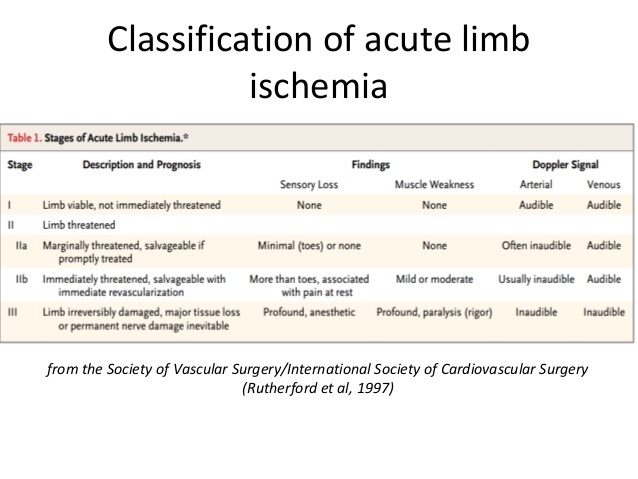
- Class I (pain) or IIA (mild numbness) ischemia - angiography - percutaneous thrombolysis
- Class IIB ischemia (rest pain, weakness, loss of signals) - OR - mech thrombolysis, thrombo/embolectomy, bypass
- radiolucent table - endovascular intervention
- inflow source (femoral or axillary artery) - bypass option
- completion angiography mandatory
- consider fasciotomy based on time of ischemia (6 hrs)
- Class III ischemia - irreversible - amputation
- Postop: echo +/- CTAs chest/abd/pelvis to find source
Discuss the diagnostic algorithm for evaluating a patient with arterial embolic disease.
- thorough cardiovascular H&P - causes of embolism, and location
- EKG: rhythm, signs of ischemia
- asymmetric vascular exam, abrupt sx, neg ischemic hx - embolism
- embolus cannot be localized by PE - duplex, CTA, and/or angiography
- occlusion at popliteal artery - exam for aneurysm (duplex)
- not amenable to femoral embolectomy
- no axillary pulse w/ upper extremity ischemia - imaging prior to exploration,
- emboli to the axillary artery are unusual
- blind proximal embolectomy - retrograde embo of vertebral artery
An elderly woman presents 6 hours after the abrupt onset of acute right leg pain, paresthesias, and paralysis of the foot at the level of the ankle. She has a history of atrial fibrillation. Her only medication is aspirin. Her physical examination is remarkable for the absence of a right femoral pulse, and more distal pulses are also absent. Left leg pulses are normal. Arterial Doppler signals are absent at the level of the ankle; venous signals are present. The foot is numb and has some decrease in mobility. Describe the management of the patient’s leg ischemia.
- A heparin bolus/drip should be given immediately - prevent distal propagation
- Class IIB ischemia - emergency operation should be scheduled; CTA if time, but not necessary
- Abdomen, R leg, and L groin prepped (inflow if R femoral not established)
- Explore groin through longitudinal R skin incision and expose artery
- If artery is relatively free from atherosclerosis - transverse arteriotomy on the CFA low enough to access the origin of both the superficial and profunda femoris arteries.
- If considerable plaque is present in the CFA - longitudinal arteriotomy extending to the femoral bifurcation is performed, and subsequent patch closure will be required.
- Distal thromboembolectomy performed first to clear the outflow tract, followed by proximal thrombectomy
- Completion angiography unless posterior tibial and dorsalis pedis pulses are readily palpable after embolectomy
- If good proximal inflow not achieved - proximal angiography or conversion to femoral-femoral bypass contralateral groin
- On the basis of degree and duration of ischemia before revascularization - ppx 4 compartment fasciotomy
- Superficial and deep posterior (through medial), anterior, lateral
After management of an embolus to an extremity, what measures can be taken to prevent future emboli?
- imaging: echo, CTA of the chest, abdomen and pelvis - identify the source
- cardiac events - therapeutic anticoagulation
- lifelong basis unless substantial contraindications - 3 to 6% annual risk of recurrence
- if an aneurysm is found - treat
- proximal ulcerated lesions of the aorta - no empirically anticoagulated - may increase further embolic events
- treated with antiplatelet agents
- treatment of ulcerated lesions in the proximal arterial tree is individualized
A patient under treatment for acute left deep venous thrombosis (DVT) develops the abrupt onset of right leg pain, and the previously palpable right femoral and distal pulses are no longer palpable. What has occurred, and what should be done?
Paradoxical embolus: pre-existing ASD or PFO, embo to R iliac artery
- Hx of subacute PEs - pulmonary HTN - elevated right heart pressure - right-to-left shunt
- Already anticoagulated for the DVT
- OR for embolectomy (class IIB) - right femoral cutdown
- IVC filter - prevent future emboli for thromboembolization while anticoagulated
- CTA chest - eval for PE (though this does not change mgmt)
- TEE - confirm the diagnosis ASD - bubble study; may need future closure
A 65-year-old male presents with a 12-hour history of pain and coolness in the left leg. On physical examination, the leg is cold, insensate, and paralyzed leg. He has a palpable femoral pulse but no distal pulses. ECG demonstrates new onset atrial fibrillation. What will you do?
- Ensure CV stability, rule out MI (EKG, troponin), cardiac rate control (B-block), anticoagulation (heparin)
- Class III - dead - cannot salvage
- Level of ampx - depends on N/V exam level, postop fx
- AKA: lower morbidity, higher mortality
- BKA - 4 finger breadths below tuberosity, fibula 1-2 cm shortness than tibia, don’t close too tight
- complications with amputation - fistula, compartment syndrome
A 70-year-old female presents with a cool leg and weak dorsiflexion of the foot, which has been ongoing for 3 hours. She recently underwent an intraocular lens implantation. She has no femoral pulse or distal pulses in the affected leg. What will you do?
- H&P: CV hx, EKG, troponin
- ABI, doppler, heparin therapy, CTA if no delay
- Weakness means threatened limb - IIB
- Do embolectomy
- Thrombolysis contraindicated d/t eye surgery
- Do diagnostic and completion angiogram
A 75-year-old male is in the CCU after an STEMI (segment elevation myocardial infarction) and has an IABP (intra-aortic balloon counter-pulsation) in his right leg. The right leg has been cool for 4 hours. The right femoral and popliteal pulses are weakly palpable, but pedal pulses are absent. Motor function and sensation are intact. What will you do?
- Examine the contralateral leg and determine if this is a unilateral phenomenon
- Determine the HD status of the pt and need for the IABP
- Following options depends on findings
- move IABP to contralateral leg
- heparinization and obs
- femoral embolectomy
A 76-year-old male had a right femoro-popliteal bypass two years ago, He now presents with a 4-hour history of coolness and paresthesias in the right leg. He has a palpable femoral pulse but absent distal pulses. Motor function is very weak. What will you do?
- IIB - requires immediate intervention, embolectomy
- Likely intimal hyperplasia or atherosclerosis in this time period
- early - technical failure at anastomosis
- late - atherosclerosis
- Tx depends: location, length, availability of autolagous vein
- Short lesions - vein patch angioplasty
- Stenosis at site or atherosclerosis - vein graft extension
- Open surgery favored over endovasc or conservative
You are placing an implantable venous access device, and shortly after your dilation cannula is placed, a larger amount of air is sucked into the venous circulation. What is the appropriate treatment? What steps can be taken to prevent this event?
- Air embolization during central venous cannulation and catheter placement - sudden respiratory distress, dyspnea, chest pain, dizziness or LoC, HD collapse, tachypnea/cardia, inc JVP
- ABC, O2, L lateral decub and Trendelenburg position
- CBC, BMP, CPK, troponin, BNP, ABG, CXR, EKG, echo, CT PE
- Bernoulli’s principle of fluid dynamics (↑ flow = ↓ pressure & ↓ flow = ↑ pressure)
- Hyperbaric oxygen ASAP, can suction air from RV through CVL
- Prevent by having patient in Trendelenburg, occluding lines during placement
You are called in consultation to evaluate a patient who has been recently diagnosed with left-sided breast cancer. Neo-adjuvant chemo/radiation has been recommended by the oncology team. What considerations will go into your planning with regard to location of the catheter?
- Effects of radiation therapy at catheter and wound sites.
- Signs and symptoms of central venous stenosis and impact on catheter/port placement.
- Lymphedema and how risks of DVT may influence the site chosen.
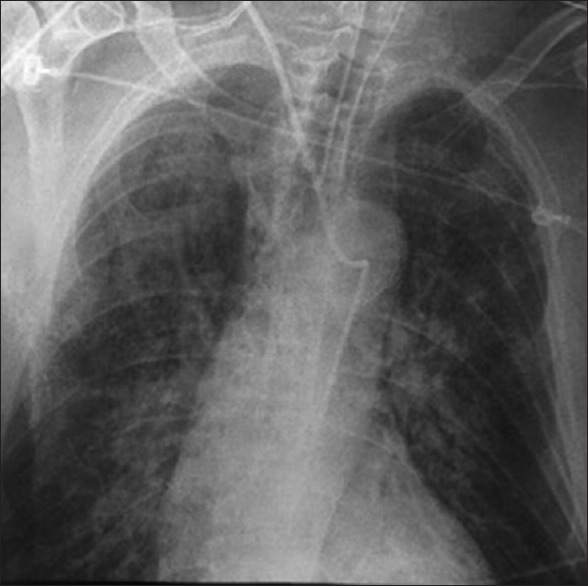
You are called to the PACU to evaluate a patient in whom you have just placed a tunneled venous access device. The post-procedure chest radiograph demonstrates a port in the right chest region with the catheter tracking underneath the right clavicle, crossing the midline and descending down the left side of the mediastinum. What is your initial work-up? What is the most appropriate treatment?
- Inadvertent arterial cannulation - bright blood, pulsatile backflow, hematoma
- Likely subclavian artery - check HDS and neurovasc exam
- Morbidity: hematoma, pseudoaneurysm, thromboembolism
- Workup: ABG from cath, US/CTA to determine location, labs, know cannula sheath size
- Tx: leave in place and vasc consult
- Leave in - risk thrombus and subsequent stroke or peripheral embolism
- Remove - risk exsanguination, pseudoaneurysm (tx w/ thrombin or coil), AVF
- Methods of repairing iatrogenic arterial injury: open repair or percutaneous coil (if distal to vertebral)
- Remove and apply pressure only feasable for femoral catheter
- Needs good neuro exam postop
You are called to the emergency department to evaluate a patient who is known to the surgical oncology service. Upon arrival, you find a 62-year-old female who is tachycardic to 114 beats per minute with a blood pressure of 91/63 mmHg. The nurse alerts you to the fact that the patient has a temperature of 102.1°F and is diaphoretic. On your exam, you note erythema overlying a subcutaneous port in the right chest. How would you manage this patient?
- Line sepsis
- Cxs from line and blood, fluid resuscitation, abx
- Coagulase-negative staphylococcus coverage
- Removal of the subcutaneous port/catheter
A patient with an indwelling subclavian central venous catheter presents with ipsilateral arm swelling and pain. What is your approach to making a diagnosis in this situation?
- Obtain a venous duplex ultrasound of the upper extremity to assess for deep vein thrombosis (DVT).
- Recognize the need to remove the catheter.
- Initiate systemic anti-coagulation to prevent clot propagation.
- Recognize the need to rule out PE
A patient presents with cellulitis at the site of peripherally inserted central line catheter and high grade fever. What is your initial treatment plan?
- Immediately initiate antibiotics with a spectrum effective against coagulase-negative staphylococcus, which has a high rate of resistance to methicillin.
- Urgent need to remove the catheter.
A patient presents with a tunneled central venous catheter which is utilized for chronic parenteral nutrition. The catheter is difficult to flush or aspirate. What are the possible causes of catheter occlusion, and what is your initial plan to determine if catheter patency can be re-established?
- Causes of catheter occlusion include fibrin sheath formation around the catheter, intraluminal or mural thrombus formation, and venous endothelial injury.
- Patency may be re-established by injecting a fibrinolytic agent [e.g., alteplase (tissue plasminogen activator {t-PA}, 0.5-2 mg)].
A 65-year-old female with Stage IV chronic kidney disease (CKD) secondary to Type II non-insulin-dependent diabetes mellitus (NIDDM) and hypertension is referred for evaluation for AV access for hemodialysis. What is your approach?
- Dominant versus non-dominant extremity
- History of prior subclavian catheters, PICC lines, ports, and pacemakers
- Duplex ultrasound as an adjunct to physical examination - mark, vein map
- Determine timing of autogenous AV fistula versus prosthetic AV graft
A 50-year-old obese male with Stage V CKD secondary to hypertension presents two and a half months post left brachiocephalic AV fistula. The nephrologist is asking whether fistula can be used to initiate dialysis. How do you decide when fistula is mature and can be used?
- Rule of 6’s: > 6mm in diameter, < 6 mm deep, > 600 ml/min flow
- Duplex ultrasound - flow volumes
- Fistulagram - if cannot get good flow volumes
A 70-year-old male with end-stage renal disease (ESRD) secondary to Type II DM on chronic hemodialysis via IJ tunneled catheter presents with a cool, painful left hand two weeks post left brachiocephalic AV fistula. He has a history of coronary artery disease (CAD) and with an MI and PCI with drug eluting stent 2 years earlier. What is your diagnostic and therapeutic approach?
- Likely 2/2 steal syndrome
- Diagnosis of hand ischemia: clinical - 5 P’s
- Rest pain, ischemia, ulcerations, necrosis, loss of ADLs
- Occlude fistula and see if resolution of sx
- Imaging: angiography
- Surgery: ligation, banding, DRIL (distal revascularization)
The prevalence of CKD is around…
7%
Superficial veins of the upper extremity used for vascular access in dialysis.
cephalic, basilic, median antecubital
Central veins used in vascular access for dialysis
axillary or internal jugular

-
Bladder Injury, Extremity Injury17
-
Skin and Soft Tissue76
-
Endocrine22
-
Breast53
-
Colorectal22
-
Abdomen - General19
-
Abdomen - Hernia49
-
Surgical Critical Care23
-
Esophagus62
-
Trauma129
-
Thoracic26
-
Wound Healing20
-
Vascular49
-
Alimentary Tract - Small Intestine93
-
Abdomen - Biliary90
-
Wound Healing22
-
Alimentary Tract - Anal Canal58
-
Alimentary Tract - Large Intestine102
-
Pediatric57
-
Nutrition and Metabolism24
-
Alimentary Tract - Stomach49
-
Abdomen - Liver73
-
FLS26
-
Preoperative Evaluation and Perioperative Care80
-
Fluids, Electrolytes, and Acid-Base Balance14
-
Vascular - Venous20
-
Infections and Antimicrobial Therapy41
-
asts.mycrowdwisdom.com14
-
DECKER58



