Correctly assess whether surgical resection is necessary for a patient with thyroid disease.
Indications for thyroidectomy include: thyroid carcinoma, thyroid mass suspicious for malignancy, functioning thyroid nodule with contraindications or intolerance to medical therapy, goiter compressing nearby structures.
Describe the workup and criteria for resection in a patient with an isolated thyroid isthmus nodule.
Isthmus nodules are unique in that they have higher rates of multifocal carcinomas and lymph node involvement. Ultrasound done to determine malignant vs benign and surgical plan is created from there. FNA is done if US is indeterminant.
Ultrasound of a thyroid isthmus nodule should be performed to determine if it appears malignant or benign. Malignant features include…
a hyperechoic nodule, irregular borders, and microcalcifications.
During mobilization of a thyroid lobe, correctly identify both the upper and lower parathyroid glands.
superior parathyroids: posterior of upper or middle thyroid lobes, dorsal to the RLN at the cricoid cartilage
inferior parathyroids: within one centimeter of the intersection of the inferior thyroid artery and the RLN, anterior to the RLN
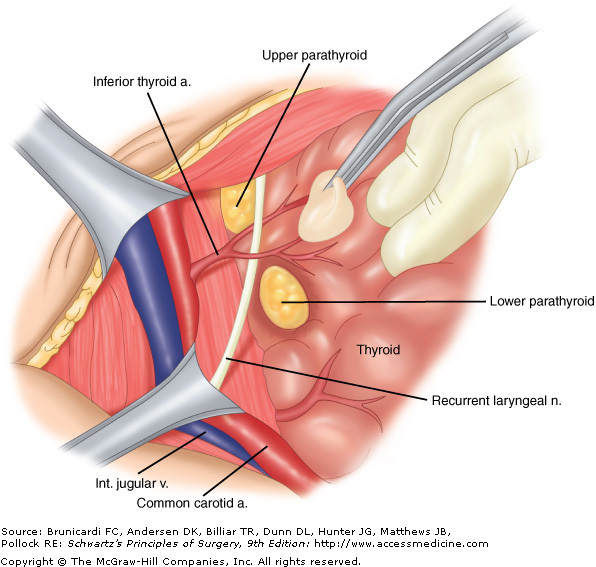
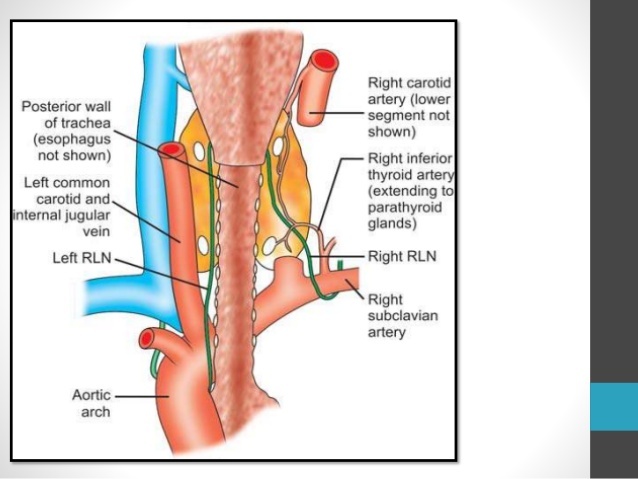
Be able to describe the course of the recurrent laryngeal nerve with respect to the inferior parathyroid gland, the thyroid gland, and the superior parathyroid gland.
The left RLN arises from the left vagus nerve where it crosses anteriorly over the aortic arch. It loops around the ligamentum arteriosum and travels cephalad within the tracheoesophageal groove. The right RLN arises from the right vagus nerve at its intersection with the subclavian artery and loops posteriorly around the artery to then travel upward in the neck. The RLN usually passes posteriorly to the inferior thyroid artery. The inferior parathyroid gland is posterior to the RLN near this junction. The superior parathyroid is anterior to the RLN near the cricoid cartilage.
Identify a toxic, hyperthyroid patient and institute oral medication in preparation for surgery.
- Sx of thyrotoxicosis: ramped up metabolism: fever, AMS, diarrhea, HTN, tachy
- Precipitating factors: infection, surgery, trauma, amiodarone, IV contrast
- Beta blockers: first-line to control symptoms
- Propylthiouracil (PTU) and methimazole: decrease circulating thyroid hormone
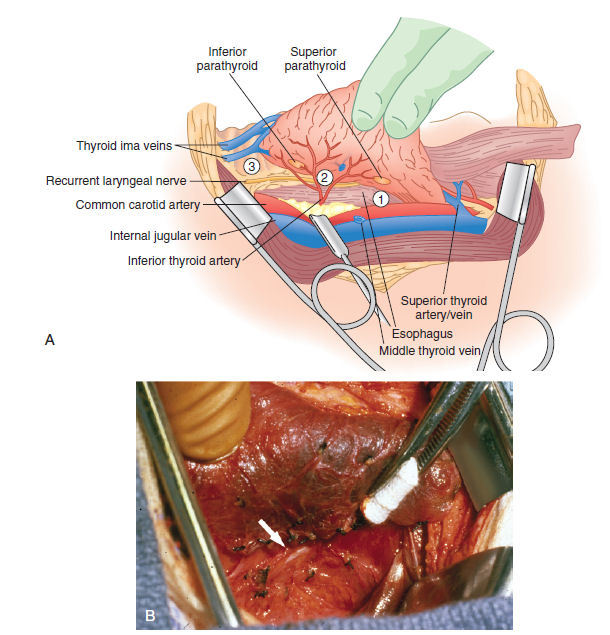
Describe the optimal placement of the incision for a thyroidectomy in terms of anatomic landmarks and expose the thyroid gland through a midline approach, naming all the relevant layers in exposure.
- A transverse collar incision within a skin crease 1 cm below cricoid cartilage.
- Incise through skin, subQ, and platysma muscle.
- Raise sub-platysmal flaps superiorly to thyroid cartilage, inferiorly to sternal notch.
- Divide fascia between strap muscles midline, separate sternohyoid muscle from sternothyroid muscle bluntly.
- Dissect the sternothyroid muscle off of the thyroid.
- Identify the recurrent laryngeal nerve and the parathyroid glands.
- Identify the middle thyroid veins. Retract thyroid medially and anteriorly in order to ligate and divide the middle thyroid veins.
Expose the superior pole vessels and describe methods for safely ligating these while avoiding injury to the cricothyroid muscle and superior parathyroid gland.
- Divide the fascia superior and inferior to the isthmus. Retract the thyroid inferiorly and medially.
- Identify the superior pole vessels and ligate and divide these close to the thyroid. Avoid damaging the external superior laryngeal nerve.
- The superior parathyroid gland should be located posteriorly.
- Medial retraction should facilitate identification of the parathyroids, the inferior thyroid artery, and the recurrent laryngeal nerve.
- The thyroid can be removed after dividing Berry’s ligament and after dividing all remaining attachments to the thyroid gland.
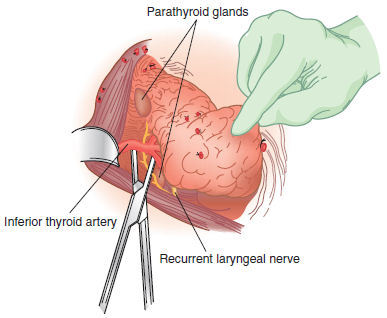
Be able to describe the course of the recurrent laryngeal nerve and then expose and protect the nerve, without undue assistance.
- The RLN is generally identifiable at cricoid at the ligament of Berry (tracheal attachment to the thyroid) near the tubercle of Zuckerkandl (posterior pyramidal thyroid extensions) and the tracheoesophageal groove.
- The inferior thyroid artery is also a good marker for the RLN which passes beneath it.
Be able to explain the justification for the extent of an operation for the following situations: FNA finding of follicular lesion, FNA finding of suspicious for malignancy, and FNA-proven papillary thyroid cancer.
- FNA finding of follicular lesion: lobectomy, ~30% malignant
- Biopsy is of unknown significance: repeat FNA
- FNA finding of suspicious for malignancy: lobectomy, 50 to 75% malignant
- FNA-proven PTC: near-total or total thyroidectomy, 99% malignant
A parathyroid gland has been devascularized. Describe the steps to autotransplantation of a parathyroid gland.
Autotransplantation of a parathyroid gland is done by placing fragmented pieces of parathyroid into the sternocleidomastoid muscle or the forearm muscles.
Revascularization will occur within 4-6 weeks, and patients will require calcium and vitamin D supplements until then.
Given a patient who has recently undergone a total thyroidectomy and who now presents with tingling and cramping of the hands, render the correct clinical and biochemical diagnosis and initiate the correct treatment.
- Likely surgical hypoparathyroidism 2/2 transient/permanent damage or removal of the parathyroid glands.
- Check Ca and PTH
- If pt is symptomatic, give IV calcium
Given a patient with follicular carcinoma who undergoes a total thyroidectomy, independently diagnose and acutely manage the clinical manifestations of recurrent and superior laryngeal nerve injury.
- Recurrent laryngeal nerve injury:
- hoarseness: unilateral - consider surgical repair
- airway obstruction: bilateral - may need tracheostomy
- Superior laryngeal nerve injury: loss of voice projection and voice fatigability - may benefit from speech therapy.
Given a patient with a 4-cm thyroid nodule, be able to discuss the evidence regarding reliability of FNA biopsy. What are the 6 possible outcomes and recommendations?
- Non-diagnostic: 20% of FNA biopsies and requires repeat biopsy under ultrasound guidance
- Benign: 60-70% of biopsies. Repeat biopsy may be required if the nodule enlarges
- Atypia or follicular lesion of unknown significance: 5% of cases and repeat FNA is recommended
- Follicular neoplasm or suspicious for follicular neoplasm: 30% are malignant; lobectomy
- Suspicious for malignancy: 60% malignant; lobectomy or subtotal thyroidectomy
- Malignant: nearly 99% malignant; subtotal or total thyroidectomy is recommended
Given a patient who has undergone total thyroidectomy for benign multinodular disease, independently and correctly prescribe long-term thyroid hormone replacement therapy and order the correct biochemical tests to ensure correct dosing.
- Within 1-2 wks postop, pts will require levothyroxine.
- Adjust based on TSH levels, checked 4-6 weeks postop
- Starting dose: 1.6 micrograms per kilogram.
Given a patient who has undergone a lobectomy for benign disease, recommend when to undergo lab testing to rule out postoperative hypothyroidism.
Thyroid function tests should be ordered 4-6 weeks postoperatively to assess for hypothyroidism which can develop in up to 20% of lobectomy patients.
If patients are symptomatic sooner, they should be tested and started on empiric thyroid supplementation.
Be able to counsel a patient on the risks of voice complications and hypocalcemia associated with thyroidectomy and also discuss the need for thyroid hormone replacement after total or partial thyroidectomy.
- Voice complications: injury to the RLN or the SLN.
- RLN injury: hoarseness if unilateral, airway obstruction if bilateral; <1%
- SLN injury: loss of voice projection, voice fatigability
- Hypocalcemia: injury/removal of PTH glands, usually transient; permanent < 2%.
- Hormone replacement: needed lifelong in most pts following thyroidectomy
A 48-year-old male presents with a 2.5-cm right thyroid nodule with papillary carcinoma on fine-needle aspiration (FNA). Neck ultrasound examination reveals a single abnormal node in the lateral right neck. What surgical approach will you use?
- FNA of suspicious lateral nodes should be performed prior to surgery to confirm involvement.
- Papillary thyroid cancer in this high-risk patient should include total thyroidectomy and central neck dissection with a right modified neck dissection.
A 52-year-old woman underwent total thyroidectomy for a 3-cm invasive papillary carcinoma with nodal involvement. What is your plan regarding postoperative radioactive iodine (RAI) ablation and thyroid hormone suppression?
- This patient is at high risk for recurrence; consider RAI.
- Low iodine diet and discontinue levothyroxine 6 to 8 weeks prior to RAI ablation, or administer recombinant TSH. Keep thyroid-stimulating hormone (TSH) near 0.05 post-treatment.
- Discuss monitoring thyroglobulin, TSH levels.
A patient who underwent thyroidectomy has developed respiratory distress with hoarseness in the recovery room. What is your differential diagnosis and treatment plan?
- Neck hematoma is most likely, or this may be an acute airway problem (edema, aspiration, laryngospasm).
- If a hematoma is identified, the patient should be immediately returned to the OR to open the incision and evacuate the hematoma.
- If airway compromise is imminent, open the incision at the bedside.
During the course of thyroidectomy, you notice that the right recurrent laryngeal nerve is transected. What will you do next?
- The nonrecurrent laryngeal nerve can have anatomic variants, especially on the right.
- Injury easily occurs in the vicinity of the ligament of Berry.
- Nerve ends should be transected sharply, confirmed to be nerve tissue and then the perineurium should be re-approximately with nonabsorbable suture under no tension.
A 14-year-old female has a 1.8-cm left thyroid nodule. FNA results are consistent with a follicular neoplasm. How will you treat this patient?
- Malignancy cannot be diagnosed on FNA with follicular neoplasms.
- Consider thyroid lobectomy to differentiate between adenoma and carcinoma.
- If surgery is not pursued, discuss active surveillance with ultrasound studies and possible repeat FNA procedures.

-
Bladder Injury, Extremity Injury17
-
Skin and Soft Tissue76
-
Endocrine22
-
Breast53
-
Colorectal22
-
Abdomen - General19
-
Abdomen - Hernia49
-
Surgical Critical Care23
-
Esophagus62
-
Trauma129
-
Thoracic26
-
Wound Healing20
-
Vascular49
-
Alimentary Tract - Small Intestine93
-
Abdomen - Biliary90
-
Wound Healing22
-
Alimentary Tract - Anal Canal58
-
Alimentary Tract - Large Intestine102
-
Pediatric57
-
Nutrition and Metabolism24
-
Alimentary Tract - Stomach49
-
Abdomen - Liver73
-
FLS26
-
Preoperative Evaluation and Perioperative Care80
-
Fluids, Electrolytes, and Acid-Base Balance14
-
Vascular - Venous20
-
Infections and Antimicrobial Therapy41
-
asts.mycrowdwisdom.com14
-
DECKER58



