The pay-off of a strategy depends on the alignment or congruence among:
- Strategic choices
- Internal resources
- Structural forces
- Competitive dynamics
Competitive dynamics = how to get this alignment
Fishing Village Example:
In a small fishing village rival boat-builders compete to supply fisherman.
- They have passed their skills down from one generation to the next.
- They create value for fisherman— who would otherwise be unable to go to sea
- However, they capture little of this value because their boats have homogeneous capabilities (so fishermen bargain hard)
One of the local boat- builders, the Innovator (I), introduces a new stronger design, allowing Fishermen to sail safely into much deeper waters, where the catch is consistently more plentiful. Results:
- Demands is tremendous
- I can sell at a much higher price
- I keeps the building techniques for her design a closely guarded secret
‘I’ Hasn’t Succeeded Alone:
- Woodcutter (W) provides a special timber that requires a process that I and W have jointly developed
- Sailmaker (S) provides rugged materials and stitching to cope with stronger winds that come with the boat’s deep sea range. The sails require more frequent repair and replacement, providing S with a steady stream of business
Market Impact of I-W-S’s Innovation:
- As I, W, and S’s sales increase rapidly, rival boat-builders see their business shrink dramatically
- A closer look at the organization and functioning of the fishing village market highlights the newly introduced outrigger:
- It has changed value creation and distribution within the market
- Surely, it will trigger competitors’ responses (e.g., product
- It heavily draws on cooperative ties—among I, W, and S—that can or cannot be sustainable in the future
Strategic Interaction Types
- Value creation: How big is the pie? What would make the pie bigger?
- Value capture: How will we divide the pie? Am I getting my fair share or more than my fair share?
- Competitive interaction: How might others shrink the pie or my share of it?
- Cooperative interaction: How might I work with others to make the pie—or my share of it—bigger?
Strategic Interaction along the 2D continuum:
First Dimension:
Value creation – value capture: impact of the interaction between firms A and B on:
- The size of the ‘pie’
- The distribution of the ‘pie’
Second Dimension:
Competition - Cooperation: A’s business model impact on B’s ability to:
- Create value
- Capture value
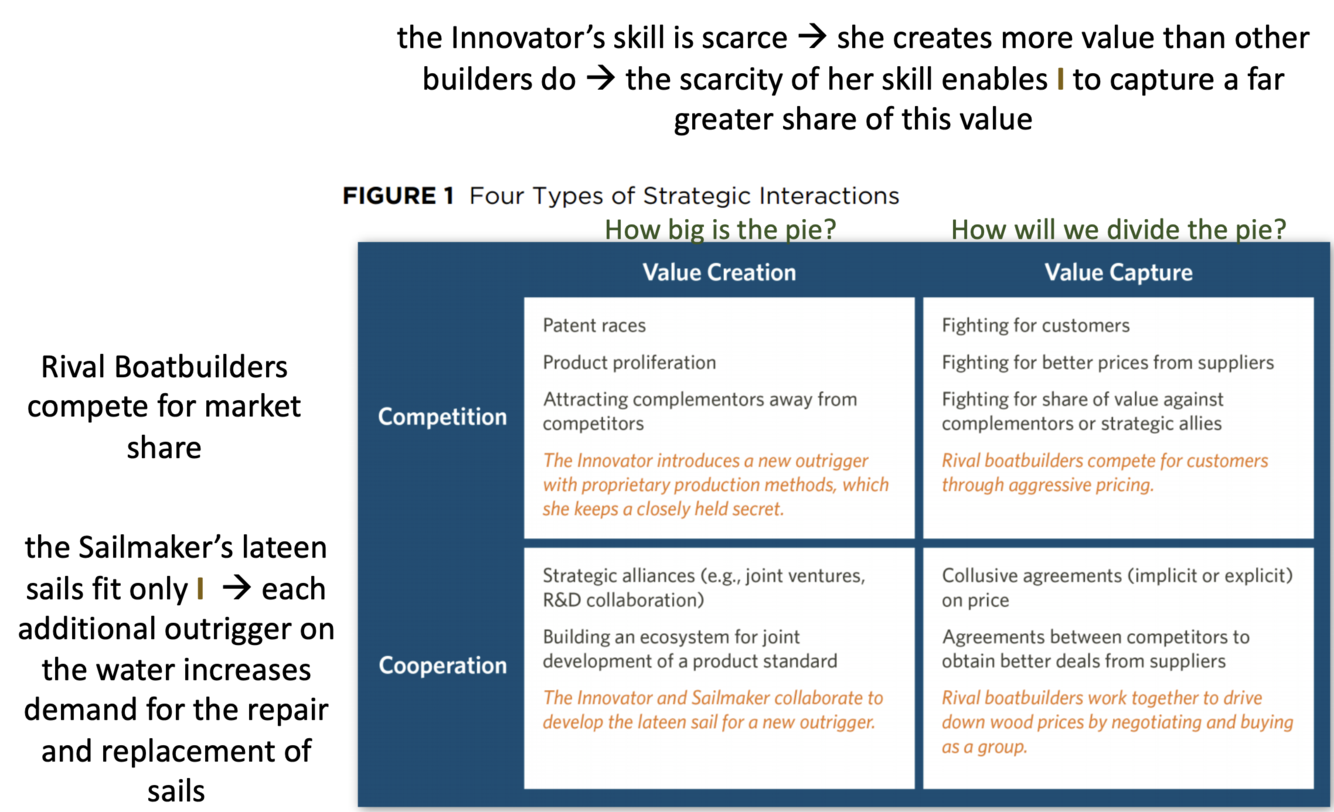
Cooperation and competition are not rigid boxes:
- Competition and cooperation are mirror-image concepts, and both must be incorporated into strategy.
- A given relationship may be manifested in more than one quadrant in the matrix. A cooperative dynamic can also be competitive, and vice versa.
- Co-opetition: Cooperation and competition can co-exist in the same interaction!
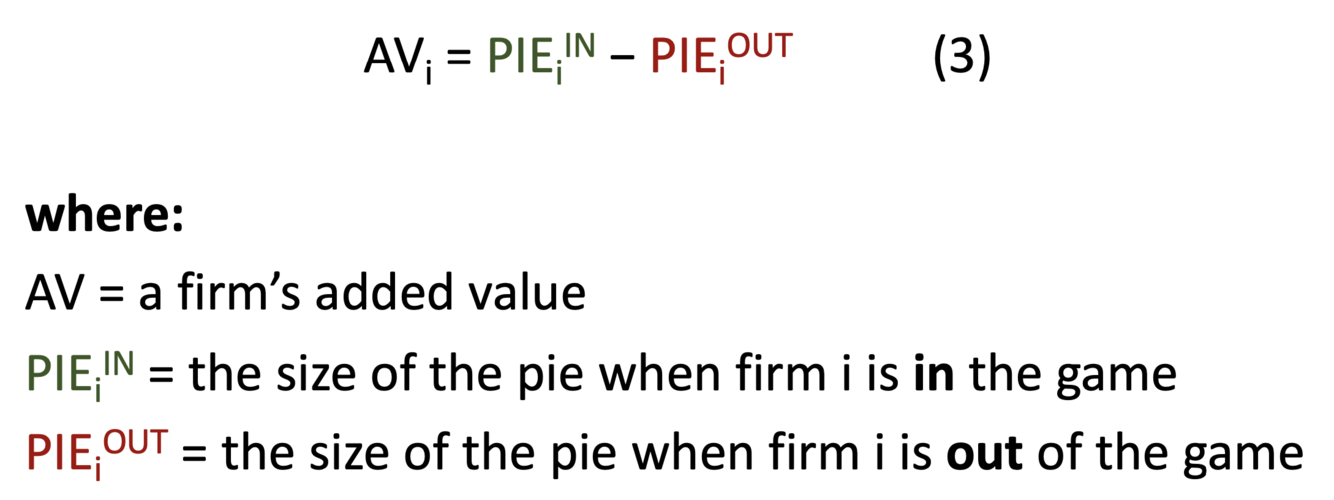
Game of strategic interaction 1st Step: Added Value
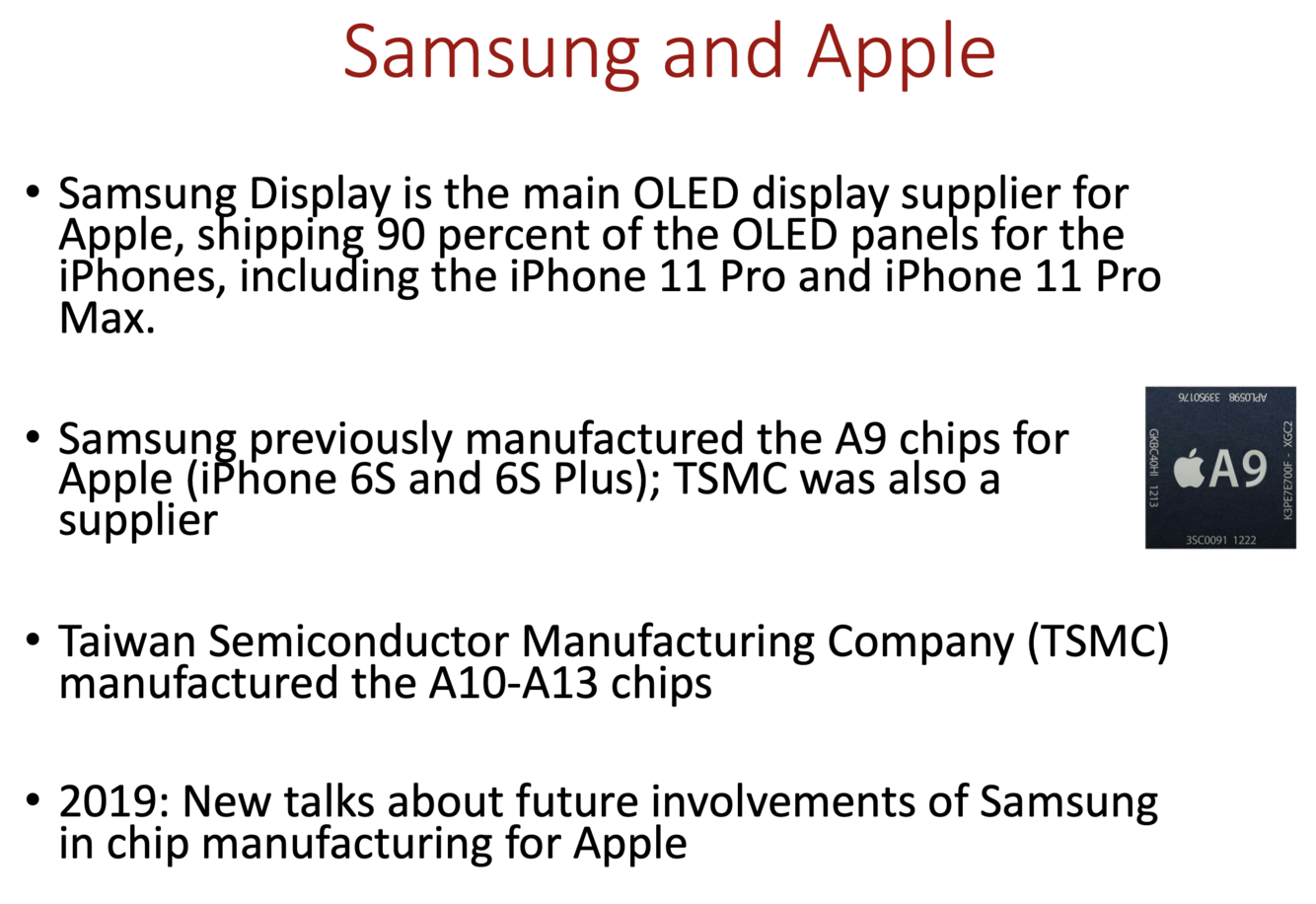
Game of strategic interaction 2nd Step: Anticipating the Game
There are three analytical tools to try to anticipate the game:
- Analysis of interdependencies: What choices can each player make and what are the consequences of those choices for other players?
- Player analysis: How does each player see its world and its choices?
- Game theory: What are the economic outcomes of various scenarios, and how do they affect each players likely choices?
Analysis of interdependencies:
The exact points at which the business model of one firm touches the business model of another. Forces the strategist to ask the following questions:
- What key choices and consequences in our business models will shape the game?
- What can we do against each other, and what can we do with each other?
Understanding business models and their interdependencies may determine what game is most likely to be played— competitive; cooperative; or, as is often the case, a mix of the two and what plays should be considered.
Complementors =
Companies in one industry whose products or services increase the value of products or services of companies in another industry.
Interactive Simulation 1: Innovator’s business model
- Diagram depicts a firm’s key choices and their consequences
- Together, the choices and consequences should represent the economic logic, or business model, of the firm
- A full rotation of the green dots represents a quarter year
- Shows how the boatbuilder’s profits over time are affected by her choices about pricing and product improvements (R&D spending, price, exclusive relationships with supplier and complementor)
Should Innovator (I) have an exclusive relationship with complementor (C) [the Sailmaker] and supplier (S) [the Woodcutter]?
Yes.
higher quality => higher WTP => lower unit sales but higher profit => higher spend on R&D => higher quality…
Should price increase or decrease? (all other things constant)
Increase. As the manufacturer has the monopoly, it will not affect sales.
higher spend on R&D => higher quality => higher WTP => lower unit sales but higher profit => higher spend on R&D
Should R&D spending be low or high when price is low/average/high?
- Low price: profit will be low w/ low R&D spending because of low WTP. Same for high R&D but higher WTP and unit sales
- Average price: profit will be good but not optimized with low R&D. Same w/ high R&D (but slightly higher WTP and unit sales)
- High price: needs high R&D spending or there will be no WTP
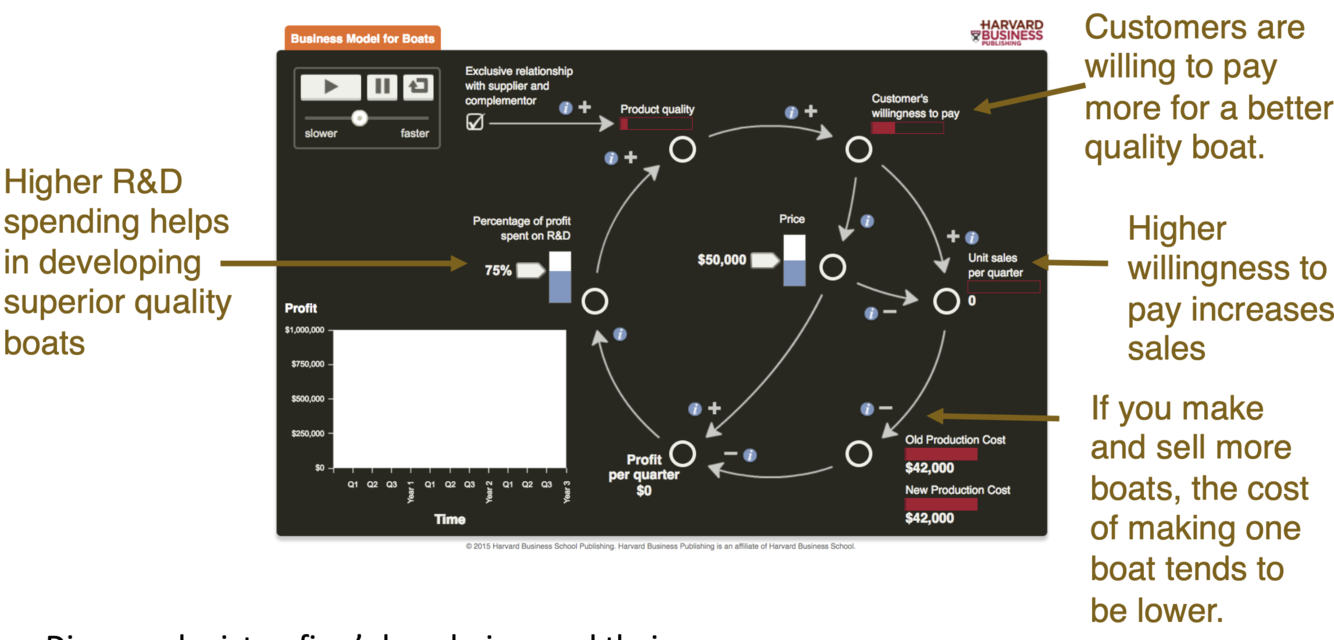
Business Simulation Take-Aways:
- By investing in the outrigger design and building a strong ecosystem with S and W**, **I has created a superior product for which fishermen are willing to pay a premium
- I’s business model sets off a virtuous cycle, enabling her to invest in new generations of outriggers and thus reinforcing her advantage
- As long as the I, W, and S cooperate and minimize any competition for the pie, it will be difficult for others to copy them and claim a share of the value
- Thus, several of her rivals drop out of boat building completely, perhaps becoming fishermen themselves.
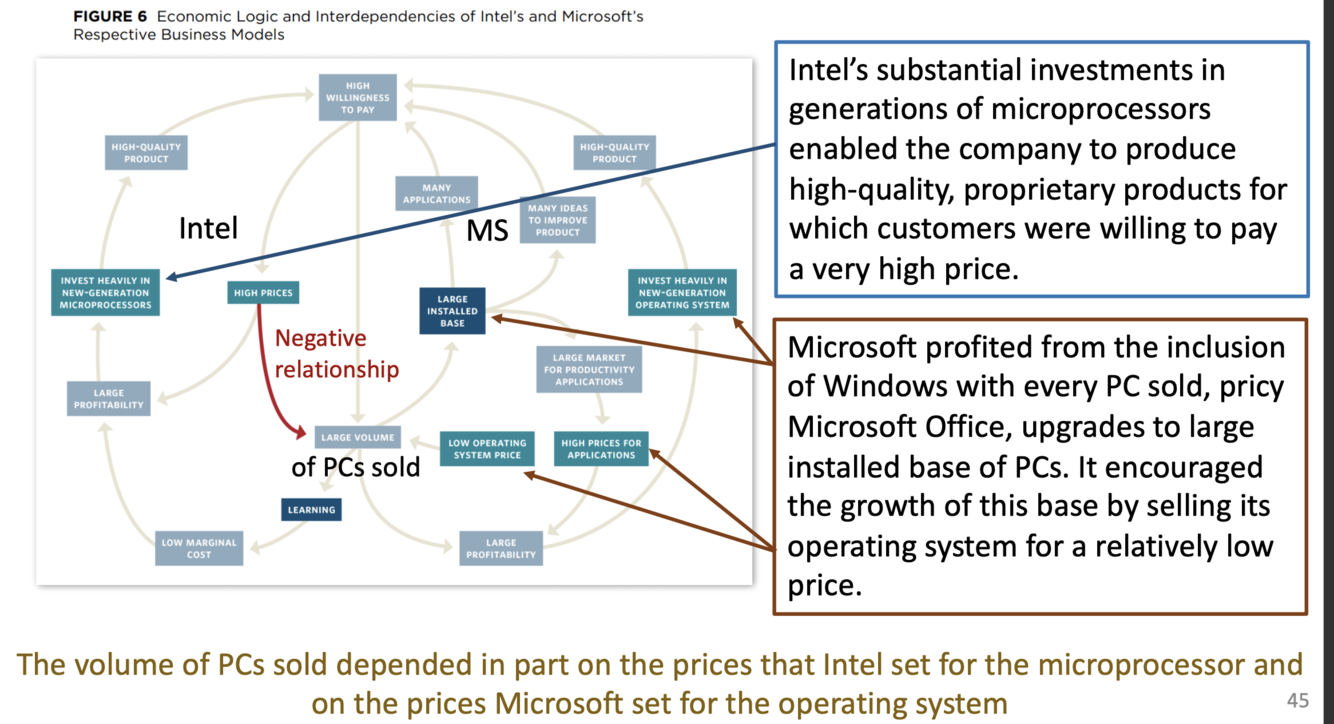
Interdependencies: Intel – MS Example
One of the remaining boatbuilders in the village, a Newbie (N), cracks the code to the Innovator’s design and enters the market!!
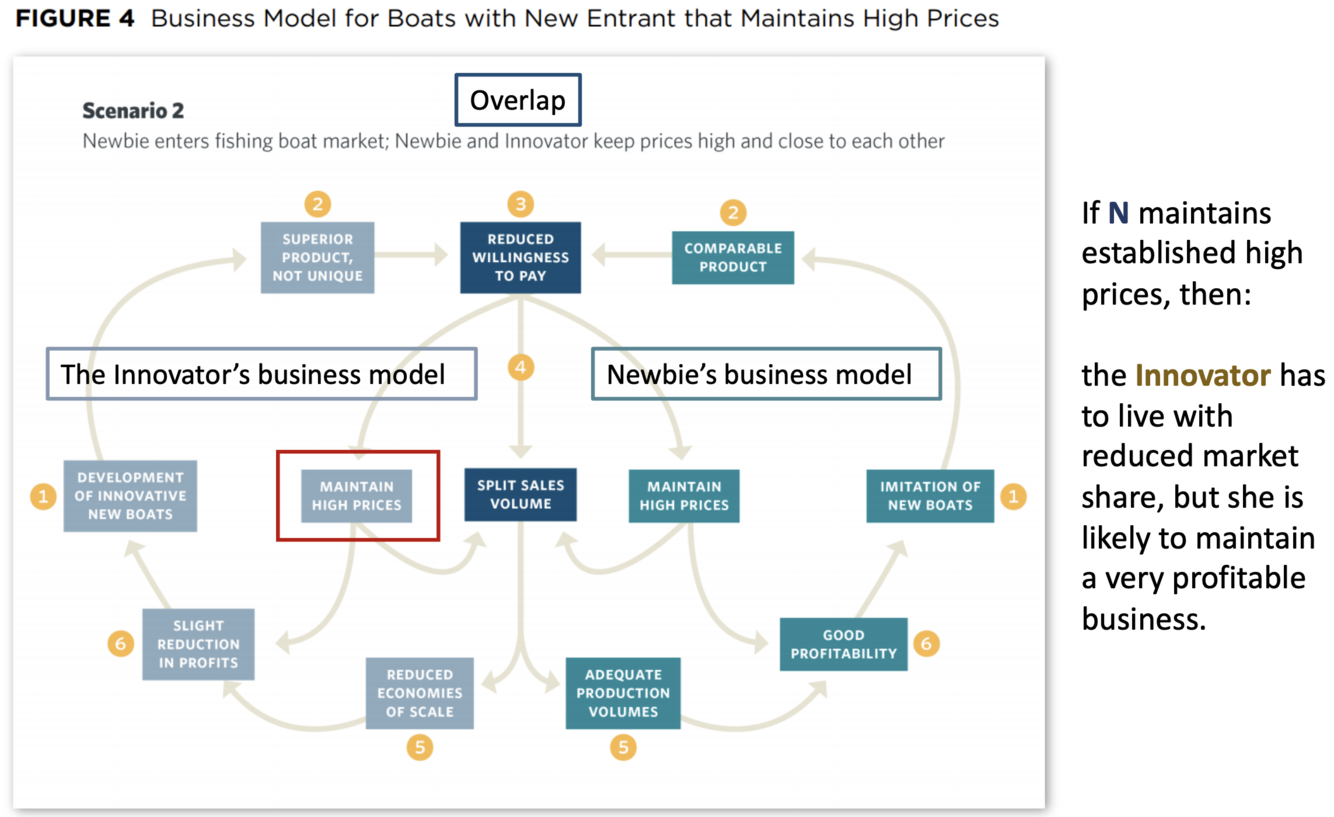
What are the 2 possible scenarios?
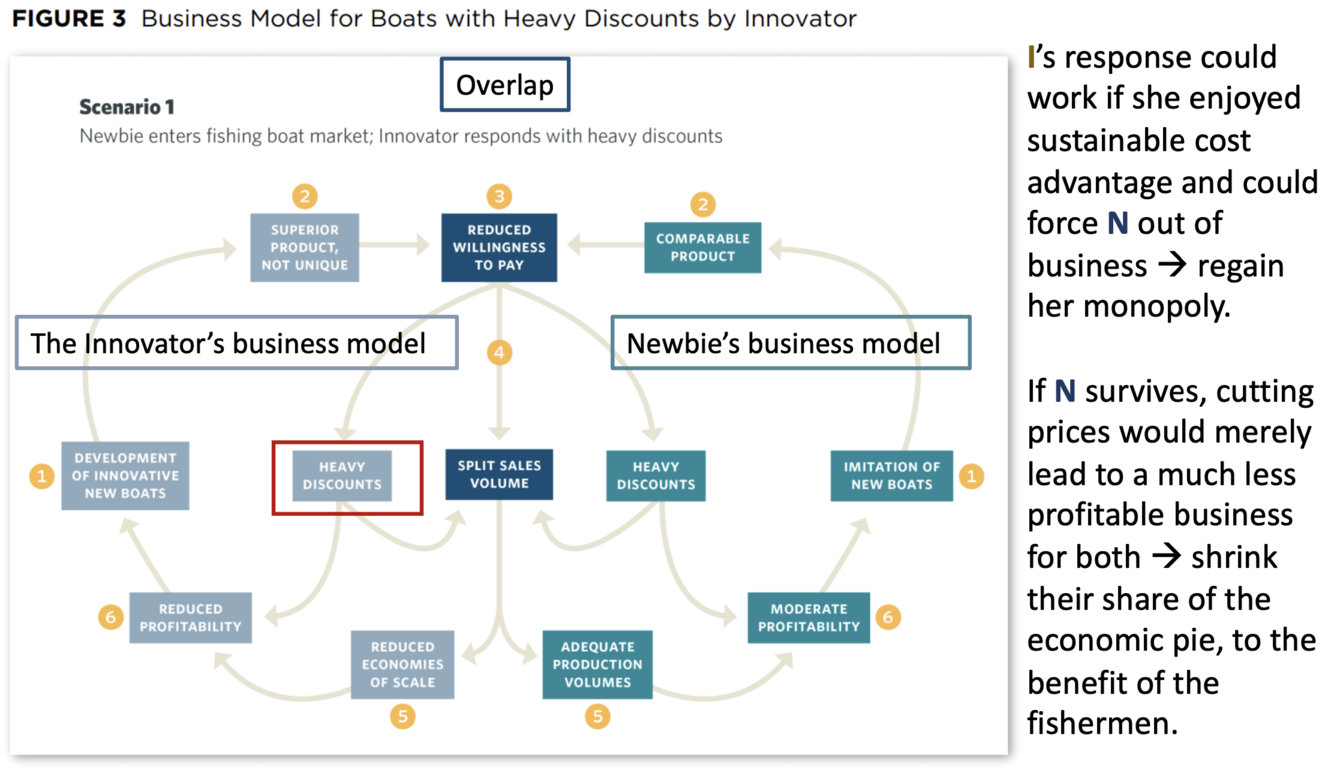
- Scenario 1: N enters market & I cuts prices
- Scenario 2: N enters market, I accepts situation
Game of strategic interaction 3rd step: Preparing for the game:
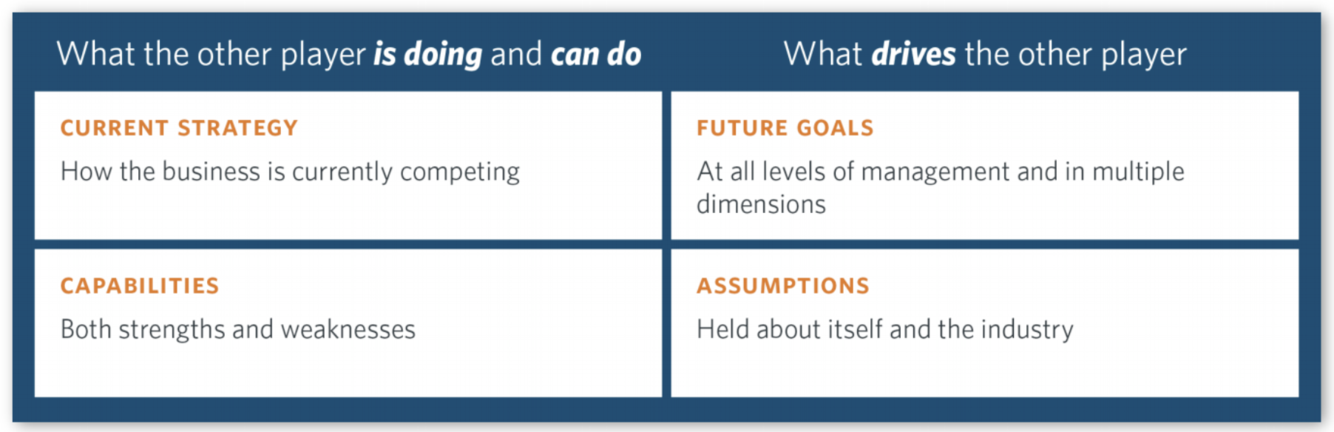
Player analysis
Analysing business models and their interdependencies is not enough—other players may have distinct perspectives or goals that might shape their choices.
The purpose of player analysis is to develop insights into the following questions:
- What is the other player’s perspective on its potential choices?
- Will this perspective lead it to a particular choice?
Porter’s integrative framework for Player Analysis:
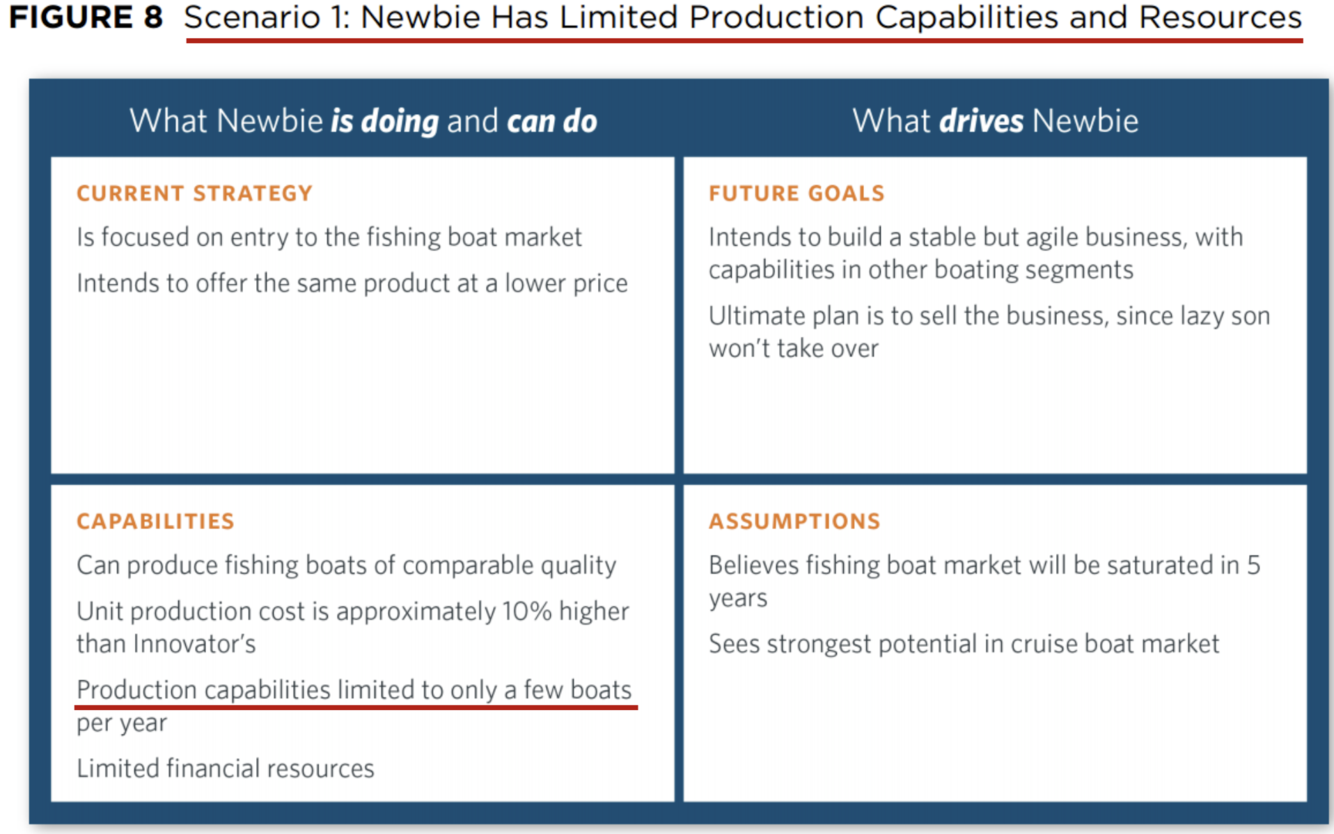
Player Analysis Scenario 1: Newbie has limited production capabilities and ressources
- Threat to the I’s market share is modest
- I may be better off keeping her outrigger prices higher
- Peaceful, long-term coexistence
- Future acquisition opportunity
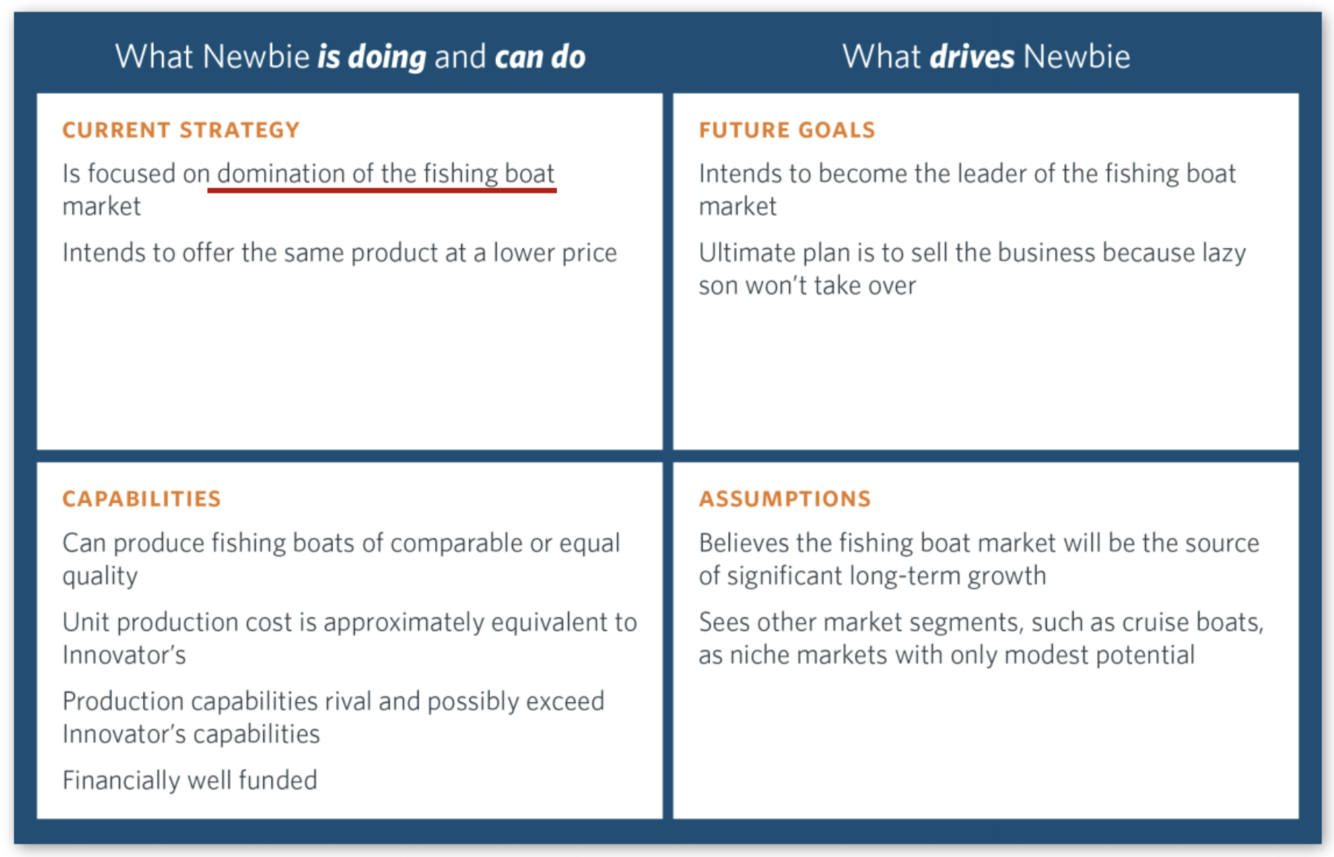
Player Analysis Scenario 2: Newbie wants to dominate the fishing boat market
- Protecting I’s profits and comfortable position as market leader becomes much more difficult.
- I would try to choose actions that optimise her economic payoff
Game of strategic interaction 3rd step: Preparing for the game:
Game Theory
Purpose: determining how various players value and thus make choices
- Involves three basic elements: players, actions, and payoffs
- Helps us think through the following questions:
- For every outcome, what is the payoff for each player
- What is each player’s best choice given what the other
*
Two basic ways to represent a game:
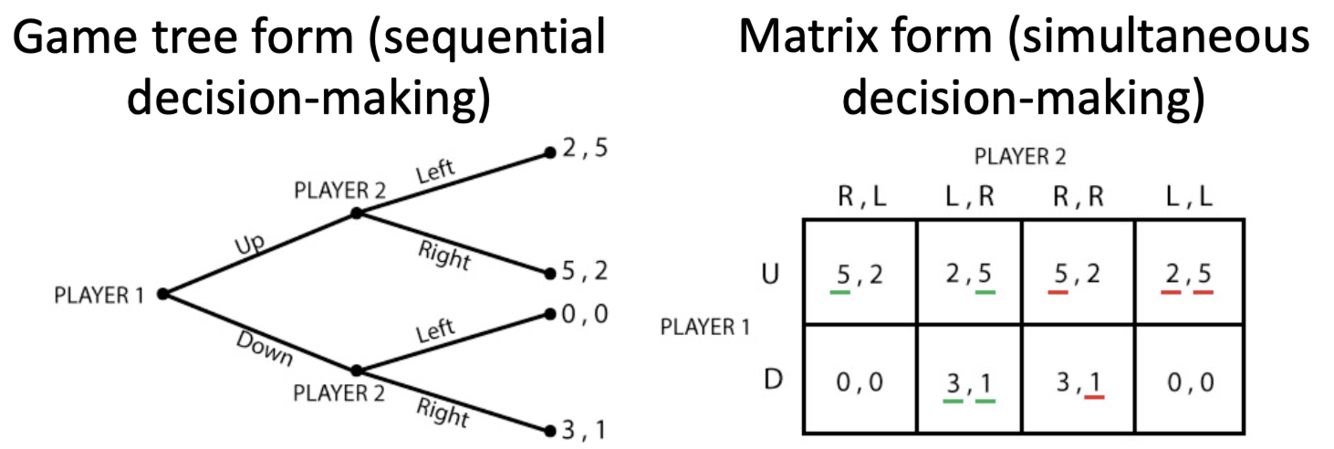
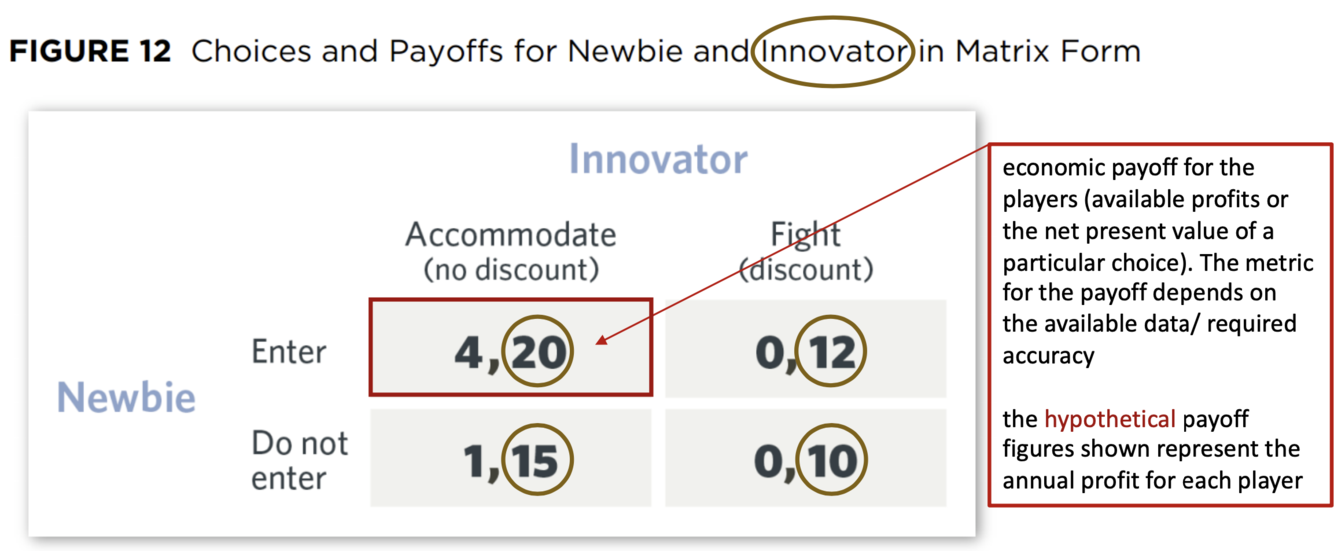
Accomodation/Fight: Matrix form of Choices and Pay-offs for I and N
Each player has an obvious (dominant) strategy: a rational choice with a better payoff no matter what the other player chooses.
- The Innovator should never discount, whether Newbie enters the market or not.
- Newbie should always enter, whether the Innovator discounts her price or not.
The solution to this game is straightforward:
- Newbie will enter the fishing boat market, and the Innovator will accommodate him by keeping prices high.
- If the Innovator goes through this analysis, she will conclude that Newbie will enter. If Newbie does the same analysis, he will see that the Innovator will never discount. Here, each player has a clear choice.
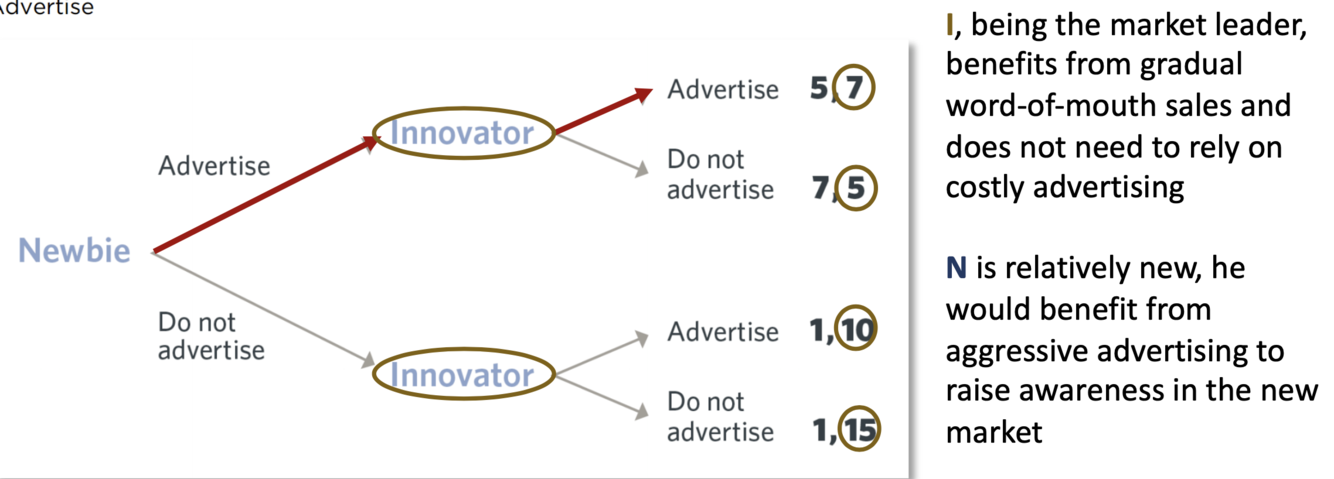
Backward induction solution game: Decision to Advertise
What happens when one player’s choice is not clear and depends on what the other player chooses? N has entered the fishing boat market and has taken some share from I
Game tree form because I will wait for N to take action
- The Innovator prefers that no one advertises, but should advertise if Newbie does
- Newbie should advertise
Two Nash Equilibria game :
I and N now consider two potential new market segments: holiday cruise boats and trading boats. Each firm has resources to build manufacturing facilities for just one market, and neither is able to wait and see what factory the other builds => make their decisions simultaneously
Best choice for each player depends on the other player’s choice
If both pursue different market segments, N and I are better off and have reached one of the two equilibria and have no reason to change their choices
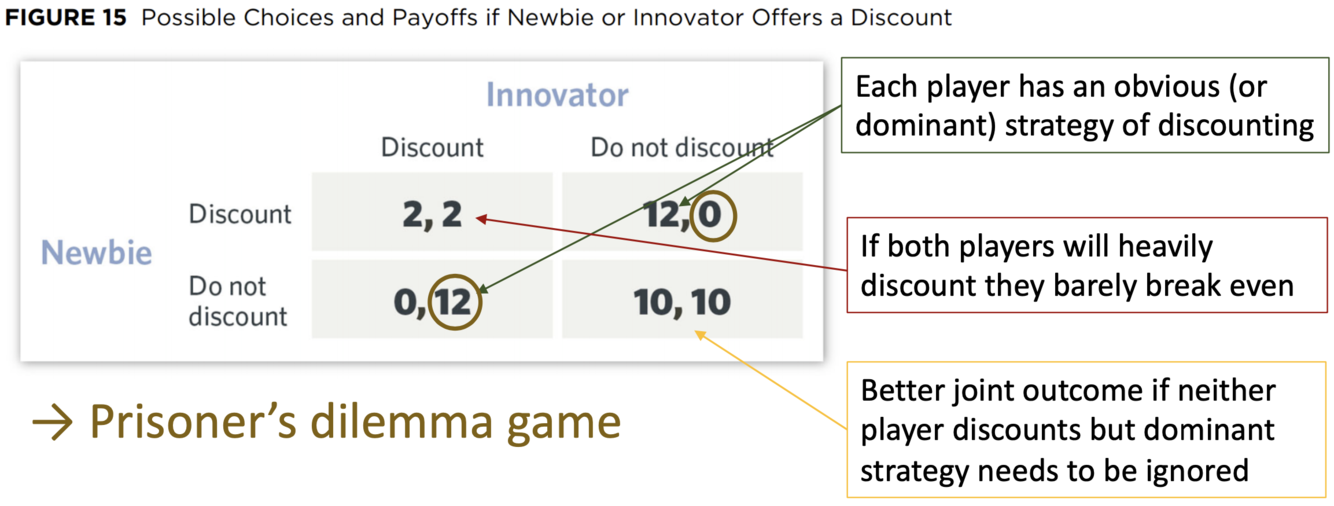
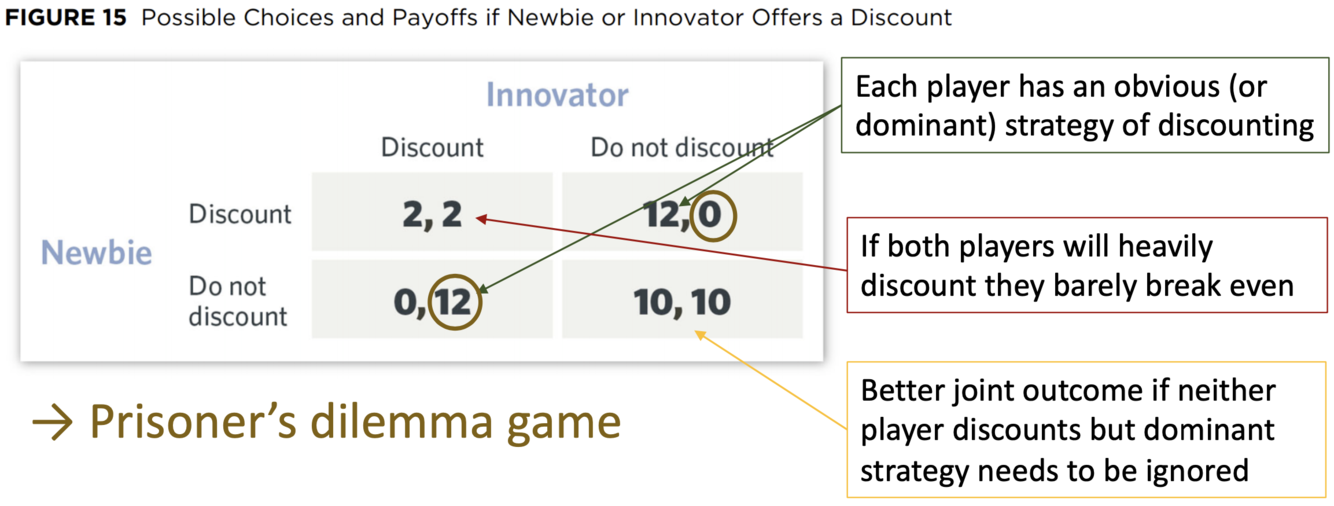
Prisoner’s dilemma game: to Discount or not discount
The fishing boat market in the village and the islands has matured, and only a few more sales can be made. I and N now have reason to discount the fishing boat in order to claim the few selling opportunities available, and they must announce their prices before the selling season starts
Definition: Paradox in decision analysis in which two individuals acting in their own self-interests (dominant strategy) do not produce the optimal outcome. The typical prisoner’s dilemma is set up in such a way that both parties choose to protect themselves at the expense of the other participant. As a result, both participants find themselves in a worse state than if they had cooperated with each other in the decision-making process
Playing to Win:
In order to create a sustainable competitive advantage, we can change payoffs or even the scope of the game.
There are three key levers to do that:
- Creating commitment and capabilities
- Changing the scope of the game
- Changing the boundaries by linking games






