anatomical effects of edentulism
- bone resorption
- profile changes
- loss of muscular support
- reduction in face height
physiological effects of edentulism
- reduced incising efficiency
- reduced masticatory fucntion
- loss of proprioception
- decreased swallowing efficiency
- redcution in speech quality
av bone loss
incisors
6.5mm
av bone loss
canines
8.5mm
av bone loss
premolars
10.5mm
av bone loss molars
12.5mm
Atwood and Howell
Ridge Classification
I
pre-extraction - dentate
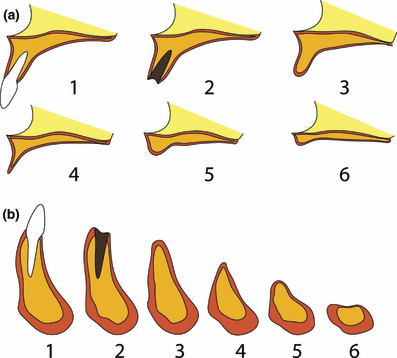
Atwood and Howell
Ridge Classification
II
post-extraction - immediately edentulous
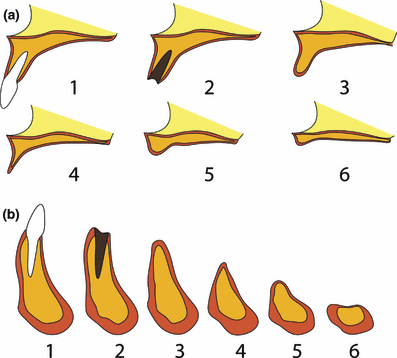
Atwood and Howell
Ridge Classification
III
high well rounded
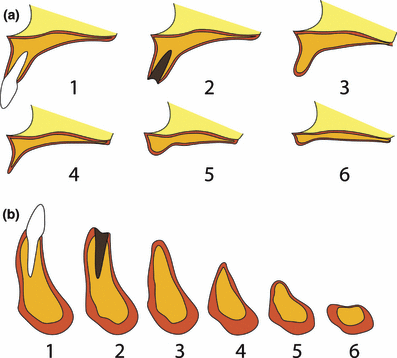
Atwood and Howell
Ridge Classification
IV
knife edge ridge
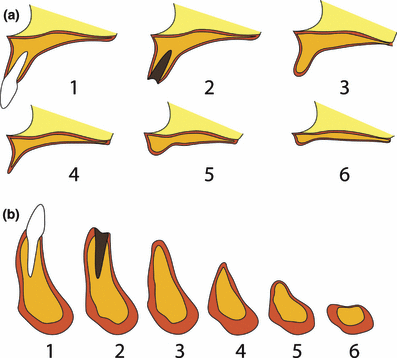
Atwood and Howell
Ridge Classification
V
low well rounded
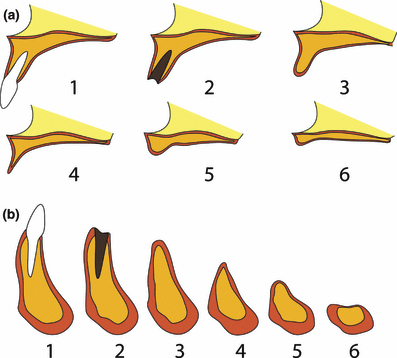
Atwood and Howell
Ridge Classification
VI
depressed
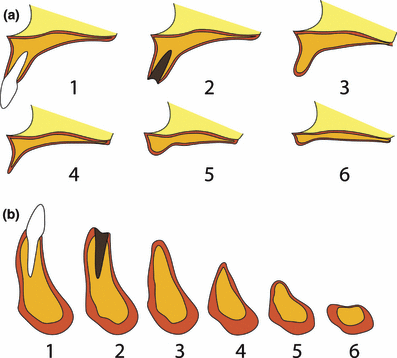
design principles for C/C denture
R etenion
E xtension
S upport
S tability
A esthetics
O cclusion
retention
definition
resistance to vertical displacement of the denture away from the edentulous ridge
retention provided by
accurate fit
border seal
retromylohyoid area - in lower jaw
extension of upper complete denture
suclus depth all way round
avoid frenal attachments
palate of denture should extend to vibrating line (junction of hard and soft palate, 1-2mm anterior to the palatine fovea)
extension of lower complete denture
sulcus depth all the way round
avoid frenal attachments
2/3 onto the retromolar pad and into the retromylohyoid area
support
definition
resistance to vertical displacement of the denture toweards the denture bearing tissues
support provided by
(upper complete)
residual ridge
hard palate
support provided by
(lower complete)
residual ridge
buccal shelf
anterior 2/3 retromolar pad
stability
definition
resistance to horizontal displacement of the denture
stability provided by
adequate extension of the denture
using the retromylohyoid area (lower)
balance occlusion
utilising the muscular forces in the neutral zone
- lips and cheeks press in from the outside
- the tongue from the inside
2 factors of C/C aesthetics
shade of teeth
- translucency
- value
- hue
- chroma
profile
- lip support
- creating a normal lateral view of the pt
Balanced Occlusion - Hanau’s Quint
C ompensating curve
O rientation of the occlusal plane
C uspal angle
C ondylar guidance angle 30o
I ncisal guidance angle 15o

-
ANATOMY111
-
Oral Sugery p32380
-
Overview of LA Techniques p20060
-
Cardiovascular system116
-
complete dentures70
-
decontamination 8756
-
dental materials 93310
-
drugs 13726
-
endocrine physiology p13895
-
dermatology p12451
-
dx in endodontics p14991
-
evidence based dentistry p16233
-
GI and hepatological system p1740
-
Haematology p18658
-
immunology p1930
-
LA science 21022
-
microbiology 22775
-
neurology p23776
-
oral biology p2470
-
oral function and dental development p25377
-
oral med and pathology p262 (275)140
-
analgesia in dentistry 3230
-
MOS minor oral surgery 327 (331)80
-
ortho3770
-
paeds 43093
-
SCD p6290
-
substance abuse8
-
Diseases191
-
Special Investigations23
-
Key729
-
past papers quick notes206
-
RPD p62256
-
maxilla anatomy18
-
mandible anatomy15
-
complete dentures glossary21
-
DMS Properties32
-
2020171
-
restorative179
-
SOP15
-
TRAUMA permanent89
-
paeds130
-
pros71
-
oral med239



