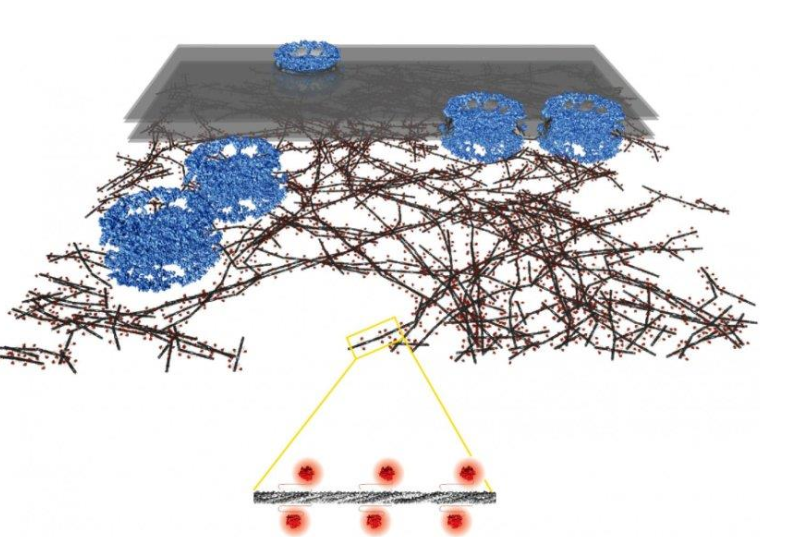
What structure is in red? What structure is in green?
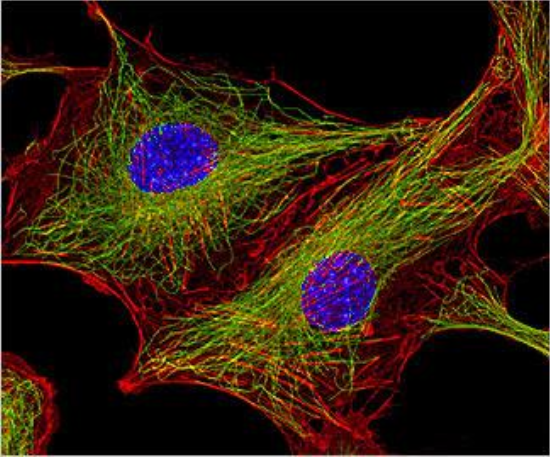
Red = F-actin
Green = microtubules
Complete the attached table.
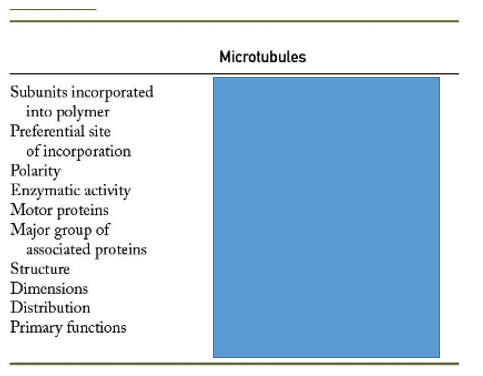
GTP alpha/beta tubulin heterodimer
+ end
Yes
GTPase
Kinesins, Dyneins
MAPs
Stiff, hollow center
25nm diameter
All eukaryotes
Support, intracellular transport, cell organization
Complete the information in the table for intermediate filaments
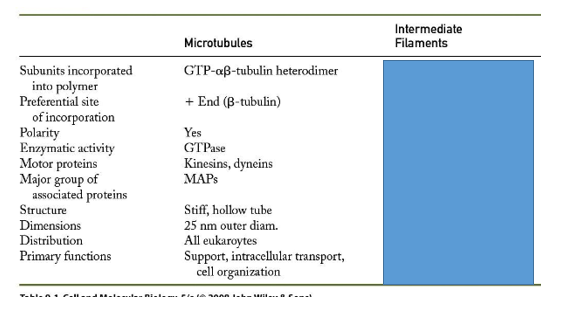
Various globular proteins
Internal
No
None
None
Plakins
Tough, ropelike
10nm
Animals
Structural support
Complete the following table for actin.
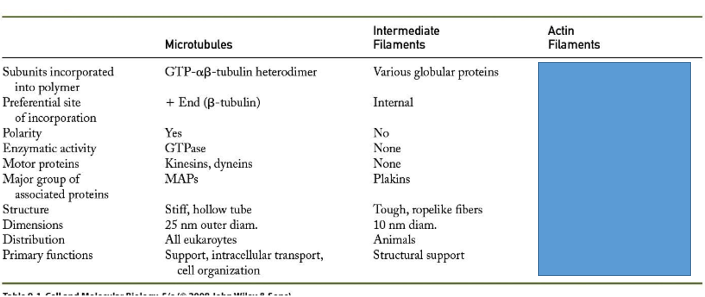
ATP-actin monomers
+ end
Yes
ATPase
Myosins
Actin-binding proteins
8nm
All eukaryotes
Motility, contractility
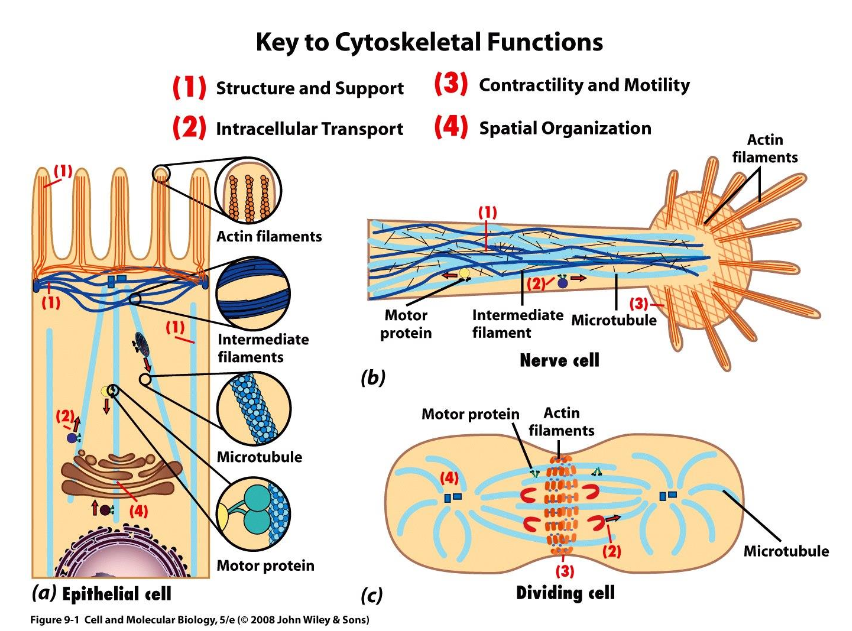
What are the 4 key features of the cytoskeleton?
- Structure and support
- Intracellular transport
- Contractility and motility
- Spatial organization
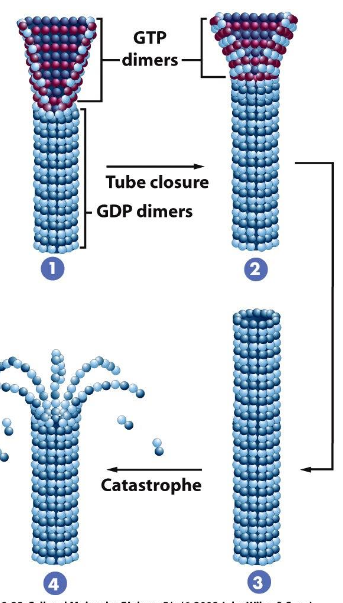
Describe the structure of an individual microtubule
- A heterodimer of alpha and beta subunits
- Alpha and beta subunits both form alpha helices so they come together as a coiled coil to form a microtubule
- In a cross-section of microtubule, there are 13 subunits visible
- Globular protein
Describe the dynamic nature of a microtubule.
New subunits can be added to the positive end such that it grows some, becomes unsable and degrades some, and then extends some more
What causes dynamic instability in microtubules?
Once new alpha/beta subunits are added to the + end of microtubule, they hydrolyze their GTP to GDP + Pi, releasing energy. Some of this energy does into deforming the tubulin subunit, causing it to be most stable in a slightly curved state. This creates excess pressure on the microtubule as new subunits are added up stream of this happening and the microtubule is made unstable and collapses spontaneously.
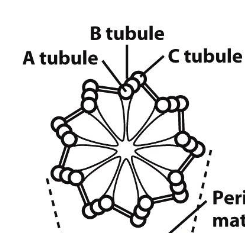
Describe the structure of a centriole.
A centriole is made up of 9 clusters of microtubules. Each cluster consists of an A, B, and C tubule. The A tubule (closest to center) has 13 subunits, while B and C each have 10 subunits. They are connected to the one another by proteins that form a web like structure inside the centriole.
What is the centrosome?
The microtubule organizing center - all microtubules have their (-) ends attached to the centrosome. The centrosome consists of 2 centrioles.
What is the purpose of gamma tubulin?
Gamma tubulin is found only near the (-) end of the microtubule. It is added to proteins that anchor the microtubule to the MTOC and it provides a place to initiate polymerization of the microtubule using alpha and beta tubulin.
Kinesins
- Where do they transport cargo?
- Is their motion processive (never detaches from microtubule)?
- What do they use to power their motion?
- What is the purpose of the heavy chain?
- What is the purpose of the light chain?
- Toward (+) end of microtubule
- Yes
- GTP
- Catalytic core, binds to microtubule and provides motion
- Confers specifiticy for cargo that binds to kinesin
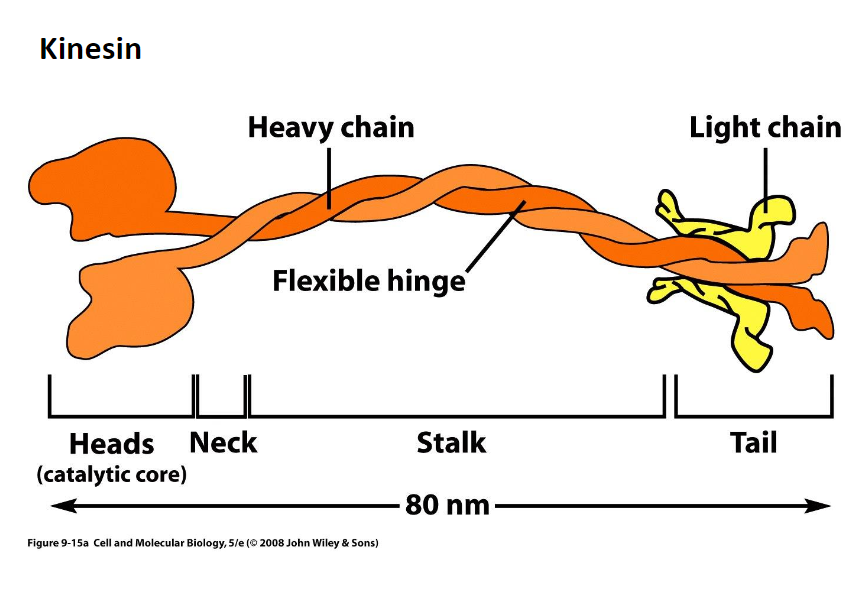
Describe how Kinesins work.
Head has GDP bound. Head recognizes microtubule via brownian motion (random). The head binds to the microtubule and releases GPD and binds GTP. This causes it to anchor to the microtubule. This gives the other head the chance to attach to the microtubule also. Once both heads bound, one hydrolyzes GTP to GDP + Pi, head dissociates and the released energy is used to catapult the head forward along the microtubule. Process repeats.
Dynein
- In what direction do they transport cargo?
- Do they require energy?
- Describe their mechanism of movement.
- Toward the (-) end
- Yes - they are also GTPases
- Their mechanism is the same as Kinesin
Are cellular contents always carried by only 1 kinesin or dynein?
No - some transport cargo require multiple kinesins and dyneins
Cilia
- What regulates the “beating” of cilia?
- Describe the action of motile (secondary) cilia?
- Ca2+
- There is a power stroke and a recovery stroke. During power stroke, cilia propel things like particles (respiratory) and food (intestines) forward and then flop back to their starting position in the recovery stroke.
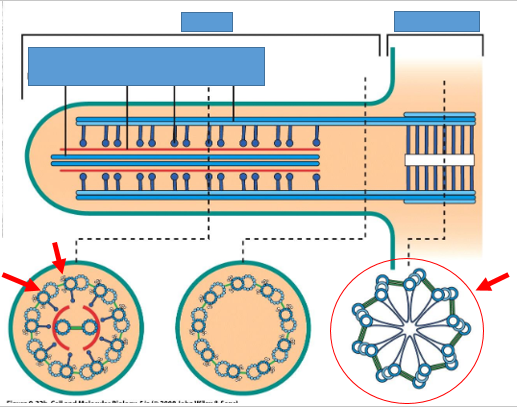
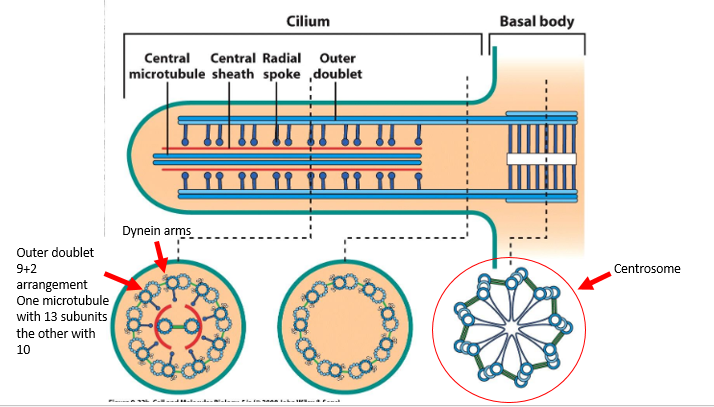
Label this image.
Why are the dynein arms so important in secondary cilia?
They are bound to the microtubule duplexes and they provide the force for movement of the cilia (GTPase activity) by causing the microtubule duplexes to slide past one another (attached between adjacent A and B tubules). Doing so causes the cilia to curve b/c the are fixed at the bottom by the basal body so they curve in a direction such that, in the attached image for example, the cilia would “beat” from 12 to 6 if this were a clock.
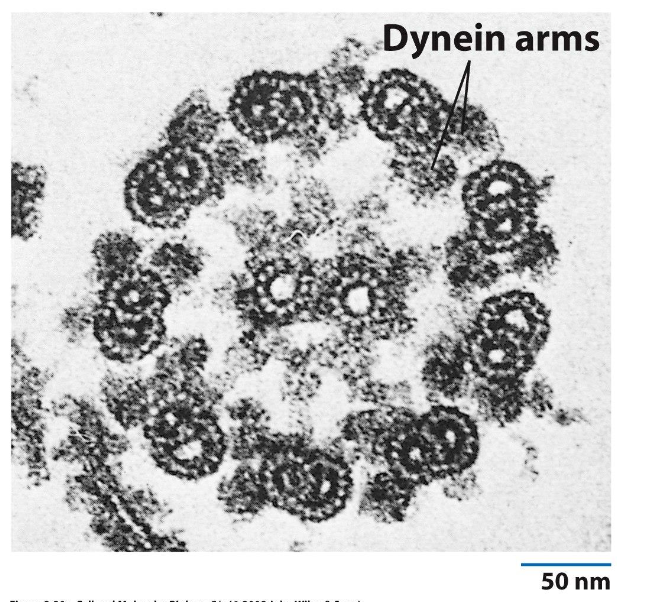
Label this image.
A - Innner dynein arm
B - Outer dynein arm
C - Interdoublet bridge
D - Central microtubule
E - Radial Spoke
F - B Tubule
G - Outer Doublet
H - A tubule
I - Central Sheath
J - Plasma membrane
Kartagener syndrome is a disorder of motile cilia. It is also known as primary cilia dyskinesia, where the primary does not mean “primary cilia”, but rather that the cilia dysfunction is the primary cause of disease.
- What structure in the cilia is altered that leads to this dysfunction?
- What symptoms would you expect patients with this disease to have?
- Autosomal recessive inheritance of mutant allele that encode for components of outer dynein arm of cilia
- Lung infections, chronic sinusitis
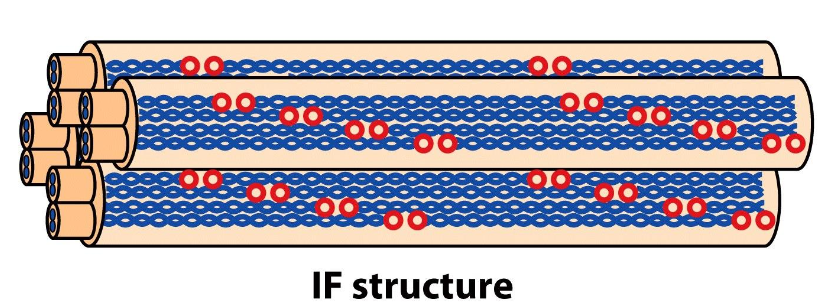
Describe how intermediate filaments are formed.
Single IF monomer subunit (alpha helical structure) associates with another subunit to form dimer. 2 dimers associate to form tetramer. Tetramers (fibrils) associate to form fiber.
Do intermediate filaments have a + or - end?
No
What are 4 important types of intermediate filaments we should know?
Keratin
Glial fibrillary acidic protein
Neurofilament proteins
Lamin proteins
What do lamin proteins do?
They give structure and support to the nucleus and it is believed that they help organize the chromatin in the nucleus so that gene rich chromatin is organized in a way that is conducive for transcription and gene-poor chromatin is buried inside the nucleus away from transcription machinery.



-
Homeostasis15
-
Overview Of Cells21
-
Intro to Proteins I1
-
Intro to Pharmacokinetics43
-
Intro to Lipids24
-
Intro to Proteins II19
-
Intro to enzymes12
-
Intro to tissues12
-
Chromatin Structure33
-
Nucleic Acid18
-
Proteins III21
-
Cell Membrane Structure20
-
DNA Replication24
-
Intro to Histology3
-
RNA Transcription24
-
Translation and Processing23
-
Human Chromosomes15
-
Intro to Mitosis and Meiosis18
-
Gene Regulation25
-
Mendelian Inheritance20
-
Non-Mendelian Inheritance31
-
DNA Mutagenesis22
-
Other RNAs12
-
Epigenetics0
-
Molecular Diagnostics23
-
Gene Therapy26
-
Intro to Receptors and Signaling16
-
Cytoskeleton32
-
Gene X6
-
Introduction to Signaling14
-
Intracellular Transport14
-
Signaling 114
-
Signaling 25
-
Cell Junctions17
-
Cell Cycle 17
-
Cell Death and Differentiation30
-
Cell Cycle 25
-
Cell Adhesion and Motility13
-
Intro to Energy Substrates20
-
Glycolysis3
-
TCA Cycle8
-
OxPhos9
-
Gluconeogenesis8
-
Glycogen Metabolism12
-
Pentose Phosphat & ROS12
-
Mono and Disaccharides6



