At what stage of the cell cycle does DNA replication occur?
The S phase
What does it mean to say that DNA replication is semi-conservative?
Each DNA strand serves as a template for the synthesis of a new strand, producing two new DNA molecules, each with one new strand and one old strand
What does it mean to say that DNA replication is semi-discontinuous?
Due to anti-parallel orientation of double stranded DNA, one strand is 5’ –> 3’ and the other is 3’ –> 5’. Cellular machinery is only able to synthesize new DNA in the 5’ –> 3’ direction, so one strand is sythesized continuously while the other is synthesized in pieces and joined together later.
Prokaryotes
How many DNA polymerases?
In what direction do they synthesize? In what direction do they proofread?
7+ different isozymes
5’ to 3’
3’ to 5’
What is a processive DNA polymerase? What is a distributive DNA polymerase?
Processive = adds a lot of bases
Distrubutive = adds only a few bases (DNA repair)
What is an exonuclease? What is an endonuclease?
Exo: can only degrade from the end of the DNA and work its way in one direction (start at 5’ or start at 3’)
Endo: Can begin to degrade DNA from internal site within the DNA sequence
Exonucleases
- When an exonuclease works in the 5’ to 3’ direction, what is it doing?
- When an exonuclease works in the 3’ to 5’ direction, what is it doing?
- Removing primers
- Proofreading
Prokaryotes
- All DNA polymerases require a ___ to initiate replication
- Which DNA polymerases elongate DNA? One of these does most of the elongation, which one is it?
- Which DNA polymerases have 3’ to 5’ exonuclease activity?
- Which DNA polymerase has 5’ to 3’ exonuclease activity?
- Primer
- I, II, III, III
- Proofreading = I, II, III
- Primer removal = DNA Pol I
Prokaryotes
- Function DNA Pol I
- Function DNA Pol II
- Function DNA Pol III
- Removes primer, fills gaps after primer is removed, clean up
- Repair
- Principal replication enzyme
DNA PolymerasesFunctionProkaryotesEukaryotes Priming DNA A B Synthesis of leading strand C D Synthesis of initial Okazaki fragment strand E F Synthesis of remaining Okazaki G H Gap filling after primer removal I J
A - DnaG primase
B - Pol alpha / primase
C - Pol III
D - Pol delta
E - Pol III
F - Pol alpha/primase
G - Pol III
H - Pol delta
I - Pol I
J - Pol delta
What do all DNA polymerases require in order for replication to occur? (2)
- Primer
- Template
How is a free nucleotide added to the growing chain of DNA?
3’ OH of DNA attacks incoming phosphate of nucleotide, phosphodiester bond formed
Prokaryotes
- DnaA protein
- DnaB Protein
- DnaC protein
- HU protein
- FIS protein
- IHF protein
- DnaG protein
- SSB protein
- DNA gyrase
- Recognizes ori sequence (origination), opens duplex at specific site
- Helicase, unwinds DNA
- Helps DnaB bind at origin
- Histone like protein - binds to DNA and stimultes initiation
- Binds to DNA, stimulates initiation
- Binds to DNA, stimulates initiation
- Primase, synthesizes RNA primers
- Single stranded binding protein
- Relieves torsional strain during DNA unwinding
Prokaryotes
What is the DUE site?
DNA Unwinding Element (DUE) - area in DNA that is rich in A=T bonds, serves as binding site for DnaA (recognizes DUE site, opens duplex to start replication)
Prokaryotes
Describe the process of termination.
2 replication forks meet at sequence called Ter –> trap fork so that it can’t proceed forward any further –> halts DNA Pol III –> final few hundred base pairs are synthesized and replisome dissociates from DNA –> Interlinked circular DNA strands are separted using Topo II
What are 4 factors that affect fidelity (the degree of exactness with which something is copied or reproduced) of DNA replication?
- Thermodynamic factors in base pairing (hydrogen bonds I assume…)
- Stereospecific effects of DNA polymerization
- Proofreading
- DNA Repair
Polymerase α Polymerase β Polymerase δ Polymerase ε Polymerase γ Polymerase ζ 3’ to 5’ exonuclease activity essential to nuclear replication Location function
Polymerase α Polymerase β Polymerase δ Polymerase ε Polymerase γ Polymerase ζ 3’ to 5’ exonuclease activity No No Yes Yes Yes No essential to nuclear replication Yes No Yes Yes No No Location Nucleus Nucleus Nucleus Nucleus Mitochondrion Nucleus function Primase Repair Replicase Replicase (lagging strand) Repair
Eukaryotes
Function of pol alpha
Lays down the RNA primer and a few DNA nucleotides thereafter, then drops off of template
Eukaryotes
Function of Pol delta
Synthesizes DNA strand, has 3’ to 5’ exonuclease activity, REPLICATES EITHER LEADING OR LAGGING STRAND
Eukaryotes
Function pol epsilon
Replaces DNA polymerase delta in some situations, such as in DNA repair. DNA polymerase ε may also function at the replication fork, perhaps playing a role analogous to that of the bacterial DNA polymerase I, removing the primers of Okazaki fragments, error correction
Eukaryotes
Function Pol Beta and Zeta
Involved in DNA repair
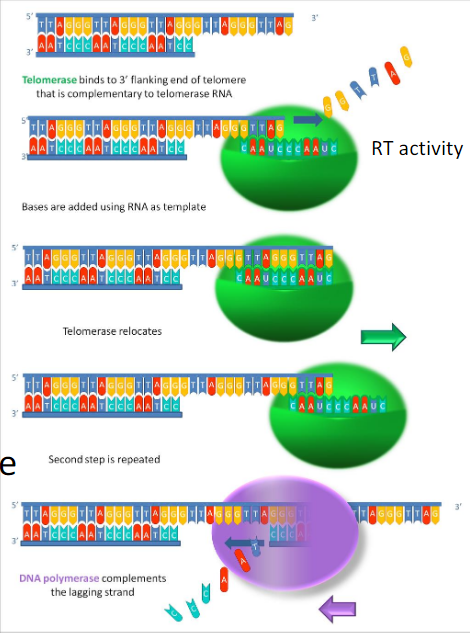
- What is a telomere?
- What is Telomerase?
- What results on the DNA after the removal of the last RNA primer on the newly synthesized strand?
- Long stretches of short repeating sequences (TTAGGG) and preserve integrity and stability of chromosomes by preventing loss of important genetic information each time cells replicate
- Enzyme that contains RNA molecule that is complementary to repeated sequence found in telomeres. This enzyme binds to the template strand and exhibits reverse transcriptase activty to extend the length of the template strand by thousands of repeats of the telomere sequence. Then, DNA polymerase can come in and bind to the template strand and add complementary bases to the telomere sequence to the newly synthesized DNA strand. Then, when RNA primer is removed from extended DNA, the only information that is being lost is part of the telomere so the coding sequence of the DNA is not distrupted.
- T-loop - “sticky” end of telomere is looped and tucked under itself to protect telomere ends
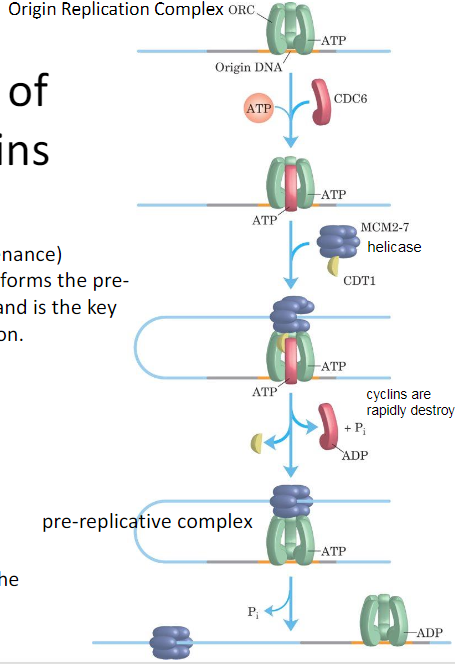
Prokaryotes use a series of Dna A-G proteins to initiate replication. How is this process different in Eukaryotes?
Eukaryotes have a protein called MCM (minichromosome maintenance) which is a helicase complex that loads onto DNA and performs the functions of Dna A-G, key step in initiation of replication
Eukaryotes
Describe the steps in termination of DNA replication
Process is less clear in eukaryotes, mediated by poly-Ub signaling

-
Homeostasis15
-
Overview Of Cells21
-
Intro to Proteins I1
-
Intro to Pharmacokinetics43
-
Intro to Lipids24
-
Intro to Proteins II19
-
Intro to enzymes12
-
Intro to tissues12
-
Chromatin Structure33
-
Nucleic Acid18
-
Proteins III21
-
Cell Membrane Structure20
-
DNA Replication24
-
Intro to Histology3
-
RNA Transcription24
-
Translation and Processing23
-
Human Chromosomes15
-
Intro to Mitosis and Meiosis18
-
Gene Regulation25
-
Mendelian Inheritance20
-
Non-Mendelian Inheritance31
-
DNA Mutagenesis22
-
Other RNAs12
-
Epigenetics0
-
Molecular Diagnostics23
-
Gene Therapy26
-
Intro to Receptors and Signaling16
-
Cytoskeleton32
-
Gene X6
-
Introduction to Signaling14
-
Intracellular Transport14
-
Signaling 114
-
Signaling 25
-
Cell Junctions17
-
Cell Cycle 17
-
Cell Death and Differentiation30
-
Cell Cycle 25
-
Cell Adhesion and Motility13
-
Intro to Energy Substrates20
-
Glycolysis3
-
TCA Cycle8
-
OxPhos9
-
Gluconeogenesis8
-
Glycogen Metabolism12
-
Pentose Phosphat & ROS12
-
Mono and Disaccharides6



