What are 4 broad uses for molecular diagnostic methods that focus on genetic information?
1) Identify and classify infectious agents (pathogens)
2) Identify genetic abnormalities, small and large
3) Direct to consumer DNA testing
4) Determine the genome of a person’s cancer cells to choose drugs that will have an impact on their cancerous cells but not on their healthy cells
What is a Primer?
How long are they?
What are they used in?
A strand of DNA bases that enables DNA to be replicated by “jumpstarting” the replication process.
Short oligonucleotides, 12-25 bp long usually
Amplification and sequencing
What is a probe?
How long are they?
Probes are complementary to the nucleic acid target and are used to establish the presence or absence of a target sequence. They are usually labeled with either fluorescent compound that shines when exposed to specific wavelength of light or a radioactive compound that emits radiation and can be imaged on film
Usually 12-25bp long
Can primers be only DNA, only RNA, or both?
Technically they can be both, but they are most often DNA b/c it is more stable
How does the length of the probe/primer effect its function?
If the probe is too short, then it will bind too non-specifically and you will tag genes that are not the gene you’re interested in. Thus, a longer probe is preferrable, generally anything over 20bp is good for identify with certainty the gene of interest.
What 3 factors affect hybridization between template and probe/primer?
Length of probe/primer
GC content
Sequence
What is the equation for determing the ideal temperature for hybridization to occur?
Thyb (ºC) = 24.21 + 0.41(%GC) - 500/n
where n = probe length
Longer probe = higher Thyb
Higher GC content = higher Thyb
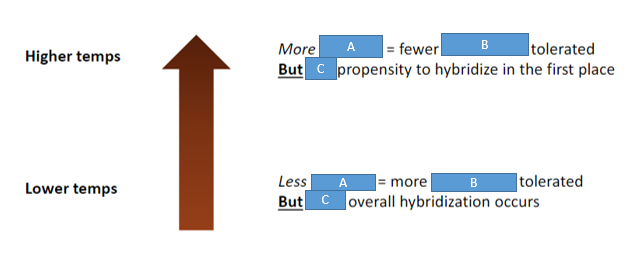
Top
- A: Stringent
- B: Mismatches
- C: Less
Bottom
- A: Stringent
- B: Mismatches
- C: More
How does the primer/probe sequence affect hybridization?
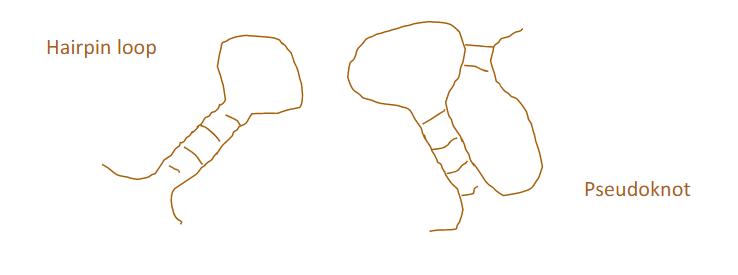
If the primer is too long, it can fold back on itself and form a hairpin loop structure, making it ineffective. Thus, primers/probes should not have complementary sequences within them.
Restriction Enzymes
- What do they do?
- Where were they isolated from?
- How does the bacteria they come from impact the enzymes?
- What are their target sequences in terms of length?
- Cause double stranded breaks in DNA at specific sites
- Isolated from bacteria where they restrict entry of nonmethylated foreign DNA into their own genome
- Different bacteria have different restriction enzymes
- They are usually short so that many fragments are produced by their action, often palindromic
What are the 2 ways in which a restriction enzyme can cleave the DNA?
Which of the 2 events is more stable?
Produce either blunt ends or sticky ends.
Sticky ends are better b/c blunt ends can be flipped around and re-inserted in the opposite orienation, which happens ~50% of the time so they are not great for isolating a specific gene of interest
Which polymerase is used during PCR?
Taq polymerase - isolated from thermophilic bacteria, doesn’t denature at high temps, uses single stranded DNA as template
How is DNA visualized in gel electrophoresis?
Ethidium bromide could be added to the gel and the gel could be treated with UV light. EthBro intercalates between bases in DNA and fluoresces under UV light to show DNA.
Alternatively a radioisotope of phosphorous could be incorporated into the growth media when the cells are dividing so that when the DNA is separated it will release radiation and a film can be placed on top of the gel and it will develop and show the bands where the radiation is located (DNA).
Describe the process of blotting.
- After separating DNA based on size using gel electrophoresis, place nitrocellulose membrane on top of gel.
- Fill tray with denaturation buffer
- Place large sponge in denaturation buffer (sponge extends beyond top of tray
- Place gel on sponge
- Place dry paper towel stack on top of membrane
- Allow enough time for denaturation buffer to transfer from tray –> sponge –> gel –> membrane –> paper towels to drive DNA from gel to membrane, towel stack will be wet
- Treat membrane with UV or heat to permanently fix DNA onto membrane
- Choose radiolabeled or fluorescent probe for target DNA sequence, wash membrane with probe, wash with buffer to remove excess probe, expose to film or process for absorbance
Restriction Fragment Length Polymorphism
- What is this?
- What is it used for?
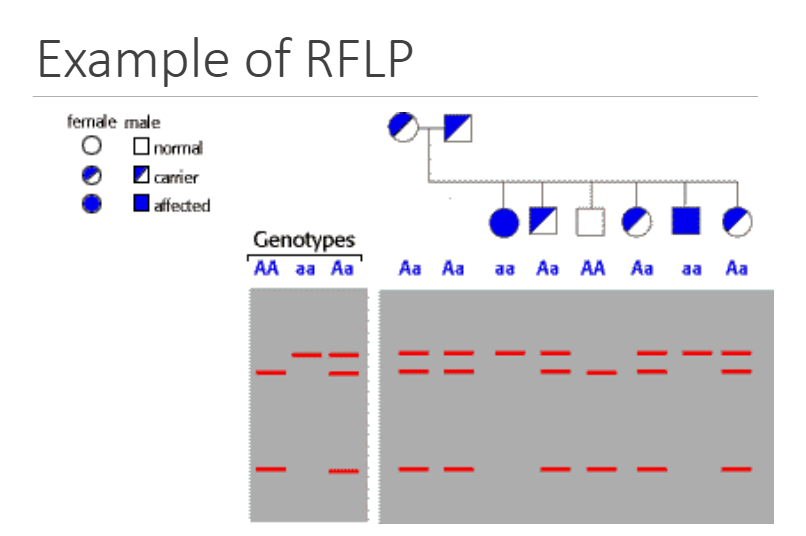
- Individuals possess unique polymorphisms for specific genes. Thus, when restriction enzymes are used to digest DNA from one of my genes, they won’t digest them exactly the same way as they would digest the same gene from nick’s cells. The resulting pattern of fragments produced will be unique to me. Thus, RFLP is just southern blotting that takes advantage of polymorphisms to characterize an individual’s unique pattern of DNA fragmentation upon digestion with restriction enzymes. All the normal processes that happen with southern blotting are still done here.
- DNA fingerprinting, paternity tests, forensic testing (innocence project)
Fluorescent In Situ Hybridization
- What does this method tell you?
- Describe the basic concept of FISH
- When in the cell cycle is it most useful to do FISH?
- When and where a gene is expressed
- A fluorescent probe is selected that is complementary to the seqence of interest, it is allowed to mix with the DNA sample so that it can hybridize with the DNA. After sufficient time, the chromosomes are visualized and the tagged areas emit light of a specific color indicating their presence and location within the cell.
- Usually done in metaphase
PCR
- What is it used for?
- Describe the process
- In PCR, there is a FWD and REV primer. Which is which?
- Primers need an exact fit at which end?
- Used to clone a DNA segment for which the sequence (or part of it) is known in advance
- Start with DNA from sample, primers, dNTPs, Mg2+, and Taq polymerase. Heat to 95C to denature DNA, lower temperature to 60C to anneal primers to DNA strands, increase temp to 70C for Taq Poly to extend DNA using primers as template (need FWD and REV primers), until eventually the target sequence is amplified significantly. Further analyses can now be done with this amplified target sequence.
- FWD = primer that hybridizes with 3’ - 5’ DNA, REV = primer that hybridizes with 5’ - 3’ DNA
- The 3 nucleotides on its 3’ end to be exact matches to the DNA target sequence
What is the amplification refractory mutation system?
ARMS is an application of PCR. Let’s suppose that we want to know if a person has a mutation in a gene and we also want to know whether they are heterozygous or homozygous. We can design a round of PCR such that we have 1 primer that is complementary to the template strands in both the WT and mutant DNA. Then we would have 2 different primers that are complementary only to mutant or only to WT. The complementary primer is used in both tubes, and the specific primers are used in separate tubes. PCR is run and the DNA is then separated using Southern blot and visualized. If the person is homozygous WT, amplication will only occur in the WT tube. If the person is homozygous mutant, amplification will only occur in the mutant tube. If the person is heterozygous, amplification will occur in both tubes.
What is reverse-transcriptase PCR used for?
To quantify the amount of mRNA present in a given state. Strong expression = lots of mRNA = strong amplification. Low expression = little mRNA = little amplification.
Real time PCR
- What is it used for?
- Describe the process
- What is unique about the probe in this PCR?
- Used to monitor the amount of target DNA made after each amplification cycle
- Start with DNA from sample, primers (FWD, REV), a fluorescent probe for the target DNA of interest, dNTPs, Mg2+, and Taq polymerase. Heat to 95C to denature DNA, lower temperature to 60C to anneal primers and probe to DNA strands, increase temp to 72C for Taq Poly to extend DNA using primers as template (need FWD and REV primers). Probe will only anneal to one of the dsDNA strands. When Taq Poly interacts with probe, the reporter is released. When reporter is released, it fluoresces. Thus, the more target DNA that is made, the higher the fluorescence.
- The probe has a quencher and a reporter molecule bound to opposite ends of the sequence. When in close proximity, the quencher makes the reporter unable to fluoresce. When the reporter is removed during replication/amplification, it can fluoresce, indicating that the target sequence was replicated.
Microarrays
- What do they tell you?
- Describe the process of running a microarray.
- Patterns of gene expression
- Microarrays can be used to look at patterns of expression of many genes and chromosomes at one time OR at a single gene/chromosome. In the first step, the target DNA is isolated, digested, and fixed to the bottom of a well on a microarray. Then, the DNA from your sample is obtained by making cDNA from RNA and tagged with fluorophores that indicate different samples (one reference sample and one test sample). The cDNA is plated on the microarray and allowed to hybridize with the bound target DNA sequences in the wells. The array is visualized - wells that are a mix of the 2 fluorphore colors show normal expression of the sample, wells that are only the control color show decreased expression and wells that are only the color of the sample show increased expression. Alternatively, you can compare the expression of genes in different conditions using the same method.
What is comparative genomic hybridization?
This is a type of microarray that looks at the amount of DNA present. It looks at a specific segment of DNA. That normal segment of DNA is digested and the different fragments are separated and DNA from individual fragments are fixed to the bottom of wells on microarray. The DNA from 2 samples (normal control vs. mutant or condition 1 vs. condition 2) is isolated and digested and labeled with fluorphores. Plate washed with sample DNA, washed with buffer, fluorescence is measured. Wells that are blend contain the same amount of DNA for that location on the gene of interest. Wells that are only one color indicate either an increase or decrease in the amount of genetic information at that location on the gene.
Describe how next generation sequencing works.
Input sample is cleaved into short sections. Fragments are ligated to adaptors and annealed to slide using adaptors. PCR is carried out to amplify each read using ddNTPs so that the amplified sequences terminate at every possible location on the fragment. New fragments remain bound to slide due to replication of adaptor. This creates a cluster on the slide that contains every possible fragment of that sequence with a fluorescently labeled probe indiciating which base is in that position in the sequence. Between cycles of PCR amplification, an image is taken of the slide and the fluorophore that terminated at the first location will fluoresce. This is read by the machine and recorded. The fluorophore is removed and a new cycle begins allowing the same process to occur but now for the second position, and so on.

-
Homeostasis15
-
Overview Of Cells21
-
Intro to Proteins I1
-
Intro to Pharmacokinetics43
-
Intro to Lipids24
-
Intro to Proteins II19
-
Intro to enzymes12
-
Intro to tissues12
-
Chromatin Structure33
-
Nucleic Acid18
-
Proteins III21
-
Cell Membrane Structure20
-
DNA Replication24
-
Intro to Histology3
-
RNA Transcription24
-
Translation and Processing23
-
Human Chromosomes15
-
Intro to Mitosis and Meiosis18
-
Gene Regulation25
-
Mendelian Inheritance20
-
Non-Mendelian Inheritance31
-
DNA Mutagenesis22
-
Other RNAs12
-
Epigenetics0
-
Molecular Diagnostics23
-
Gene Therapy26
-
Intro to Receptors and Signaling16
-
Cytoskeleton32
-
Gene X6
-
Introduction to Signaling14
-
Intracellular Transport14
-
Signaling 114
-
Signaling 25
-
Cell Junctions17
-
Cell Cycle 17
-
Cell Death and Differentiation30
-
Cell Cycle 25
-
Cell Adhesion and Motility13
-
Intro to Energy Substrates20
-
Glycolysis3
-
TCA Cycle8
-
OxPhos9
-
Gluconeogenesis8
-
Glycogen Metabolism12
-
Pentose Phosphat & ROS12
-
Mono and Disaccharides6



