Function of the digestive system and the two basic processes
Breaks down food into forms that can be absorbed and used by body cells. •Absorbs water, vitamins, and minerals, and it eliminates wastes from the body. oTwo Basic Process: •Mechanical digestion •Chemical digestion
Explain mechanical digestion and chemical digestion
Mechanical - chewing, swallowing, mixing Chemical - chemicals secreted into the digestive system like acids, enzymes secreted in saliva, enzymes secreted in the stomach, enzymes in small intestine
Organs of the digestive system
Two groups of organs:
o The gastrointestinal (GI) tract:
- a continuous tube that extends from the mouth to the anus through the thoracic and abdominopelvic cavities
- Mouth, most of the pharynx, oesophagus, stomach, small intestine, and large intestine
oThe accessory digestive organs: •Teeth, tongue, salivary glands, liver, gallbladder, and pancreas - These are the organs that secrete some really important liquids into GI tract to help GI tract do its thing
List in order the functions of the disgestive system
- Ingestion: taking food into mouth.
- Secretion: release of water, acid, buffers, and enzymes into lumen of GI tract.
- Mixing and propulsion: churning and propulsion of food through GI tract.
- Digestion: mechanical and chemical breakdown of food.
- Absorption: passage of digested products from GI tract into blood and lymph.
- Defecation: elimination of faeces from GI tract.
Layers of the GI tract
o Four-layered arrangement of tissues: in the wall of the GI tract from the lower oesophagus to the anal canal
oFrom deep to superficial:
- Mucosa
- Submucosa
- Muscularis
- Serosa/Adventitia (visceral peritoneum)
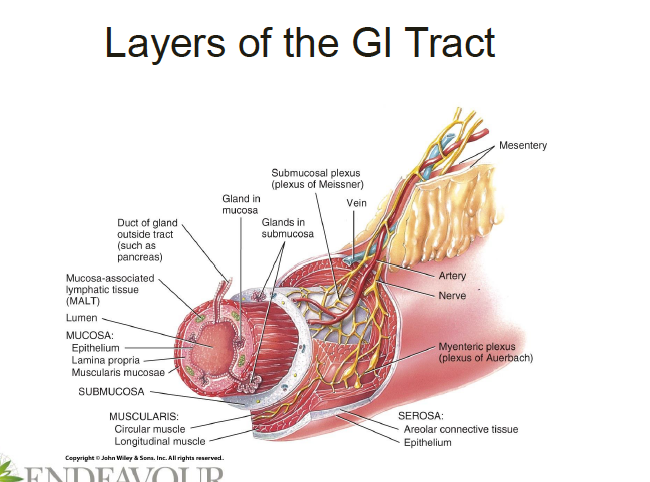
Mucousa ( layer of GI tract)
- A mucous membrane
- Inner lining of the GI tract
oConsists of:
- A layer of epithelium: in direct contact with the contents of the GI tract
- Lamina propria: a layer of connective tissue
- Muscularis mucosa: a thin layer of smooth muscle ( Important for allowing the epithelial layer to move around and come in contact with more food )
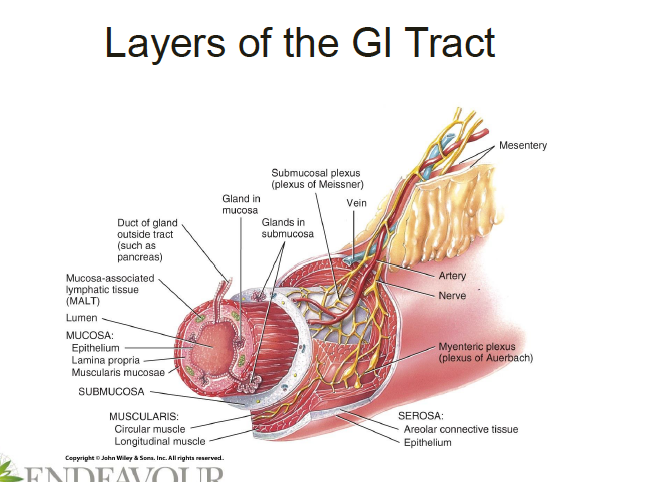
Mucosa epithelium consists of?
Nonkeratinized stratified squamous:
‒in mouth, oesophagus and anus
‒serves as a protective layer
•Simple columnar:
–in the stomach and intestines
–functions in secretion and absorption
•Exocrine cells: secrete mucus and fluid into the lumen of the tract,
•Enteroendocrine cells: secrete hormones
Mucosa (Layer of GI tract )
The lamina propria consists of ?
Loose areolar connective tissue: adheres the epithelium to the lower layers,
- Blood and lymph vessels: transport absorbed food to other tissues,
- Mucosa associated lymphatic tissue (MALT):
‒Prominent lymphatic nodules containing immune system cells.
‒Present all along the GI tract, especially in the tonsils, small intestine, appendix, and large intestine.
Function of the muscularis mucosa:
•Throws the mucous membrane of the stomach and small intestine into many small folds which creates an Increase in surface area for digestion and absorption. Movement of the epithelial layer allowing it to come in contact with food
The submucosa consists of?
oBlood and lymphatic vessels:receive absorbed food molecules.
o Submucous Plexus:
- An extensive network of neurons from the autonomic nervous system.
- Innervates mucosa, blood vessels and secretory cells of mucosal glands.
o Glands and lymphatic tissue
The Muscularis consists of:
Skeletal muscle: in mouth, pharynx , upper oesophagus and anus
- voluntary control
- control over swallowing and defaecation
oSmooth muscle: rest of the tract (about 90%)
- involuntary control
- mixes, crushes and propels food along by peristalsis
oMyenteric plexus (Motor, command centre of the gut)
•Innervate circular (below) and longitudinal (above)smooth muscle layers
The Serosa consists of
- a serous membrane
- Superficial layer to the GI tract organs that are suspended in the abdominopelvic cavity
- part of the visceral peritoneum
o Secretes slippery fluid = Important as it allows the GI tract to sit in the right orientation
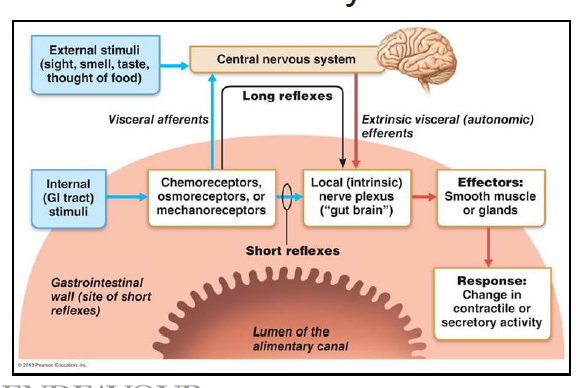
What is the GI tract regulated by?
•Enteric Nervous System (ENS): an intrinsic set of nerves
- Is able to perfrom all the functions of GI tract independent of any other neural input. regulates the amount of absorption to occur, how much and what type of motility (motion), amount of secretions
- The activity of the enteric nervous system can be influenced by other nervous systems so our ANS can Influence the activity of our gut
- Autonomic Nervous System (ANS):an extrinsic set of nerves
- Gastrointestinal Reflex Pathways
What are the two plesuses of the Enteric nervous system
oTwo plexuses:
- Myenteric plexus:control gastric motility
- Submucosal plexus:control the secretory cells
Enteric Nervous System (ENS): the “brain of the gut,” can function…
oCan function independently of the CNS and ANS
Enteric Nervous System (ENS)
consists of 100 million neurons that extend from the oesophagus to the gut
• motor neurons, interneurons, and sensory neurons
- Contains more nerves than your spinal cord!
Great big tube that extends from your mouth all the way to your anus that’s packed full of nervous.
Fully independent, fully functioning nervous system
The enteric nervous system lets the CNS and ANS know what’s going on but can function on its own
What is the connection between the ANS and ENS ?
oAutonomic Nervous System (ANS):
Forms neural connections with ENS and regulates functions of ENS - The ANS talks to the ENS but the ENS can function on its own
- _Parasympathetic nerves: (_rest and digest nerves) increase GI secretion and motility by increasing the activity of ENS neurons.
- Sympathetic nerves:decrease GI secretion and motility by inhibiting the neurons of the ENS.
What are the Gastrointestinal Reflex Pathways?
and their function?
chemoreceptors and stretch receptors are associated with the sensory neurons of the ENS synapse with other neurons located in the ENS, CNS, or ANS.
o Regulate secretions and motility in response to stimuli present in the lumen.
What is the peritoneum ?
name and define the two divisions and cavity
The peritoneum:
•The largest serous membrane of the body. (serous membrane = lines outside of organs)
oTwo divisions:
- The parietal peritoneum: lines wall of abdominal cavity, surrounding entire abdominal cavity
- The visceral peritoneum: covers some of the organs of the GI tract and constitutes their serosa, surrounds the gut (GI tract)
oPeritoneal cavity: The potential space between the parietal and visceral portions of the peritoneum
•contains serous fluid.
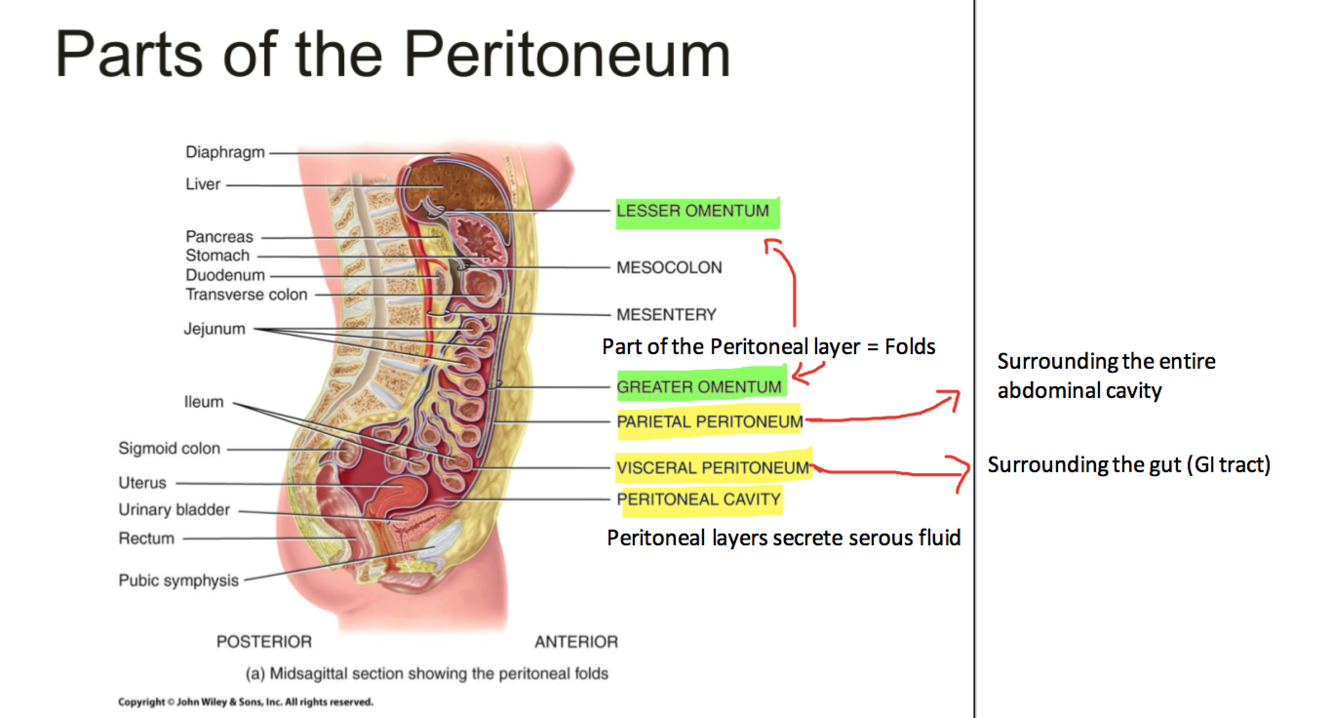
What are the peritoneal folds?
They are a part of the peritoneal layers that are folds
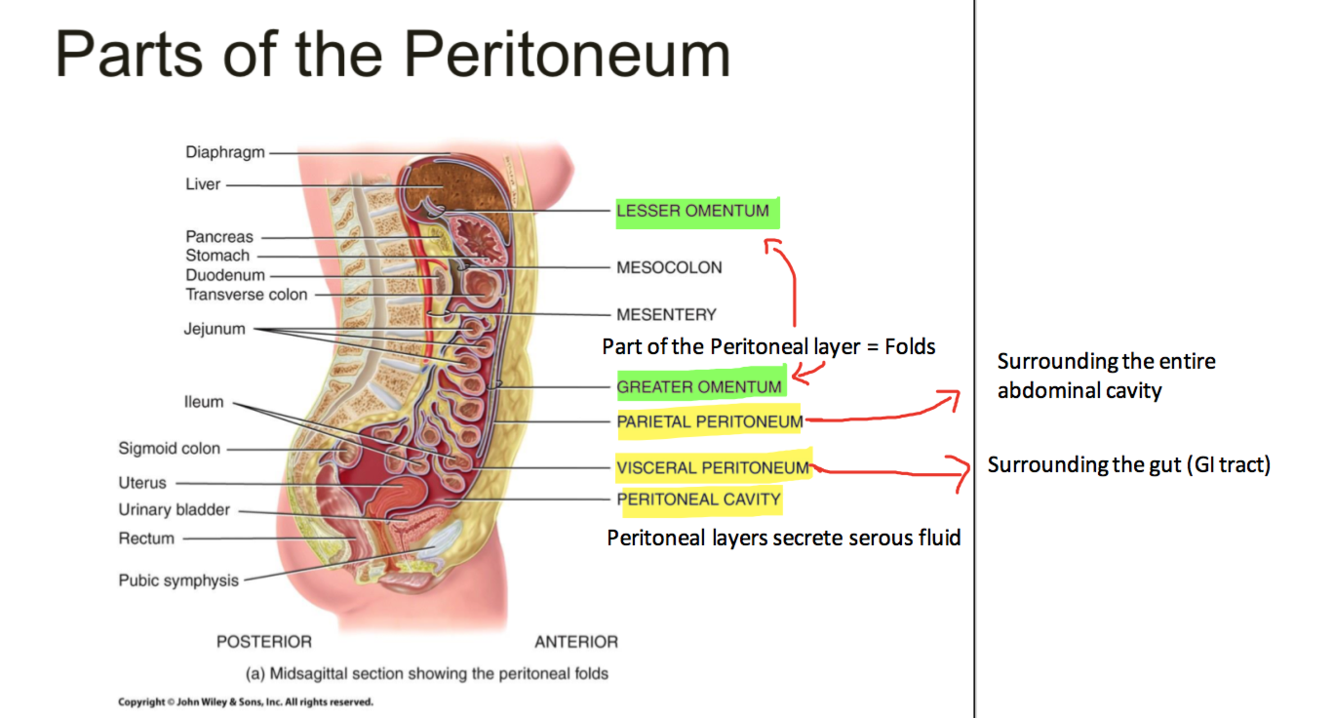
- Weave between the viscera.
- Bind the organs to one another and to the walls of the abdominal cavity.
- Contain blood vessels, lymphatic vessels, and nerves of the abdominal organs.
What are the five major peritoneal folds ?
- Greater omentum
- Falciform ligament
- Lesser omentum
- Mesentery
- Mesocolon
What are the small and major salivary glands of the mouth?
Salivary Glands: secrete saliva into the oral cavity
oSmall salivary glands: In mucous membrane of the mouth and tongue
- labial
- buccal
- palatal
- lingual
oMajor salivary glands: lie outside the oral mucosa (exocrine glands)
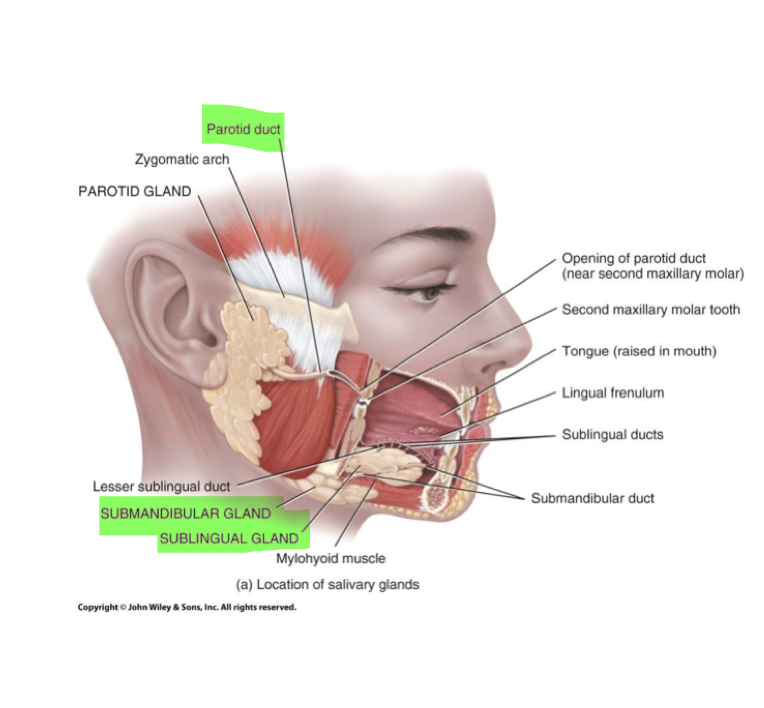
- Parotid
- Submandibular
- Sublingual glands
Where do you find the major salivary glands?
oParotid:inferior and anterior to the ears, between the skin and the masseter muscle
oSubmandibular: medial and partly inferior to the body of the mandible
oSublingual glands: beneath the tongue and superior to the submandibular glands.
Name some functions of saliva
o Water:dissolve foods to be tasted by gustatory receptors and begin digestive reactions.
o Mucus:lubricates food to facilitate bolus formation and swallowing
o Bicarbonate and phosphate ions: buffer acidic foods that enter the mouth
o Chloride ions: activate salivary amylase
o Salivary amylase: starts the breakdown of starch in the mouth
o Lysozyme:kills bacteria
o Immunoglobulin A (IgA):prevents attachment of microbes to the epithelium,
o Help remove waste molecules from the body, which accounts for the presence of urea and uric acid in saliva
o Protects mouthfrom infection with its rinsing action -1 to 1.5 liters/day
o Keep the mucous membranes of the mouth and pharynx moist



-
Session 1 - Blood and the elements35
-
Session 2 - Haemostasis and blood groups16
-
Session 3 - Cardiovascular system - the heart27
-
Session 7 - Lymphatic and Immune System 140
-
session 8 - immune system28
-
Session 9 - Immunity system 238
-
Session 10 - Respiratory system31
-
Session 11 - Pulmonary ventilation30
-
Session 12 - Gas Transportation19
-
Digestive system47
-
session 14 - digestive system part 2 - Pancreas, Liver, Small Intestine32
-
Session 15 - Digestive System 3 – Small Intestine & Large Intestine27
-
Urinary system 1 - the kidneys26
-
session 17 - Urinary system - glomerular filtration15
-
Session 18 - Urinary system - Tubular Reabsorption and Secretion37
-
Session 19 - Urine Production, Storage and Elimination61
-
Session 20 - male repro14
-
session 431
-
session 528
-
session 633



