The second line of defence:
Internal defences are provided by? and occurs when?
• Antimicrobial substances • Natural killer cells • Phagocytes • Inflammation • Fever occurs when first line of defence has been breached
Antimicrobial substances that discourage microbial growth are?
• Interferons • Complement system • Iron-binding proteins • Antimicrobial proteins
Interferons (IFNs)
Produced by lymphocytes, macrophages, and fibroblasts infected with viruses. •Interfere and stop viral replication.
Complement system
A group of about 30 inactive proteins present in blood plasma and on plasma membranes •when activated, these proteins “complement” or enhance certain immune, allergic, and inflammatory reactions.
Iron-binding proteins
Inhibit growth of certain bacteria by reducing amount of available iron The following are Antimicrobial substances that bind to iron so the iron is no loner free for bacteria to bind to - therefore cannot grow and divide •Transferrin: in blood and tissue fluids •Lactoferrin: in milk, saliva, and mucus •Ferritin: in the liver, spleen, and red bone marrow •Haemoglobin: in red blood cells
What is innate immunity?
Non specific ( e.g will defend against any bacteria, not specific! ), We have the ability to produce from birth
Natural killer cells - what are they? where are they found? function?
- cytotoxic lymphocyte
- Present in blood, spleen, lymph nodes and red marrow
Function
- kill a wide variety of microbes and tumour cells
- attack any body cells that display abnormal or unusual plasma membrane proteins and cause cytolysis or induce apoptosis
- kill infected cells and release microbes to be destroyed by phagocytes
Phagocytes are.. and the 2 major types
cells that ingest microbes (cells) or other particles such as cellular debris ( cells that eat cells)
•Neutrophils - most abundant white blood cells we have
When they go up they are a really good indicator that there is a bacterial infection
•Macrophages (developed from monocytes)
–fixed macrophages stand guard in specific tissues
- In the skin, liver, lungs, brain, spleen, red marrow and lymph nodes
–wandering macrophages are in most tissues
The five phases of phagocytosis
- Chemotaxis, - recognition
- Adherence - bind to
- Ingestion - eat
- Digestion - break down of bacterial components (internalised)
- Killing
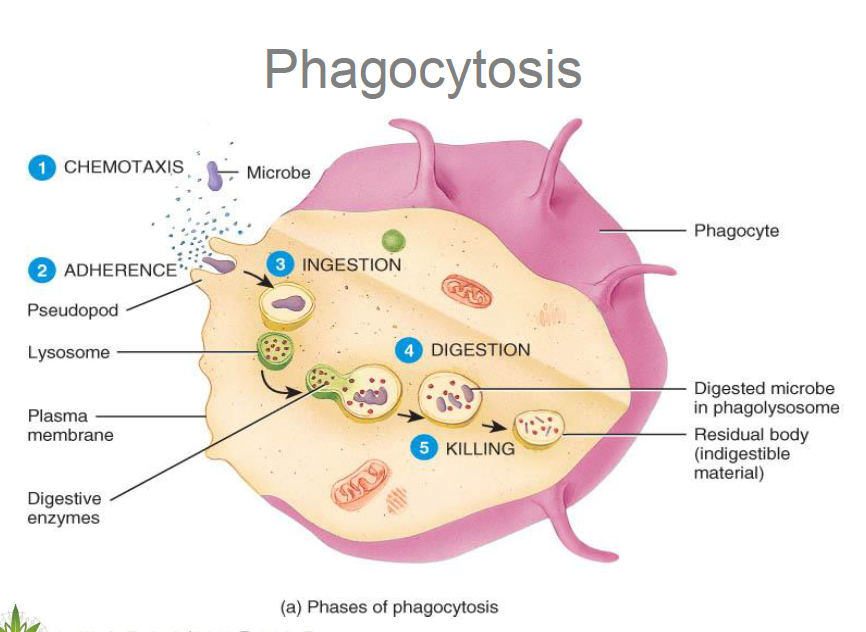
Phagocytosis
1.Chemotaxis:
a chemically stimulated movement of phagocytes to a site of damage
• chemicals from invading microbes, white blood cells, damaged tissue cells, or activated complement proteins
Phagocytosis
- Adherence:
Attachment of the phagocyte to the microbe or other foreign material
• Enhanced by the binding of complement proteins to the invading pathogens
Phagocytosis
- Ingestion:
a process of engulfing the microbe
• Caused by pseudopods which in turn merge to form phagosomes.
Phagocytosis
- Digestion:
- Lysozyme, which breaks down microbial cell walls
- Other digestive enzymes that degrade carbohydrates, proteins, lipids, and nucleic acids.
- Lethal Oxidants produced by phagocytes such as
- superoxide anion (O2–),
- Hydrogen peroxide (H2O2)
*combined with Lysozymes will break down microbe*
Phagocytosis
- Killing:
The chemical attack of lysozyme, digestive enzymes, and oxidants will quickly lead to the death of microbes.
o A microbe may evade (escape, avoid) phagocytosis through:
- capsule formation, - can form a capsule to prevent the action of lysozymes
- toxin production, - toxins desgined to kill the cells that are trying to kill them
- interference with lysozyme secretion,
- microbe’s ability to counter oxidants produced by the phagocytes.
Describe Inflammation
What is it’s function and what causes it
a nonspecific, defensive response of the body to tissue damage
oFunction:to trap microbes, toxins or foreign material and begin tissue repair
oInitiated by damaged cells due to:
- Pathogens - viruses and bacteria
- Abrasions - blisters etc
- Chemical irritations - strong chemicals burning skin
- Distortion or disturbances of cell
- Extreme temperatures
signs and symptoms of inflammation
Vasodilation and increased permeability of vessels:
• caused by histamine, prostaglandins, leukotrienes from variety of cells
Occurs within minutes producing
- Redness
- Heat
. Oedema
- Swelling
- Pain can result from injury, pressure from oedema or irritation by toxic chemicals
- Loss of function depending on the site and extent of the injury. ( e.g rolled ankle )
What are the 3 basic Stages of Inflammation
- Vasodilation and increased permeability of blood vessels,
- Emigration (movement) of phagocytes from the blood into interstitial fluid,
- Tissue repair
Stage 1 of inflammation
- Vasodilation and increased permeability of vessels:
o Vasodilation:
- allows more blood to flow through the damaged area,
- helps remove microbial toxins and dead cells.
- Redness and heat is a function of vasodilation and permeability due to increase of blood flow
oIncreased permeability:
- permit the substances to pass from the blood vesselsthat normally retained in blood
- permits defensive proteins such as antibodies and clotting factors to enter the injured area from the blood
- Swelling occurs when the body is helping get all the white blood cells and antibodies out of the blood and into the tissue. We are also getting a lot of plasma coming out into our tissues and that’s the basis of our swelling.
Stages of inflammation
- Phagocyte emigration
• within an hour, neutrophils and then monocytes arrive and leave blood stream (emigration) to reach the damaged area.
Stages of Inflammation
What is stage 3
Tissure Repair
Symptoms of inflammation: what causes vasodilation and capillary permeability ?
and what are the symptoms
caused by histamine, prostaglandins, leukotrienes being released from a variety of cells
• Occurs within minutes producing
- heat, redness and oedema
- pain can result from injury, pressure from oedema or
irritation by toxic chemicals
What is Fever and when does it occur
An abnormally high body temperature that occurs because the hypothalamic thermostat is reset
o Occurs during infection and inflammation
o Bacterial toxins trigger release of fever-causing cytokines such as interleukin-1 from macrophages
o Significance of the release of interleukin-1 and fever:
• Intensifies effects of interferons
- Inhibits bacterial growth
- Speeds up tissue repair
Extra notes for understanding:
What is adaptive specific immunity and its properties ?
The ability of the body to defend itself against specific invading agents such as bacteria, toxins, viruses, and foreign tissues.
oProperties: Differs from nonspecific defense mechanisms
- Specificity: specific for particular foreign molecules (antigens) and recognize self and non-self
- Memory: Remembers most previously encountered antigens so that a second encounter produces an even more vigorous response
What are the 2 types of Adaptive (Specific) immunity?
o Antibody Mediated Immunity (AMI) / Humoral Immunity
• Mediated by B Cells ( type of lymphocyte, made in bone marrow )
- Antibodies mediating the immune response to an antigen
o Cell Mediated Immunity (CMI)
• Mediated by T Cells ( made in bone marrow, matures in thymus)
- cells killing cells


-
Session 1 - Blood and the elements35
-
Session 2 - Haemostasis and blood groups16
-
Session 3 - Cardiovascular system - the heart27
-
Session 7 - Lymphatic and Immune System 140
-
session 8 - immune system28
-
Session 9 - Immunity system 238
-
Session 10 - Respiratory system31
-
Session 11 - Pulmonary ventilation30
-
Session 12 - Gas Transportation19
-
Digestive system47
-
session 14 - digestive system part 2 - Pancreas, Liver, Small Intestine32
-
Session 15 - Digestive System 3 – Small Intestine & Large Intestine27
-
Urinary system 1 - the kidneys26
-
session 17 - Urinary system - glomerular filtration15
-
Session 18 - Urinary system - Tubular Reabsorption and Secretion37
-
Session 19 - Urine Production, Storage and Elimination61
-
Session 20 - male repro14
-
session 431
-
session 528
-
session 633



