Describe the blood supply to the nasal septum
Blood supply to the nose can be divided into:
- Branches of the internal carotid
- Branches of the external carotid
What are the branches of the internal carotid?
- opthalmic artery
- anterior ethmoidal
- posterior ethmoidal
What are the branches of the external carotid?
- Facial artery ->
- superior labial artery, angular artery
- Maxillary artery ->
- sphenopalatine artery
- greater palatine artery
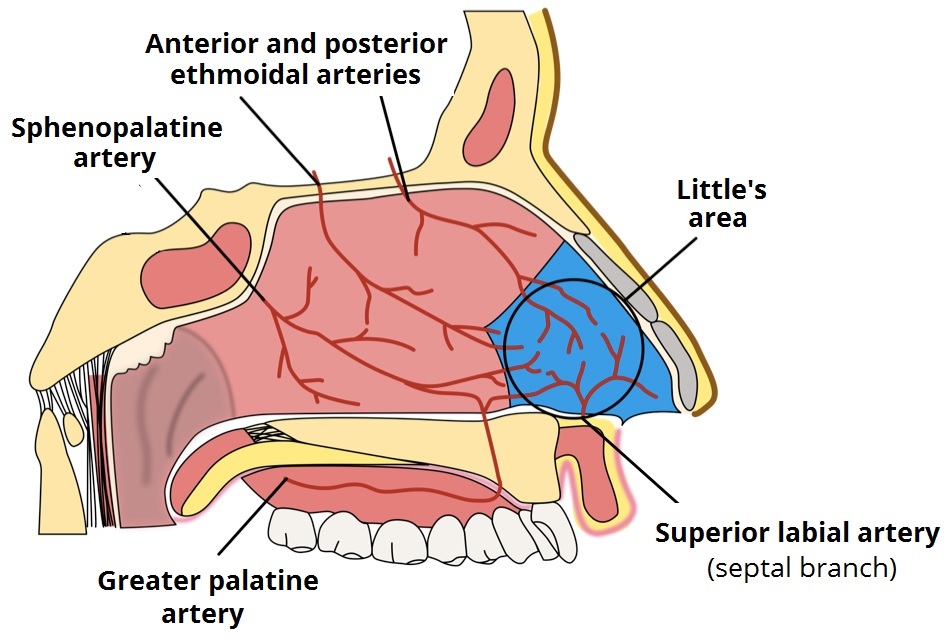
What is ‘Little’s area’?
Which 4 arteries are involved?
- AKA Kiesselbach’s plexus
- region in the anterioinferior part of the nasal septum
- where 4 arteries anastamose to form a plexus:
- anterior ethmoidal artery
- sphenopalatine artery
- greater palatine artery
- septal branches of superior labial artery
- 90% of nosebleeds occur here
Epistaxis can be divided into anterior or posterior. What is anterior?
- 90%
- bleeding almost always occurs from Little’s area
- source of bleeding is obvious
What is posterior epistaxis?
usually arises in the posterior nasal cavity at the following sites:
- behind posterior part of middle turbinate
- posterior suprior part of the roof of nasal cavity
- involves branches of sphenopalatine artery and mayr esult in sudden massive bleeding
What are the local causes of epistaxis?
- idiopathic
- trauma (nose picking, fracture, foreign body, sneezing)
- nasal allergy
- infection eg. sinusitis
- tumours (angiofibroma, hemangioma, malignancy)
- hereditary telangiectasia
What are the systemic causes of epistaxis?
- hypertension
- cardiac -> CCF, mitral stenosis
- pulmonary -> COPD
- cirrhosis -> vit K def
- coagulopathies -> haemophilia, leukaemia, agranulocytosis
- exanthematous fevers
- hormonal -> vicarious menstruation, endometriosis
- drugs -> XS salicylates, anticoagulant therapy
Generally, resuscitation is not required in most people presenting with epistaxis, but is required in the rare instance of haemodynamic compromise.
When is it likely required?
- there is severe bleeding
- patient is older
- patient is unwell or frail
These patients need ABC approach, look out for symptoms of haemodynamic instability
What are the initial conservative measures for acute active bleeding?
- entire lower compressible cartilage of nose is pinched
- to apply pressure to possible anterior bleeding sites
- ice pack
- bed rest
For initial measures, what topical agent can be applied to help stop bleeding?
oxymetazoline (vasoconstrictor)
can be diagnostic + therepeautic
help visualise epistaxis site and encourage haemostasis
can then also apply topical anaesthetic
if bleeding continues, can soak cotton wool in above agents and apply to nose
What should the patient do to remove possible blood clots?
- blows nose to clear blood + clots
- suction may be used
What can be done to stop any obvious, visible bleeding?
- silver nitrate cautery
- uncomfortable
- use petroleum jelly after for moisturisation
- important to avoid cautery at same location on both sides of septum -> can result in septal perforation
- electrocautery indicated for brisker bleeding resistant to silver nitrate cautery (done by ENT consultant)
If cautery fails to control bleeding, what can be done next, surgically?
- anterior nasal packing
- traditional packing vs expanding nasal sponges
- anterior-posterior nasal packing if above fails
- posterior packing:
- double-balloon epistaxis device
- traditional gauze anterior pack w/ foley urinary catheter placed posteriorly
- endoscopic management of epistaxis sites
- angiography and embolisation w/ interventional radiology
- open surgical ligation

-
Hearing Loss21
-
Acute Otitis Media8
-
Chronic Otitis Media & Cholesteatoma11
-
Conditions of the Pinna and External Auditory Canal0
-
Earache (Otalgia)3
-
Tinnitus4
-
Vertigo20
-
Acoustic Neuroma0
-
Epistaxis14
-
Rhinitis & Nasal Polyps10
-
Acute & Chronic Sinusitis11
-
Nasal Injury and Foreign Bodies0
-
Tumours of Nose, Sinuses and Nasopharynx0
-
Airway Obstruction and Tracheostomy11
-
Laryngitis and Epiglottitis14
-
Pharyngitis and Tonsillitis14
-
Head and Neck Carcinoma19
-
Sleep Apnoea7
-
Vocal Cord Paralysis0
-
Diseases of Salivary Glands0



