What is vertigo?
- vertigo is an illusion of movement
- includes sensation of rotation of self or of the environment as well as sensations of being pulled downwards/sideways or the room tilting - ie. ‘spinning’
- always worsened by movement
- often associated w/ difficulty in walking or standing with relief on lying or standing still
- other common symptoms → nausea, vomiting, pallor, sweating
Dizziness is a generic term that may refer to lightheadedness, faintness, giddiness, swimming or floating sensation, unsteadiness, imbalance, mental confusion, minor seizures or even true vertigo.
What is the impact of dizziness?
- 12x more likely to fall
- falls commonest cause of accidental death in over 75s
- psychological → dizziness increases anxiety + depression which interferes w/ recovery, reluctance to go out as unsteadiness mimics drunkenness
- socio-economic → not able to go back to work, may not be able to do certain types of work, not able to drive in certain conditions, poor QoL
Causes of vertigo
- Otological → meniere’s disease, vestibular neuronitis, labyrinthitis, BPPV, cerumen impaction, perilymphatic fistula, trauma, infection
- Central → CN VIII nerve disorders, MS, stroke, haemorrhage, migraine, acoustic neuroma, malignancy, trauma, infection, epilepsy
- Other → DM, hypoglycaemia, alcohol, anaemia, dysrhythmias, iatrogenic, multisensory disease syndrome
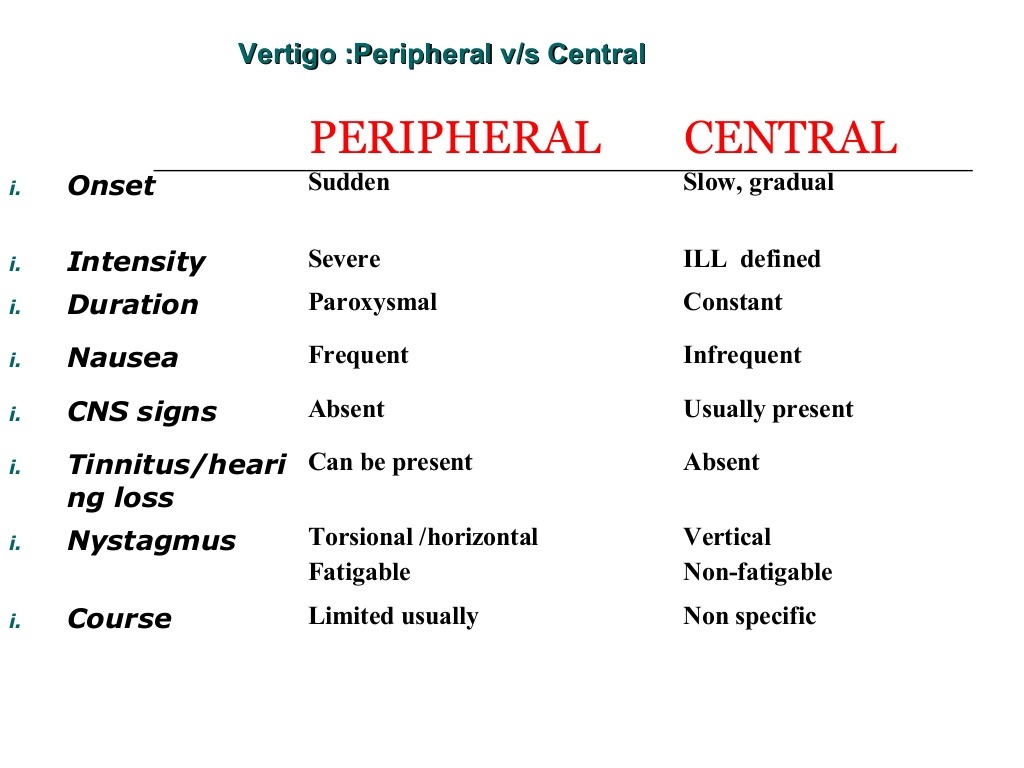
Peripheral vertigo (85%) is the result of a problem with your inner ear or CN VIII, which controls balance. Central vertigo refers to problems within your brain or brainstem.
How do these present differently?
What is physiologic vertigo?
- “motion sickness”
- mismatch between visual, proprioceptive and vestibular inputs
- not a diseased cochleovestibular system or CNS
What is Benign Paroxysmal Positional Vertigo (BPPV)?
Most common cause of vertigo (a peripheral cause)
Acute attacks of transient vertigo lasting seconds-mins initiated by certain head position accompanied by torsional (rotatory) nystagmus
Commonly occurs on getting out of bed / looking up / rolling
What is the Dix-Hallpike maneouvre?
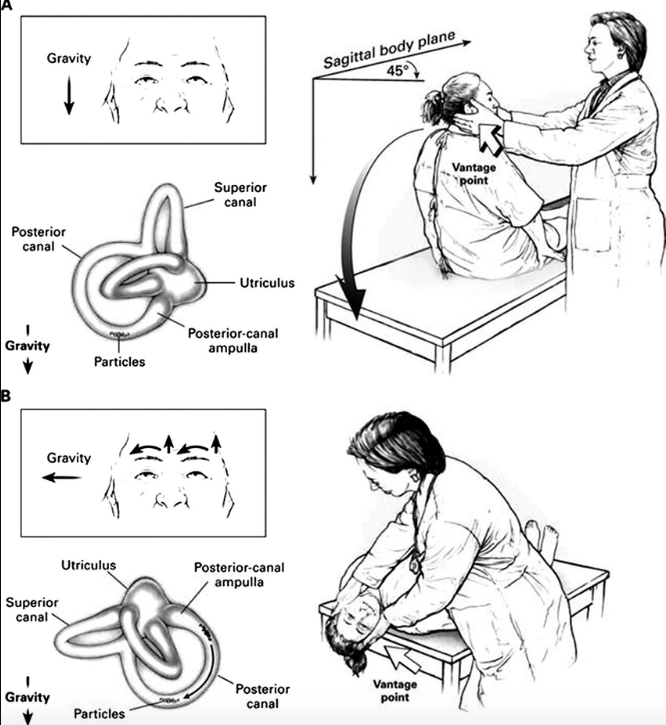
- rapidly moving pt from a sitting position to supine position
- w/ head hanging over end of table, turned 45o to one side
- hold for 15-20s to elicit nystagmus
- onset of vertigo + rotatory nystagmus indicate positive test for dependent side
- top pole of the eyes rotates towards the undermost (affected) ear
What is the pathophysiology BPPV?
Otoliths
Tiny crystals of calcium carbonate (normal part of inner ear) detach from otolithic membrane in utricle + collect in one of the semicircular canals (most commonly posterior)
Head still → gravity causes otoliths to clump + settle
Head moves → otoliths shift → stimulates cupula to send false signal to brain → vertigo and nystagmus occur
Treatment for BPPV
- reassure patient that process resolves spontaneously
- particle repositioning maneouvres
- main aim → reposition the otoliths back to utricle
- 3-step PRM / Epley manouvre
- Semont manouvre
- Brandt-Daroff exercise (by patient)
- surgery for refractive causes
What is vestibular neuritis?
- inflammation of the nerve - affects branch associated w/ balance, resulting in dizziness or vertigo but no change in hearing
- sudden onset
- only vestibular symptoms + worst symptoms in the beginning
- prodromal viral URTI may be present
- symptomatic recovery by central compensation
- recovery influenced by age, vision, proprioception, mental health + medications
What is labyrinthitis?
- commonly used to denote vestibular neuritis
- labyrinth is structure in inner ear, consisting of semicircular canals, vestibule and cochlea
- it is inflammation of the labyrinth
- occurs when an infection affects whole structure of inner ear (labyrinth)
- affects both vestibular apparatus AND cochlea
- results in hearing changes as well as dizziness or vertigo
Management of labyrinthitis
- Vestibular sedatives (benzos) should be used only for short duration
- act by inhibiting normal side to reduce asymmetry
- hence it interfered w/ central compensation
- may prolong recovery from symptoms
- vestibular rehabilitation exercises mainstay of treatment
- anti-emetics for N+V
- sudden hearing loss → steroids
- IV antibiotics if bacterial
What is Meniere’s disease?
- AKA endolymphatic hydrops
- idiopathic, XS endolymphatic fluid pressure
- triad of fluctuating low freq hearing loss, severe vertigo + roaring tinnitus
- RFs → high salt intake, caffeine, stress, nicotine, alcohol
- recurrent episodes, initial episodes usually worse
- preceding aural fullness common
- occasionally bilateral
Investigations for Meniere’s disease
- pure-tone air + bone conduction w/ masking
- speech audiometry
- tympanometry
- oto-acoustic emissions
- MRI internal auditory canals
Management of Meniere’s disease
- life-style changes → limiting salt + caffeine
- MEDICAL:
- symptomatic relief of an acute attack → cinnarizine, prochloperazine, cyclizine
- prophylactic preventive → betahistine, diuretics (bendroflumethiazide)
- SURGICAL:
- trans-tympanic treatment → gentamicin, steroids
- endolymphatic sac surgery
- vestibular neurectomy
- labyrinthectomy
What is an acoustic neuroma (vestibular schwanomma)?
- schwannoma of the vestibular portion of CN VIII
- acoustic neuroma most common intracranial tumour causing SNHL + most common cerebellopontine angle tumour
- starts in internal auditory canal + expands into cerebellopontine angle (CPA), compressing cerebellum and brainstem
- presentation → unilateral SNHL or tinnitus, dizziness and unsteadiness may be present but true vertigo rare as tumour growth slow + compensation occurs
- facial nerve palsy + trigeminal (V1) sensory deficit (corneal reflex) are late complications
How is acoustic neuroma diagnosed?
- DIAGNOSIS
- MRI w/ gadolinium
- audiogram
- poor speech discrimination relative to hearing loss
- stapedial reflex absent or significant reflex decay
- ABR - increase in latency of 5th wave
- vestibular test → normal or asymmetric caloric weakness
Causes of BPPV
Idiopathic (50%)
Head injury
Whiplash
Post-vestibular neuritis
Risk factors for Meniere’s disease
High salt intake
Caffeine
Stress
Nicotine
Alcohol
Management of acoustic neuroma
Surgical exicison
Other → gamma knife, radiation

-
Hearing Loss21
-
Acute Otitis Media8
-
Chronic Otitis Media & Cholesteatoma11
-
Conditions of the Pinna and External Auditory Canal0
-
Earache (Otalgia)3
-
Tinnitus4
-
Vertigo20
-
Acoustic Neuroma0
-
Epistaxis14
-
Rhinitis & Nasal Polyps10
-
Acute & Chronic Sinusitis11
-
Nasal Injury and Foreign Bodies0
-
Tumours of Nose, Sinuses and Nasopharynx0
-
Airway Obstruction and Tracheostomy11
-
Laryngitis and Epiglottitis14
-
Pharyngitis and Tonsillitis14
-
Head and Neck Carcinoma19
-
Sleep Apnoea7
-
Vocal Cord Paralysis0
-
Diseases of Salivary Glands0



