Name some obstructive conditions
- COPD
- asthma
- bronchiectasis
- bronchitis
Name some restrictive conditions
- Pneumoconiosis
- Pulmonary fibrosis
- ARDS
- sarcoidosis
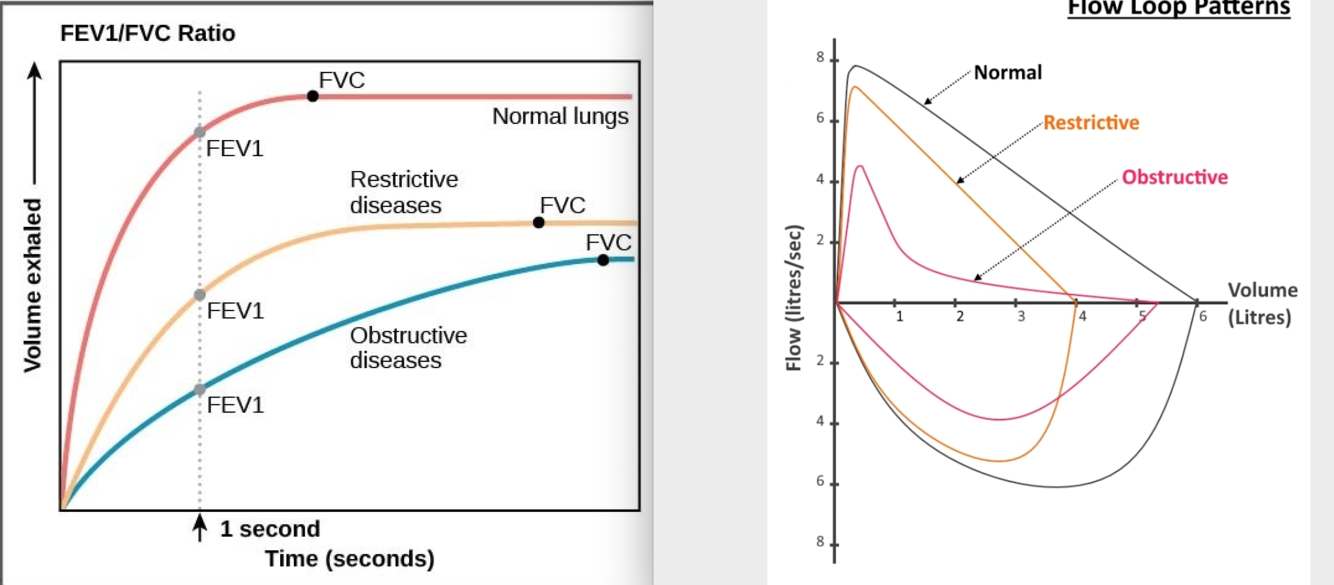
What are the clinical differences between restrictive and obstructive pulmonary conditions?
Obstructive
- Reduced FVC (<80% of normal)
- Reduced FEV1:FVC ratio (<70%)
- Reduced peak flow rate
Restrictive
- Reduced FVC
- Reduced FEV1
- Normal FEV1:FVC ratio
- Normal peak flow rate
What values are given on an ABG?
- pH
- PO2
- PCO2
- HCO3
- SO2
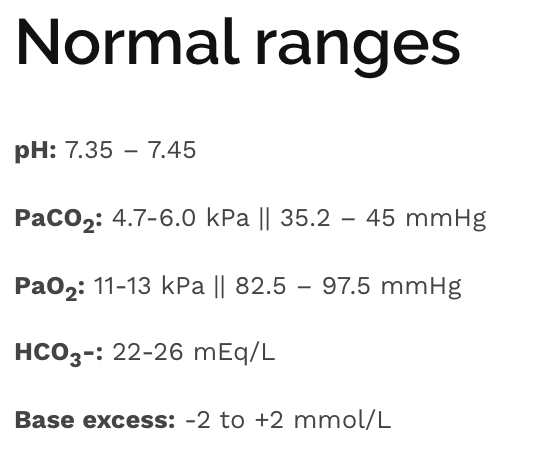
What are the normal values for each parameter on the ABG?
What does
a) PaO2 is <10 kPa on air
b) PaO2 is <8 kPa on air
mean clinically?
a) hypoxaemia
b) severe hypoxaemia & in resp. failure
- which type? –> look at CO2
- Type 1 respiratory failure = severe hypoxaemia + hypo/normocapnaeia
- Type 2 respiratory failure = severe hypoxaemia + hypercapnaeia
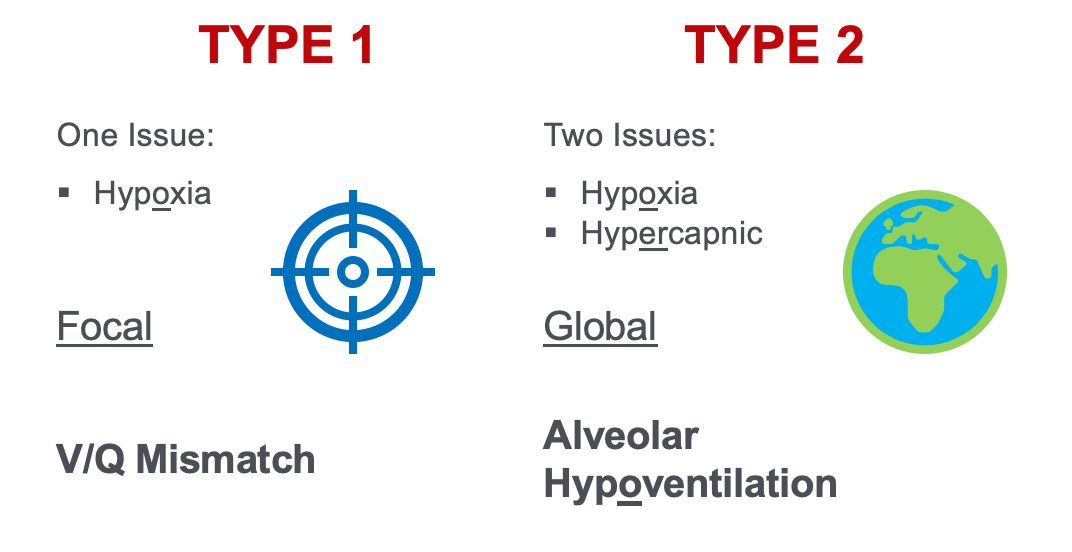
Describe the distinction between type 1 and type 2 respiratory failure
i.e. in type 1, the lung’s ability to compensate for hypercapnia is preserved, but not in type 2
Type 1 respiratory failure involves
- hypoxaemia (PaO2 <8 kPa)
- normocapnia (PaCO2 <6.0 kPa).
Type 2 respiratory failure involves
- hypoxaemia (PaO2 <8 kPa)
- hypercapnia (PaCO2 >6.0 kPa).
What abnormality is shown?
a) Metabolic Alkalosis
b) Type 1 Respiratory Failure
c) Type 2 Respiratory Failure
d) Respiratory Alkalosis
e) Metabolic Acidosis
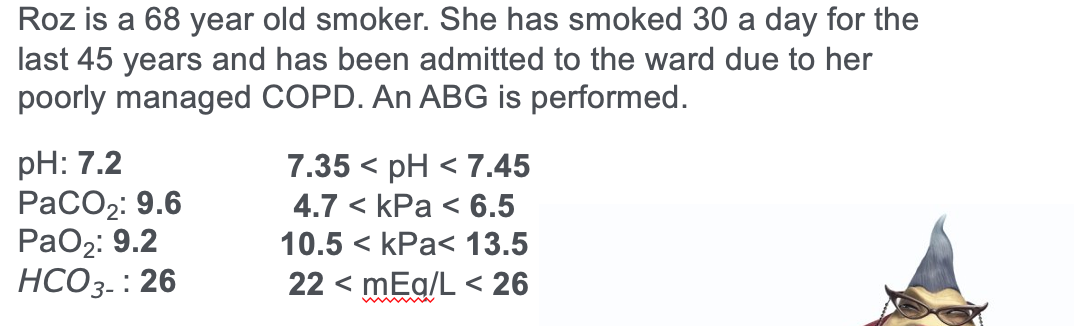
C: Type 2 Respiratory Failure
In this case we find her CO2 is raised, indicating her lungs are failing to blow it off. This mixes with water to form carbonic acid and dissociates into ions. The added hydrogen ions into the system increase the arterial pH and cause the acidosis. This is not a metabolic, but a respiratory problem.
Why is PaCO2 not raised in Type 1 Respiratory failure?
Respiratory compensation
this allows hyperventilation –> blowing off excess CO2 via other sections of lung (as focal damaged area is ‘underperforming’)
Name some acute causes of Type 1 resp. failure
- Acute asthma
- Collapse of alveolar spaces (e.g. Atalectasis, Pneumothorax)
- Fluid filling of alveolar spaces (e.g Pulmonary Oedema)
- Diffusion problem (oxygen cannot enter the capillaries due to parenchymal disease, e.g. Pneumonia, ARDS)
- Ventilation-perfusion mismatch (parts of the lung receive oxygen but not enough blood to absorb it (e.g. PE)
Name some acute causes of Type 2 resp. failure
- Acute severe asthma
- COPD
- Upper airway obstruction
- Neuropathies (GBS, MND)
- Drugs (opiates)
What sound will be heard on percussion:
- pleural effusion
- consolidation e.g. pneumonia
- Pneumothorax
- pleural effusion = stony dull
- consolidation e.g. pneumonia = dull
- Pneumothorax = hyperresonant
O/E how can you differentiate between pleural effusion and pneumonia?
- both = percussion: dullness
BUT
- pleural effusion = vocal fremitus: decreased
- pneumonia = vocal fremitus: increased
What can be heard on ausculation:
- Normal lung
- Consolidation
- Pneumothorax
- Effusion
- Normal lung = Vesicular
- Consolidation = Bronchial (liquid –> better sound)
- Pneumothorax = Diminished
- Effusion = Diminished
How can pleural effusions be categorised?
Transudates: protein<30gL
Exudates: protein>30gL
What can cause transudates (–> pleural effusion)?
A transudative pleural effusion occurs when too much fluid starts to leave the capillaries either because of increased hydrostatic pressure or decreased oncotic pressure in the blood vessels.
Oncotic pressure results from the the inability of solutes like large proteins - albumin for example - to move across through the capillary.
- increased venous pressure
- cardiac failure
- restrictive pericarditis
- fluid overload
- hypoproteinaemia
- cirrhosis
- nephrotic syndrome
- malabsorption
- hypothyroidism
- Meig’s syndrome (right pleural effusion + ovarian fibroma)
What can cause exudates (–> pleural effusion)?
An exudative pleural effusions is due to inflammation of the pulmonary capillaries which makes them much more leaky.
- increased capillary permeability secondary to infection
- pneumonia
- TB
- inflammation
- pulmonary infarction
- RA
- SLE
- malignancy
- e.g. bronchogenic carcinoma
Name 4 ECG changes that may seen in a case of pulmonary embolism?
- deep S wave (I), pathol. Q wave (III), inverted T waves (III)
- quite rare
- right axis deviation
- right BBB
- new onset AF
Name some causes of finger clubbing
- empyema
- mesothelioma
- bronchogenic carcinoma
- cystic fibrosis
N.B. not COPD
etc
What is cor pulmonale?
the enlargement and failure of right ventricle as a response to:
- increased vascular resistance OR
- high blood pressure in the lungs
What are some causes of cor pulmonale?
cor pulmonale = RVH & right ventricular failure in response to chronic increased vascular resitance (in lungs) or high BP in lungs.
- lung disease
- asthma, bronchiectasis, COPD, pulmonary fibrosis
- pulmonary vascular disease
- PE, vasculitis, HTN, ARDS, sickle cell
- thoracic cage abnormality
- kyphosis, scoliosis
- neuromuscular disease
- myasthenia gravis, poliomyelitis, MND
w. r.t. to cor pulmonale
a) what are the symptoms
b) what are the signs O/E
a) dyspnoea, fatigue, syncope
b) cyanosis, tachycardia, raised JVP, RV heave, pansystolic murmur, early diastolic murmur hepatomegaly, oedema
If the exudate from an empyema infection was analysed, what would be the
a) pH
b) LDH
c) glucose
a) 7.2
b) normal
c) normal
What else can cause a pleural pH of <7.2, but with normal blood p

-
General27
-
Pneumonia20
-
Pneumothorax21
-
Pulmonary embolism39
-
Sarcoidosis14
-
Tuberculosis9
-
Acute respiratory distress syndrome12
-
Lung cancer49
-
Asthma15
-
Bronchiectasis23
-
Chronic obstructive pulmonary disease (COPD)10
-
Obstructive sleep apnoea6
-
Asbestos-related lung disease (incl. asbestosis and mesothelioma)25
-
Aspergillus lung disease17
-
Extrinsic allergic alveolitis12
-
Idiopathic pulmonary fibrosis9
-
Pneumoconiosis10
-
Buzz words: Respiratory34
-
Amir Sam Images19
-
Blackboard EMQs Respiratory88
-
Resp - DPD43



