Define sarcoidosis
Sarcoidosis is a chronic granulomatous disorder of unknown aetiology, commonly affecting the lungs, skin, and eyes.
- It is characterised by accumulation of lymphocytes and macrophages and the formation of non-caseating granulomas in the lungs and other organs.
- Although lungs and lymph nodes are involved in more than 90% of patients, virtually any organ can be involved.
- It has a bimodal age distribution with 2 peaks in the third and fifth decades.
- The clinical course is often heterogeneous and unpredictable.
Which conditions must be excluded before a diagnosis sarcoidosis can be made?
Sarcoidosis is a diagnosis of exclusion of granulomatous lung diseases, including tuberculosis and histoplasmosis.
What is the aetiology of sarcoidosis?
Aetiology is unknown.
However, several aetiological factors have been suggested, including genetic, immunological, and infectious causes
- (e.g., viruses, Borrelia burgdorferi, Propionibacterium acnes, Mycobacterium tuberculosis, and Mycoplasma
How is sarcoidosis classified?
Commonly used classification according to organ/system involvement
- Systemic sarcoidosis: multisystem involvement, sometimes with chronic fatigue
- Pulmonary sarcoidosis: lungs involved in >90% of patients; further classified into stages I, II, III, and IV
- Cutaneous sarcoidosis: plaques; lupus pernio
- Ocular sarcoidosis: anterior uveitis is most common
- Cardiac sarcoidosis: 5% of patients; various types of heart block; cardiomyopathy later in course; if pulmonary arterial hypertension occurs can be debilitating
- Neurosarcoidosis: <10% of patients; headaches; seizures.
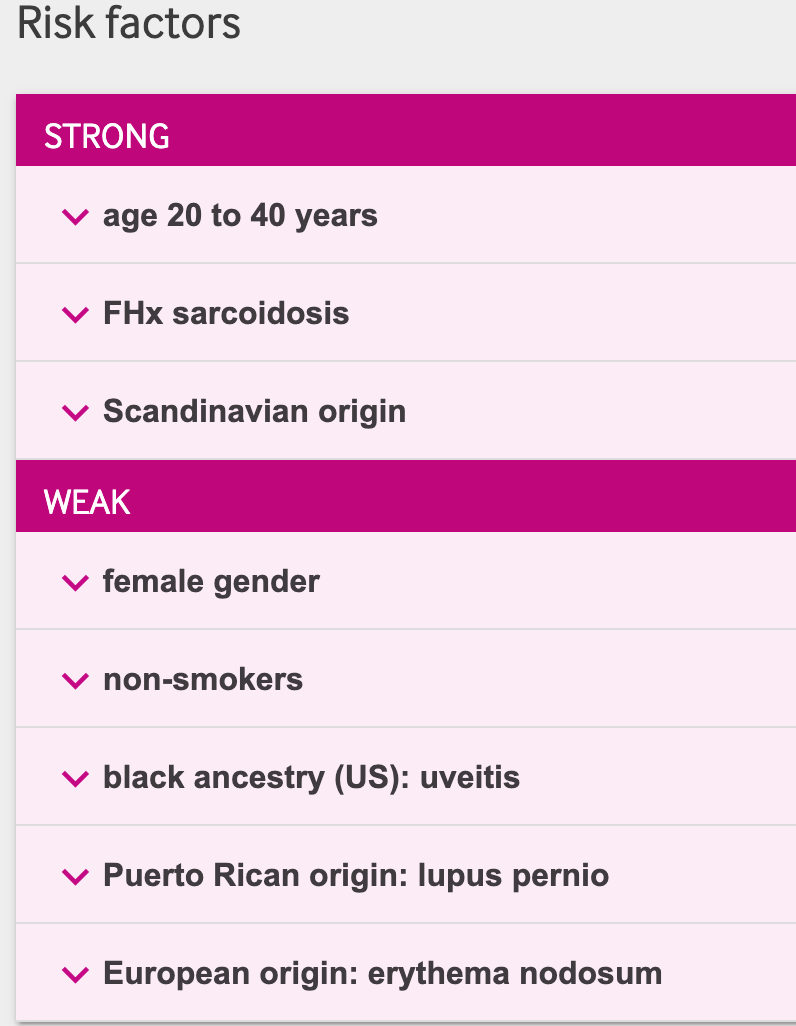
What are the risk factors for sarcoidosis?
genetic
- afro-caribbean
- FHx of sarcoidosis
environmental
- prior infection w TB or borrelia burgdorferi
Summarise the epidemiology of sarcoidosis
Incidence is about 6 cases per 100,000 person-years
- The lifetime risk of sarcoidosis for black people & Scandinavian in is slightly higher than for white people
- Extrathoracic manifestations are more common in certain populations, such as chronic uveitis in black people in the US, lupus pernio in Puerto Ricans, and erythema nodosum in Europeans.
- Cardiac and ocular sarcoidosis appear to be more common in Japan
- Women are more likely to have eye and neurological involvement and have erythema nodosum, whereas men are more likely to be hypercalcaemic.
- Black people are more likely to have skin manifestations (other than erythema nodosum) and have eye, liver, bone marrow, and extrathoracic lymph node involvement
What are the presenting symptoms of sarcoidosis?
- SOB
- wheeze
- cough
- dyspnoea
- nodules on lower legs
- (erythema nodusum)
- arthralgia
- vision changes - photophobia, red painful eye, blurred vision
- palpitations
- non specific: fever, weight loss, fatigue
What are some uncommon symptoms of sarcoidosis?
- chest wall pain
- haemoptysis
- weight loss
- low-grade fever
- arrhythmias
- heart block
- hepatomegaly
- headache
- seizures
- symptoms and signs of pituitary lesion
What are signs of sarcoidosis O/E?
- erythema nodusum
- due to inflammation of lipids
- usually on tibias
- red, hard, painful
- uveitis
- ~ facial palsy
- arrythmias O/A?
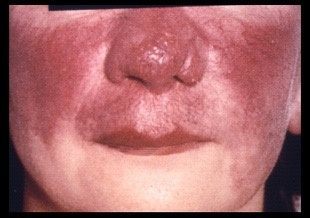
What is lupus pernio?
Indurated plaques with discoloration of the nose, cheeks, lips, and ears.
- More common in black women.
- Predictor of poor prognosis
What are some primary investigations for ?sarcoidosis?
Typical history and biopsy from affected organs are essential for the diagnosis.
- CXR
- = hilar and/or paratracheal adenopathy with upper lobe predominant, bilateral infiltrates; pleural effusions (rare) and egg shell calcifications (very rare) may be seen
- FBC
- Usually secondary to splenic and/or bone marrow involvement
- = anaemia in 4%-20%; leukopenia in 40%
- serum urea
- In cases of renal involvement.
- = may be elevated
- creatinine
- see above
- liver enzymes
- = Asymptomatic aminotransferase (AST and ALT) elevation possible.
- serum calcium
- Due to dysregulated production of calcitriol by activated macrophages and granulomas.
- = hypercalcaemia
- PFTs
- To monitor disease.
- Persistent decline in forced vital capacity indicates disease progression.
- = restrictive or obstructive or mixed pattern
- ECG
- To exclude or confirm cardiac involvement.
- About half of patients with cardiac sarcoidosis have abnormalities of rhythm, conduction, or repolarisation
- = conduction abnormalities
- purified protein derivative of tuberculin (PPD)
- Partial to complete anergy in sarcoidosis, secondary to depressed cellular immunity
- = negative in sarcoidosis
What are the stages of sarcoidosis seen on CXR?
Stage 0: normal
Stage I: bilateral hilar lymphadenopathy
Stage II: bilateral hilar lymphadenopathy plus pulmonary infiltrates
Stage III: pulmonary infiltrates without hilar lymphadenopathy
Stage IV: extensive fibrosis with distortion.
What are some secondary investigations for ?sarcoidosis?
- CT scan of chest
- Ground-glass appearance may indicate a potentially reversible condition.
- Cystic architectural distortion suggests irreversible disease
- = hilar and/or paratracheal adenopathy with upper lobe predominance, bilateral infiltrates in a bronchovascular distribution; calcified hilar or mediastinal lymph nodes in patients with longstanding disease
- flexible bronchoscopy with transbronchial lung biopsy
- Essential for diagnosis in most cases.
- Transbronchial needle aspiration from large mediastinal lymph nodes if present.
- = non-caseating granulomas
- bronchoalveolar lavage (BAL)
- Specificity of 94%. Sensitivity of 53%
- BAL lymphocytosis, with CD4-to-CD8 ratio >3.5
- skin biopsy
- Skin biopsy of lesion suspicious for sarcoidosis may histologically confirm diagnosis
- = non-caseating granulomas
- 24-hour urine calcium
- Hypercalciuria due to abnormal calcium and vitamin D regulation from macrophages inside granulomas
- = hypercalciuria
- serum ACE
- Elevated in about half of patients
- May not reflect disease activity.
- Utility is unreliable and controversial
- = elevated
- gallium-67 scan
- Typical patterns include panda sign: lacrimal and parotid gland uptake; lambda sign: parahilar, infrahilar, and right paratracheal or azygos node uptake
- Lacks specificity. Serial images sometimes require 48 hours to complete.
- The clinical value of this test remains controversial
- may show typical uptake patterns
- endobronchial ultrasound-transbronchial needle aspiration
- Endobronchial ultrasound-transbronchial needle aspiration is standard of care and routine practice for the diagnosis of mediastinal lymphadenopathy, with high sensitivity (88%) and specificity (100%).
- = non-caseating granulomas
What are some emerging tests for ?sarcoidosis
- MRI
- May be useful in identifying areas of sarcoidosis involvement, including the heart and the brain
- = heart findings include nodular lesions and/or focal myocardial thickening;
- = brain findings are varied and non-specific, and include meningeal enhancement with or without periventricular white matter lesions
- (18)F-fluorodeoxyglucose (FDG) PET scan
- PET scanning has been shown to have a characteristic pattern of uptake in sarcoidosis and may aid in the diagnosis of cardiac sarcoidosis.
- This is much less invasive than endomyocardial biopsy, with minimal to no complications from the procedure
- = heterogeneous myocardial FDG uptake

-
General27
-
Pneumonia20
-
Pneumothorax21
-
Pulmonary embolism39
-
Sarcoidosis14
-
Tuberculosis9
-
Acute respiratory distress syndrome12
-
Lung cancer49
-
Asthma15
-
Bronchiectasis23
-
Chronic obstructive pulmonary disease (COPD)10
-
Obstructive sleep apnoea6
-
Asbestos-related lung disease (incl. asbestosis and mesothelioma)25
-
Aspergillus lung disease17
-
Extrinsic allergic alveolitis12
-
Idiopathic pulmonary fibrosis9
-
Pneumoconiosis10
-
Buzz words: Respiratory34
-
Amir Sam Images19
-
Blackboard EMQs Respiratory88
-
Resp - DPD43



