Define intussusception.
Intussusception describes the invagination of one portion of bowel into the lumen of the adjacent bowel, most commonly around the ileo-caecal region.
What is the classic triad of intussusception?
- colicky abdominal pain
- redcurrant jelly stool
- and a palpable abdominal mass
How common is inussusception?
- Intussusception usually affects infants between 6-18 months old
- Boys> girls: 2:2-3:1
What are the risk factors for intussusception?
- male sex
- age 6-12 months
- recent viral illness
- first gen rotavirus vaccine (tetravalent rhesus-human reassortant rotavirus vaccine [RRV-TV])
Why is intussusception clinically important?
It results in venous obstruction and bowel-wall oedema that can progress to bowel necrosis, perforation, and, rarely, death
What are the presenting features of intussusception?
- abdominal colic pain - lasts between 1-3 minutes with normal episodes in between (during paroxysm the infant will characteristically draw their knees up and turn pale)
- vomiting
- PR blood- ‘red-currant jelly’ is a late sign
- lethary/irritability in between waves of pain
What are the findings on examination in inussusception?
- sausage-shaped mass in the right upper quadrant
- PR examination may show blood on gloved finger
What is the investigation of choice for intussusception? What are the results?
Abdominal ultrasound - shows a target like mass. Colour Doppler can show if bowel is ischaemic.
Air contrast enema - can also diagnose itussusception
Results: Target sign (variants include bull’s eye sign, doughnut sign, crescent-in-doughnut sign, and multiple concentric ring sign); pseudokidney sign; sandwich sign; abnormal Doppler flow
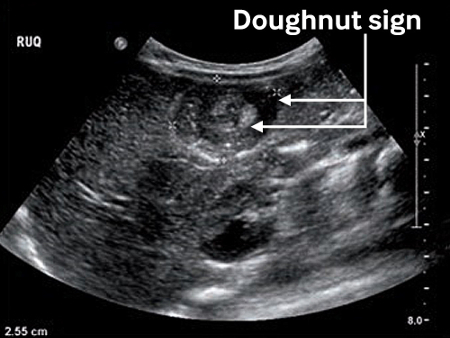
What is the most common anatomic location for intussusception to occur?
Ileocolonic intussusception (prolapse of the terminal ileum into the proximal colon) is the most common anatomical location for intussusception to occur, followed by ileoileal and colocolonic

What is the management of intussusception?
Refer to surgeons
- fluid resuscitation
- +/- WS antibiotics (clindamycin + gentamycin)
- +/- NG tube insertion if repeated vomiting
- radiological air reduction (air enema/barium enema/US guided saline enema)
- if that fails then surgery (bowel resection)
When is surgery rather than air reduction indicated in intussusception?
- unsuccessful air reduction
- perforation,
- peritonitis,
- Henoch-Schönlein purpura.
What are the predisposing factors for intussusception? What are the lead points in older children/adults?
- Young children: hyperplasia of Peyer’s patches and lymphoid tissue from viral infection e.g. gastroenteritis. Appendicitis. These may act as the lead point.
- Older children and adults: pathological lead point include luminal polyps, malignant tumours (including lymphoma), and benign mass lesions (e.g., lipomata, Meckel’s diverticulum, Henoch-Schonlein purpura[haematoma of bowel wall], and enteric duplication cysts, cystic fibrosis [hypertrophied mucosal glands])
Summarise the pathophysiology of intussusception.
- One portion of the bowel telescopes into the portion distal to it
- The mesentery is dragged along with it and causes venous obstruction
- This causes oedema and mucosal bleeding
- Arterial obstruction can also occur causing necrosis
What is the risk of recurrence in intussusception?
10%
Surgical reduction: 2-5%
What is seen on this abdominal x-ray showing intussusception? Why is AXR indicated?
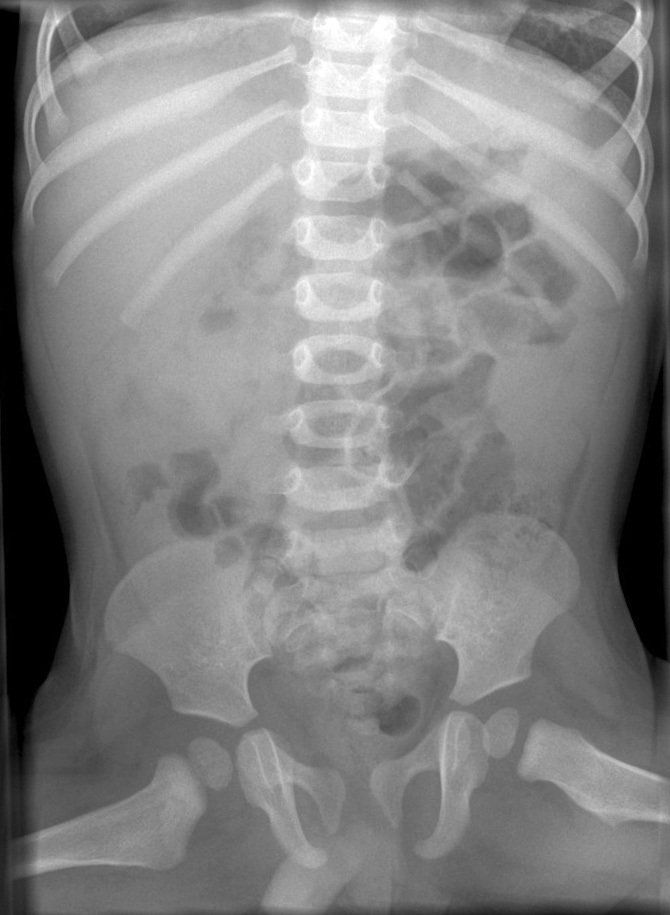
- A mass and paucity of bowel gas in the right upper quadrant (ileo-colic likely)
- Loss of clarity of the liver edge.
- Dilated loops of small bowel proximal to the intussusception
- Paucity of gas within the deflated large bowel distal to the obstruction
Essential to look for free air if the patient has signs of peritonitis and may have perforated.
What are the late complications of intusussception?
- bowel wall gangrene
- adhesions and infection
- bowel perforation
What is the recurrence rate in intuseusception?
10%

-
AGPAR2
-
Childhood vaccinations and counselling31
-
Developmental Milestones32
-
Autism Spectrum Disorder27
-
Attention deficit hyperactivity disorder (ADHD)15
-
Asthma and/or Viral induced wheeze in a child28
-
Allergic reactions in a child - anaphylaxis, allergic rhinitis, CMPA, food allergy50
-
Anal fissure in a child4
-
Appendicitis in a child8
-
Breath holding attacks10
-
Bronchiolitis19
-
Cardiac failure in a child12
-
Cerebral palsy & hypoxic-ischaemic encephalopathy51
-
Chromosomal syndromes - trisomy 13/18/21, Noonan, Prader-Willi, Turner, Klinefelter57
-
Congenital adrenal hyperplasia14
-
Congenital heart disease - ASD, AVSD, CoA, PDA, PS, ToF, ToGA, VSD34
-
Congenital, perinatal and neonatal infection (TORCH)40
-
Constipation in a child14
-
Croup14
-
Cystic fibrosis21
-
Developmental dysplasia of the hip13
-
Diabetes in a child39
-
Dysmorphism/congenital abnormality67
-
Encopresis10
-
Enuresis13
-
Eye disease in a child (conjunctivitis, hypermetropia, myopia, retinoblastoma, retinopathy of prematurity, strabismus)38
-
Fever in a neonate / child23
-
Febrile convulsion14
-
Fracture in a child23
-
Gastro-esophageal reflux in a child13
-
Gastroenteritis in a child57
-
Growth disorder (constitutional delay, precocious/delayed puberty, premature thelarche/adrenarche/menarche, skeletal dysplasia)70
-
Haematological disease in a child (haemophilia, idiopathic thrombocytopenic purpura, iron-deficiency anaemia, sickle cell, thalassaemia)82
-
Haemolytic disease of the newborn14
-
Headache in a child23
-
Hearing testing7
-
Hernias in child8
-
Hirschsprung disease18
-
IgA Vasculitis (Henoch-Schonlein purpura)14
-
Immunodeficiency in a child (incl. HIV)22
-
Inflammatory bowel disease in a child25
-
Inherited metabolic disorders (G6PD deficiency)9
-
Intussusception17
-
Jaundice in a neonate/child29
-
Kawasaki disease10
-
Laryngomalacia6
-
Liver disease in a child (incl. liver failure)54
-
Malabsorption in a child (lactose intolerance, coeliac disease)21
-
Malignancy in a child63
-
Malnutrition in a child (obesity, rickets)37
-
Malrotation & Volvulus in a child9
-
Meckel’s diverticulum6
-
Meconium aspiration10
-
Mental health disorder in a child (bullying, depression)2
-
Meningitis and encephalitis in a child51
-
Mesenteric adenitis4
-
Necrotising enterocolitis (NEC)9
-
Neurological disease in a child95
-
Seizures/epilepsy (neurological disease in a child)53
-
Osteochondritides (incl. Perthe’s, Osgood-Schlatter)30
-
Osteomyelitis in a child17
-
Phimosis & foreskin disorders (+ hypospadias, testicular tortion)23
-
Pneumonia in a child18
-
Pyloric stenosis13
-
Renal disease in a child (nephrotic syndrome, renal failure, acute glomerulonephritis)49
-
Respiratory disease in a neonate (CLD of prematurity, RDS, PPH, transient tachypnoea)29
-
Rheumatological disease in a child (arthritis; infective, juvenile idiopathic, reactive)51
-
Safeguarding - non-accidental injury and neglect33
-
Septicaemia in the neonate/child11
-
Slipped upper femoral epiphysis15
-
Small / Preterm baby14
-
Skin diseases in a child - (acne, eczema, haemangioma, milia, molluscum contagiosum, mongolian blue spot, nappy rash (irritant, candida, seborrhoeic), seborrhoeic dermatitis, tinea)75
-
Somatisation in a child (functional abdominal pain)20
-
Sudden infant death syndrome (SIDS)8
-
Thyroid disease in a child15
-
Threadworm infection (Year 6)7
-
Toddler diarrhoea5
-
Tropical disease in the child (malaria, typhoid, dengue)15
-
Upper respiratory tract infection in a child (rhinitis, sinusitis, otitis media/externa, tonsillitis, epiglottitis, pharyngitis, laryngitis)44
-
Urinary tract infection in a child31
-
Viral infection in a child (Mumps, Measles, Rubella, Erythema infectiosum, Parvovirus B19, Roseola infantum (HHV6), Chickenpox, Hand, foot and mouth disease)81
-
Vasovagal syncope in a child9
-
Whooping cough (Pertussis)16
-
Birth injuries11
-
SBAs50
-
Paeds58
-
ICSM Paeds Mock46
-
Paeds EMQs30
-
Paeds #150
-
Paeds #250
-
Random pre-exam things67



