A 4 yr old presents with 2 week history of increasing oedema with scrotal swelling and now periorbital swelling; He has proteinuria 4+. His BP and renal function are normal. The most likely diagnosis is
- Henoch-Schonlein Purpura
- SLE
- Angioneurotic-edema
- Glomerulonephritis resulting in nephrotic syndrome
- Post streptococcal glomerulonephritis
- Could be 1,2 or 5 but not enough in the q to say this; the presentation is of nephrosis, many causes so generic answer is 4.
This 5 year old, just emigrated from Australia 10 days ago has a 1 week of high fevers and cough; no response to IV cefuroxime; The most likely organism is…
- Haemophilus
- Strep Pneumonia
- Moxarella
- Staph Aureus
- Mycobacterium TB
Staph aureus; there are small pneumatocoeles. Also if you thought about TB, Australia has one of the lowest incidences in the world so very unlikely
Which is the most appropriate treatment for an acutely wheezy, alert 18 month old in ED, RR 40/min; HR 120/min sats 90% (100% in oxygen)
- 6 puffs salbutamol via a turbohaler
- 10 puffs salbutamol via an MDI + aerochamber
- 6 puffs salbutamol via an MDI
- 5mg salbutamol via nebuliser
- 2.5 mg salbutamol via nebuliser
Answer is 2; whilst one can use a nebuliser, this is now reserved for life threatening wheeze or failure to tolerate spacer; even if needing oxygen (in non life threatening wheeze), remove this temporarily to give spacer
A 2 yr old child had their first febrile convulsion, which was a very prolonged one resulting in intubation. For the next febrile illness, the parents are best advised:
- To give prophylactic nurofen and paracetamol to reduce risk of a convulsion
- Tepid sponge and place in a warm (not cold) bath
- Apply a cool fan to the child
- Give the child rectal diazepam if they start fitting and call 999
- Always seek medical attention to have the child examined
No evidence 1 works; 2 and 3 should not be advised; 4 is correct; no need to always have the child examined just because the child has a fever and a previous convulsion
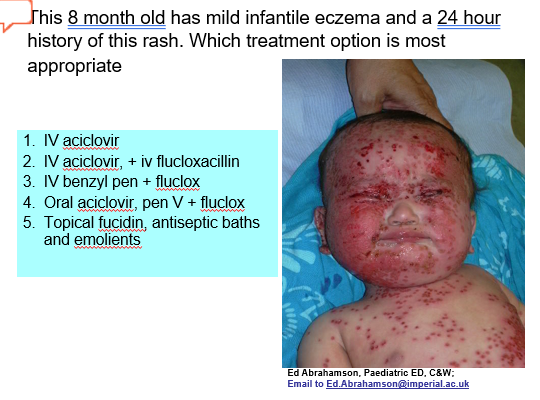
2
This is a case with evidence of multiple similar sized circular lesions (some vesicles) and also crusting + exudates; one has to consider both staph aureus and herpes; this was eczema herpeticum and secondary staph infection. Do not use topical antibiotics for infected eczema.
Note added by Dr Gareth Tudor-Williams: there is a widespread myth that using penicillin to treat Strep, plus flucloxacillin to treat Staph is good practice. In fact, flucloxacillin is a semi-synthetic penicilin and when given in appropriate doses iv is just as effective at treating Strep as penicillin. It is unnecessary to duplicate the cover, and simply costs more in terms of nursing time, and may reduce the half life of peripheral cannulae by doubling the number of drug doses given intravenously
A 10 month old baby had a mild allergic reaction to egg (rash); What should happen with MMR
- Admit for MMR under hospital observation
- No MMR
- Single jabs in community setting
- Single jabs under hospital observation
- MMR in community setting
V easy here – only 1 answer which is 5. NO need to admit for observation, and never single jabs, ever!
What is the most appropriate management strategy for an alert, well oxygenated 3 yr old with 24 hr history of barking cough, increasing (moderate) stridor and fever >40 + rigors. No drooling. She is being given oxygen.
- Adrenaline nebuliser stat and call ENT and anaesthetic teams
- Oral dexamethasone and lateral neck X-Ray
- IV cefuroxime + flucloxacillin (after blood cultures)
- Budesonide nebuliser
- Oral dexamethasone, IV cefuroxime + flucloxacillin (after blood cultures) and review
History suggests viral croup but also possible bacterial tracheitis raised. Adrenaline not needed at this stage unless deteriorates (when ENT/anaesthetics should be called). Never do lateral neck xrays; oral dex is first line although you can give a budesonide neb instead; but in this case, advisable to also give broad spectrum antibiotics too, hence 5 is most appropriate answer.
A 14 month old child presents with 2 weeks of increased bruising, and a few nose bleeds; no recent history except MMR 2 weeks ago; No family history; Exam normal, no Lymph nodes, no enlarged liver or spleen; lots of bruises over contact points; FBC shows Hb 11.9; WCC 7.8 (Normal diff); Plats 8,000; Blood film normal. Most likely diagnosis is..
- Acute lymphoblastic leukemia
- Idiopathic thrombocytopenic purpura
- Henoch Schonlein Purpura
- MMR associated thrombocytopenia
- Aplastic Anaemia
Most likely is an immune thrombocytopneia – so 2 or 4 but given the MMR history, seems 4 more likely
A bright 9 yr old presents with primary nocturnal enuresis. Parents tried pad and alarm, failed; have tried lots of self-help remedies to no avail. Which is the most useful first line approach?
- Start DDAVP tablets for 3 months and review
- Give imipramine for 3 months trial
- Encourage lifting at midnight and reduction in oral fluids at night
- Commence behavioural approach
- Do nothing, just reassure
The best approach is 4, meds have v limited role (short term use of DDAVP occasionally used to support behavioural approach; sleepovers etc); imipramine almost never nowadays; lifting at night will delay continence; doing nothing not an option at this age.
In asthma in an 8 yr old, with persisting cough/wheeze at night and exertion, who is needing regular salbutamol, the next step is
- Montelukast 5mg orally once daily
- Low dose inhaled steroids via turbohaler
- Low dose inhaled steroids via MDI
- Salmeterol and low dose steroid combination via MDI and spacer
- Low dose inhaled steroids via MDI and aerochamber
Option 5
What would be the most appropriate immediate response in a situation where a child with severe acute asthma is being removed from the ED by their carers prior to treatment
- Accept parental wishes
- Prevent child from leaving, by force if necessary
- Ask security to intercept and rescue the child
- Call social services and ask them to go to Court for an emergency protection order
- Call the police
The only immediate option is 5, so that you can get the child back to start immediate treatment (able to do this without parental consent, in best interests of the child; Meanwhile you will then pursue point 4. Security cannot use force = assault.
A 15 yr old takes an overdose or tricyclic antidepressants and is comatose, GCS 6; The most appropriate first line management is
- Ipecac forced emesis
- Activated charcoal via an NG tube
- Gastric washout, then activated charcoal via an NG tube
- Oxygen, suction and intubation
- Contact psychiatrists
Easy as the only safe option is 4 as she has an unsafe airway; then consider 3 and of course 5; No role ever now for forced emesis.
In a 6 month old with a 2 week history of persisting diarrhoea (watery, no blood, 6-8 x a day) after an initial bout of vomiting and fever; with no travel or drug history, the most appropriate management would be
- 24 hours of diarolyte instead of all other fluids
- Perform a coeliac screen, stool cultures and refer to a paediatric gastroenterologist
- Send stool cultures and start ciprofloxacin
- Stop all dairy products and substitute with a hydrolysed formula; also send stool cultures
- Send stool cultures and start metronidazole
Please see “Diarrhoea and vomiting in under 5’s”, (nice.org.uk); Approach is 4; If giardia was found, Rx with metronidazole can be considered but there are very few other indications to use antibiotics in children with infective gastroenteritis (other than with possible sepsis)
- A 6 wk old breast fed infant with a 2 week history of worsening vomiting after feeds, with poor weight gain and constipation. The Chloride is 90 mmols/L.
- A 1 week old with vomiting, lethargy, increasing jaundice and on exam a 3 cm liver is felt and cataracts are noted
- 3 yr old with acute onset abdominal pain for 4 hrs (3 similar episodes in the past, all self resolved), but this time with bile stained vomiting
- 6 month old breast fed infant, vomiting since early on, not resolved with anti-reflux medication; also has eczema hard to control and constipation
- 2 week old boy with frequent vomiting, lethargy, no fevers. The abdomen is soft and non tender. U&E’s show Na 122, K+ 6.4.
- Pyloric stenosis
- Galactosaemia
- Malrotation
- Cow’s milk protein intolerance - NB CMP intolerance can occur in breast fed infants, as small amounts of cow’s milk protein fragments may be found in the breast milk of mothers who have not excluded milk from their own diet
- CAH
- A 5 yr old with 1 week of severe left sided headaches, analgesic unresponsive. Having high fevers, vomiting, and earache, on oral amoxicillin for otitis media. Aside from a red left TM, nothing to find on examination.
- Acute onset severe right sided headaches in 7 yr old, with left sided weakness lasting an hour then full recovery. Several similar episodes in the past but getting worse; weakness is taking longer to resolve each time and more severe.
- 3 yr old with 2 week history of waking with headaches and vomiting; becoming unsteady on feet and presents with a sudden squint of left eye, with diplopia on looking to the left.
- 9 yr old with 6-12 months of continuous daily frontal and vertex headaches; unresponsive to analgesia; does not wake from sleep; no interruption with ADL’s. No other symptoms. Exam N, inc BP and fundi
- 14 yr old girl, 6 weeks worsening headaches, early morning with vomiting; grossly blurred fundi, CT scan normal
- Intracranial abscess
- Arterio-venous malformation
- Posterior fossa tumour
- Tension type headache
- Idiopathic intracranial hypertension
- 5 yr old recently returned Nigeria; has had 3 day history of swinging high fevers, also urine is noted to be dark red. On exam has enlarged liver, otherwise nil else. Dipstick positive for blood +++.
- 2 year old with frank haematuria, some abdominal pain, rigors. Urine nitrite and blood +++.
- 6 month old brought in by parents as they noted blood in the nappy; well infant; history of constipation last 6 weeks; exam, right sided abdominal mass palpable; urine blood ++++.
- A 3 yr old with urine noted to be very dark by parents; Has had puffy eyes and been generally unwell recently with a fever and sore throat. Urine shows blood ++++, protein +++. BP 110/65.
- 6 yr old male, UK born, of Iraqi parents, develops sudden onset very dark red urine, no pain. He has a current viral infection. On exam, slightly jaundiced, no liver or spleen; urine – blood ++++. There was a history of prolonged neonatal jaundice.
- Malaria
- UTI
- Wilm’s tumour
- Acute glomerulonephritis
- G6PD deficiency
A previously healthy 2-year-old child presents with a 24 hour history of diarrhoea and vomiting. Which of the following is the single, most accurate method for assessing the degree of dehydration?
a. Assess skin turgor
b. Assess the fontanelle
c. Calculate the difference between the current weight and the predicted weight from the child’s growth records
d. Examine the mucous membranes
e. Measure the heart rate and blood pressure
c
A 3-year-old boy attends the Paediatric A+E Department because he has developed an itchy rash whilst at a birthday party. Of the following features, which requires immediate treatment with 0.01 ml/kg of 1:1000 adrenaline i.m.?
a. Blood pressure of 88/50
b. Generalised urticaria
c. Lip swelling
d. Respiratory rate of 22/minute
e. Wheeze on auscultation
e
A 15-month-old girl presents with a 3-day history of intermittent fevers and vomiting and poor feeding. On examination her temperature is 38.6 C but there are no localising signs. What is the most likely cause?
a. Bronchiolitis
b. Encephalitis
c. Meningitis
d. Pyloric stenosis
e. Urinary tract infection
e
A 6 yr old male born in the UK to Iraqi parents, develops sudden onset very dark red urine with no dysuria. He has a intercurrent viral infection. On examination; slightly jaundiced, no liver or spleen; urine – blood ++++. There was a history of prolonged neonatal jaundice. Which investigation is most likely to reveal the underlying diagnosis?
a. Blood film
b. G6PD level, now and in one month’s time
c. Hb electrophoresis
d. Liver function tests
e. Urine M,C&S
b
A twelve year old boy has had seven episodes of spontaneous lip swelling and bilateral periorbital oedema in the last three years. His father also had similar episodes in childhood. What is the most likely immunological mediator?
a. C1 esterase inhibitor
b. Complement C4
c. Eosinophils
d. Histamine
e. IgE antibodies
a
A term baby is born normally at 38 weeks gestation at 2.3 kg. Labour was difficult with prolonged rupture of membranes. At 35 minutes of age the infant was noted to have an increasing oxygen requirement with grunting and respiratory distress. On examination he was floppy with an oxygen saturation of 95% in 2L/min of oxygen. A CXR showed reticulonodular shadowing. What is the most likely diagnosis?
a. Bacterial pneumonia
b. Bronchiolitis
c. Chronic lung disease
d. Persistent pulmonary hypertension
e. Respiratory distress syndrome
a
A 5-year-old girl who never received MMR was exposed to chicken pox last week at school. She now presents with a 12 hour history of rash and abdominal pain and is reluctant to walk. On examination, she is unwell with cold hands and feet, and a widespread blanching maculopapular rash with spots of different sizes sparing the head and neck. What is the most likely diagnosis?
a. Chicken pox (Varicella zoster)
b. Measles
c. Meningococcal sepsis
d. Roseola infantum
e. Rubella
c
A 10 year old girl with known sickle cell disease presents to her GP on Monday morning complaining of weakness in her right leg. She says she had a fall on Saturday afternoon and has not felt right since. She has not been febrile and is not in pain. What is the most likely diagnosis?
a. Acute bone marrow aplasia
b. Cerebral infarction
c. Osteomyelitis of the right femur
d. Parvovirus B19 infection
e. Sickle cell crisis
b

-
AGPAR2
-
Childhood vaccinations and counselling31
-
Developmental Milestones32
-
Autism Spectrum Disorder27
-
Attention deficit hyperactivity disorder (ADHD)15
-
Asthma and/or Viral induced wheeze in a child28
-
Allergic reactions in a child - anaphylaxis, allergic rhinitis, CMPA, food allergy50
-
Anal fissure in a child4
-
Appendicitis in a child8
-
Breath holding attacks10
-
Bronchiolitis19
-
Cardiac failure in a child12
-
Cerebral palsy & hypoxic-ischaemic encephalopathy51
-
Chromosomal syndromes - trisomy 13/18/21, Noonan, Prader-Willi, Turner, Klinefelter57
-
Congenital adrenal hyperplasia14
-
Congenital heart disease - ASD, AVSD, CoA, PDA, PS, ToF, ToGA, VSD34
-
Congenital, perinatal and neonatal infection (TORCH)40
-
Constipation in a child14
-
Croup14
-
Cystic fibrosis21
-
Developmental dysplasia of the hip13
-
Diabetes in a child39
-
Dysmorphism/congenital abnormality67
-
Encopresis10
-
Enuresis13
-
Eye disease in a child (conjunctivitis, hypermetropia, myopia, retinoblastoma, retinopathy of prematurity, strabismus)38
-
Fever in a neonate / child23
-
Febrile convulsion14
-
Fracture in a child23
-
Gastro-esophageal reflux in a child13
-
Gastroenteritis in a child57
-
Growth disorder (constitutional delay, precocious/delayed puberty, premature thelarche/adrenarche/menarche, skeletal dysplasia)70
-
Haematological disease in a child (haemophilia, idiopathic thrombocytopenic purpura, iron-deficiency anaemia, sickle cell, thalassaemia)82
-
Haemolytic disease of the newborn14
-
Headache in a child23
-
Hearing testing7
-
Hernias in child8
-
Hirschsprung disease18
-
IgA Vasculitis (Henoch-Schonlein purpura)14
-
Immunodeficiency in a child (incl. HIV)22
-
Inflammatory bowel disease in a child25
-
Inherited metabolic disorders (G6PD deficiency)9
-
Intussusception17
-
Jaundice in a neonate/child29
-
Kawasaki disease10
-
Laryngomalacia6
-
Liver disease in a child (incl. liver failure)54
-
Malabsorption in a child (lactose intolerance, coeliac disease)21
-
Malignancy in a child63
-
Malnutrition in a child (obesity, rickets)37
-
Malrotation & Volvulus in a child9
-
Meckel’s diverticulum6
-
Meconium aspiration10
-
Mental health disorder in a child (bullying, depression)2
-
Meningitis and encephalitis in a child51
-
Mesenteric adenitis4
-
Necrotising enterocolitis (NEC)9
-
Neurological disease in a child95
-
Seizures/epilepsy (neurological disease in a child)53
-
Osteochondritides (incl. Perthe’s, Osgood-Schlatter)30
-
Osteomyelitis in a child17
-
Phimosis & foreskin disorders (+ hypospadias, testicular tortion)23
-
Pneumonia in a child18
-
Pyloric stenosis13
-
Renal disease in a child (nephrotic syndrome, renal failure, acute glomerulonephritis)49
-
Respiratory disease in a neonate (CLD of prematurity, RDS, PPH, transient tachypnoea)29
-
Rheumatological disease in a child (arthritis; infective, juvenile idiopathic, reactive)51
-
Safeguarding - non-accidental injury and neglect33
-
Septicaemia in the neonate/child11
-
Slipped upper femoral epiphysis15
-
Small / Preterm baby14
-
Skin diseases in a child - (acne, eczema, haemangioma, milia, molluscum contagiosum, mongolian blue spot, nappy rash (irritant, candida, seborrhoeic), seborrhoeic dermatitis, tinea)75
-
Somatisation in a child (functional abdominal pain)20
-
Sudden infant death syndrome (SIDS)8
-
Thyroid disease in a child15
-
Threadworm infection (Year 6)7
-
Toddler diarrhoea5
-
Tropical disease in the child (malaria, typhoid, dengue)15
-
Upper respiratory tract infection in a child (rhinitis, sinusitis, otitis media/externa, tonsillitis, epiglottitis, pharyngitis, laryngitis)44
-
Urinary tract infection in a child31
-
Viral infection in a child (Mumps, Measles, Rubella, Erythema infectiosum, Parvovirus B19, Roseola infantum (HHV6), Chickenpox, Hand, foot and mouth disease)81
-
Vasovagal syncope in a child9
-
Whooping cough (Pertussis)16
-
Birth injuries11
-
SBAs50
-
Paeds58
-
ICSM Paeds Mock46
-
Paeds EMQs30
-
Paeds #150
-
Paeds #250
-
Random pre-exam things67



