What is the most common malignancy affecting children?
ALL (acute lymphoblastic leukaemia) also accounts for 80% of childhood leukaemia
Leukaemia accounts for 31% of all childhood cancers - is the most common childhood cancer
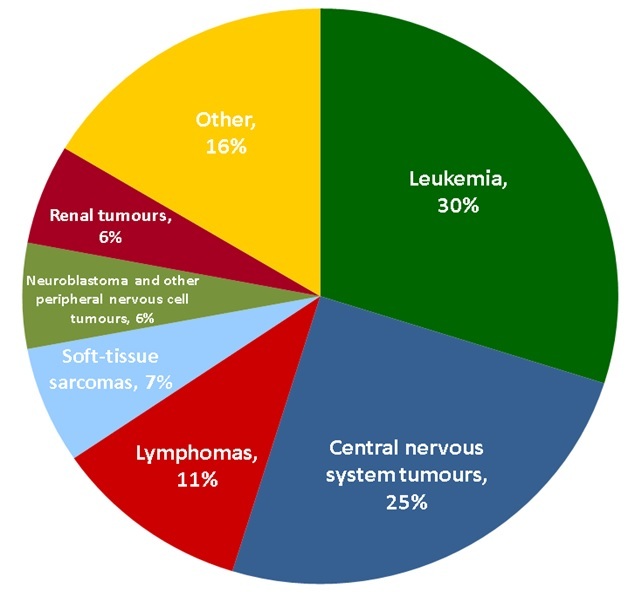
When is the peak incidence of ALL? Which sex is more affected?
2-5 years
Boys slightly more affected
What are the signs showing bone marrow failure in ALL?
- anaemia: lethargy and pallor
- neutropaenia: frequent or severe infections
- thrombocytopenia: easy bruising, petechiae
Which of these will be high in ALL?
- Hb
- Neutrophils
- Platelets
- Potassium
- Phosphate
- Uric acid
- Calcium
- LDS
Potassium, phosphate, uric acid and LDH will be high - these are due to high number of cells undergoing lysis.
Bone marrow fails to produce normal cells such as Hb, neutrophils or platelets so these are low.
What are the non-bone marrow failure features of ALL?
Other features
- bone pain (secondary to bone marrow infiltration)
- splenomegaly
- hepatomegaly
- fever is present in up to 50% of new cases (representing infection or constitutional symptom)
- testicular swelling
What are the three types of ALL?
- common ALL (75%), CD10 present, pre-B phenotype
- T-cell ALL (20%)
- B-cell ALL (5%)
What features of ALL are poor prognostic factors?
Poor prognostic factors
- age < 2 years or > 10 years
- WBC > 20 * 109/l at diagnosis
- T or B cell surface markers
- non-Caucasian
- male sex
What is a complication of ALL with high WCC that should be avoided? How do you treat infection in these patients?
Tumour lysis sundrome and subsequent renal failure - this can occur due to high cell breakdwon. Manage with hyperhydration and allopurinol.
Risk of gram negative sepsis, since there is neutropenia - so use broad spectrum antibiotics like piptazobactam/gentamycin.
A 3-year-old girl is brought in by her mother. Her mother reports that she has been eating less and refusing food for the past few weeks. Despite this her mother has noticed that her abdomen is distended and she has developed a ‘beer belly’. For the past year she has opened her bowels around once every other day, passing a stool of ‘normal’ consistency. There are no urinary symptoms. On examination she is on the 50th centile for height and weight. Her abdomen is soft but slightly distended and a non-tender ballotable mass can be felt on the left side.
What is the diagnosis?
Wilm’s nephroblastoma
What age group is most affected by Wilm’s nephroblastoma?
It typically presents in children <5 years , with a median age of 3 years old.
What are the genetic associations with Wilm’s nephroblastoma?
Most occur in healthy children but 10% occur in children with malformations e.g.
- Overgrowth syndromes (excess somatic growth causing macroglossia, nephromegaly and hemihypertrophy) e.g. Beckwith-Wiedemann syndrome or isolated hemihypertrophy
- No ‘overgrowth’ - e.g. trisomy 18 (Edwards syndrome), WAGR syndrome (Wilm’s with Aniridia, Genitourinary malformations, mental Retardation)
1-2% - Familial Wilms’ tumour - autosominal dominant transmission, associated with mutation in the WT1 gene (WAGR) or WT2 gene (BW) on chr11, or WT3 on chr16
What are the presenting features of Wilm’s nephroblastoma?
- abdominal mass (most common presenting feature) - unilateral in 95%
- painless haematuria
- UTI
- flank pain
- other features: anorexia, fever, respiratory symptoms if metastasised
How often is Wilm’s nephroblastoma unilateral? How common are metastases?
- unilateral in 95% of cases
- metastases are found in 20% of patients (most commonly lung)
What investigations are useful in diagnosing Wilms’ tumour?
Bloods: FBC, U&E, creatinine
Imaging: US/renal angiography - may show distorsion of renal pelvis/hydronephrosis
Staging: CT/MRI including chest for metastases
How quickly should children with suspected Wilm’s tumour be seen?
Refer to a paediatrician to be seen within 48 hours.
What is the prognosis with Wilm’s tumour?
Prognosis - good, 80% cure rate
Management - nephrectomy, chemotherapy, radiotherapy if advanced disease
What is the aetiology of childhood leukaemia?
- De novo mutations (most common)
- Genetic syndromes may predispose
- Chromosomal and genetic abnormalities:
- Translocation to TCR loci in ALL
- TF mutations regulating B cell development and maturation in ALL
- Aberrational disruption of genes coding for TFs and coactivators in AML
- BCR-ABL1 fusion and activation of multiple kinases in CML
What age is ALL/AML/CML most common?
- ALL - 2-3 years
- AML - <2 years
- CML - <1 year and young adolescents
What are the risk factors for leukaemia?
- Boys>girls
- Caucasian
- Cytogenetic abnormalities
- Down’s syndrome (x10-20 fold risk), Faconi’s anaemia, ataxia telangiectasia and Bloom’s syndrome
- Exposure to ionising radiation/maternal XR exposure during pregnancy
What are the presenting features of leukaemia?
- Anaemia, thrombocytopenia, hepatosplenomegaly, lymphadenopathy
- Malaise, fatigue, lethargy
- Prolonged fever
- Growth restriction/failure to thrive
- SOB/dizziness/palpitations
- Bone/joint pain
- Constipation
- Headache
- Nausea and vomiting (CNS infiltration)
- Repeated/severe common childhood infections
Signs:
- Pallor
- Petechiae/purpura/bruising
- Expiratory wheeze
- CN lesions
- Testicular enlargement
What investigations would you do for lymphoma?
- FBC with differential and blood film - pancytopenia due to bone marrow infiltration; WCC elevated due to blasts despite neutropenia
- BM aspiration and biopsy
- Imaging
- Immunophenotyping and cytogenic analysis (e.g. FISH) for risk stratification
- Lumbar puncture (if suspected CNS infiltration)
Summarise the management of ALL/AML/CML.
ALL - high intensity chemotherapy through Hickman lines or myeloablation with allogeneic BM transplantation in disease refractory to chemotherapy
AML - intensive chemotherapy to destroy leukaemic population ASAP
CML - imatinic anti-tyrosine kinase therapy being investigated; myeloablative HSCT mainstay therapy for now
Colony stimulating factors given to promote haematopoiesis following chemotherapy.
Which two electrolyte abnormalities are common in leukaemia?
hyperkalaemia and hyperphosphataemia (due to blast crisis)
What is the prognosis of childhood leukaemia?
- Five year survival is 79% and cure rates are 68%
- ALL cure rate is 80% and best in those ages 1-10 years
- Average time to cure in ALL is 19 years (due to relapse, secondary malignancy and toxicity)
- AML 5 year survival is 66%


-
AGPAR2
-
Childhood vaccinations and counselling31
-
Developmental Milestones32
-
Autism Spectrum Disorder27
-
Attention deficit hyperactivity disorder (ADHD)15
-
Asthma and/or Viral induced wheeze in a child28
-
Allergic reactions in a child - anaphylaxis, allergic rhinitis, CMPA, food allergy50
-
Anal fissure in a child4
-
Appendicitis in a child8
-
Breath holding attacks10
-
Bronchiolitis19
-
Cardiac failure in a child12
-
Cerebral palsy & hypoxic-ischaemic encephalopathy51
-
Chromosomal syndromes - trisomy 13/18/21, Noonan, Prader-Willi, Turner, Klinefelter57
-
Congenital adrenal hyperplasia14
-
Congenital heart disease - ASD, AVSD, CoA, PDA, PS, ToF, ToGA, VSD34
-
Congenital, perinatal and neonatal infection (TORCH)40
-
Constipation in a child14
-
Croup14
-
Cystic fibrosis21
-
Developmental dysplasia of the hip13
-
Diabetes in a child39
-
Dysmorphism/congenital abnormality67
-
Encopresis10
-
Enuresis13
-
Eye disease in a child (conjunctivitis, hypermetropia, myopia, retinoblastoma, retinopathy of prematurity, strabismus)38
-
Fever in a neonate / child23
-
Febrile convulsion14
-
Fracture in a child23
-
Gastro-esophageal reflux in a child13
-
Gastroenteritis in a child57
-
Growth disorder (constitutional delay, precocious/delayed puberty, premature thelarche/adrenarche/menarche, skeletal dysplasia)70
-
Haematological disease in a child (haemophilia, idiopathic thrombocytopenic purpura, iron-deficiency anaemia, sickle cell, thalassaemia)82
-
Haemolytic disease of the newborn14
-
Headache in a child23
-
Hearing testing7
-
Hernias in child8
-
Hirschsprung disease18
-
IgA Vasculitis (Henoch-Schonlein purpura)14
-
Immunodeficiency in a child (incl. HIV)22
-
Inflammatory bowel disease in a child25
-
Inherited metabolic disorders (G6PD deficiency)9
-
Intussusception17
-
Jaundice in a neonate/child29
-
Kawasaki disease10
-
Laryngomalacia6
-
Liver disease in a child (incl. liver failure)54
-
Malabsorption in a child (lactose intolerance, coeliac disease)21
-
Malignancy in a child63
-
Malnutrition in a child (obesity, rickets)37
-
Malrotation & Volvulus in a child9
-
Meckel’s diverticulum6
-
Meconium aspiration10
-
Mental health disorder in a child (bullying, depression)2
-
Meningitis and encephalitis in a child51
-
Mesenteric adenitis4
-
Necrotising enterocolitis (NEC)9
-
Neurological disease in a child95
-
Seizures/epilepsy (neurological disease in a child)53
-
Osteochondritides (incl. Perthe’s, Osgood-Schlatter)30
-
Osteomyelitis in a child17
-
Phimosis & foreskin disorders (+ hypospadias, testicular tortion)23
-
Pneumonia in a child18
-
Pyloric stenosis13
-
Renal disease in a child (nephrotic syndrome, renal failure, acute glomerulonephritis)49
-
Respiratory disease in a neonate (CLD of prematurity, RDS, PPH, transient tachypnoea)29
-
Rheumatological disease in a child (arthritis; infective, juvenile idiopathic, reactive)51
-
Safeguarding - non-accidental injury and neglect33
-
Septicaemia in the neonate/child11
-
Slipped upper femoral epiphysis15
-
Small / Preterm baby14
-
Skin diseases in a child - (acne, eczema, haemangioma, milia, molluscum contagiosum, mongolian blue spot, nappy rash (irritant, candida, seborrhoeic), seborrhoeic dermatitis, tinea)75
-
Somatisation in a child (functional abdominal pain)20
-
Sudden infant death syndrome (SIDS)8
-
Thyroid disease in a child15
-
Threadworm infection (Year 6)7
-
Toddler diarrhoea5
-
Tropical disease in the child (malaria, typhoid, dengue)15
-
Upper respiratory tract infection in a child (rhinitis, sinusitis, otitis media/externa, tonsillitis, epiglottitis, pharyngitis, laryngitis)44
-
Urinary tract infection in a child31
-
Viral infection in a child (Mumps, Measles, Rubella, Erythema infectiosum, Parvovirus B19, Roseola infantum (HHV6), Chickenpox, Hand, foot and mouth disease)81
-
Vasovagal syncope in a child9
-
Whooping cough (Pertussis)16
-
Birth injuries11
-
SBAs50
-
Paeds58
-
ICSM Paeds Mock46
-
Paeds EMQs30
-
Paeds #150
-
Paeds #250
-
Random pre-exam things67



