What is the definition of MS?
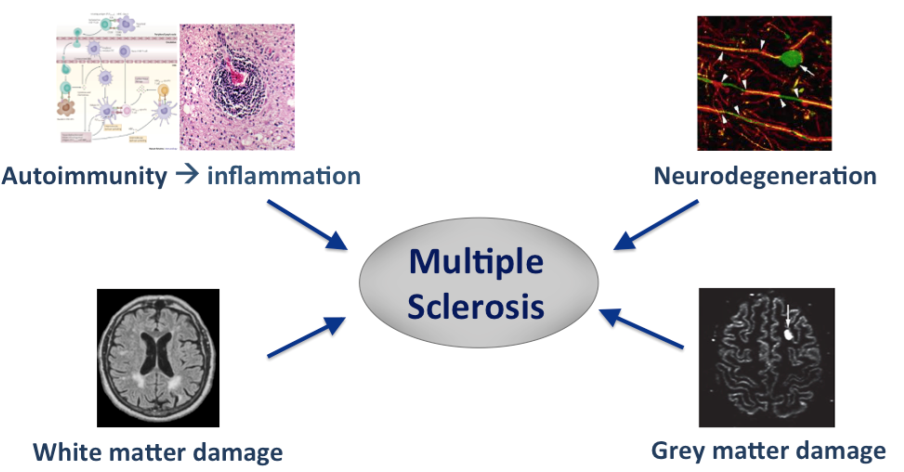
A chronic inflammatory multifocal, demyelinating disease of the central nervous system of unknown cause, resulting in loss of myelin, and oligodendroglial and axonal pathology.
- We know that autoimmune mechanisms play a key role in determining inflammatory lesions
- But also the axonal degeneration and loss, which is the pathological basis of irreversible disability, represents a landmark features
- Although historically MS has been regarded as a white matter disease, it is now well establish that these pathological processes involve also the grey matter (esp. the inflammation and neurodegeneration)
Give an introduction to the epidemiology of MS, and the prevelance in the UK
It affects around 2.5 millions individuals around the world and it is considered one of the most common causes of disability among young adults. It has an uneven geographic distribution, with a higher prevalence among white people of Nordic origin, living at high latitudes. This is called the latitude effect.
MS Prevalence in the UK.
Up until 2010 there were more than 120,000 cases in the UK, which had one of the highest incidence and prevalence among north European countries, along with Sweden and Denmark.
- 258/100.000 women (affects women more than men)
- 113/100.000 men
Incidence is 9.64/100.000 per year.
Discuss the mortality associated with MS
It is important to note that life expectancy among people with MS is not dramatically reduced compared to the general population on average reduced by 7-14 years. As the disease is usually diagnosed around the age of 30, the disease can last up to 40-50 years. It is the poor quality of life because of the unremitting disability that exerts the most significant burden on patients.
Quantify the social impact of MS
- Probability of remaining in active employment after MS onset:
- At 15 years: 31% MS patients vs. 89% controls
- Probability of remaining in a relationship after MS onset:
- At 24 years: 33% MS patients vs. 53% controls
Give an introduction to the aetiology of MS
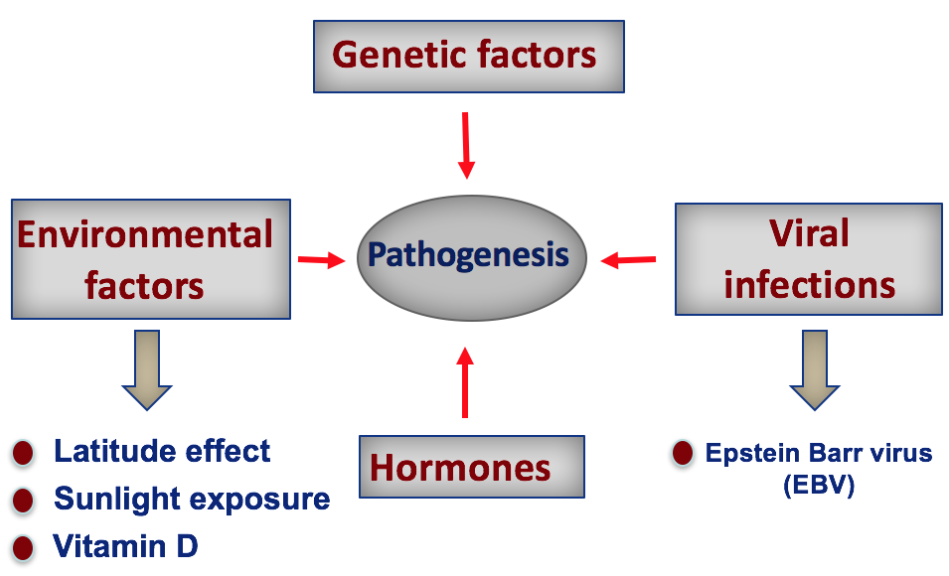
The cause of MS remains largely unknown. It is hypothesised that multiple factors contribute to its aetiology. The disease probably develops in genetically susceptible populations and it is triggered by the exposure to environmental factors, including sun exposure and viral infections.
Various factors influence MS aetilogy such as:
- The latitude effect (more likely the further north of equator)
- The viral hypothesis (EBV likely culprit)
- The role of Vit-D (low Vit-D)
- Time of expsosure (seasonal variation)
- Genetic factors
- The role of hormones
Describe the Latitude effect in the aetiology of MS
The disease has a distinct latitudinal variation: the risk of developing the disease is higher in areas at high geographic latitude. This rule can be applied to the world distribution, as we looked at previously, but also within countries. For example, there are more cases of MS in Scotland and Northern Island, in comparison to England and Wales.
Describe the role of Vitamin D in the aetiology of MS
The latitude effect led to hypothesis that the incidence of MS might be related to the sun exposure. If we look at the UVB worldwide intensity, this is well known to be lower at higher altitudes. The striking similarities with the MS worldwide distribution strongly support a correlation between low UVB intensity and risk of MS. This correlation is possibly mediated by low vit D level, resulting from the low sun exposure UK, Scandinavian countries,
These observations support the hypothesis that vit D deficiency plays a primary role in determining the risk of MS.
Supporting evidence:
- People with low vit D oral intake are more likely to develop the disease.
- Low Vit D level probably associates with higher probability of having MS attacks (more severe disease course).
However, it is important to take into account the methodological difficulties of carrying out such studies. There any many confounding factors that affect serum vitD levels; smoking, intake of other nutrients, endocrinological diseases all influence vitamin D levels. Furthermore, black people are more likely to be vitamin D deficient, but have a lower incidence of MS in comparison to Caucasian people.
Despite it remaining a grey area, it is common practice recommending daily vit D dose to patients with MS, as this might exert a protective effect.
An observation from Norway offers interesting insight on the potential role of Vit D. In Norway the north-south gradient is inverted, as the incidence of MS is lower in the north, among people living by the coast. It has been demonstrated that the coastal communities spend more time in outdoor activities and consume large quantities of oily fish, which probably compensate for the lack of vit D.
Discuss the evidence of the role of Vitamin D in the aetiology of MS
Supporting evidence:
- People with low vit D oral intake are more likely to develop the disease.
- Low Vit D level probably associates with higher probability of having MS attacks (more severe disease course).
However, it is important to take into account the methodological difficulties of carrying out such studies. There any many confounding factors that affect serum vitD levels; smoking, intake of other nutrients, endocrinological diseases all influence vitamin D levels. Furthermore, black people are more likely to be vitamin D deficient, but have a lower incidence of MS in comparison to Caucasian people.
An observation from Norway offers interesting insight on the potential role of Vit D. In Norway the north-south gradient is inverted, as the incidence of MS is lower in the north, among people living by the coast. It has been demonstrated that the coastal communities spend more time in outdoor activities and consume large quantities of oily fish, which probably compensate for the lack of vit D.
Describe how the time of exposure affects the susceptability of MS
Although it appears clear that environmental factors influence the MS risk, it remains largely unclear when in life these factors affect the individual susceptibility. For instance, vit D deficiency is quite diffuse, but only few eventually develop MS.
John Kurtzke was a pioneer with his studies on MS people migrating from high risk to low risk area or the other way round.
- He observed that those migrating after the age of 15 from north Europe to South Africa, which is an area of low risk, retained their original high risk of MS. Whereas when migration occurred before the age of 15, they would acquire the risk of the country they were moving too.
- Therefore, it is hypothesised that there exists a period of susceptibility early in life.
Whether the age of 15 is the true cut off remains extremely controversial. For instance, some studies seem to suggest that environmental factors might act in utero.
- This is the so called month of birth effect, supported by observations that there is a higher incidence of MS among those born in May and lower incidence among those born in November.
- This is possibly because of the low sunlight exposure and vit d during pregnancies carried out in autumn/winter .
- In line with this hypothesis, some studies suggest that MS activity exhibits a seasonal variation. New MS lesions at MRI are more likely to occur during summer time. MS attacks are more frequent during spring, as recently demonstrated in a very large study. Possibly explained by low vit D levels in previous winter months.
Describe the viral hypothesis in the aetiology of MS, and what evidence there is for it.
The virus hypothesis was initially proposed again by Kurztke, following the so-called epidemic of MS in the Faroe Islands. Here MS seems to have appeared for the 1st time only after British troops during the 2nd WW occupied the islands. Since then its been hypothesised that MS is a transmissible infection, or at least it is triggered off be a virus.
Among many viruses, EBV is the most likely candidate. (Note: 90-95% of human beings are EBV seropositive)
Evidence:
- MS and infective mononucleosis share strikingly similar geographic and socioeconomic distribution
- Latitude gradient
- High income populations
- Women more commonly affected
- In addition, the risk of MS is strongly affected by EBV sero-status. Most interesting and compelling evidence linking EBV to MS.
- It has been claimed that MS is virtually absent among EBV seronegative individuals (OR [odds ratio] = 0.18)
- The risk of MS increases dramatically (OR [odds ratio] = 13) among seropositive. The problem is that 5-10% of world population is EBV negative, therefore it is difficult to establish a direct correlation.
- Studies also showed that both the risk of MS and the disease severity are correlated with anti-EBNA abs titres (EBV titre/level)
- More importantly, a previous history of mononucleosis associates with a 3 folds higher risk of MS.
Describe the role of genetics in the aetiology of MS
No one gene has been implicated in MS. However, we know that genetic factors contribute 30% of the risk in developing MS. First-degree relatives have 10-25 times greater risk of MS than the general population. This risk correlates directly with the degree of kinship.
Further supporting evidence come from twin studies from different populations, consistently showing that a monozygotic twin of an affected individual has much higher risk of developing the disease than a dizygotic
Twin. Concordance rates:
- 25-30% monozygotic twins
- 2-3% dizygotic twins
- 1.9% non-twin siblings
HLA-class ΙΙ genes exert the strongest effect, accounting for 20- 60% of the genetic risk, with a predominant role played by the HLA-DRB1*15 gene.
Discuss the role of hormones in the aetiology of MS
Finally, it is also believed that hormones might contribute to the disease susceptibility. At the beginning of last century the disease was equally distributed among men and women. However, the incidence of MS has steadily increased only among women and it almost doubled over the past 50 years. This was confirmed in two separate independent studies carried out in Canada and Denmark. It is now commonly accepted that that women are twice as likely then men to have MS
In support of a role of hormones, epidemiological studies demonstrated that the disease activity, in terms of
frequency of attacks, decreases during pregnancy and sharply increases the first 3 months after partum.
This can have practical implications as women with MS, who have stopped the therapy during pregnancy, often choose to avoid breastfeeding in order to restart the therapy immediately, as they fear a disease rebound after partum.
Summarise the types of clinical manifestations of MS
Relapses and progression are the two main clinical manifestations of MS. They are completely opposite phenomenon. As relapses are acute symptoms which, by definition, have to last more than 24 hours, and can be followed by remission. Whereas, progression (which shouldn’t be confused with worsening), is an insidious
relentless phenomenon leading to irreversible disability. In fact it requires retrospective assessment for at least 1 year.
This pattern of relpase and remission can be categorised into sub-types of MS.
Describe the concept of relapse in MS
The demyelinated plaques represent the pathological substrate of relapses. These are areas of inflammation, with loss of myelin, which are scattered around the CNS. The inflammation leads to demyelination, which causes delay of the nerve impulse and eventually the neurological symptoms.
Relapses are most of the time followed by remission, as a result of remyelination. As you can see from natural history registries spontaneous recovery occurs in most of cases, especially following the early attacks. Remission can occur over weeks and, in some cases, even after 12 months. During the late stage, remission is less likely.
Symptoms occurring during a relapse are extremely variable. The most common manifestations at onset are:
- Optic neuritis
- Motor weakness
- Sensory disturbances
What are the symptoms of MS, and to what lesion do they correlate to?
Optic neuritis:
- Monocular vision loss
Spinal cord lesion:
- Weakness of limbs with spasticity and hyper-reflexia
- Paraesthesiae pain or sensory loss in limbs or trunk
- Lhermitte’s sign (electric shock radiating down back and triggered by neck flexion)
- Urinary urgency and incontinence
- Sexual dysfunction
Brainstem lesion:
- Diplopia
- Paraesthesiae, pain (neuralgia) or numbness of face or tongue
- Vertigo and nsytagmus
- Dysarthria
Cerebellar lesion:
- Incoordination of limbs
- Ataxic gait
Cerebral lesion:
- Impairment of concentration or memory
- Hemiparesis
- Hemi-sensory loss
- Visual field defect
- Seizures
- Psychiatric disturbances
- Severe fatigue
What are the subtypes of MS?
MS can present with different clinical phenotypes, which are characterised by relapses and progression in combination or alone. These are split into Relapsing-Remitting (RR), Secondary Progressive (SP) and Primary Progressive (PP).
- Clinically Isolated Syndrome (CIS): is a first episode with neurologic symptoms caused by inflammation and demyelination in the central nervous system — which must last at least 24 hours — but does not yet meet the criteria for a diagnosis of the disease.
- Relapsing Remitting Multiple Sclerosis (RRMS): This is the most common form of MS with clear defined phases of relapse (repeat attacks or exacerbations), with progressive worsening of nerve functions with each attack, followed by phases of relief (or remission) where normal conditions are restored partially or completely.
- Primary Progressive Multiple Sclerosis (PPMS): This represents a condition with steady progression without early relapses or remissions, and temporary periods of stability.
- Secondary Progressive Multiple Sclerosis (SPMS): This follows RRMS, with continued relapses and progressive neurological damage. Most patients will eventually transition to a secondary progressive course, with worsening of nerve damage, with or without remissions.
Describe the disease course of RRMS
RR MS is the most common form of MS (80-85%) with an age of onset around 30 years. Most patients start out with RR MS, but eventually progress to secondary progressive MS – this switch is completely unpredictable (after average of 15 years – but this is just an average, some cases never occurs or occurred after 40 years).
Common onset symptoms:
- Optic neuritis
- Sensory disturbances
Annualised relapse rate decreases over time (17% less every 5 years). Regression to the mean - 70% at least 5 years relapse-free period. The frequency of the attacks decreases over time, due to the regression to the mean phenomenon.
It is commonly believed that during the early phase of the disease, when relapses are more frequent, focal inflammatory phenomenon dominate in the pathophysiology of the disease. By the time the disease convert
to the SP phase, the axonal loss takes over and drives the accumulation of irreversible disability which characterises progressive MS.
Describe the epidemiology of PPMS and SPMS
Primary and secondary progressive MS start around the same age. Age at onset ~40 years each, leading to a controversial theory that PP MS has asymptomatic relapses. However, the sex ratio is different between the two:
- SS MS = 2-3:1
- PP MS= 1.3:1
Discuss the approach to diagnosing MS
The key to all diagnostic criteria is the absence of an alternative diagnosis in the context of an appropriate clinical presentation. It is a primarily clinical diagnosis which requires the fulfillment of 2 criteria for the CNS lesions:
- Dissemination in time (DIT)
- Dissemination in space (DIS)
This can be demonstrated by evidence from the history and the clinical examination, and can be supported by imaging/tests:
- Radiological evidence (MRI)
- Laboratory analysis (CSF)
- Electrophysiology (evoked potentials)
How can radiological tests be used to diagnose MS?
The MRI is an important tool for the diagnosis that can be used for demonstrating the dissemination in time and space of the lesions. The 4 typical locations where lesions occurs are:
- Periventricular
- Subcortical
- Infratentorial (midbrain)
- Spinal cord
The dissemination in time requires demonstration of new lesions compared to previous imaging, or the simultaneous presence of GAD enhancing and non enhancing lesions.
Note: lesions as seem on an MRI look very similar to clots that happen in old patients. So it’s important to note where the lesions are, as it gives you a better idea of whether it is MS or clotting. Obviously clinical background is very important too.
New MRI lesions occur 5-10 more frequently than clinical attack. Most lesions are clinically silent. This is the clinical-radiological paradox. Roughly estimated that a relapse occurs every 10-15 lesions.
We use gadolinium (GAD) to enhance MRI. GAD is important because it implies damage of BBB, so GAD has entered the brain and taken up by the lesion. So if lesion lights up with GAD, it means the lesion is no older than 6 weeks, because after 6 weeks the BBB repairs and GAD can’t get into brain. This is used to identify newer/fresher lesions.
How can electrophysiological tests be used to diagnose MS?
Electrophysiology - visual evoked potentials (VEP) are helpful because they show evidence of dissemination in
space – e.g. if patient presents with arm weakness, can measure VEP in eyes and find a sub-clinical level of slowing down, indicating inflammation and demyelination even without the patient having noticed any symptoms from it.
How can CSF analysis be used to diagnose MS?
CSF analysis can be supportive of the MS diagnosis by showing:
- Increased production of Immunoglobulin in CSF
- Oligoclonal bands (OCB) in CSF only (not in serum, as that would indicate a global autoimmune disease rather than CNS confined one)
White cells:
- Normal or mildly increased (10-20 cells/mm3)
- Note: if >50 WBC, suspect alternative diagnosis
- 90% lymphocytes, 5% PMN [polymorphonuclear leukocytes - e.g. neutrophils]
Proteins:
- 2/3 cases normal
- 1/3 cases minor increase (0.5-0.7g/L)
IgG oligoclonal bands:
- Positive in CSF only (unmatched with serum)
- (If matched in serum it means the oligoclonal bands are from a different source, so unlikely to be MS)
- Positive in >95% of clinically definite MS
What differential diagnoses can share a similar symptomology with MS?
Main possibilities out of many CNS inflammatory disorders can be categorised into:
- Systemic immune diseases affecting the CNS:
- Neurosarcoidosis
- Systemic lupus erythematosus (Neuro-lupus)
- Anti-phospholipid syndrome
- Sjögren’s syndrome
- CNS vasculitis exist
- Behçet’s syndrome
- CNS-specific inflammatory syndromes
- Acute disseminated encephalomyelitis (ADEM)
- Neuromyelitis optica (NMO)
Describe the prognosis of MS
We are unsure what affects the prognosis. The patient may have end up experiencing a relatively benign form of MS with little or no disability after 15 years, or a more malignant MS with severe disability 5 years after onset. The majority of patients fall within the middle ranges.







