How was Parkinson’s Disease originally described?
Shaking palsy (paralysis agitans) Involuntary motion, with lessened muscular power, in parts not in action even when supported, with propensity to bend the trunk forward, and to pass from a walking to a running pace: the senses and the intellect being uninjured” James Parkinson (1817) Essay on the Shaking Palsy. Turns out he was actually quite accurate, except for the ‘senses and intellect being uninjured’.
What is the epidemiology of Parkinson’s Disease?
- 1 in 1000 of the population
- 1 in 100 of those aged >60 years
- Mean age of onset at 65 years
- 4:1 male : female - for reasons we’re not really sure about
Confounders: Parkinsonism, essential tremor, comorbidity in elderly, neuroleptic drugs
Identify the key neuropathological features of Parkinson’s disease (PD)
- Degeneration of the dopamine neurones in the substantia nigra pars compacta of the midbrain. Loss of neuromelanin pigment intensity occurs first, which is a normal dopamine metabolite that should build up with time, in the locus classicus. Since neurons from the substantia nigra project to the striatum (in the basal ganglia), the putamen and caudate are implicated in the pathology as well. - You also see ventricular enlargement, but not much gyral atrophy/prominent sulci. This is why normal pressure hydrocephalus can sometimes mimic PD? - Lewy Body inclusions in the cell bodies - Lewy neurites inclusions in surviving neurones.
What are Lewy Bodies and Lewy Neurites?
A lewy body is a hyaline (smooth) circular inclusions in the neuronal cell bodies - it is a large lump of protein (α-synuclein) sitting in the cell. They pick up the pink eosinophil stains very easily and are therefore described as lamellated eosinophilic cytoplasmic inclusions. A lewy neurite is this accumulation of granular material and abnormal α-synuclein filaments, in a neurone’s neurite (a projection from the cell body). Both are found in α-synucleinopathies such as dementia with Lewy bodies, Parkinson’s disease, and multiple system atrophy.
What is the function of α-synuclein?
α-synuclein is a member of the human synuclein family along with β- synuclein and γ-synuclein. It is abundant in the brain. It has an unknown physiological function but may be involved in the regulation of synaptic plasticity and neurotransmitter release (due to its presynaptic location).
Neuritic Dystrophy Hypothesis of Lewy Neurodegeneration?
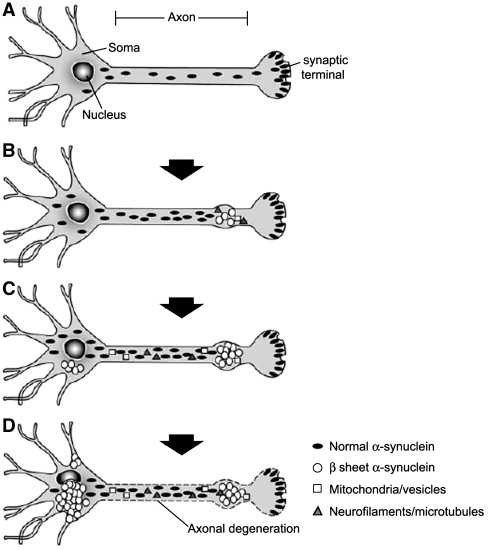
Normally, α-synuclein is transported to synaptic terminals. In the neuritic dystrophy hypothesis, normal (soluble) α-synuclein transforms into (insoluble) β-pleated sheet form. This then builds up accumulates in mitochondria and vesicles, and eventually disrupts neurofilaments and microtubules, blocking axonal transport. Eventually resulting in neuronal death.
What is Braak staging of PD based on?
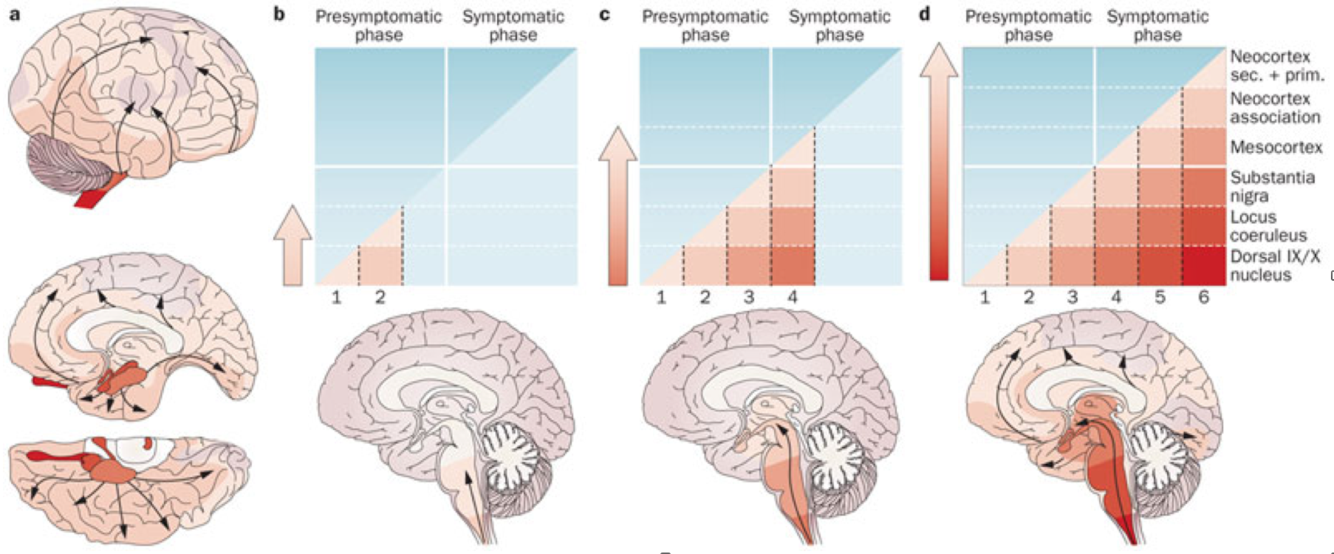
These stages are based on Lewy body localisation. It suggests that Lewy body pathology does not begin in substantia nigra. The first pathology appears to begins in dorsal motor nucleus of glossopharyngeal and vagus nerves, anterior olfactory nucleus, and enteric nerve cell plexus. The pathology proceeds in rostral direction toward neocortex.
What is the difference between Parkinson’s Disease Dementia (PDD) and Dementia with Lewy Bodies (DLB)?
Parkinson’s Disease Dementia (PDD) is dementia resulting from PD.
Lewy Body Dementia (LBD, Dementia with Lewy Bodies) is dementia that precedes, or occurs within 1 year from motor symptoms. It involves mostly cortex pathology without subcortical involvement – there is great debate whether it is a different disease or not. Is this 1 year cut-off arbitrary?
Describe the Braak Staging of Parkinson’s Disease Pathology, and roughly to what symptoms they produce.
Based on a progressive model from brainstem to neocortex:
- Stage 1: Dorsal IX/X nucleus and/or olfactory bulb
- Stage 2: Raphe nuclei and then locus coeruleus
- Stage 3: Substantia nigra and then amygdala and hippocampus. Produces motor signs.
- Stage 4: Temporal mesocortex and allocortex. Produces cognitive signs.
- Stage 5 and 6: High order sensory association areas of the neocortex, and the prefrontal cortex.
Stage 1-2 are not associated with motor signs. May lose sense of smell. Stage 3 is associated with motor signs. Stage 4-6 is associated with cognitive and emotional signs.
What are the problems with Braak staging?
Progression of PD does not always comply with this model.
Others (including Prof Gentleman) have suggested that the dorsal motor nucleus of the vagus is not an obligatory trigger site of Parkinson’s disease, as it isn’t always affected.
Some suggest that it begins in the peripheral ganglia, as α-synuclein pathology can be found in the epicardial nerve fascicles and paravertebral sympathetic ganglia.
Others suggest it could be in the in the anterior olivary nucleus of the nerves originating from the nose.
What mechanism tries to explain how environmnetal triggers can cause PD?
Retrograde transport from gut, and airborne through nose are the 2 main entry sites to the brain. This supports theories that suggest such neurodegenerative diseases may have a transmissible “prion-like” spread. Anosmia is a common early symptom of PD (and Alzheimer’s disease) – but not definitive. Constipation is another early symptom of PD.
- This could be important for early disease detection – gut or nose biopsies potentially?
- Also suggests an environmental trigger. Organophosphate exposure may explain why farmers have a greater incidence of PD
What are the causes of Parkinsonism?
- Idiopathic Parkinsonism (Parkinson’s Disease)
- Genetic
- Atypical Parkinsonism*
- Multiple system atrophy (MSA) - a α-synuclein pathology which is seen in glial cells.
- Progressive supranuclear palsy (PSP) - a tau protein pathology (nothing to do with α-synuclein)
- Corticobasal degeneration (CBD) - a tau protein pathology (nothing to do with α-synuclein)
- Vascular
- 20 other disorders
- Secondary Parkinsonism
- Drug-induced e.g. MPTP
- Head trauma
- Toxins e.g. fertilisers
Note: Parkinson’s disease is the most common form of Parkinsonism (which is a spectrum of symptoms)
*Most of the P+ syndromes are difficult to diagnose clinically – so just labelled as “atypical” PD – and specific P+ syndrome is diagnosed in post-mortem.
Discuss the clinicopathological correlates of dementia in Parkinson’s disease.
Around 80% of PD patients develop dementia
This presents as abnormalities of attention, concentration, memory, word list generation, abstraction and categorisation, judgement, problem resolution, strategy formulation and visuospatial dysfunction (such as problems with visual discrimination, visual organisation, spatial orientation, drawing and angle perception) represent core features of the dementia syndrome in PD.
Note: As opposed to mainly memory problems in AD, PD mainly has frontal pathology and hence decision making (though memory can also become involved later on).
However, the underlying pathology of cognitive deficits and dementia associated with PD has been a matter of controversy, both in terms of site and type of pathology
Recent neuropathological studies have described global Aβ [amyloid- β] deposition in the striatum in Lewy body disorders, especially in Parkinson’s disease with dementia (PDD) and dementia with Lewy bodies (DLB)
However, PET studies using the 11C PIB ligand that binds to Aβ detects significant striatal pathology only in DLB, not PDD
To see why this was, immunohistochemistry was done post- mortem, found that in PDD, there was more diffuse amyloid pathology than clumps – so it was a problem with imaging in the point above.
This suggests that striatal Aβ pathology is common in both PDD and DLB, and may reflect the development of dementia in these conditions
Define the term “parkinsonism” and list the CNS disorders that may present in this way
Parkinsonism is a clinical syndrome characterized by tremor, bradykinesia, rigidity, and postural instability. Parkinsonism can be caused by:
- Idiopathic Parkinson’s disease
- Drug-induced parkinsonism
- Multiple system atrophy (MSA)
- Progressive supranuclear palsy (PSP)
- Corticobasal degeneration (CBD)
- Vascular pseudo-parkinsonism
- Alzheimer’s changes
- Frontotemporal neurodegenerative disorders
- 20 other disorders
What is MSA and it’s sub-classifications?
Multiple System Atrophy is a term covering three disorders with very similar cellular pathology, so grouped together. They are all alpha-synucleinopathies:
- Olivopontocerebellar atrophy (OPCA) - When the inferior olivary nucleus in the medulla, pons and cerebellum are affected
- Shy-Drager syndrome - Characterised by autonomic dysfunction: postural hypotension, etc.
- Striatonigral degeneration - Slightly different pathology from PD (but mimics PD the most of these 3 conditions)
These are old terms used. They are now all grouped as MSA. But can be sub-classified.
Now characterised as:
- MSA-P – predominant parkinsonism
- MSA-C – cerebellar features
What are the macroscopic neuropathological features of MSA?
- Cortical atrophy (motor, premotor)
- Cerebellar atrophy (can be really quite marked)
- Shrinkage of middle cerebellar peduncle, pons and inferior olivary nucleus
- Pallor of locus coeruleus and substantia nigra
What are the microscopic neuropathological features of MSA?
- Mixed neuronal and glial pathology
- α-synuclein immunoreactive glial cytoplasmic inclusions (GCI)
- Neuronal cytoplasmic inclusions (like in PD)
- Neuronal nuclear inclusions
- Oligodendroglial nuclear inclusions (Papp-Lantos bodies)
- Neuropil threads
- ↑Hot-cross-bun sign – sign of MSA
What is CBD?
Corticobasal Degeneration (CBD) is a progressive neurodegenerative disorder.
4R Tauopathy not alpha-synucleinopathy
What are the symptoms of CBD?
Symptoms include rigidity, clumsiness, stiffness and jerking of arm, and “alien limb”. Clinically distinguished from PD mainly due to Alien limb syndrome/phenomenon – limb moves without the consciousness of the patient – disconnect between cognition and motor movement
Affects cerebral cortex (fronto-parietal atrophy), deep cerebellar nuclei and substantia nigra
What are the neuropathological features of CBD?
- Glial and neuronal inclusions
- Neuropil threads particularly prominent
Microscopically distinguished by:
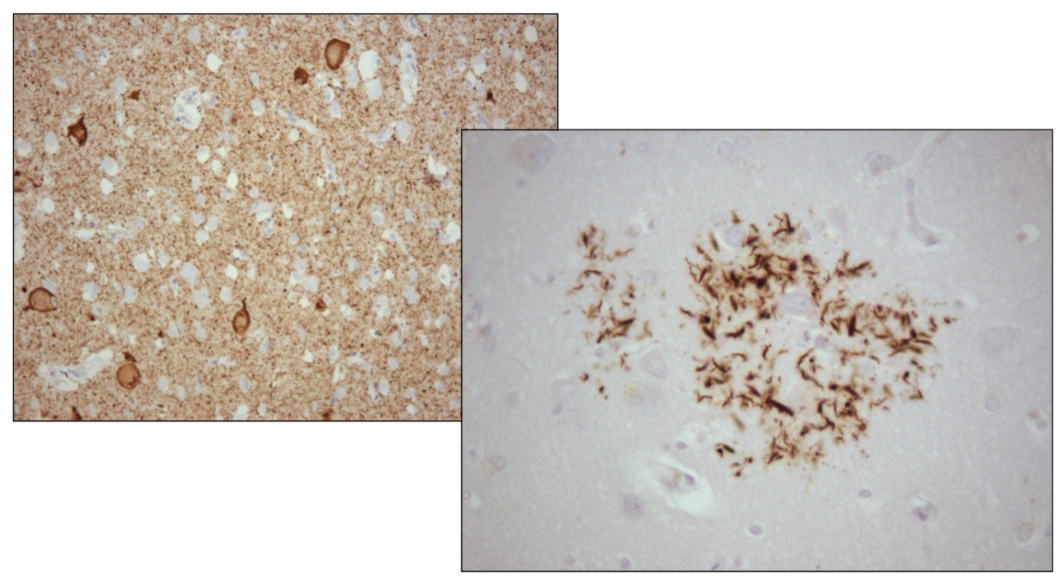
- Diagnosis is made via presence of astrocytic plaques which contain tau protein. (picture on right)
- Background is pretty much all neuropil threads (neuropil threads are particular prominent in CBD - filled with hyperphosphorylated tau) - picture on left
What is the most common form of atypical parkinsonism?
Progressive Supranuclear Palsy (PSP)
What is PSP?
Progressive Supranuclear Palsy (PSP) is the most common form of atypical parkinsonism. PSP is also a 4R tauopathy.
What are the symptoms of PSP?
Symptoms:
- Supranuclear gaze palsy. I.e. vertical gaze palsy
- Postural instability
- Not being able to look down, with poor posture leads to lots of falls down stairs.
What are the neuropathaological features of PSP?
PSP - Macroscopic pathology:
- Atrophy of basal ganglia, subthalamus & brainstem
- Discolouration of the subthalamic nucleus
PSP - Microscopic pathology:
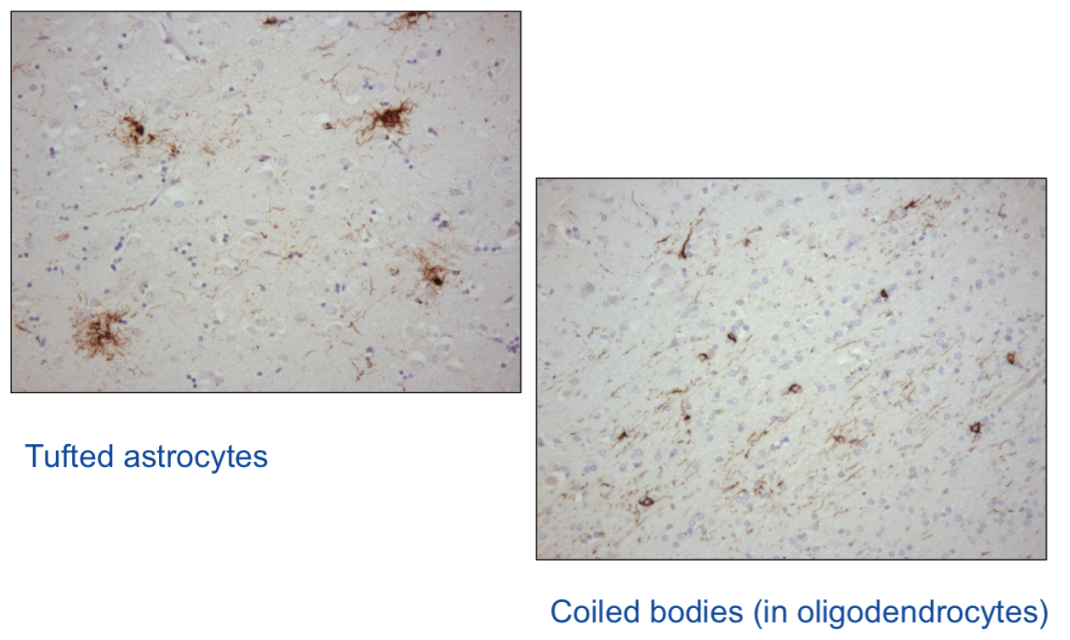
- Neuronal loss and gliosis (the defining lesions are the tufted astrocytes - different from astrocytic plaques as they are individual astrocytes with tau, rather than many astrocytes)
- Neuronal and glial tau-positive inclusions. E.g. there are coiled bodies with tails, which are tau in oligodendrocytes.