What are personality disorders?
Class of mental disorders characterised by enduring maladaptive patterns of behaviour, cognition & inner experience exhibited across many contexts and deviating markedly from those accepted by the individual’s culture. Patterns develop in adolescence and continue into adulthood. They are inflexible and lead to significant distress and/or impairment.
- *NHS defintion: conditions in whicih an inndividual differs significantly from an average person in terms of how they think, perceive, feel or relate to others.*
- *HINT: 3P’s (pervasive, persistent & problematic)*
State some risk factors for personality disorders (think about biological, psychological & social risk factors)
Biological
- Genetics
- Diagnosed with childhood conduct disorder
Psychological
- Abuse during childhood (physical, sexual, emotional, neglect)
- Chaotic childhood
- Social reinforcement of abnormal behaviours e.g. see others behave abnormally
- Loss of parents (e.g. death or traumatic divorce)
Social
- Low socioeconomic status
Discuss the epidemiology of personality disorders, include:
- What % of adults have PD of at least mild severity
- Age of onset
- Top 3 most prevelant personality disorders
- 4-13%
- Adolescence - early 20’s
- Cluster B most prevelant:
- Borderline
- Dissocial
- Histrionic
- Narcissistic (not in ICD-10)
ICD-10 classified personality disorders in to three clusters A, B and C; state the name of each cluster and the personality disorders within each cluster
NOTE DSM-V includes:
- Schizotypal in cluster A
- Narcissistic in cluster B

According to ICD-10 there are two personality disorders within cluster A: parnoid & schizoid. Describe clinical features of paranoid personality disorder
*HINT: SUSPECTS mneumonic
- Suspcious of others
- Unforgiving (bears grudges)
- Spouse fidelity questioned
- Perceives attack
- Envious
- Criticism not liked/cold affect
- Trust in others reduced
- Self-reference (misinterprets things.. thinks they are directed to them)

According to ICD-10 there are two personality disorders within cluster A: parnoid & schizoid. Describe clinical features of schizoid personality disorder
*HINT: DISTANT mneumonic
- Detached
- Indifferent to praise or criticism
- Sexual drive reduced
- Tasks done alone
- Absence of close friends
- No emotion (cold)
- Takes pleasure in few activities

Although not included in ICD-10, schizotypal personality disorder is also grouped with cluster A; describe schizotypal personality disorder
- Difficult to make close relationships
- People think you have odd, eccentric behaviour
- Unconventional beliefs
Cluster A PDs may present with similar features to psychotic disorders; what is the differentiating factor?
Hallucinations and true delusions are absent in cluster A PDs
According to ICD-10 there are three personality disorders within cluster B: borderline/emotionally unstable, dissocial/antisocial and histrionic. Describe clinical features of borderline/emotionally unstable personality disorder
*HINT: AM SUICIDE mneumonic
- Abandonment feared
- Mood instability
- Suicidal & parasuicidal behaviour
- Unstable relationships
- Intense relationships
- Control of anger poor
- Impulsivity
- Disturbed sense of self (don’t have a strong sesne of who you are)
- Emptiness (chronic)
According to ICD-10 there are three personality disorders within cluster B: borderline/emotionally unstable, dissocial/antisocial and histrionic. Describe clinical features of dissocial/antisocial personality disorder
*HINT: CORRUPT
- Callous (disregard for others)
- Others blamed
- Reckless disregard for safety & rules
- Remorseless (lack of guilt)
- Underhanded (deceiful)
- Poor planning (impulsivity)
- Temper/tendancy to violence

According to ICD-10 there are three personality disorders within cluster B: borderline/emotionally unstable, dissocial/antisocial and histrionic. Describe clinical features of histrionic personality disorder
*HINT: PRAISE
- Provocative behaviour
- Real concern for physical attractiveness
- Attention seeking
- Influenced easily
- Seductive inappropriately
- Egocentric (vain)/exaggerated emotions

Although not included in ICD-10, narcissistic personality disorder is also grouped with cluster B; describe narcissistic personality disorder
- Grandoise/increased sense of self-importance
- Resent other peoples success
- May be seen as seflish & unaware of other peoples needs
- Fragile self-esttem so you rely on others to recognise your worth and needs
Which of the cluster B personality disorders is linked with conduct disorder?
Dissocial/antisocial
According to ICD-10 there are three personality disorders within cluster C: dependent, anxious/avoidant and anankastic/obsessive compulsive. Describe clinical features of dependent personality disorder
*HINT: RELIANCE mneumonic
- Reassurance required
- Expressing disagreement is difficult
- Lack of self-confidence
- Initiating projects is difficult
- Abandoment feared
- Needs others to assume responsibility
- Companionship sought
- Exaggerated fears

According to ICD-10 there are three personality disorders within cluster C: dependent, anxious/avoidant and anankastic/obsessive compulsive. Describe clinical features of anxious/avoidant personality disorder
*HINT: CRIES mneumonic
- Certainty of being liked needed before becoming involved with people
- Restriction to lifestyle to maintain security
- Inadequacy/feel inferior to others
- Embarassment potential prevents involvement in new activities
- Social inhibition

According to ICD-10 there are three personality disorders within cluster C: dependent, anxious/avoidant and anankastic/obsessive compulsive. Describe clinical features of anakastic/obsessive-compulsive personality disorder
*HINT: LAW FIRMS mneumonic
- Loses point of activity (due to preoccupation with detail)
- Ability to complete tasks compromised due to perfectionism
- Workaholic at expense of leisure
- Fussy (excessively concerned with minor details)
- Inflexible
- Rigidity
- Meticulous attention to detail
- Stubborn

Examples of questions to ask in history for PD
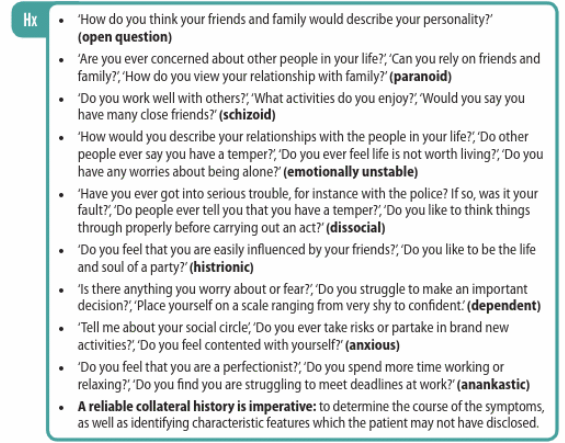
Pt’s with personality disorder often have full insight into their psychiatric disorder; true or false?
FALSE; often have no insight into PD
Collateral history required to establish the pervasiveness and stability of presentation (i.e. are they like this all the time in all that they do)
Questionnaires exist to help support diagnosis of PDs; true or false?
True
e.g. personality diagnostic questionnaire (PDQ-4)
State some differential diagnoses for PDs
- Mood disorders: depression, mania
- Psychotic disorders: schizophrenia, schizoaffective disorder
- Substance misuse
Outline the main principles in the management of PDs
- Biopsychosocial model
- Identify & treat any comorbid psychiatric illness
- Identify & treat any substance misuse
- Risk assessment (particulary in borderline PD)
- Give written crisis plan if appropriate
- Consider CHRT is necessary
- Support & educate friends & family
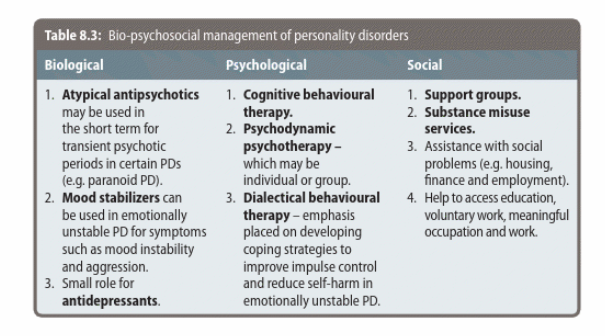
Discuss the biopsychosocial management of PDs
Mainstay of management is psychological therapy. Medications should only be prescribed in event of comorbidities. Options for psychotherapy include dialectical behavioural therapy, psychodynamic therapy, cognitive analytical therapy.
Should avoid hospital admissions where possible- particularly in EUPD- due to attachment & institutionalisation. Admit only if necessary in crisis for brief defined period.
Biological
- Antipsychotics:
- Can help with paranoid/suspiciousness in cluster A
- Can help in borderline/EUPD if people feel paranoid, hearing noises or voices
- Antidepressants:
- Can help with mood & emotional difficulties in cluster B
- Can help reduce anxiety in cluster C
- Mood stabilisers:
- Can help with unstable mood & impulsivity in borderline/EUPD

-
Psychiatry Basics/Introduction17
-
Psychiatric History Taking & MSE44
-
Affective Disorders75
-
Schizophrenia & Psychoses52
-
Anxiety Disorders101
-
Personality Disorders23
-
Substance Misuse64
-
Eating Disorders65
-
Self Harm & Suicide26
-
Psychotherapies36
-
Psychopharmacology: Antidepressants & Antipsychotics80
-
Psychopharmacology: Mood Stabilisers, Anxiolytics & Others46
-
Legal Aspects of Psychiatry34
-
Child & Adolescent Psychiatry63
-
ECT16
-
Liason Psychiatry8
-
Psychological Problems Presenting with Physical Symptoms31



