What is psychiatry?
Branch of medicine that deals with the diagnosis, treatment and prevention of mental, emotional and behavioural disorders.
Describe how we can broadly classify psychiatric disorders
*Think about organic vs ____ and any subdivisions
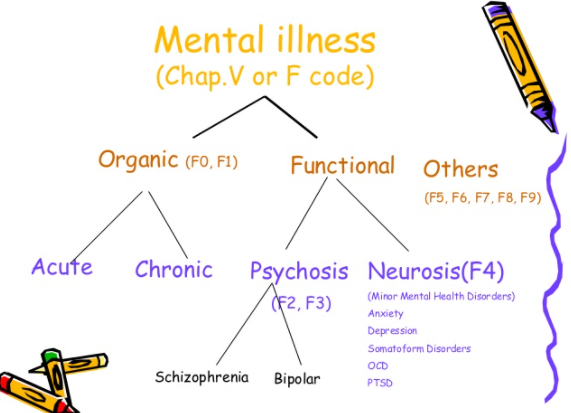
Define neurosis
Neurosisis a collective term for psychiatric disorders characterised by distress, that are non-organic, have discrete onset and where delusions & hallucinations are not present
State at least 5 different areas of psychiatry (i.e. subspecialties)
- General adult (18-65yrs)
- Child and adolescent psychiatry (CAMHS)
- Old age psychiatry (65+)
- Forensic psychiatry
- Addiction psychiatry
- Eating disorder psychiatry
- Liason psychiatry
- Crisis & home treatment team (CRHT)
- Psychotherapy
- Learning disability psychiatry
State the two main classification systems that we use in psychiatry
Highlight which one you should use for purposes of Leicester Mental Health Block
- ICD-10 (changing to ICD-11 in Jan 2022. But most likely still use ICD-10 in exam)
- DSM- V
ICD-10 divides psychiatric disorders into 9 categories; true or false?
False; divides into 10 categories:
- Organic
- Disorders due to psychoactive substances
- Schizophrenia, schizotypal and delusional disorders
- Mood (affective) disorders
- Neurotic, stress-related and somatoform disorders
- Behaviour syndromes asscoiated with physical factors & physiological disturbances
- Disorders of personality and behaviour
- Mental retardation
- Disorders of psychological development
- Behavioural and emotional disorders in childhood & adolescence
Explain the difference between organic and functional
- Organic: due to demontrable pathology of the brain e.g. delirium, dementia, substance related disorders/due to detectable physical or biochemical changes
- Functional: any non-organic condition
For each of the 10 categories in the ICD-10 classificaiton of psychiatric disorders, that are listed below, state some example conditions:
- Mood (affective) disorders
- Neurotic, stress-related and somatoform disorders
- Disorders of personality and behaviour
- Mental retardation
- Psychological development
- Mental retardation (=learning disabilities)
- Psychological development (e.g. autism, Asperger’s syndrome)
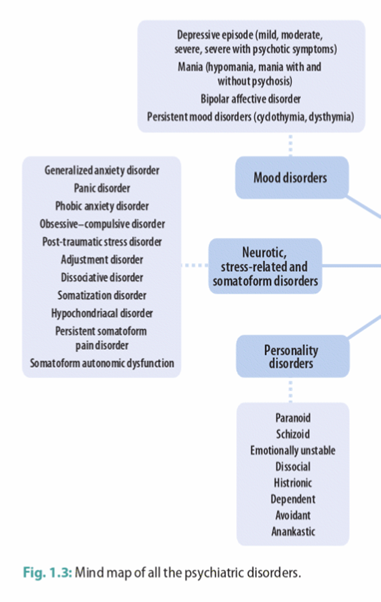
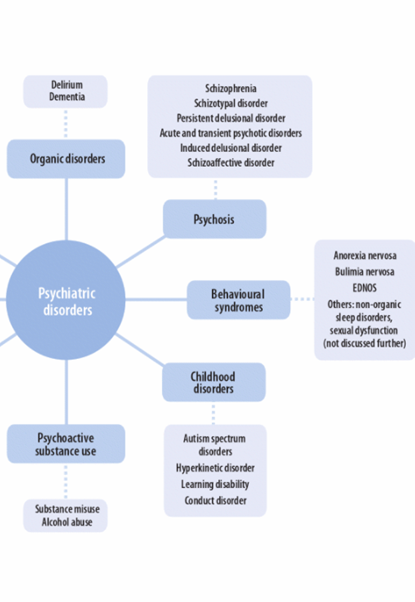
For each of the 10 categories in the ICD-10 classificaiton of psychiatric disorders, that are listed below, state some example conditions:
- Organic
- Disorders due to psychoactive substances
- Schizophrenia, schizotypal and delusional disorders
- Mood (affective) disorders
- Behaviour syndromes asscoiated with physical factors & physiological disturbances
- Behavioural and emotional disorders in childhood & adolescence
What investigations do we commonly do in psychiatry?
- Biochemical e.g. blood, urine tests (for substance misuse)
- Imaging e.g. CT head (for dementia), CXR (e.g. in delirium where suspect pnuemonia as cause)
- Questionnaires
The community mental health team (CMHT) are a multidisciplinary team with many different professionals. What is the role of the crisis resolution team?
- Manage severely unwell pts and often suicidal pts in the community
- Deal with psychiatric emergencies
- Available 24hrs per day
- Short term interventions with people at home either to arrange admision or to prevent admission
What does the assertive outreach team do?
- Provide intensive support and treatment in community for chronically unwell psychiatric pts who have history of disengangement from mainstream psychiatric services
- CPNs can visit several times a week over a long period of time
What is the care programme approach?
System of care to meet pt’s psychiatric and social needs once in community after significant contact with psychiatric services e.g. inpatient admission.
Member of CMT is appointed as care coordinator (or key worker) and they work closely with social services
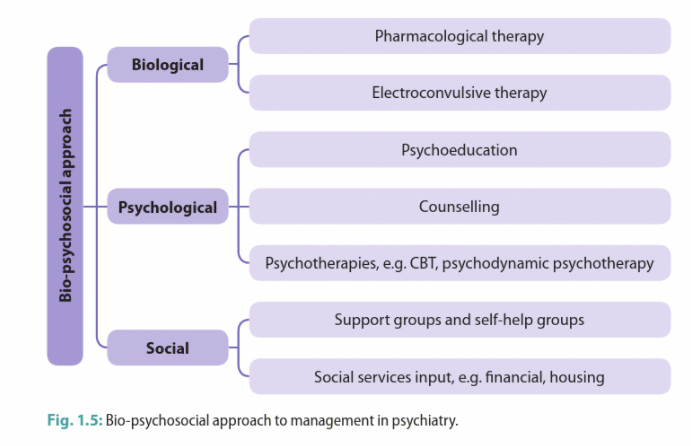
When managing pts in psychiatry you should use the biopsychosocial model; state some of examples of:
- Biological management
- Psychological management
- Social management
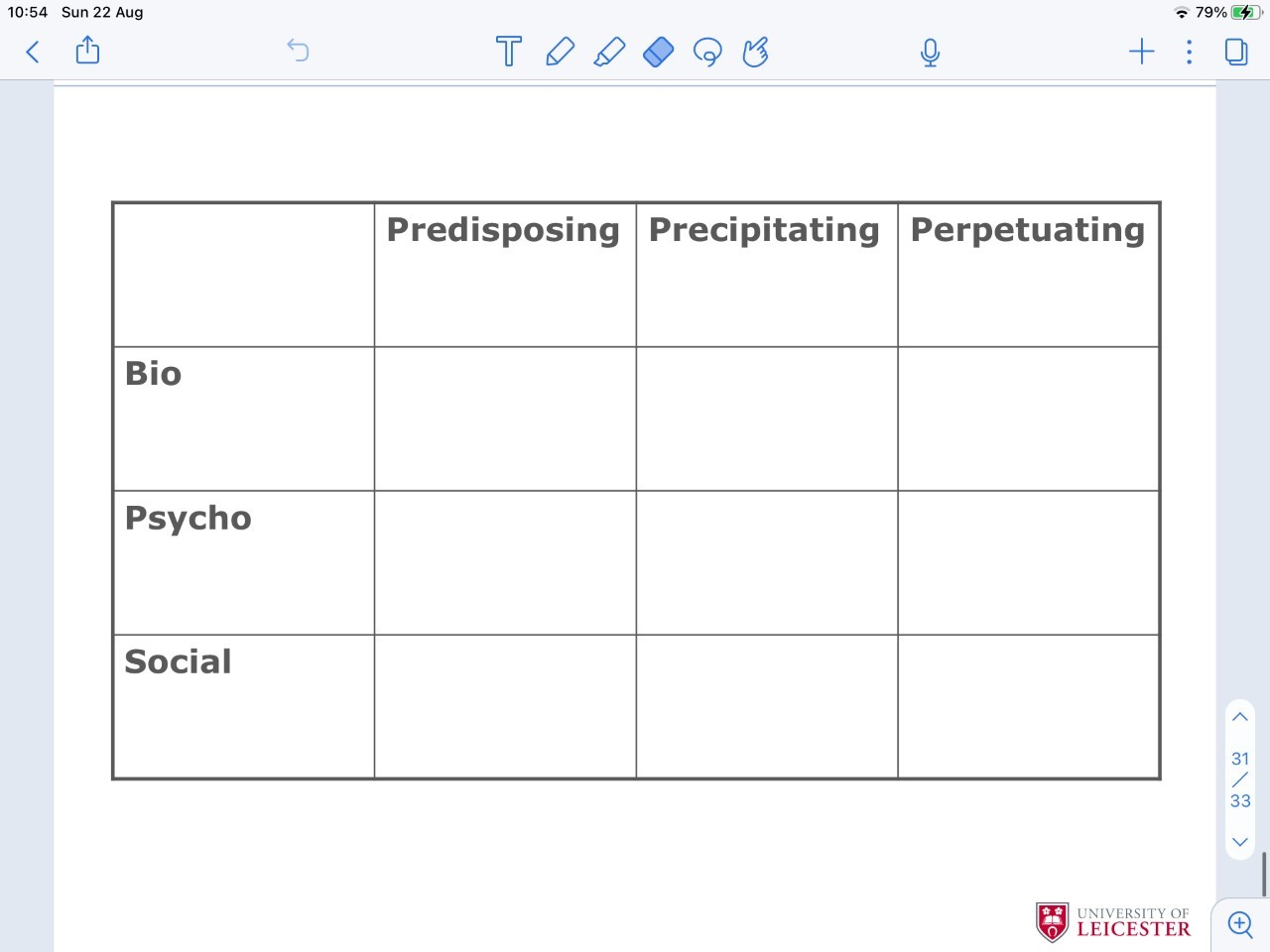
When trying to understand a pt with psychiatric illness you need to be asking yourself one key question; what is this?
What can you explore to help you answer the above question? (4)
Why has this person got this disorder at this time?
Questions:
- Predisposing factors
- Precipitating factors
- Perpetuating factors
For each of the above you can think about biological, psychological and social cuases for each.
*also explore protective factors. Loss of protective factors may be precipitating factor
There are many rules on DVLA website about when a pt can and cannot drive with mental health disorders. Don’t need to know all of them but be aware they exist and know common ones such as:
- Mild-moderate depression without suicidal ideation, behaviour disturbances, agitation or concentration problems
- Severe depression with memory or concentration problems, agitation, behavioural disturbance or suicidal thoughts
- Acute psychotic episode, hypomania/mania, schizophrenia
- Can drive, don’t need to inform
- Can’t drive, must inform
- Can’t drive, must inform
- *Criteria must be met before can drive again*
- *Rules about lorrry drivers different.*
Next few Flashcard about university days:
- What is second victim?
- What are the stages in the secondary victim recovery process?
- What are 3 potential outcomes following being a second victim?
- Second victims are healthcare employees who are involved in an unanticipated adverse patient event, a medical error and/or a patient-related injury and become victimized in the sense that the employee is emotionally traumatized by the event. Frequently, these individuals feel personally responsible for the patient outcome. Many feel as though they have let the patient down, second-guessing their clinical skills and knowledge base1.
- Stages in secondary victim recovery process:
- Chaos & accident response: asked to write statement about what happened
- Intrusive reflections: you questioning what you did, why you did it, doubting your personal abilities
- Restoring personal integrity: restoring your own believes in your own morales/character
- Enduring the inquisition: enduring the court proceedings
- Obtaining emotional first aid: seeking support
- Moving on: not all will move on (some will drop out)
- Potential consequences: dropping out, surviving, thriving

-
Psychiatry Basics/Introduction17
-
Psychiatric History Taking & MSE44
-
Affective Disorders75
-
Schizophrenia & Psychoses52
-
Anxiety Disorders101
-
Personality Disorders23
-
Substance Misuse64
-
Eating Disorders65
-
Self Harm & Suicide26
-
Psychotherapies36
-
Psychopharmacology: Antidepressants & Antipsychotics80
-
Psychopharmacology: Mood Stabilisers, Anxiolytics & Others46
-
Legal Aspects of Psychiatry34
-
Child & Adolescent Psychiatry63
-
ECT16
-
Liason Psychiatry8
-
Psychological Problems Presenting with Physical Symptoms31



