What are somatoform disorders?
Group of disorders who symptoms are suggestive or, or take form of, a physical disorder but in the absence of physiological illness leading to the presumption that they are caused by psychological factors
State some risk factors for somatorm disorders (think about biopsychosocial)
- Genetics/FH
- History of physical or sexual abuse
- Social stressers/stressful life events that they wish to escape from
- Other psychiatric illness:
- Mood disorders
- Anxiety disorders (particulary PTSD- high proportion of PTSD pts have somatoform disorders)
- Personality disorders
For somatoform disorders, discuss:
- Prevalence
- Whether it is equally common in both sexes
- Age of onset
ICD-10 categorises somatoform disorders into 5 categories; state these
*HINT: PUSHy SOMATOFORM pts
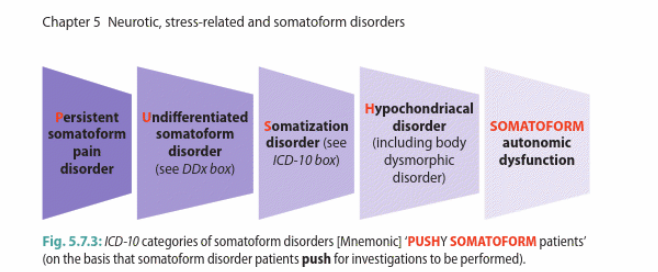
Discuss what persistent somatoform pain disorder is
- Persistent (at least 6 months) and severe pain that cannot be fully explained by physical disorder
- Usually occurs as a result of psychological stressors & emotional difficulties
*NOTE: differs from somatization disorder in that pain is primary feature & multiple symptoms from diff systems not present
Discuss what somatization disorder is, include:
- What it’s also known as
- What it is
- Male vs feamle
- History of contact with medical services
- Briquet’s syndrome
- Multiple, recurrent and frequently changing physical symptoms not explained by physical illness
- More common in females (10:1)
- Long history of contact with medical services
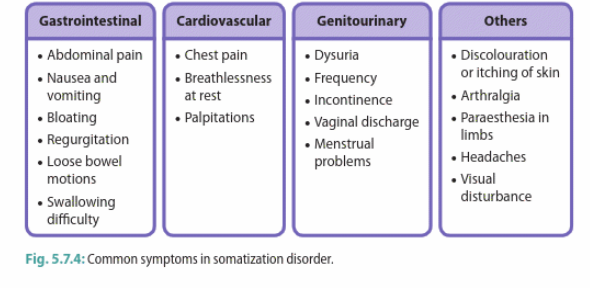
State some symptoms of somatization disorder
*HINT: consider GI, cardio, genitourinary & other body systems
Discuss the ICD-10 criteria for somatization disorder
Require all of the following:
(a) at least 2 years of multiple and variable physical symptoms for which no adequate physical explanation has been found
(b) persistent refusal to accept the advice or reassurance of several doctors that there is no physical explanation for the symptoms
(c) some degree of impairment of social and family functioning attributable to the nature of the symptoms and resulting behaviour
Discuss what somatoform autonomic dysfunction is
- The symptoms are presented by the patient as if they were due to a physical disorder of a system or organ that is largely or completely under autonomic innervation and control, i.e. the cardiovascular, gastrointestinal, or respiratory system
- E.g. psychogenic hyperventiltion
- E.g. Da Costa’s syndrome
- Symptoms may be objective (e.g. sweating, tremor) or subjective (e.g. pain, parasthesia
Discuss hypochondriacal disorder
- Pt misinterprets normal bodily sensations which leads to them to non-delusional preoccupations that they have a serious physical illness e.g. cancer
- Refuse to accept reassurance from doctors
- Body dysmorphic disorder is a variant of hypochondriacal disorder in which there is excessive preoccupation with barely noticeable or imagined defects in physical appearance which causes physical distress
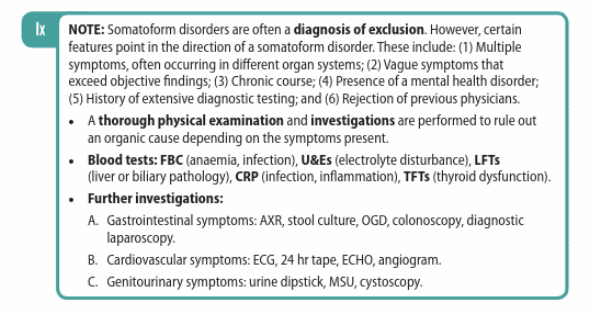
Somatoform disorders are a diagnosis of exclusion although there are features that may make you think a pt has somatoform disorder. State some of these features
- Multiple symptoms often from different organ systems
- Vague symptoms
- No objective findings
- Chronic course
- Presence of MH disorder
- History of extensive diagnostic testing
- Rejection/refusal to accept reassurance/no diagnosis
State some examples of investigations you would have to do BEFORE you could diagnose somatoform disorders
What are dissociative (conversion) disorders?
Characterised by symptoms which cannot be explained by medical disorder and where there are convincing associations in time between symptoms & stressful events, problems or needs.
What two processes occur in dissociative disorders ?
*HINT: asking for sequence of events as to why their dissociation leads to symptoms
- First, dissociation occurs; pt separates off certain memories from consciousness/stops them entering their conscious mind as a psychological defence mechanism because it is so distressing
- Next, conversion happens: emotional distress is transformed into physical symptoms
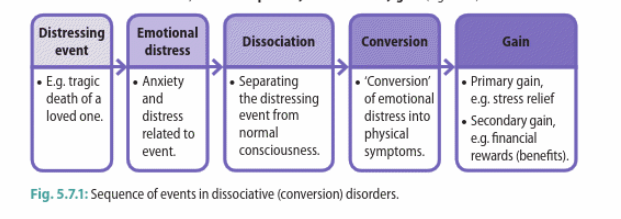
Both somatoform and dissociative (conversion) disorders can lead to primary and secondary gain; describe what each is
- Primary gain: provides relief from stressful or unachievable interpersonal expectations
- Secondary gain: attention, care, financial rewards
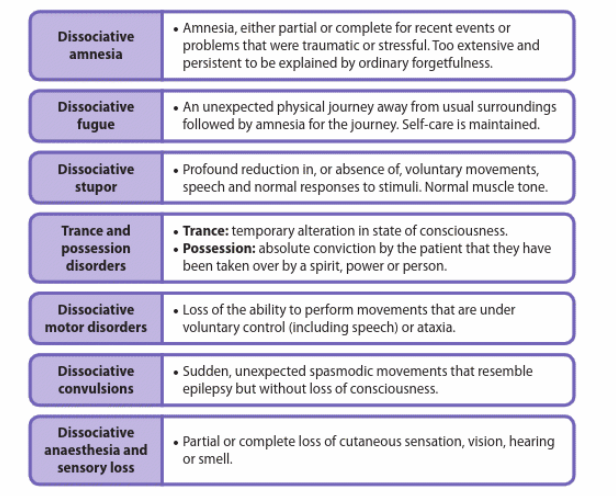
ICD-10 has 7 different types of dissociative disorder; state and briefly describe each of these
What is factitious disorder (Munchausen’s syndrome)?
Physical or psychological symptoms are intentionally produced (faked) because the pt wishes to adopt the ‘sick role’ to receive care and for internal emotional gain.
(Primary gain)
What is malingering disorder?
Physical or psychological or disability symptoms are intentionally produced as the pt seeks advantageous consequences of being diagnosed with medical condition e.g. evading criminal prosecution. obtaining illicit drugs, avoiding military conscription or dangerous military duty, and attempts to obtain sickness benefits or improvements in living conditions such as housing.
(Secondary gain)
What’s the key difference between factitious disorder (Munchausen’s syndrome) and malingering disorder?
The motive
- Factitious disorder: primary gain (wants to adopt sick role)
- Malingering disorder: secondary gain (wants advantageous consequences of being diagnosed with medical condition)
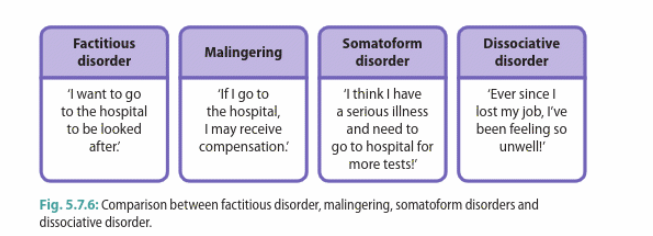
Examples to help differentiate between factitious, malingering, somatoform and dissociative disorders
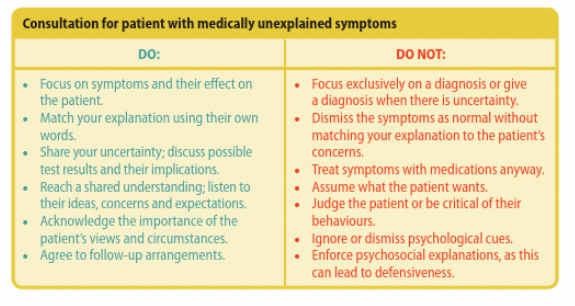
Discuss the management of medically unexplained symptoms (including somatoform & dissociative disorders); structure as biopsychosocial
Biological
- Treatment of any underling psychiatric condidtions:
- e.g. antidepressants (primarily SSRIs) for any underlying mood disorder
- e.g. support for substance misuse
Psychological
- CBT
- Coping strategies
Social
- Stress relieving activities e.g. mindfulness
- Other help to identify stressors in life e.g. marriage counselling
- Involve family if appropriate
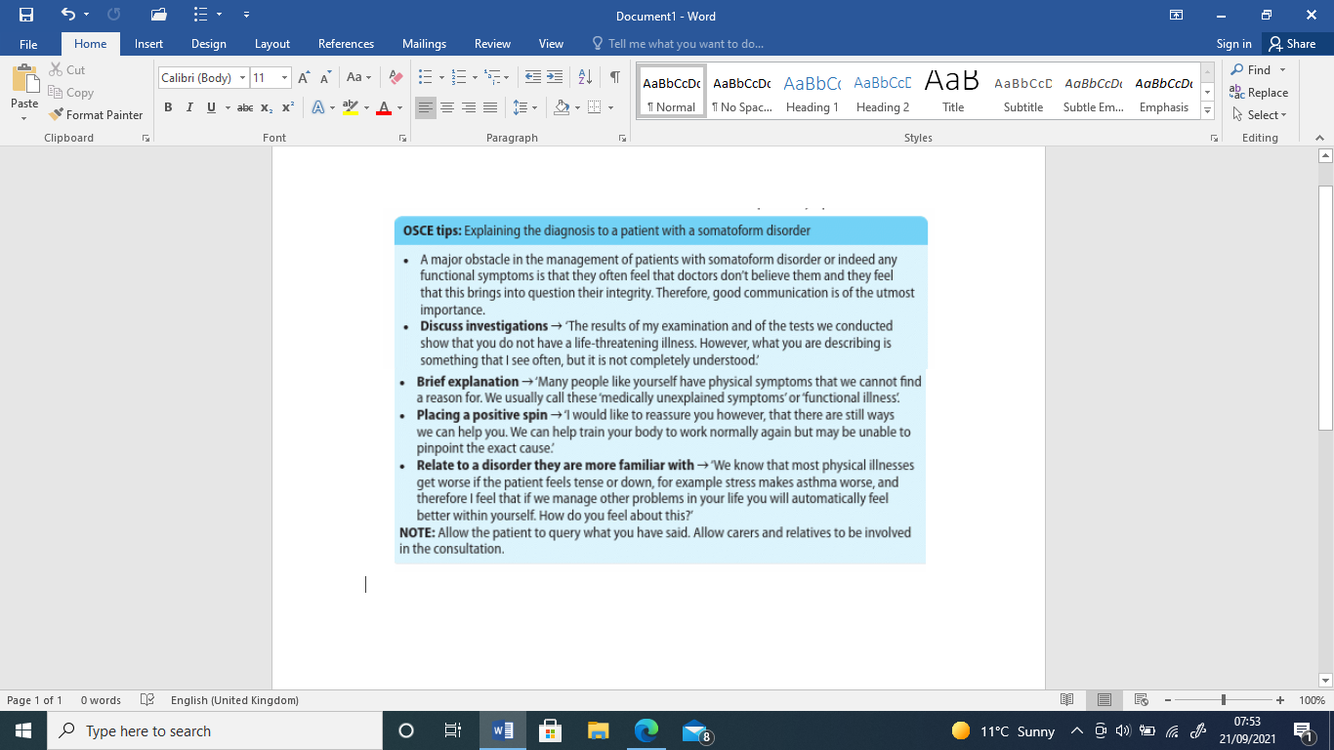
OSCE tips for somatoform & dissociative disorders
What is chronic fatigue syndrome?
Charcterised by exhaustion after miminal activity, poor concentration & muscle tenderness
Recommended first line treatmetn is CBT and/or graded exerxise therapy
What do we mean by neuropsychiatric disorders?
Conditions in which mental disorders arise from demonstrable structural or neurophsysiological disturbance of brain
“disorders which straddl the boundaries between neurology & psychiatry”

-
Psychiatry Basics/Introduction17
-
Psychiatric History Taking & MSE44
-
Affective Disorders75
-
Schizophrenia & Psychoses52
-
Anxiety Disorders101
-
Personality Disorders23
-
Substance Misuse64
-
Eating Disorders65
-
Self Harm & Suicide26
-
Psychotherapies36
-
Psychopharmacology: Antidepressants & Antipsychotics80
-
Psychopharmacology: Mood Stabilisers, Anxiolytics & Others46
-
Legal Aspects of Psychiatry34
-
Child & Adolescent Psychiatry63
-
ECT16
-
Liason Psychiatry8
-
Psychological Problems Presenting with Physical Symptoms31



