Define oxidation and reduction
Oxidation is defined as the loss of electrons
Reductions is defined as the Gain of electrons
In Redox reactions, what causes the gain and loss of carbon atoms ?
Making bonds with an electronegative atom, such as oxygen loses a carbon atom electron
Breaking bonds with an electronegative atom, such as oxygen, and forming bonds with an electropositive element such as hydrogen, gains a carbon atom electron
Draw the reversible redox reactions between a secondary alcohol and a ketone
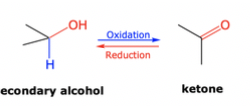
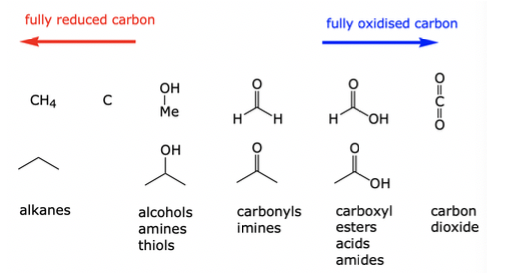
Explain the oxidation levels of carbon and give an example of each level
CH4 and C = oxidation level 0
Alcohols, amine, thiols= oxidation level 1
Carbonyls, imines= oxidation level 2
Carboxyl, esters, acids, amides= oxidation level 3
Carbon dioxide= oxidation level 4
(the levels correspond to the bonds between the Carbon and oxygen atoms in the molecule)
Are alkanes generally reactive or unreactive?
They are generally unreactive
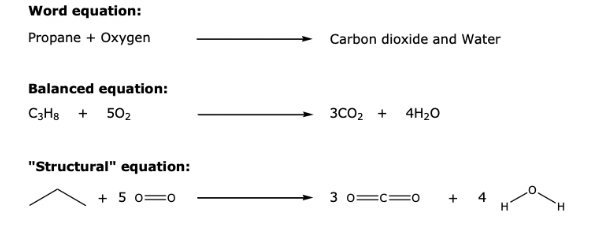
Tell me the reaction between alkanes and oxygen using propane as an example
What is used to oxidise alcohols, and what cannot be used?
Oxidation is not achieved by reaction with molecular oxygen (O2), but with an oxidising agent such as Chromic acid (H2CrO4) or Potassium permanganate (KMnO4)
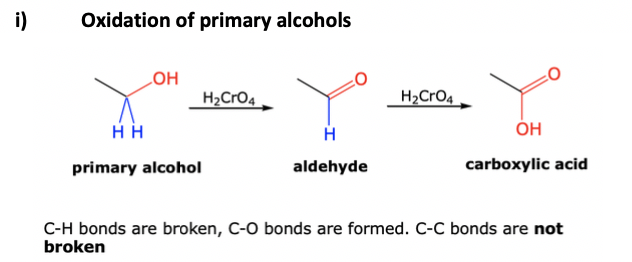
Tell me about the oxidation of primary alcohols
Include…
- worked example
- reagents
- whats bonds are broken/formed
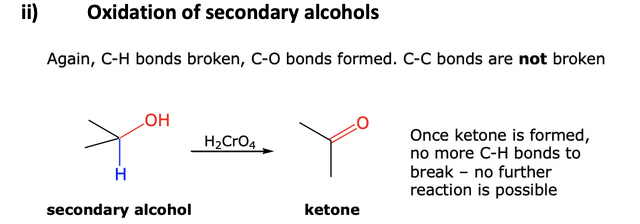
Tell me about the oxidation of secondary alcohols
Include…
- worked example
- reagents
- whats bonds are broken/formed
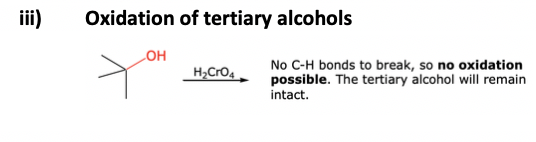
Tell me about the oxidation of tertiary alcohols
Include…
- worked example
- reagents
- whats bonds are broken/formed
Whats the name of the bond that is very reactive in alkenes?
The π bonds
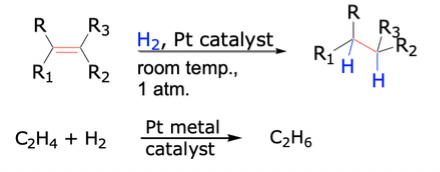
Tell me about hydrogenation of alkenes
- reagents
- catalyst
- conditions
- products
- react with hydrogen in the presence of a metal catalyst to form alkanes
- H2 is added to the molecular formula- an example of reduction
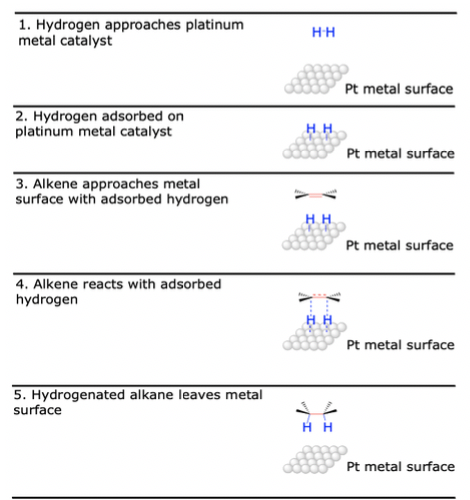
Tell me the detailed processes of hydrogenation
- H is added in the same face of the double bond
Why is hydrogenation not used to reduce aldehydes/ ketones, what is used instead?
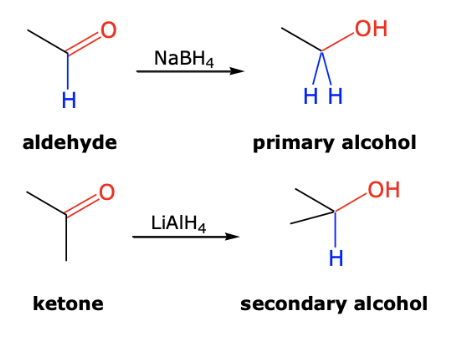
Hydrogenation is not effective at reducing polarised C=O bonds. Inorganic reducing agents, such as sodium borohydride (NaBH4) and lithium aluminium hydride (LiAlH4) are usually used
Tell me the reaction of the reduction of aldehydes and ketones, the reagent used and the product formed for each?
- You will never get an oxidation level of 0 or 4
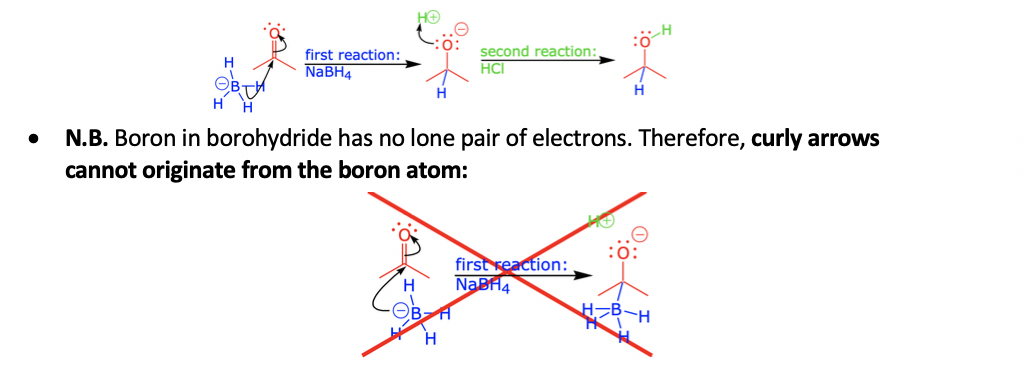
Whats the mechanism of carbonyl reduction by hydride transfer reagents ?
- attack by hydride at the carbonyl generates a tetrahedral intermediate, which can be protonated to give an alcohol
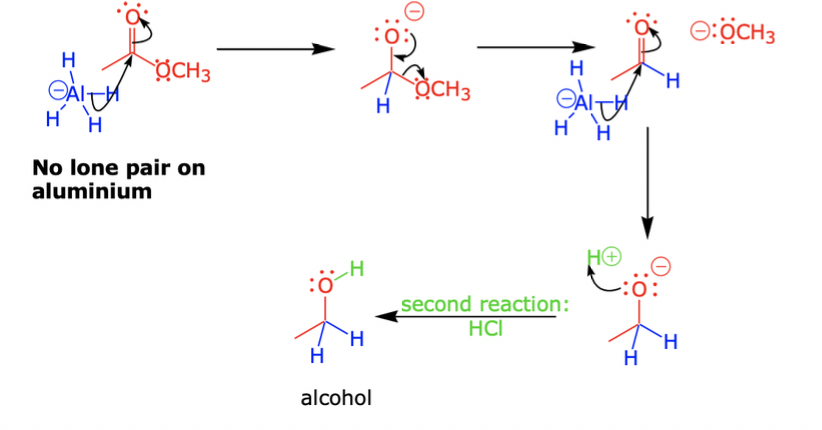
Show the mechanism of reduction of esters by hydride transfer reagents
As with the Claisen reaction, nucleophilic attack generates a tetrahedral intermediate which can kick out a leaving group, rather than protonate:
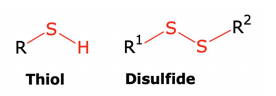
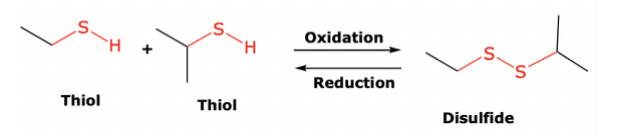
Draw the functional group of a thiol and disulphide
Draw the redox reaction between thiols and disulphides
- how do the reactions occur/ spontaneously or with reagents?
- Oxidation of thiols to disulphides occurs spontaneously in air
- Reduction of disulphides to thiols requires an inorganic reducing agent, such as sodium borohydride (NaBH4) or another thiol, such as beta-mercaptoethanol
What is crucial to protein structure?
How are they formed?
What can disruption of this lead to?
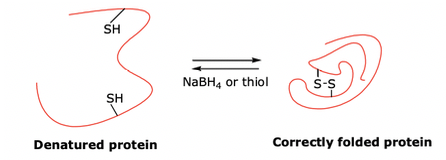
- Disulphide bonds are crucial to protein structure
- The three-dimensional structure of proteins can depend on the formation of disulphide bonds (often called disulphide bridges) between cysteine amino acid residues
- Disruption of the structure of proteins usually leads to their inactivation
Show how alcohol is processed in the body
What enzymes are used?
What issue can arise?
Ethanol (an alcohol) is first oxidised to ethanal (an aldehyde), which is even more toxic than ethanol
When glutathione is depleted, ethanal accumulates

What is NAD the co-factor to?
alcohol dehydrogenase
Whats the redox reaction of NAD and what is it converted to?
NADH



