Structural features of the vegetation:
- Vegetation can be described by different characteristics:
- height of vegetation cover
- density of vegetation cover
- root penetration depth / intensity
- species composition !!!
- spectrum of life forms !!!
Structural features of the vegetation:
- in the course of evolution, a large number of species have evolved in adaptation to very different site conditions
- but at the same time only a small number of life and growth forms have developed
⇒ genotypic differences + similar appearance and function in the ecosystem (= ecological equivalence)
Structural features of the vegetation:
- Description of a plant stand by:
- species composition > plant communities
- spectrum of life forms > plant formations
⇒ Plant formations give information about abiotic environmental conditions by their shape = physiognomic‐ecological vegetation units
⇒ different classification systems
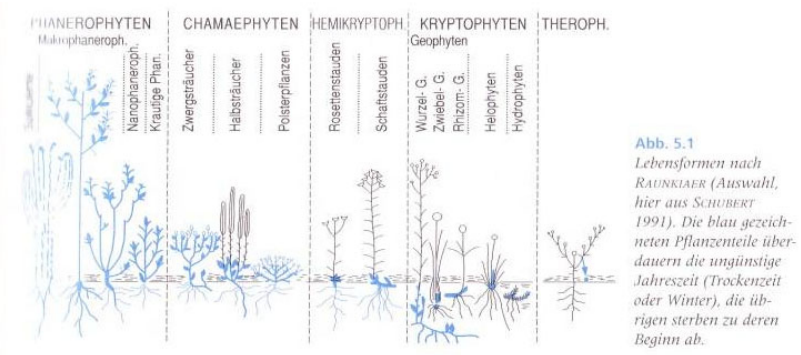
Life and growth forms:
- includes total habitus (size, shape, outline) and life span
- plants: especially the shape of the leaves, the type of branching, the degree of lignification or the location of the renewal buds
- animals: additionally the predominant nutrition, the degree of the mobility or prominent behaviors
- Life forms after RAUNKIAER
Life forms after Raunkiaer:
Ecosystem characteristics:
- Ecosystem turnover
- Growth or defense (primary vs. secondary metabolism)
- Plant interactions (competition, mutualism, niches, resilience, valence)
Turnover:
- Net primary production (NPP) depending on site conditions:
- duration of the vegetation period
- global radiation
- air temperature during vegetation period
- water availability during vegetation period
- availability of mineral nutrients
- ‐ 4. climatic
- further turnovers:
- animal feed (=secondary production)
- Litter decomposition
- Humification
- Mineralization
- Net ecosystem exchange (NEE)
- Ecosystem respiration:
- Reco = CO2 release from soil + plant
⇒ NEE = GPP ‐ Reco
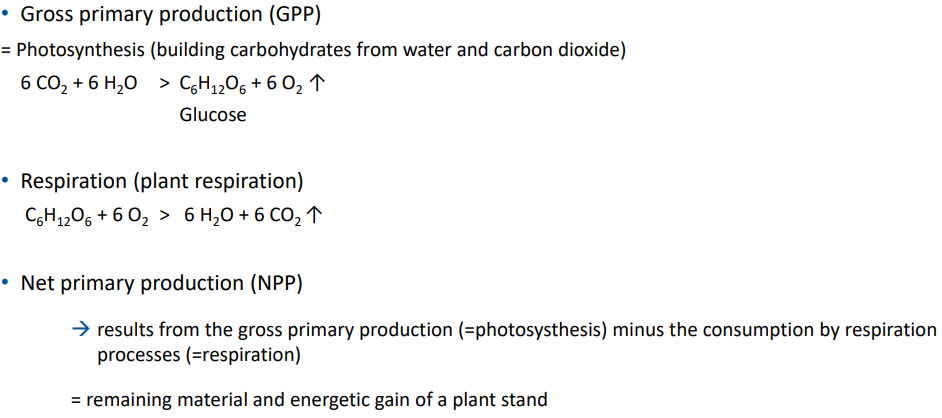
Change in primary production, biomass growth, litter and respiration:
- Ecosystems are dynamic, longest dwell time in the mature phase
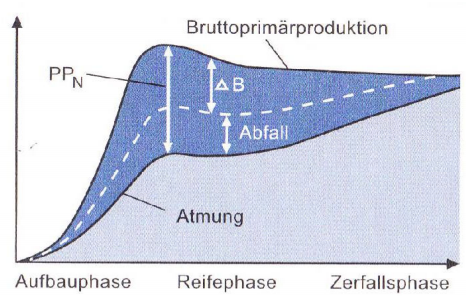
Model scheme of a natural/near‐natural ecosystem:
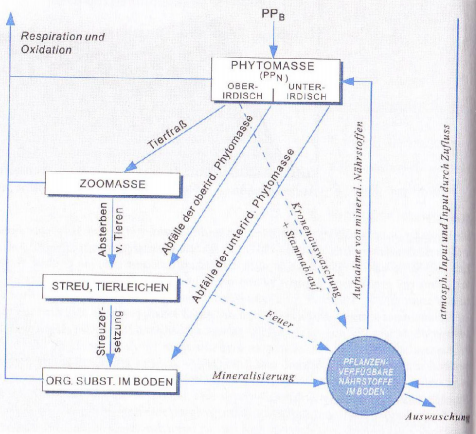
Primary production:
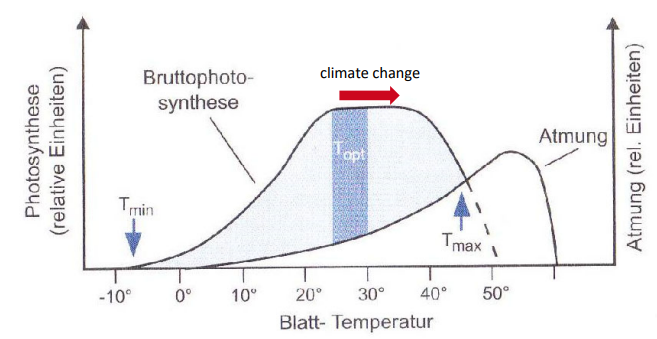
photosynthesis and respiration
- light can be the limiting factor
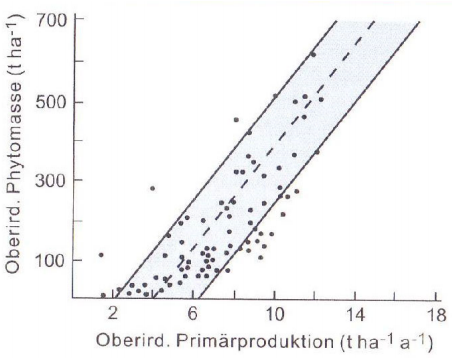
Phytomass and primary production in forest systems:
- esp. assimilation areas (LAI)
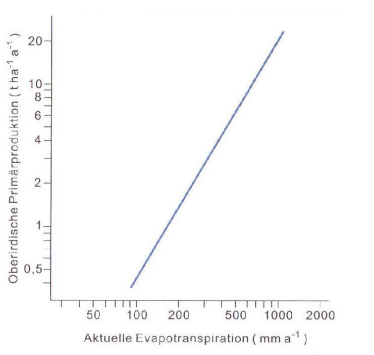
Primary production and evapotranspiration:
- Water use efficiency (g formed dry substance / liter of transpired water)
- Relation between production and water consumption
Secondary production (animal feed):
- Animals:
- heterotrophic creatures
- nutrition directly or indirectly from organic products of primary producers
- Consumers
- Secondary producers
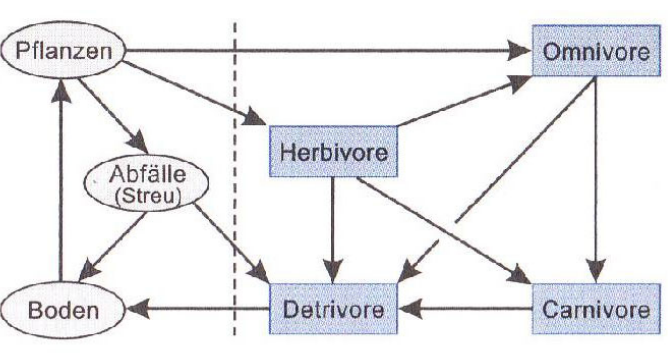
- Biofages (live substance eaters):
- herbivores, carnivores, omnivores
- Dead substance eaters:
- detrivors ( ⇒ together with bacteria / fungi (saprobionic plants): decomposers)
- quantitative importance of biophages:
- a few percent of the above‐ground phytomass eaten by herbivores
Four main groups of heterotrophic organisms:
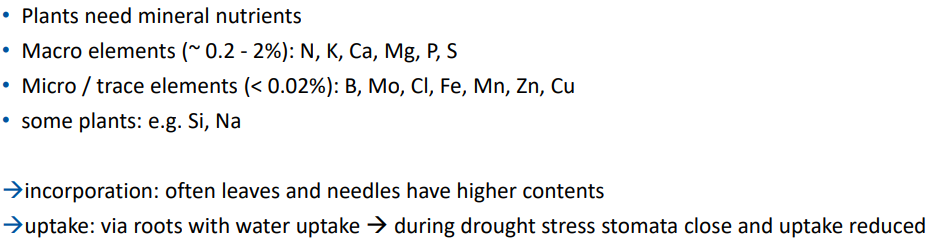
Mineral turnover:
Primary and secondary metabolism:
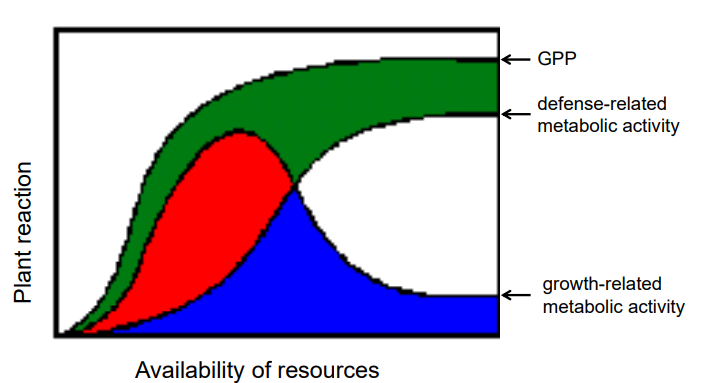
- Trade‐off between primary and secondary metabolism
- what is put into defense is no longer available for growth
- Secondary metabolites often “expensive“
Plant defense:
- Response to stress caused by environmental conditions (pests, climate, air pollution, scarcity of resources, competition, …)
- New production of secondary metabolites
- Supply of secondary metabolites
- “Toxins”
- “Warning signals”
- “Calls for help”
- Triggering of numerous functions (e.g. maturation)
⇒ not absolutely necessary for cell survival but useful or necessary for the whole organism
Plant defense, Example:
desert mugwort (Wüsten‐Beifuß) and wild tobacco
- in one group mugwort pruned, other group unchanged
- emission of VOCs
- tobacco near the pruned mugwort plants switches metabolism to defense
- significantly less feeding damage by locusts
- “eavesdropping” on neighboring plants / species
Interaction of individuals of the same or different species:
- Competition
- Mutualism (mutual benefit)
- Dependence on environmental conditions
⇒ Result: site‐specific species clusters
⇒ Plant communities and formations
Ecological niche:
- The entity of environmental factors that a uniform group of plants or animals (e.g. species) needs for their survival
- biotic and abiotic factors combine to form a multidimensional hyperspace
- functional relationship between a species and the ecosystem
- within the niche space: competition, mutualism, symbioses
fundamental niche ⇔ realized niche
Competition:
- nteraction of organisms (of the same or different species) based on competition for limited resources
- intra‐ and interspecific competition
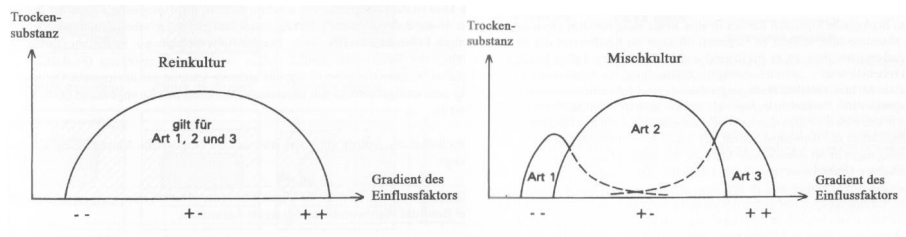
- mind‐experiment: pure vs. mixed culture
- Picture:
- Species 2 could also grow under extreme conditions, but is displaced by more competitive plants under these conditions
Physiological valence:
- every plant species can exist from its physiological constitution under wide ranges of environmental conditions
⇒ physiological range of existence / physiological valence
- depending on the intensity of the influencing factor, different growth and distribution
- range of highest production output: physiological optimum
Ecological valence:
- in case of occurrence of several species: mutual displacement/enforcement from more or less large parts of the physiological area of existence ⇒ ecological subsistence area / ecological valence
- ecological optimum
- ecological and physiological optimum coincide only in a few cases (mostly at the physiological edge)
- misleading or wrong: “drought loving”, “in need of warmth”, “lime seeking”
- species only more competitive ⇒ “drought‐bearing”
Effects of competition:
- intraspecific competition for water, nutrients and radiation
- e.g. same total biomass production with different numbers of individuals of the same species (e.g. three or six Lolium perenne and three Daucus carota plants)
- die off of the “weak” individuals ⇒ Selection of the best adapted individuals ⇒ Optimization of the genetic adaptation of the species
- interspecific competition
- e.g. three Lolium and three Daucus plants
- Lolium biomass almost as in pure culture
- Daucus biomass only at about 10% of the possible biomass
- total biomass (Lolium + Daucus) same as before
- with a three‐week growth advantage of Daucus:
- Lolium only 40%
- at three‐week growth advance of Lolium:
- Daucus practically at 0
- Adaptation to competition:
- little energy in generative apparatus, more in height growth
- e.g. with Daucus ahead:
- Lolium compared to normal growth 40% stalk and leaf biomass, only 20% ear biomass (few seeds) ⇒ less offspring ⇒ extinction after some generations
- Competition for nutrients and water underground, light above ground
⇒ Plant individuals recognize competing individuals very early via their photoreceptors (e.g. by the red/far red ratio)



