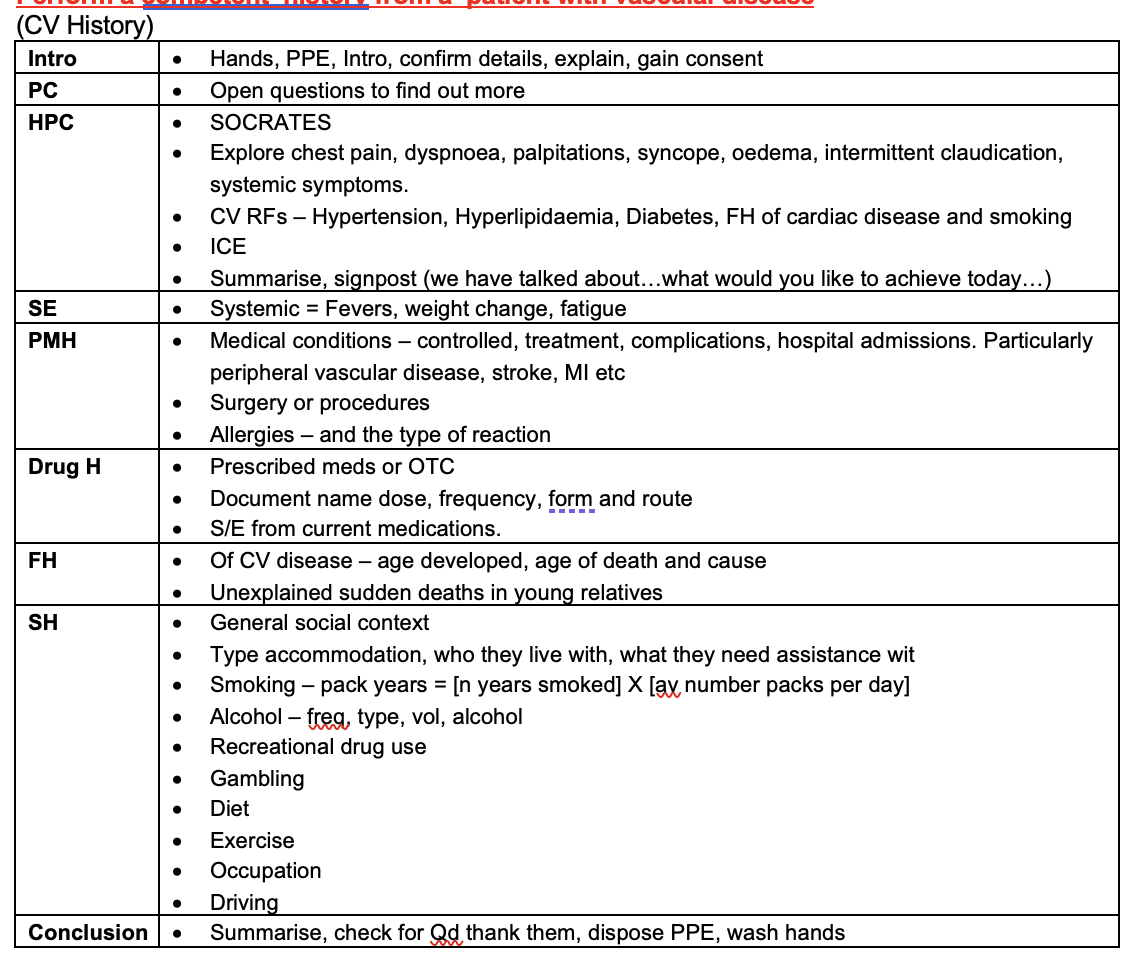
Vascular disease (CV)history
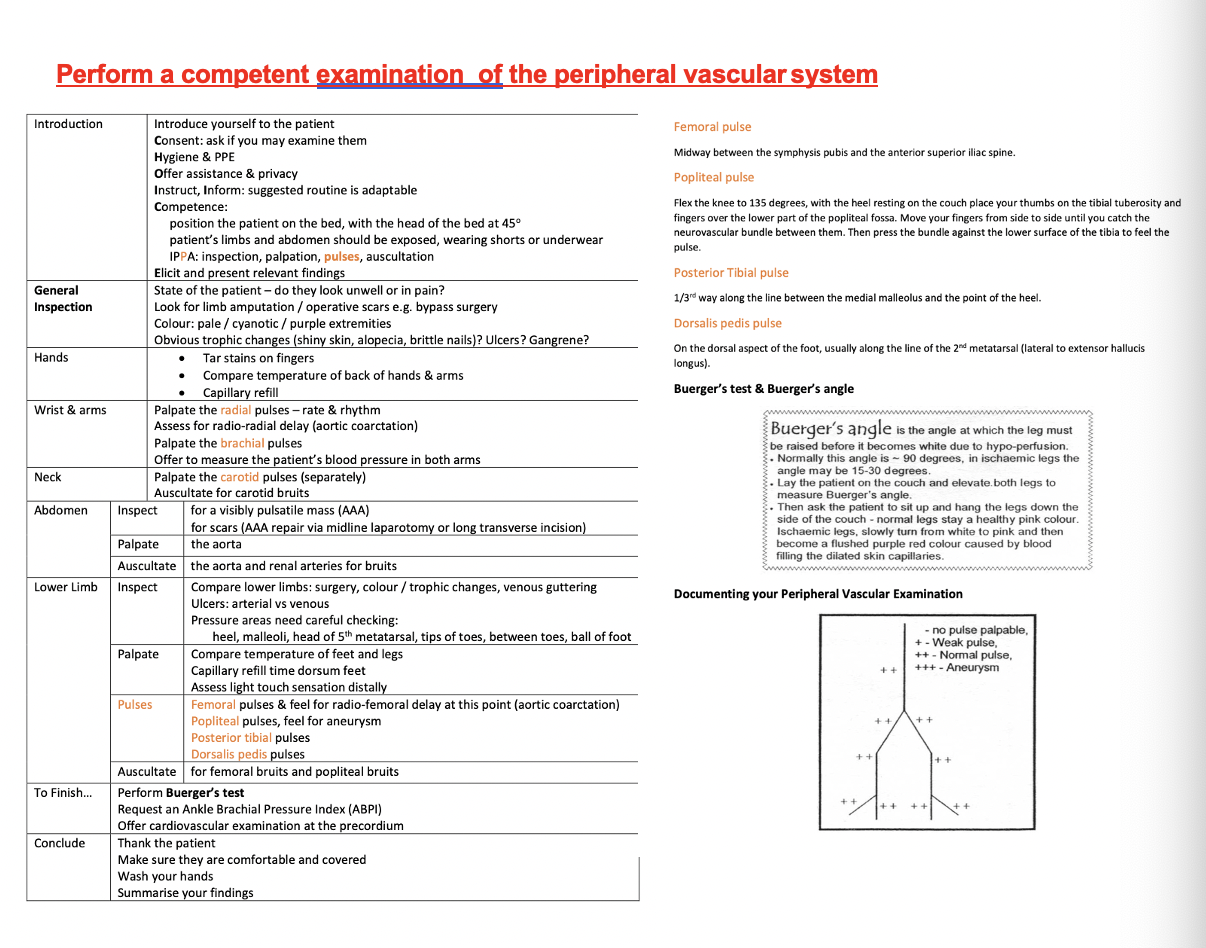
Peripheral vascular system exam
What is Peripheral vascular disease?
Slow and progressive circulation disorder. Narrowing, blockage to spasms in a blood vessel can cause PVD. This may affect blood vessels outside of the heart including arteries veins or lymphatic vessels
Explain the presentation and natural history of peripheral vascular disease
Most people are asymptomatic but for those with symptoms the most common first one is painful leg cramping with exercise and is relieved by rest (intermittent claudication). During rest, the muscles need less blood flow, so the pain disappears. It may occur in one or both legs depending on the location of the clogged or narrowed artery.
Other symptoms:
- Changes in the skin (decreased skin temp, thin, brittle, shiny)
- Weak pulses in the legs and feet
- Gangrene (dead tissue due to lack of blood flow)
- Hair loss on the legs
- Impotence
- Wounds that wont heal over pressure points, such as heels or ankles
- Numbness, weakness or heaviness in muscles
- Pain at rest
- Paleness when legs elevated
- Reddish-bluish discolouration of extremities
- Restricted mobility
- Severe pain when artery narrowed or blocked
- Thickened, opaque toenails
Explain the causes of peripheral vascular disease
Most commonly atherosclerosis which is the build-up of plaque inside the artery wall. It reduced the blood flow to the limbs and decreases oxygen and nutrients available to the tissue. Blood clots may form on the artery walls further decreasing inner size of blood vessel and block off major arteries.
Other causes: Injury to arms or legs, irregular anatomy of muscles or ligaments and infection
RFs:
- Cant change – age >50, history of hesrt disease, male gender, postmenopausal women, FH of high cholesterol, Hight BP, or PVD
- Can change – coronary artery disease, diabetes’s, high cholesterol, high BP, overweight, physical inactivity, smoking or use of tobacco.
Explain the principles of investigation of peripheral vascular disease
- Physical exam – weak/absent pulse, whooshing sounds with stethoscope, poor wound healing
- ABI, Ankle-brachial index – compares BP in ankle with BP in arm
- US – like doppler to evaluate blood flow
- Angiography – dye injected into blood vessels and trace flow of dye using Xray usually.
- Blood tests – cholesterol + triglycerides and check for diabetes
Explain the principles of surgicla management of peripheral vascular disease
- Angioplasty – small balloon on ip of catheter inflated to flatten plaque in artery wall and reopen artery while stretching artery open to increase blood flow. Doctor may insert stent to help keep it open
- Bypass surgery – Create path around blocked artery with blood vessel or synthetic vessel so blood can bypass blocked or narrowed artery.
Explain the principles of non-surgical management of peripheral vascular disease
Medications:
- Thrombolytic therapy – Inject clot dissolving drug into artery to break clot.
- Cholesterol lowering – statins to reduce risk of MI and stroke
- HB meds
- Medications to control bloo sugar if diabetic
- Medications to prevent blood clots
- Symptom relief meds – cilostazol increases blood flow to limbs by keeping blood thin and widening blood vessels so helps to treat leg pain but can get headache and diarrhoea. Also pentoxifylline
Supervised exercise program to increase the distance you can walk pain free.
Lifestyle:
- Stop smoking -contributes to constriction and damage of arteries and it can worsen it.
- Exercise – helps condition muscles to use oxygen more efficiently Eat healthy – heart healthy diet low in saturated fat can help control BP and cholesterol levels to lower risk of atherosclerosis.
- Avoid certain cold medications – OTC cold remedies with pseudoephedrine in construct blood vessels and can increase PAD symptoms.
- Careful foot care – risk of poor healing sore and injuries
- Coping and support
Differentiate the different types of aortic or arterial aneurysms
- Abdominal aortic aneurysm aorta weakens and enlarges or balloons outwards. Usually in older men with RFs such as emphysema, FH, HBP, Cholesterol, smoking, obesity. Women with AAA often have more ruptures with smaller ones.
- Clinical features = abdo pain, back/loin pain, distal embolization
- Cerebral aneurysm – occur when wall of blood vessel in the brain becomes weakened and bulges or balloons out. Three types: Berry (saccular), fusiform and mycotic
- Thoracic aortic aneurysms – Abnormal bulging or ballooing of the part of aorta that goes through chest.
Explain the principles of surgical treatments of abdominal aortic aneurysms
Surgery should be considered If AAA>5.5cm, expanding at >1cm/year or symptomatic AAA in someone who is otherwise fit.
If unfit patients, AAA may be left until6cm or more prior to repair from the risk of mortality from elective repair.
Main treatment options:
Open repair – midline laparotomy or long transverse incision, exposing arta and clamping aorta proximally and the iliac arteries distally, before the segment is then removed and replaced with prosthetic graft.
Endovascular repair – Involves introducing a graft via femoral arteries and fixing the stent across the aneurysm. Does have improved short term outcome in terms of decreasing hospital stay ad 30day mortality but higher rate of reintervention and aneurysm rupture. After 2years, mortality both same for either.
AAA rupture – increases risk as diameter increases. Cab present with abdominal pain, back pain, syncope or vomiting and typically haemodynamically compromised with pulsatile abdominal mass and tenderness.
Principles of non-operative management of abdominal aortic aneurysms
- Immediate high flow O2, IV access (2x large bore cannulae), urgent blood (FBC, U&Es, clothing) with crossmatch for minimum 6U units.
- Any shock should be carefully treated as raising Bp can dislodge clot and cause mor ebleedign so keep BP<100mmHg as long as they are cerebrating/
- Transferred to local vascular unit with vascular registrar, consultant, anaesthetist, theatre and blood transfusion lab informed.
- Unstable = immediate transfer to theatre for open surgical repair
- Stable = CT angiograph to determine if aneurysms is suitable for endovascular repair.
WHat is lower limb ischaemia and the 2 types
- Acute (No previous symptoms): Embolic (classic), thrombotic (More common), trauma/dissection (rare). More likely to be acute on chronic. Pain, Pallor, parasthetic, pulseless, poikilothermic. If leg ha been cold, paraesthetic and painful for more than 6hours then either analgesia or amputation – too late to revascularize the leg and by doing so you would get lots potassium released etc from dead cells.
- Chronic: Intermittent claudication, chronic critical ischaemia (rest pain, tissue necrosis, more than 2weeks duration).
RFs: smoking diabetes hypertension, hypercholesterolaemia, homocytsteine
Intermittent claudication, aetiolgoy and investiagtions
Intermittent claudication: Pain produced by the abnormal accumulation of metabolic products within the muscle. Resting blood flow to affected limb is normal.
Natural history PAD: Some 75% of patients will remain stable or improve. Only 1-2% will progress to limb loss. Most patients will have occult myocardial and cerebral vascular disease.
Aetiology: Atherosclerosis
Other rare causes:
- Buerger’s disease (and other arteritides)
- Popliteal aneurysm Popliteal entrapment
- Cystic adventitial disease
- Trauma
Investigation: history (pain, where, when), exam, imaging
- ABPI measurement:
- Requires compliant vessels
- Not good for calcified arteries
- May be unreliable in obesity
- Difficult in ulcerated leg
- Upper limb ischaemia may confuse result
- ABPI Leg = Pleg/Parm
- Normal = 0.9-1.2
- <0.9 likely atherosclerosis
- >13 may indicate calcification
- Not necessarily ischaemia
- Duplex scan
- DSA
- MRA – magnetic resonance angiogram
ABPI Measurement:
Management intermittend claudication
Management:
- Correct risk factors
- Modify at risk behaviour
- Encourage patients to keep walking and stop smokin
- Management claudication: Structured exercise programmes, angioplasty, bypass surgery
- Remember:
- Claudication doesn’t kill, myocardial ischaemia does. Claudication doesn’t always require treatment.
- Intervention does not improve limb salvage in claudicants and only 1-2% of claudicants will loose limb.
Critical limb ischaemia
The limb at risk
- Tissue necrosis
- Rest pain
- Reduced ankle pressure/toe pressure
- RFs as for claudication, more extreme and needs planned intervention.
- Management: analgesia/ medical therapy, angioplasty, reconstructive surgery.
What is ‘rest pain’
- Affects distal extremity
- Made worse by elevation
- Classically patient hangs foot out of bed or sleeps in chair
- Occurs over days/weeks
Rest pain
- Intermittent claudication is a common condition and in most cases is easily diagnosed
- It is associated with a significantly increased risk of death from cardiovascular disease
- Only a small proportion of patients with claudication require revascularisation
- The main treatment aim is to reduce the risk of mortality from cardiovascular events
- Smoking cessation, control of hypertension and diabetes, and prescription of statins and antiplatelet drugs are key elements for treating the condition
- Exercise, angioplasty, and bypass surgery can improve symptoms of claudication
Indications for revasculrisation in intermittend claudication
- A predicted or observed lack of response to exercise or drug treatment
- Presence of severe disability, patient being unable to work or perform important activities
- Absence of other disease that would limit exercise even if claudication were improved (such as angina, chronic respiratory disease)
- Patient’s anticipated natural history and prognosis
- Morphology of lesion makes it suitable for revascularisation



