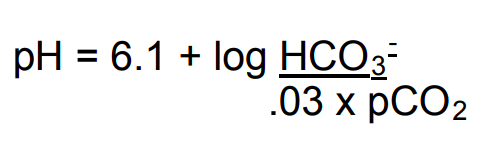
According to the Henderson Hasselbach equation, raising __ or lowering __ would increase pH.
Raising HCO3- or lowering pCO2
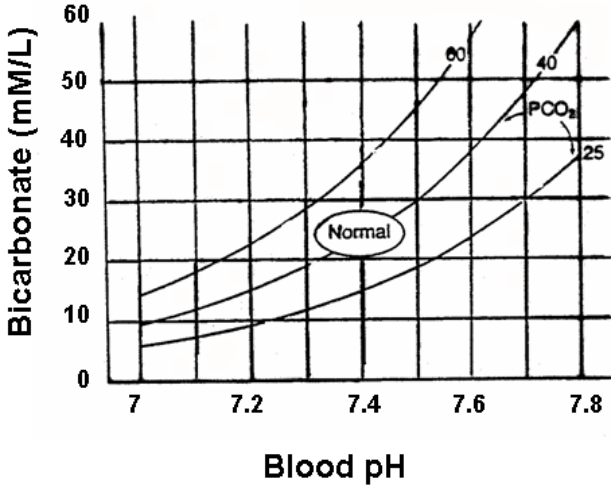
Uncompensated metabolic acidosis = Moving down along a pCO2 diagonal to a lower bicarbonate
Uncompensated respiratory acidosis = Moving from one pCO2 diagonal to a higher pCO2 diagonal
What are the two types of acid loads?
CO2 = respiratory acidosis
Nonvolatile acids = metabolic acidosis
Causes of metabolic acidosis (nonvolatile acids)
- Exogenous acid loads
- Salicylate, methanol, ethylene glycol
- Excess endogenous acid production
- Ketoacids, lactic acid
- Decreased renal excretion of normal endogenous acids
- Renal failure
- Loss of alkali
- GI losses (e.g. diarrhea), urine losses (e.g. proximal tubular acidosis)
Alkali loads
- Excess CO2 removal = respiratory alkalosis
- Nonvolataile alkali = metabolic alkalosis
- Exogenous alkali
- NaHCO3 administration
- Loss of acid
- GI losses (e.g. gastric fluid)
- Excess urine H+ losses
- Exogenous alkali
A small increase in pCO2 will immediately cause
an immediate change in the cerebral interstitial pH that will activate chemoreceptors –> hyperventilation to blow off CO2
Increase in nonvolatile acids or a decrease in [HCO3-] will cause..
a slower ventilatory response because it takes longer for nonvolatile acids and HCO3- to cross the BBB to reach central chemoreceptors
The ventilatory response to metabolic acid-base disturbances is not achieved for ___
12-24 hours!
Does urine have bicarbonate in it?
Nope.
70-80% of filtered bicarb is reabsorbed at the proximal tubule
The rest is reabsorbed at teh more distal segments
What are the 2 ways kidneys regulate HCO3- concentration?
- Reabsorption of HCO3-
- Generation of new HCO3-
How does the kidney produce additional HCO3- beyond what was filtered at the glomerulus?
It excretes acid (titratable acid and ammonium), generating bicarb in the process.
Net acid excretion = Amt of bicarb regeneration
The kidney excretes titratable acid and ammonium to regenerate bicarb.
What is titratable acid?
Protons coupled to urinary buffers like phosphate
The nephron can’t excrete free protons that well.
Under normal conditions, the amt of titratable acid excreted is ____ at the amt of ammonium excreted.
Under acidic conditions, which one gets excreted more?
Normal: it’s about half&half
Acidic: Way more NH4+ is excreted
What is the equation of net acid excretion in the urine?
Net acid excretion =
titratable acid + ammonium - urinary bicarbonate
Recall how HCO3- is reabsorbed at the proximal tubule
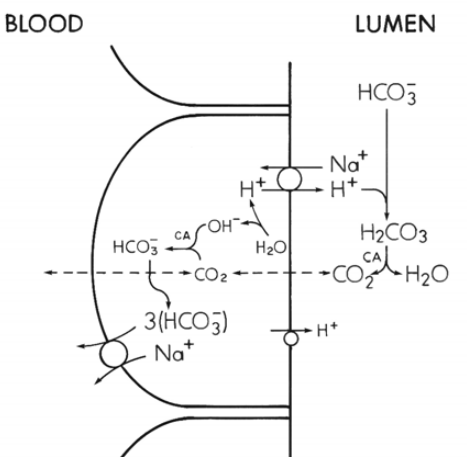
- Na,H exchanger on the apical membrane sends out H+ into the lumen, which combines with HCO3- to form H2CO3
- Carbonic anhydrase turns it into CO2 + H2O
- CO2 enters the proximal tubule cell, where another carbonic anhydrase combines it with OH- to reform HCO3-
- An Na,HCO3- exchanger on the basolateral side sends both Na+ and HCO3- out into the blood.
What drives the Na,H exchanger on the apical side?
The basolateral Na,K+ ATPase keeps [Na+] in the cell low –> driving force to take in Na+ and send out H+
How is proximal tubule bicarbonate reabsorption regulated?
pH
peritubular bicarbonate
extracellular volume status
hormones
pH & bicarbonate reabsorption
Factors that decrease intracellular pH increase the amt of H+ available for secretion –> allosterically enhance the Na,H-exchanger to promote reabsorption.
- Ex) Increased pCO2 will decrease pH
- Ex) Chronic K+ depletion will decrease pH
- Chronic acidosis may also increase the # of apical Na,H-exchangers and basolateral Na,HCO3- transporters in the proximal tubule.
Peritubular bicarbonate & HCO3- reabsorption
Decreased peritubular HCO3- will increase reabsorption
Extracellular volume status & proximal bicarbonate reabsorption
Increased ECFV will inhibit HCO3- reabsorption
Decreased ECFV will promote reabsorption
(just think starling forces)
Hormones that influence HCO3- reabsorption:
Adrenergic agonists
Angiotensin II
Parathyroid hormone
Glucocorticoids
Adrenergic agonists & Angiotensin II activate the apical Na/H exchanger. (Maintains metabolic alkalosis during volume or Cl- depletion)
Parathyroid hormone decreases reabsorption (though hypercalcemia increases it)
Glucocorticoids are involved in chronic adaptation to acidosis through the Na/H exchanger.
While the distal tubule isn’t as good at secretingH+ and reabsorbing HCO3- as the proximal tubule, it can generate a large transepithelial pH gradient because of its ____.
This is used to drive HCO3- reabsorption
H+ ATPase & H,K-ATPase both secrete H+ to drive HCO3- reabsorption
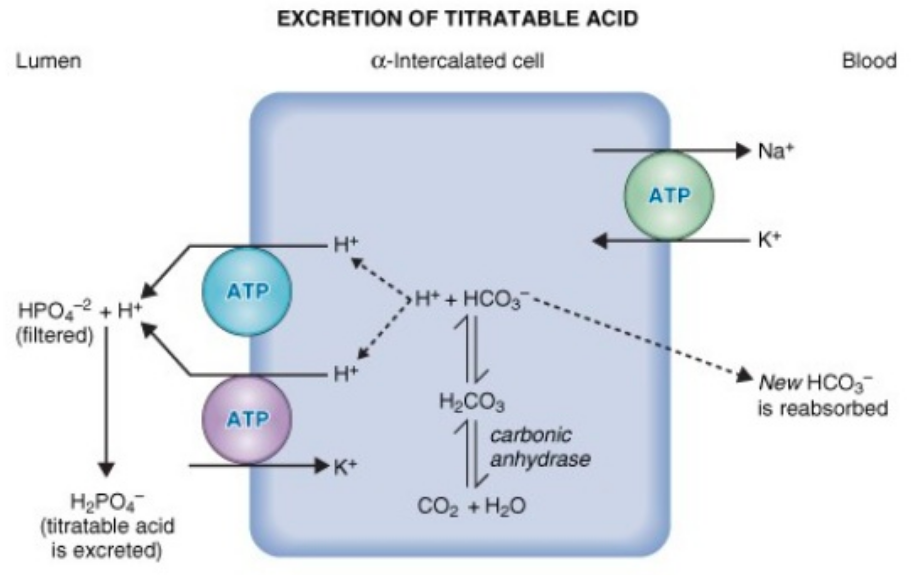
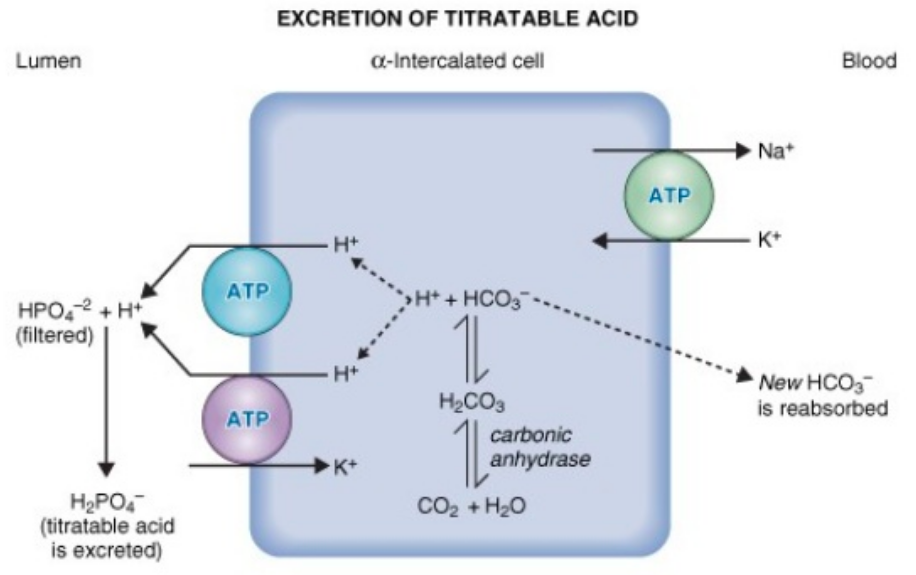
How does H+ secretion cause HCO3- generation in an intercalated cell of the collecting tubule?
- H+ secretion via H+ ATPase and H-K ATPase lowers intracellular [H+]
- These H+ will combine with an ion like phosphate to form a tiratable acid in the urine like H2PO4-
- This drives the carbonic anhydrase reaction to keep splitting up H2CO3 into H+ and new HCO3-
- New HCO3- gets reabsorbed via the HCO3-/Cl exchanger


-
Transmembrane Potential29
-
Action Potentials22
-
Effects of Altered Extracellular Ion Concentrations on Resting Membrane Potentials, Action Potentials, and Excitability25
-
Skeletal Muscle28
-
Smooth Muscle24
-
Cardiac Excitation and Contraction I52
-
The Normal ECG/EKG14
-
Heart as a Pump14
-
Cardiac cycle23
-
Hemodynamics II25
-
Local Control of the Vasculature33
-
Regulation of Heart Rate & Arterial Pressure16
-
Cardiac output and Venous Return15
-
Response to Exercise and Stress26
-
Pulmonary Structure & Function55
-
Ventilation29
-
Diffusion26
-
Blood Flow and Metabolism38
-
Ventilation-Perfusion Relationships19
-
Gas Transport by the Blood46
-
Mechanics of Breathing25
-
Control of Ventilation19
-
Respiratory System Under Stress17
-
Body Fluids (just handout)8
-
gfr & renal clearance18
-
proximal tubule30
-
loop of henle26
-
distal tubule & collecting duct6
-
renal hormones28
-
bp regulation & htn20
-
acid base35
-
SWALLOWING & GASTRIC EMPTYING27
-
MOTILITY19
-
SECRETIONS19
-
STOMACH36
-
PANCREAS30
-
LIVER47
-
DIGESTION & ABSORPTION I40
-
Endocrine Organ38
-
Growth Hormone & Somatomedin42
-
Independent: Ovary41
-
Thyroid Hormones41



