Major functions of the stomach
- Temporal storage for food
- Absorption of water-soluble and lipid-soluble substances
- E.g. alcohol, some drugs
- Preparation of the “chyme” (semi-fluid material produced by gastric digestion of food) for digestion in the small intestine
Digestion in the stomach
- Physical - muscles contract and relax
- Chemical - pepsin breaks down proteins
- Requires acidic medium
Name the major cells of the gastric (oxyntic) gland and what they secrete
- Surface mucous cells - mucus (more alkaline & viscous), HCO3-, water
- Mucus neck cells - soluble mucus, HCO3-, water
- Parietal (oxyntic) cells: HCl & intrinsic factor
- Chief (zymogen) cells - pepsinogen
- D cell - somatostatin
- Enterochromaffin-like (ECL) cells: histamine
- G cell - gastrin
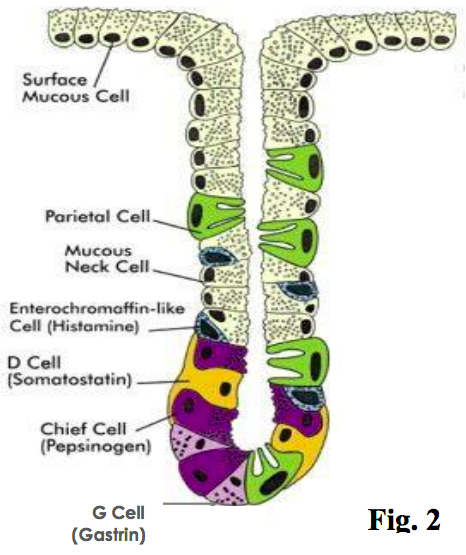
What cells are found in teh basal region of gastric glands?
Chief (zymogen) cells
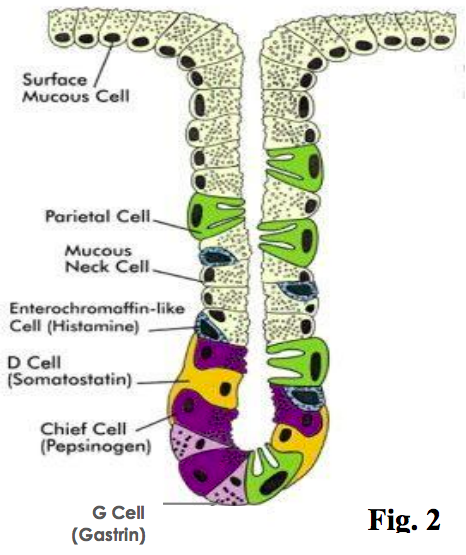
What cells are found in the antrum?
D cells
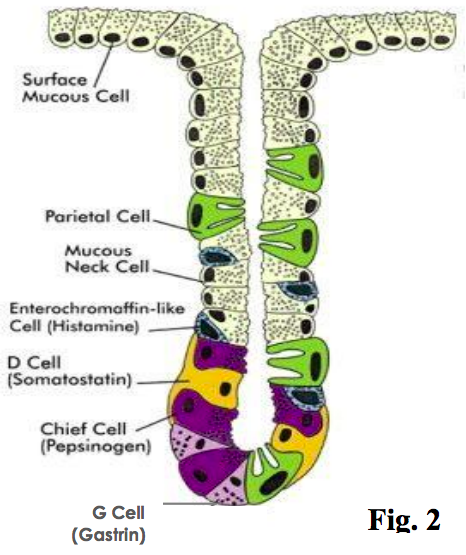
What cells are found in the pyloric region?
G cells
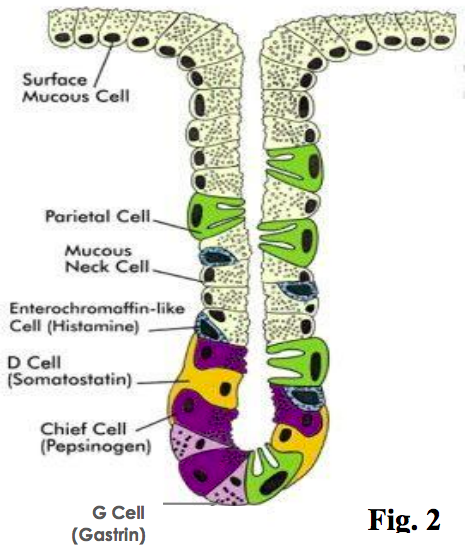
Functions of HCl & intrinsic factor from parietal cells
- HCl -
- Denatures proteins
- Breaks up cell membranes
- Activates pepsinogen
- Antibacterial
- Solubilizes calcium salts
- IF - absorption of vitamin B12 in ileum for production of mature RBCs
Pepsin
Endopeptidase auto-catalytically activated from chief cells’ inactive pepsinogen
refers to all enzymes activated at a pH below 3 by HCl
Somatostatin from D cells
inhibits acid secretion & gastrin release
Histamine from ECL ells
Stimulates acid secretion
Increases local blood flow
Gastrin from G cells
Secreted into the blood (not stomach lumen) to stimulate gastric juice secretion & gastrin/intestinal motility
Function of gastric acid
- Digestion of proteins via acid & proteolytic enzyme production
- Absorption, esp vitamin B12
- Protects mucosa from bacteria & autodigestion from its own acid & proteolytic enzymes
Gastric lipase
Homologous to lingual lipase
Loss of intrinsic factor causes
achlorhydria & pernicious anemia
Gastric juice:
- mucous
- pepsin
- gastric lipase
- intrinsic factorHCl
- Other electrolytes: ___, __, and ___
HCO3- from mucous cells
K+ for H,K-ATPase
Na+ from mucous cells
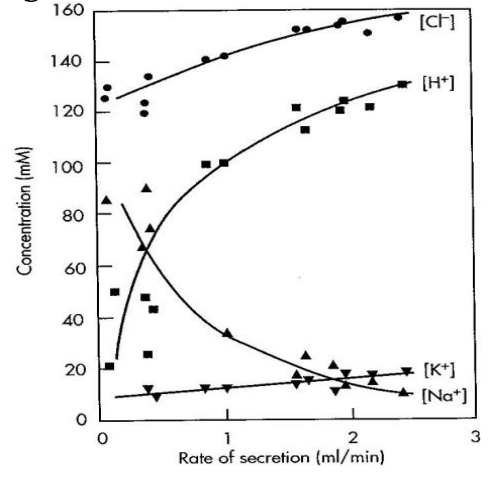
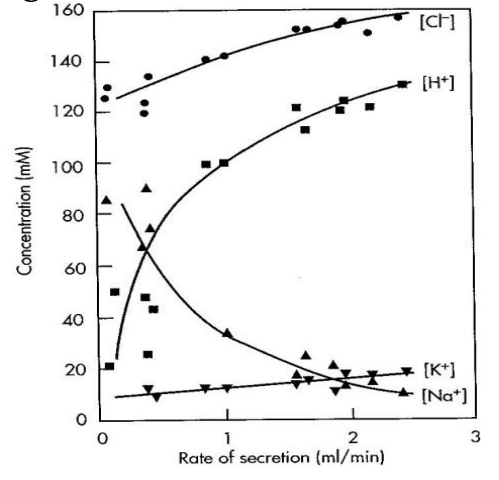
How do [HCl], [K+], and [Na+] change as the rate gastric juice secretion increases?
HCl increases sharply (food acts a buffer)
K increases a bit
Na+ falls
As the stomach empties, what happens to the rate of H+ secretion?
It increases
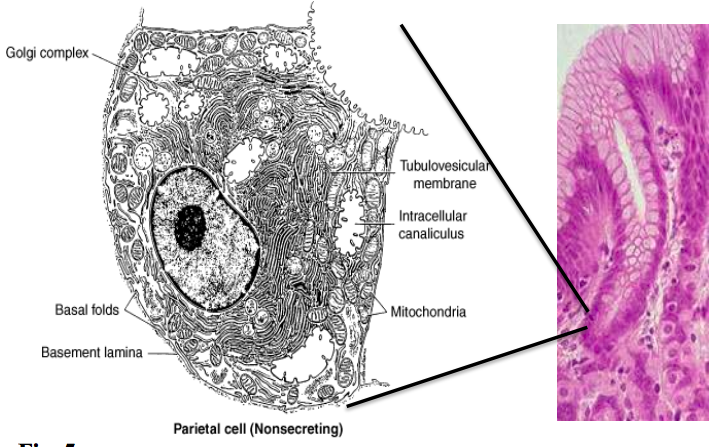
What makes the parietal cell distinct?
Intracellular canliculi
Abundance of mitochodnria
Extensive smooth ER (tubulovesicular membranes)
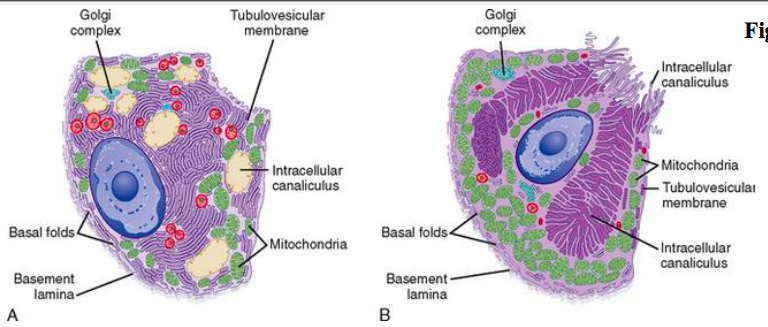
Resting state of parietal cell vs Stimulated for acid secretion
Resting state: tubulovesicles w H/K-ATPase are underneath the plasma membrane on the apical side.
Stimulation: tubulovesicle membranes fuse into the canalicular membrane to increase the apical membrane’s surface area
- –> increases the # of H/KATPase, K+ and Cl- channels into the plasma membrane
- –> increases O2 consumption to support acid secretion
Name the transporters in the parietal cell on the apical vs the basoalteral membrane
- Apical:
- H,K-ATPase
- K+ channel
- Cl- channel
- Basolateral:
- Na,K-ATPase
- K+ channel
- Cl-/HCO3- exchanger
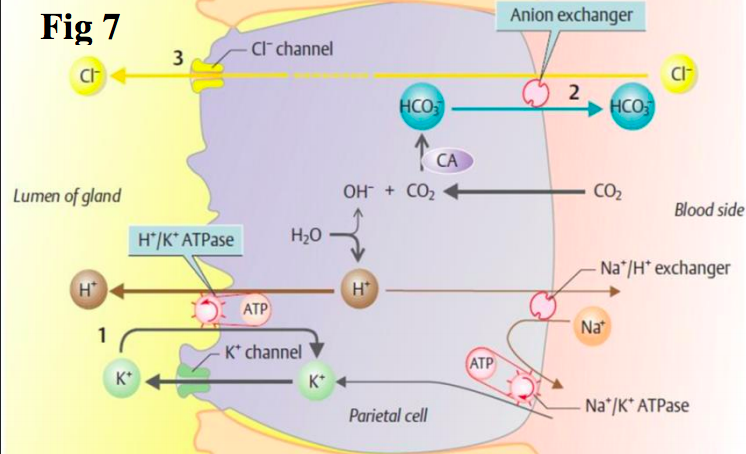
Secreted H+ from the parietal cell are derived mostly from ___
During active HCl secretion, the blood coming from the stomach contains a lot of ___.
H+ secretion is derived mostly from the dissociation of water & the carbonic anhydrase rxn
The blood coming from the stomach contains a lot of HCO3- (alkaline tide)b
Name the parietal cell receptors for gastrin, Ach, and histamine (secretagogues) and hwo they mediate their effects
Gastrin: gastrin-cholecystokinin (CCK-B)
Ach: muscarinic receptor, M3
HIstamine: H2 receptor
CCK-B & M3 increase intracellular Ca2+ –> HCl secretion
H2 increases intracellular cAMP –> HCl secretion
Potentiation effect
The effect of any 2 stimulants is greater than the effect of either stimulant alone.
The effect of gastrin, Ach, and histamine will result in an increase in cAMP & Ca2+ –> greatly enhances H/K-ATPase –> more acid secretion
Describe parietal cell activation
- Stomach distension stimulates mechanoreceptors
- Activates parietal directly thru
- Short local reflexes
- Long vago-vagal reflexes (traveling on vagus n)

-
Transmembrane Potential29
-
Action Potentials22
-
Effects of Altered Extracellular Ion Concentrations on Resting Membrane Potentials, Action Potentials, and Excitability25
-
Skeletal Muscle28
-
Smooth Muscle24
-
Cardiac Excitation and Contraction I52
-
The Normal ECG/EKG14
-
Heart as a Pump14
-
Cardiac cycle23
-
Hemodynamics II25
-
Local Control of the Vasculature33
-
Regulation of Heart Rate & Arterial Pressure16
-
Cardiac output and Venous Return15
-
Response to Exercise and Stress26
-
Pulmonary Structure & Function55
-
Ventilation29
-
Diffusion26
-
Blood Flow and Metabolism38
-
Ventilation-Perfusion Relationships19
-
Gas Transport by the Blood46
-
Mechanics of Breathing25
-
Control of Ventilation19
-
Respiratory System Under Stress17
-
Body Fluids (just handout)8
-
gfr & renal clearance18
-
proximal tubule30
-
loop of henle26
-
distal tubule & collecting duct6
-
renal hormones28
-
bp regulation & htn20
-
acid base35
-
SWALLOWING & GASTRIC EMPTYING27
-
MOTILITY19
-
SECRETIONS19
-
STOMACH36
-
PANCREAS30
-
LIVER47
-
DIGESTION & ABSORPTION I40
-
Endocrine Organ38
-
Growth Hormone & Somatomedin42
-
Independent: Ovary41
-
Thyroid Hormones41



