What happens in the small intestine?
What two types of waves allow this to occur?
Digestion (fat, protein, carbs, absorption of breakdown products) and absorption - vitamins, nutrients, water, electrolytes
Optimized by
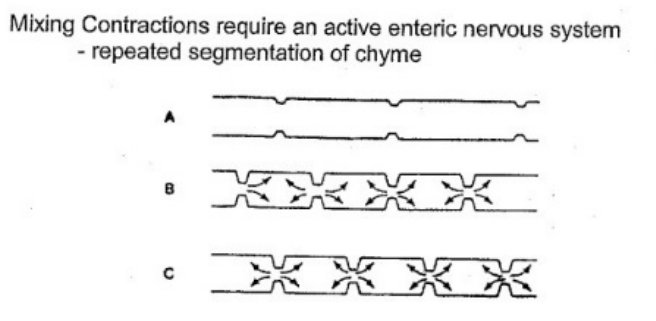
- Segmentation waves: brings chyme into close contact w villi & maximizes mixing of chyme w enzymes and bile
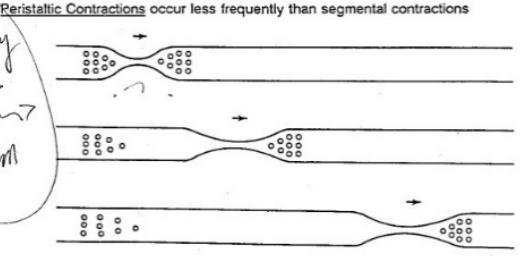
- Peristaltic waves: move content slowly toward the colon, enabling absorption by including contact with segments
___ & ___ absorbed in the upper small intestine
___ & ___ absorbed in teh terminal ileum
Calcium & iron - upper small intestine
Vitamin B12 & bile salts - terminal ileum
Segmentation’s ring-like contractions are
- generated by ___ nerves
- occur at sites where ___
- Generated by enteric nerves
- Contractions occur at sites of distension
- –> squeeze & split the distending bolus in half so half of it is ‘orad’ and the other half is ‘caudad’
- –> distends adjacent segments of the bowel
- –> process repeats over and over, maximizing mixing of chyme w enzymes & bile
Peristaltic waves occur due to
Bolus is propelled toward colon due to inherent differences in basic electrical rhythms between the
- duodenum (12/min),
- jejunum (10/min)
- ileum (8/min)
These differences ensures that chyme gets moved caudally to the slower contracting segments until emptied into the colon
Which occurs more frequently - peristaltic or segmental contractions?
Segmental contractions
Power propulsion
Abnormal peristaltic contractile response to irritation that moves material too rapidly over long stretches of bowel –> diarrhea
Ileocolic reflex - what brings it on? what is it? what inhibits it?
- Initiated by the residual products distending the terminal ileum
- Relaxation of the ileocecal valve -> contents flow into cecum (first part of colon)
- Inhibited by cecum distension –> ileocecal valve closes
Important for maintaining bacterial gradient between colon and small bowel
What happens if you didn’t have your ileo colic reflex?
Bacteria would enter & thrive in the nutrient-rich small bowel –> diarrhea, bloating, gas, weight loss, B12 deficiency
Migrating motor complex (fasted state)
- Begins 2 hrs post-meal
- Antrum produces a perstaltic wave that sweeps through the entire small inestine and ends in the ileocecal valve 2 hrs later.
- This cycle repeats itself every 2 hours as long as a meal is not digested
- “Housekeeping”:
- Removes particles larger than 2mm from the stomach
- Clears residual chyme from the small bowel into colon to prevent bacteria in small intestine
What abolishes the MMM?
Eating –> fed state abolishes the MMM wherever it is within its 2 hr cycle by liberating gastrin or CCK
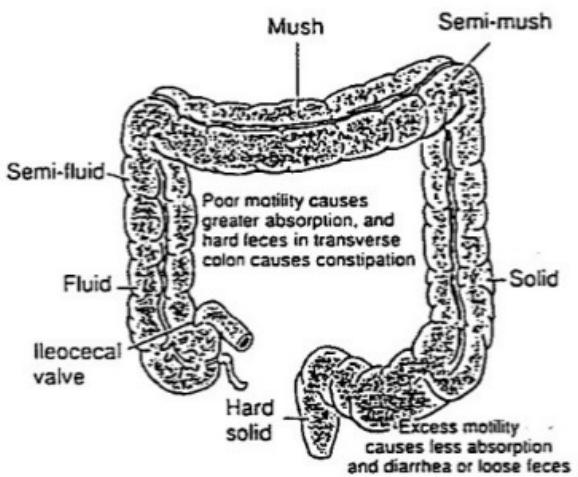
The changes in fluidity of feces is determined by what organ?
Colon (4-5ft long)
- cecum
- ascending colon
- transverse colon
- descending colon
- rectum
- anus
Two purposes of colon
- Absorption of water & electrolytes (90% of 2L presented to it)
- Leaves 200 cc for softening stool
- Elmination of undigestible solids (feces)
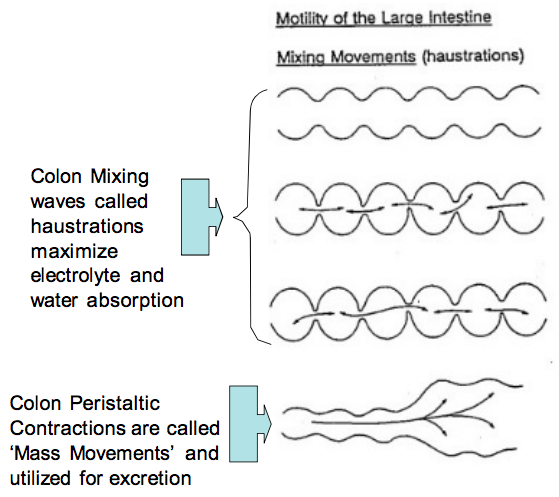
Two types of mixing movements in the colon
Haustrations: maximize electrolyte & water absroption; segmental contractions bringing feces in close contact w colonic epithelium
Mass movements: move feces distally for excretion; peristaltic
Defecation reflex
Vasovagal reflex initiated by rectal distension that results in release of nitric oxide to relax the internal anal sphincter –> feces and gas can enter the anal canal
Sensory signals in the anal canal tell you if it’s solid, liquid or gas in there.
If you consciously decide to maintain continence, what happens?
Ach is released to raise the pressure/contract the skeletal-muscled external anal sphincter & puborectalis muscle.
When you maintain continence (keep feces in rectum), how do you overcome rectal discomfort?
Rectal muscles undergo nitric oxide-mediated receptive relaxation (like the fundus after a meal)
–> reduced retal pressure
–> internal anal sphincter can contract again, so you don’t need the voluntary contraction of the external anal sphincter & puborectalis muscles
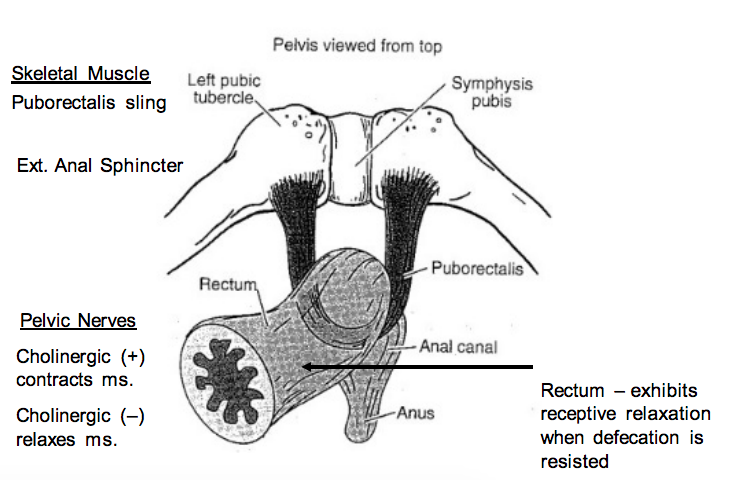
Puborectal muscles
A rein on the rectum.
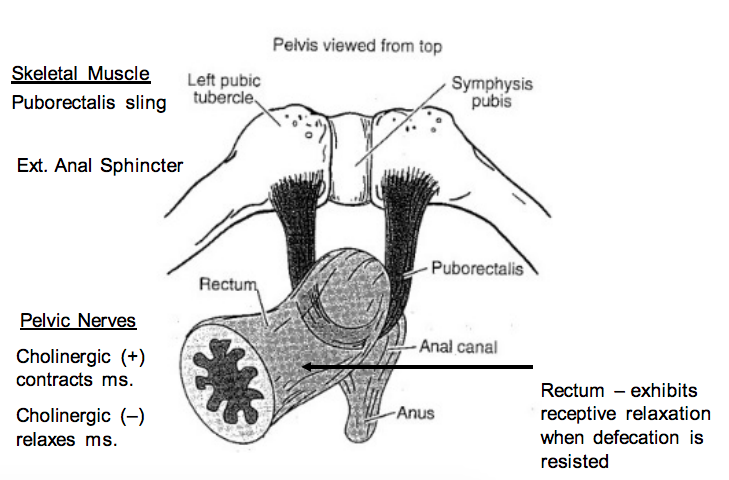
Contraction impedes feces from entering anal canal
Relaxation straightens outthe rectum
Gastroscopic reflex
Food entering the stomach signals the colon to produce a mass movement
–> movement forces material into the rectum
–> distension produces the defecation reflex
Gastrolienal reflex
Food entering the stomach signals the distal small bowel to empty remaining ileal chyme into the right colon

-
Transmembrane Potential29
-
Action Potentials22
-
Effects of Altered Extracellular Ion Concentrations on Resting Membrane Potentials, Action Potentials, and Excitability25
-
Skeletal Muscle28
-
Smooth Muscle24
-
Cardiac Excitation and Contraction I52
-
The Normal ECG/EKG14
-
Heart as a Pump14
-
Cardiac cycle23
-
Hemodynamics II25
-
Local Control of the Vasculature33
-
Regulation of Heart Rate & Arterial Pressure16
-
Cardiac output and Venous Return15
-
Response to Exercise and Stress26
-
Pulmonary Structure & Function55
-
Ventilation29
-
Diffusion26
-
Blood Flow and Metabolism38
-
Ventilation-Perfusion Relationships19
-
Gas Transport by the Blood46
-
Mechanics of Breathing25
-
Control of Ventilation19
-
Respiratory System Under Stress17
-
Body Fluids (just handout)8
-
gfr & renal clearance18
-
proximal tubule30
-
loop of henle26
-
distal tubule & collecting duct6
-
renal hormones28
-
bp regulation & htn20
-
acid base35
-
SWALLOWING & GASTRIC EMPTYING27
-
MOTILITY19
-
SECRETIONS19
-
STOMACH36
-
PANCREAS30
-
LIVER47
-
DIGESTION & ABSORPTION I40
-
Endocrine Organ38
-
Growth Hormone & Somatomedin42
-
Independent: Ovary41
-
Thyroid Hormones41



