ureter peristaltic contractions
- There are various pacemaker cells that initiate spontaneous action potentials that lead to the peristaltic contractions. Similar to situation for the heart, there are multiple areas of intrinsic potential pacemaker activity along the entire collecting system, but the fastest one dominates the slower, secondary areas of latent pacemaker activity. In the renal collecting system, the areas of fastest pacemaker activity are in the kidney calyces.
- The ureteral peristaltic waves push boluses of urine forward toward the bladder until the urine exits the ureter and enters the bladder at the ureterovesical junction (UVJ). The ureteral pressure pushing the bolus forward must be greater than the pressure encountered at the UVJ in order for the urine to enter the bladder. Because the bladder normally stores urine at low pressure, urine enters the bladder easily.
hydronephrosis
- There are various pacemaker cells that initiate spontaneous action potentials that lead to the peristaltic contractions. Similar to situation for the heart, there are multiple areas of intrinsic potential pacemaker activity along the entire collecting system, but the fastest one dominates the slower, secondary areas of latent pacemaker activity. In the renal collecting system, the areas of fastest pacemaker activity are in the kidney calyces.
- The ureteral peristaltic waves push boluses of urine forward toward the bladder until the urine exits the ureter and enters the bladder at the ureterovesical junction (UVJ). The ureteral pressure pushing the bolus forward must be greater than the pressure encountered at the UVJ in order for the urine to enter the bladder. Because the bladder normally stores urine at low pressure, urine enters the bladder easily.
bladder smooth muscle
The bladder is composed of smooth muscle arranged in a rather diffuse, random arrangement. The smooth muscle is NOT arranged in the classic inner circular and outer longitudinal layers as seen in the bowel.
bladder body
The body of the bladder is distensible and allows accommodation of urine as the bladder fills with urine. The bladder base is relatively fixed in place and is the location where urine enters and leaves the bladder
bladder base
The bladder base consists of the trigone and bladder neck (area where bladder and urethra connect).
bladder outlet
The bladder outlet is a conceptual term that includes all the anatomic structures involved urinary continence and the exit of urine from the bladder: bladder base + urethra + external (striated) sphincter which surrounds the urethra.
smooth or internal sphincter
- Bladder neck + proximal urethra are often termed the “smooth” or “internal” sphincter
- The bladder neck/proximal urethra contribute to urinary continence in men and women (more so in males, however), but it is not the primary zone of urinary continence in either.
external urethral sphincter or rhabdosphincter
male
- surrounds urethral smooth muscle
- slow twitch fibers
- In both men and women, the periurethral muscles that compose the pelvic floor (the levator ani muscles, which are under conscious control) augment the action of the rhabdosphincter. The periurethral muscles of the pelvic floor are composed of both fast and slow-twitch skeletal muscle
- The striated sphincter in the male exists at the membranous urethra just distal to the apex of the prostate where the urethra passes through the pelvic floor musculature
external urethral sphincter
female
- surrounds urethral smooth muscle
- slow twitch fibers
- In both men and women, the periurethral muscles that compose the pelvic floor (the levator ani muscles, which are under conscious control) augment the action of the rhabdosphincter. The periurethral muscles of the pelvic floor are composed of both fast and slow-twitch skeletal muscle
- In the female, the rhabosphincter is at the level of the mid-urethra
male urethra
The male urethra is long and has 4 distinct divisions:
(1) the bladder neck/prostatic urethra
(2) membranous urethra (area of the external sphincter)
(3) the bulbar urethra at the penile base
(4) pendulous urethra (penile shaft).
- The primary zone of male continence is the membranous urethra.
- The bladder neck/prostatic urethra forms a secondary zone of continence and is a secondary sphincter that closes during ejaculation, but also has a basal tone that promotes urinary continence.
- The male with often remain continent after resection of the prostate or bladder neck whereas destroying the external sphincter will typically lead to urinary incontinence (involuntary loss of urine).
- Mother Nature has designed the male urethra to perform
(1) sexual function (ejaculation)
(2) urinary storage. It is important to be mindful that in lower mammals (and in certain humans, I suppose…), the release of urine is heavily involved in sexual/reproductive function as well—marking territory, social dominance, attracting mates, etc. Therefore, nature has made the male continence mechanisms robust.
female urethra
- The precise mechanism of female continence is still subject to significant debate.
- The female urethra is significantly shorter and is fused to the anterior wall of the vagina with its distal meatus visible at the vaginal introitus. There is no true anatomic plane between the female urethra and vaginal wall. The anterior vaginal wall (with its supporting fascia) forms a fundamental support of the female urethra contributing to female continence. This is why women with vaginal prolapse (laxity of the vaginal walls) often suffer concurrently from urinary incontinence.
- Female continence is thought to occur through a combination of 3 mechanisms which seem to converge most strongly at the area of the middle of the female urethra (“the mid-urethral complex”):
(1) The tone of the female external sphincter which occupies the mid-to-distal urethra
(2) the firm supportive “hammock” provided to the urethra by the anterior vaginal wall and its fascia,
(3) strong apposition (coaptation) of the anterior and posterior walls of the urethral lumen (“viscous seal”). Damage to these mechanisms by childbirth, nerve injury, or loss of estrogen can lead to involuntary loss of urine.
Examples:
- Vaginal childbirth can cause damage to the pudendal nerves promoting loss of innervation to the external sphincter and weak pelvic floor muscles leading to incontinence risk.
- Vaginal childbirth (and loss of estrogen) can lead to tearing and laxity of the anterior vaginal wall leading to poor urethral support and increasing incontinence risk.
- Loss of estrogen (post-menopause) can lead to atrophy of the well vascularized, spongy tissue of the female urethra leading to poor coaptation of the urethral walls increasing incontinence risk.
Reasons why urinary incontinence has an earlier onset in the female population
The fundamental differences between men and women with regard to the anatomic urethral configuration, the physiologic mechanisms of continence, and the different roles of the male/female genital tracts (i.e. vaginal childbirth).
Detrusor Autonomic Physiology
• The entire detrusor is rich is muscarinic acetylcholine (Ach) receptors. The release of acetylcholine (Ach) onto the bladder detrusor muscle results in contraction of the detrusor muscle. o
- M2 and M3 are the subtypes of Ach receptors on the detrusor and both are targets for antimuscarinic drugs used to treat conditions in which the detrusor muscle is overactive (“overactive bladder”).
- Despite that M2 receptors are more common on the detrusor muscle, it is the M3 receptors that lead to bladder contractions.
- The exact role of bladder M2 receptors are still being studied.
•Typically, the bladder outlet relaxes when the detrusor muscle contracts to allow efficient voiding. This relaxation is thought to occur because a different nitric oxide based system is activated leading to smooth muscle relaxation in this region. This is still an area of ongoing research.
Bladder Body Autonomic Physiology
- The bladder body (dome) is rich in Beta-adrenergic receptors. Release of norepineprine (NE) onto these receptors causes direct relaxation of the detrusor muscle, promoting urine storage.
- The relaxation is mediated primarily by Beta-3 adrenergic receptors which occurs via a cAMP-mediated relaxation of the smooth muscle (discussed below).
- The bladder Beta-3 receptors are the target for Beta-3 agonists used to treat overactive detrusor mucle (“overactive bladder”).
Bladder Base Autonomic Physiology
- The bladder base and proximal urethra (part of the bladder outlet) are rich in Alpha-adrenergic receptors. Release of NE onto these receptors (Alpha-1 receptors) promotes constriction of the smooth muscle of the bladder neck, promoting urine storage.
- The bladder neck in males has significantly higher concentrations of Alpha receptors in the bladder neck than females.
-The reason: the male bladder neck must contract during ejaculation to ensure the ejaculate exits via the urethra. Failure to do so results in retrograde ejaculation into the bladder which can negatively affect male fertility.
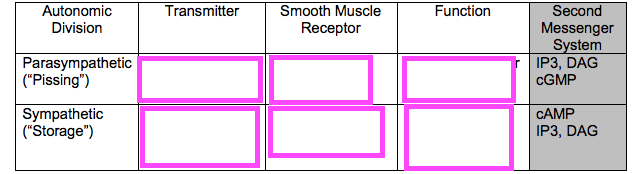
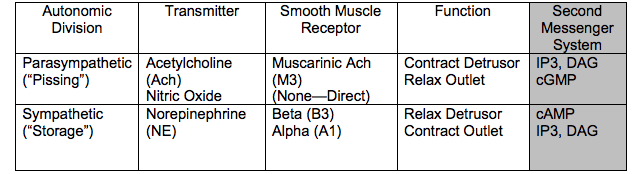
During normal voiding there is both ______ contraction and relaxation of the ______ _______.
During normal voiding there is both detrusor contraction and relaxation of the bladder outlet.
Bladder Function
- Storage
- Emptying
• The normal micturition cycle involves a complex interplay between the autonomic and somatic nervous systems and the end organs involved (bladder, urethra, pelvic floor musculature). The normal micturition cycle involves the exertion of conscious control over autonomic reflexes controlling urine storage and emptying. If output from the cerebral cortex is lost (and the brainstem/spinal cord is intact), the bladder will cycle itself by pure reflex control.
Bladder Function - Storage
Storage:
- Bladder must store adequate and increasing volumes of urine at low pressure (therefore must be highly compliant and have adequate capacity)
- When the bladder fails to store urine properly, it typically results in the involuntary loss of urine, otherwise known as urinary incontinence.
Bladder Function - Emptying
Emptying:
- Efficient bladder emptying requires synchronous activation of the entire detrusor (otherwise all the urine would flow into the non-contracting part, as occurs with large bladder diverticulae in certain diseases).
- Efficient emptying also requires the ability to properly and adequately relax the bladder outlet (i.e. reduce the resistance to urine flow)
- Failure to empty the bladder efficiently can result in high Post Void Residuals (PVRs)—that is the volume of urine that remains inside the bladder after emptying. Ideally, the PVR of a healthy person should be zero or negligible. The PVR can be measured with a small ultrasound device called a bladder scanner or can be done by catheterizing the bladder immediately after voiding.
- Taking this to the extreme, certain problems result in complete failure to empty the bladder, a condition referred to as urinary retention. It is important to identify these patients because the urine can back up into the kidneys resulting in dilated ureters (hydronephrosis) which can ultimately lead to renal failure, which is potentially life threatening.
Bladder Filling (Storage)
• Laplace’s Law relates bladder wall tension (T) to bladder pressure (Pves) and radius (R): T= Pves(R/2d), where R=bladder radius and d= bladder wall thickness. Bladder thickness is often ignored since it is normally small compared to radius (volume), yielding T= P(R/2). Therefore, as the bladder distends (increases in radius), wall tension increases.
-This is important because the afferent nerves controlling bladder function actually sense wall tension and send this information to higher centers controlling the decision to void.
• Compliance = ΔV/ΔP, where ΔV= volume change, ΔP=pressure change.
- This is important because compliance influences wall tension during filling. Therefore compliance can alter how the bladder afferent nerves sense bladder filling and thus alter the threshold for micturition.
- For example, patients with thickened, non-compliant bladders will often complain of the need to urinate frequently which is, at least in part, thought to be due to the increased wall tension at lower filling volumes.
Bladder Compliance Alterations
• Compliance is altered by two components:
(1) the collagen and elastin content of the bladder (which is altered by disease states)
(2) the intrinsic tone of the detrusor muscle, called tonus (which can also be affected in disease).
• Physiologic filling occurs at low pressure (<10cm H2O) due to the normally high compliance of the bladder.
Voiding Mechanism - Intravesicular Pressure
- Pves = Pdet + Pabd
- Pdet = Pves - Pabd
Voiding Mechanisms
• Voiding is achieved by a combination of 2 events:
(1) relaxation of the bladder outlet
(2) contraction of the detrusor muscle.
- There is often a great deal of emphasis on detrusor contractility, but relaxation of the bladder outlet is just as important.
- Some patients with atonic (non-contractile) bladders are able to void by voluntary relaxation of the bladder outlet and abdominal straining (valsalva maneuvaer) and/or manual compression of the bladder (this is known as Crede voiding).


-
Kidney Structure27
-
Urinary Tract Structure20
-
Renal Blood Flow and Glomerular Filtration Rate50
-
Tubular Function I: Sodium Transport21
-
Osmoregulation and Vasopressin System34
-
Volume Regulation and RAS9
-
Tubular Transport II: Potassium8
-
Tumors of Kidney and Urinary Tract46
-
Acid Base52
-
Kidney Development19
-
Hyponatremia and Hypernatremia39
-
Cystitis, Pyelonephritis and Interstitial Nephritis57
-
Hypokalemia and Hyperkalemia40
-
Bladder Function and Dysfunction64
-
Mineral Metabolism13
-
Hematuria and Renal Stones14
-
Acute Renal Injury I and II39
-
Diuretics10
-
Urinalysis Introduction and Vascular Disease in the Kidney62
-
Nephrotic Syndrome I and II53
-
Nephritic Syndrome I and II70
-
Drugs Acting on the Angiotensin System9
-
Drugs Mentioned in Lecture (aka Misc)14
-
Chronic Kidney Disease I and II43
-
Secondary Hypertension36
-
Genetic Diseases of the Distal Nephron15



