At what vertebral levels are the kidneys located?
The kidneys are located in the posterior body wall just inferior to the diaphragm, at the level of T12 through L3 vertebrae.
Why is the right kidney lower than the left?
The right kidney is usually a little lower than the left kidney because of the relationship to the right lobe of the liver, which is larger than the left.
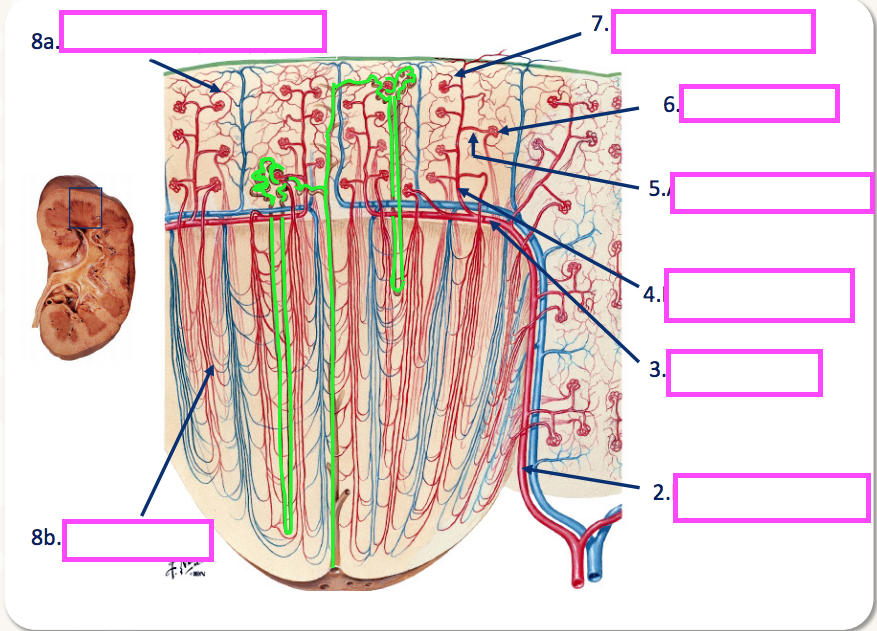
Kidney Blood Flow Path
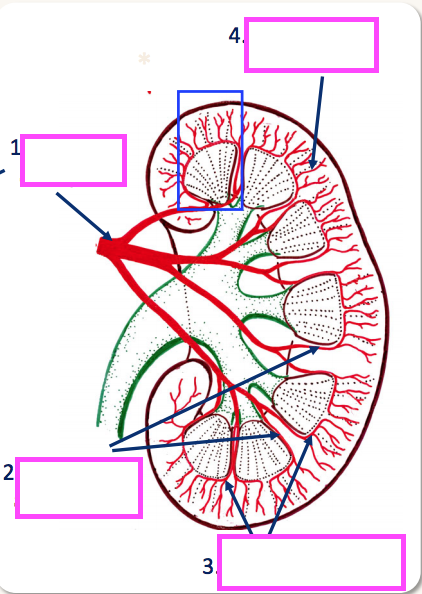
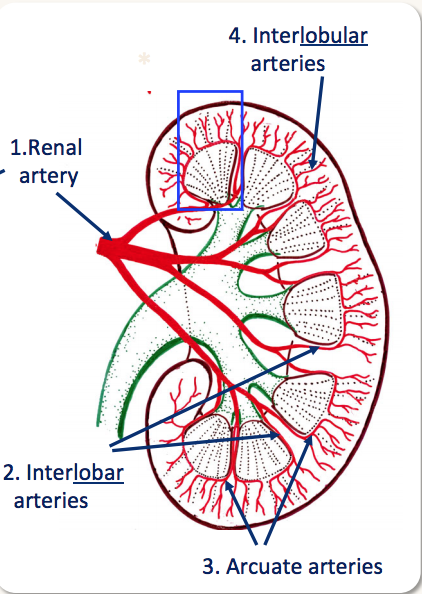
Arterial supply:
- renal
- interlobar
- arcuate
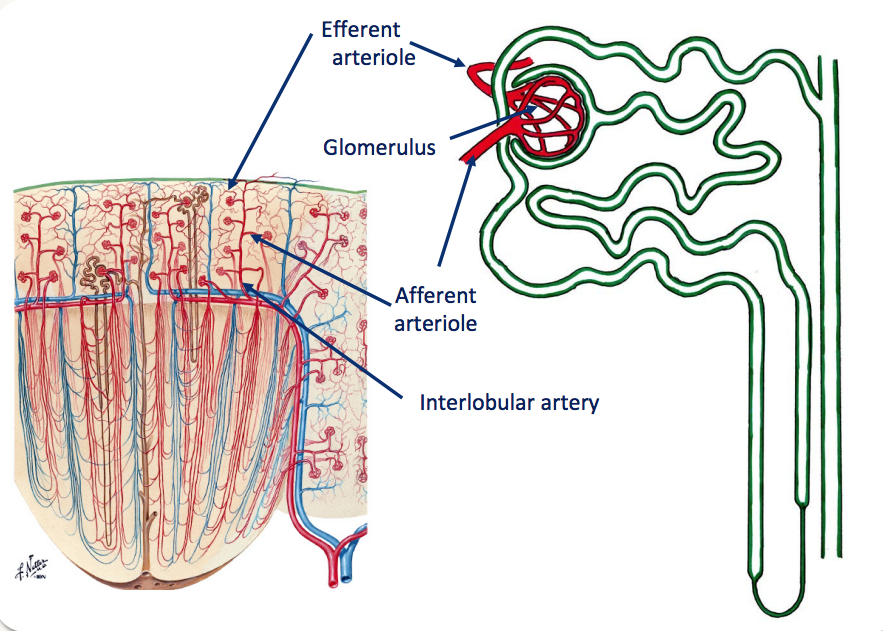
- interlobular
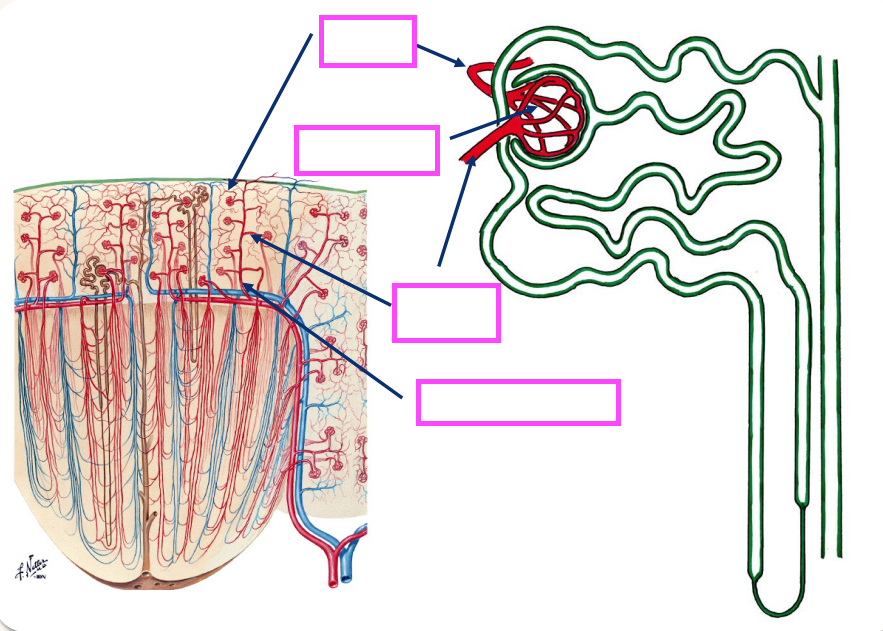
- afferent arteriole
- glomerular capillary tuft
- efferent arteriole drains to
a. peritubular capillary network (cortical nephrons only)
OR
b. vasa recta (juxtamedulary nephrons only)
Peritubular and vasa recta capillaries then drain to venules, which drain to interlobular or arcuate veins respectively, then to veins that parallel arteries and exit the kidney.
***Note that all of the capillary supply serving the metabolic needs of the kidney derives from efferent arterioles. This means that any damage to the glomerulus is likely to cause secondary damage to the whole kidney due to impaired blood flow through glomerular capillaries.
Kidney weight vs. CO
The kidneys are only about 0.5% of total body weight but receive 25% of the cardiac output.
Glomerular Capillary Tuft
The glomerular capillary tuft is formed from the afferent arteriole and drained by the efferent arteriole. The diameter of the efferent arteriole is smaller than that of the afferent, and this difference creates a pressure that drives filtration of plasma through the walls of glomerular capillaries into the lumen of Bowman’s capsule, which is the beginning of the nephron.

Bowman’s Capsule
Bowman’s capsule is formed from the invaginated end of the nephron, which forms a double epithelium surrounding the glomerulus:
- The parietal layer of Bowman’s capsule is a simple squamous epithelium.
- The visceral layer is a complex epithelium made of specialized cells called podocytes, elaborate epithelial cells with complex branching foot processes that are closely associated with each capillary in the glomerulus.
- Slit diaphragms formed of specialized glycoproteins form a barrier between podocyte processes where they contact the glomerular basement membrane.
- Between the two layers of epithelium lining Bowman’s capsule is Bowman’s space, which receives the ultrafiltrate of plasma from glomerular capillaries.
Podocytes
elaborate epithelial cells with complex branching foot processes that are closely associated with each capillary in the glomerulus
Glomerular Basement Membrane
The glomerular basement membrane (GBM) is mainly secreted by the podocytes, which also provide structural reinforcement to help withstand the very high glomerular filtration pressures. The GBM is present between the podocytes and the fenestrated endothelium of the glomerular capillaries.
***The GBM is susceptible to damage by proteins that it traps, especially immunoglobulins. Immunoglobulin accumulation in GBM causes inflammation and damage to the GBM, which in turn causes leakiness. Leaking of proteins into the ultrafiltrate beyond the capacity of the nephron to reabsorb them results in proteinuria – proteins in the urine. Inflammation caused e.g. by buildup of immunoglobulins in the GBM, if severe enough, can also damage glomerular capillary walls and allow passage of blood cells into the urine (hematuria).
Filtration Barrier within the Glomerulus
The fenestrated capillary endothelium, the GBM, and the podocyte slit diaphragms variously contribute to filtration barrier within the glomerulus.
Mesangial Cells
Mesangial cells reside within the glomerular tuft, in the same compartment as the glomerular capillaries, and separated from podocytes by the GBM.
Their main function is support of glomerular capillaries.
Mesangial cells contain microfilaments and can contract and affect glomerular filtration rate.
Mesangial cell proliferation in response to inflammation is a cause of glomerular damage, e.g. in diabetic nephropathy and in immunoproliferative diseases.
Pars Radiata
- in the cortex, loops of Henle and collecting ducts travel together - medullary rays, aka pars radiata
- alternate with pars convoluta
Pars Convoluta
- in the cortex, convoluted tubules and glomeruli travel together - aka pars convoluta
- alternate with medullary rays (pars radiata)
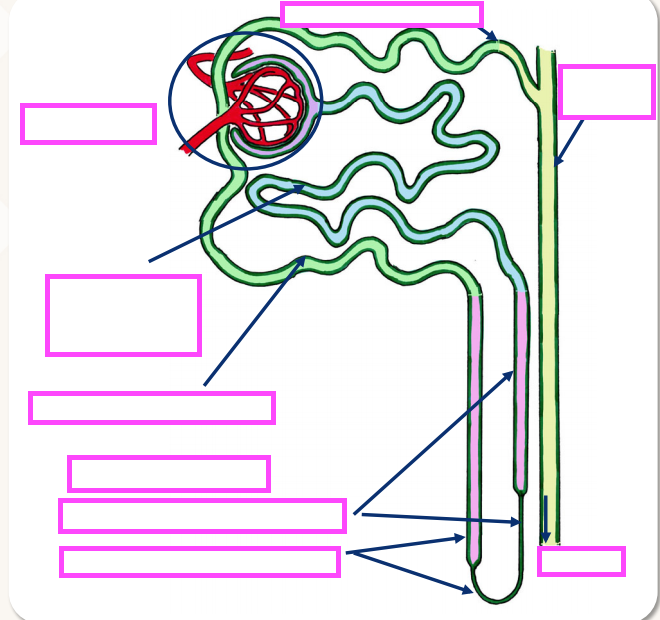
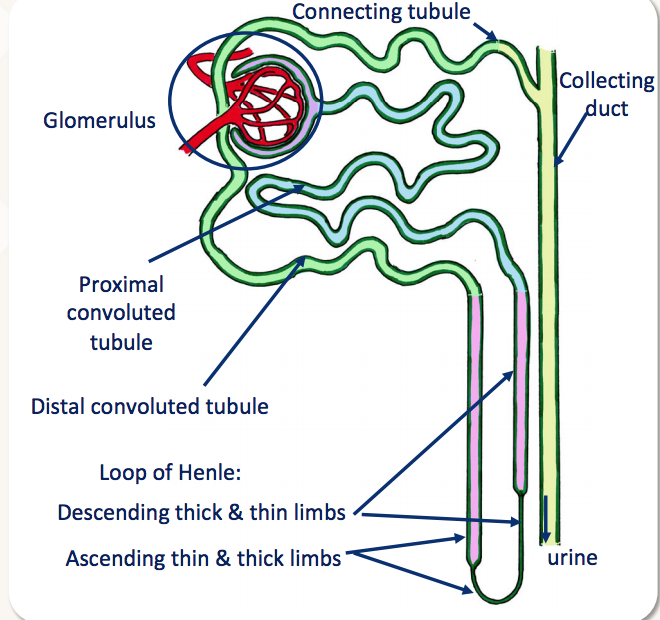
Proximal Convoluted Tubule
- Once the ultrafiltrate has passed the glomerular basement membrane into the lumen of Bowman’s capsule it is essentially outside the body. Since most of the components of the ultrafiltrate are essential to the body, much of the remainder of the nephron is devoted to selectively recovering these materials.
- The proximal convoluted tubules (proximal with respect to the glomerulus) reabsorb about 70% of the ultrafiltrate, and their cells have a structure that reflects this absorptive function in several ways.
- PCT cells have:
- a very well-developed brush border to increase surface area for absorption (e.g. for ion channels)
- an extensive apical collection of endocytic vesicles involved in recovery of small proteins from the ultrafiltrate
- a basolateral membrane which is heavily interdigitated to increase surface area for ion transport enzymes especially Na+K+/ATPase
- numerous mitochondria to provide fuel for the very high activity of these cells.
- PCT are very likely to absorb toxins if they are present in the blood and hence the ultrafiltrate, so PCT cells are very vulnerable to chemical injury.
- Materials reabsorbed by the PCT are returned to the blood in the peritubular capillary plexus, an extensive network of capillaries that arise from the efferent arteriole of each glomerulus, and are abundant in the interstitium of the kidney cortex.
- Interstitial fibroblasts associated with the peritubular capillary plexus are thought to be the main source of erythropoietin, a hormone that stimulates red blood cell production in the bone marrow.
Erythropoetin
Interstitial fibroblasts associated with the peritubular capillary plexus are thought to be the main source of erythropoietin, a hormone that stimulates red blood cell production in the bone marrow.
The Loop of Henle
The loop of Henle is a hairpin-shaped loop that connects the proximal convoluted tubule to the distal convoluted tubule. Loops of Henle belonging to cortical nephrons are relatively short and are situated mainly or exclusively in the kidney cortex. Loops of Henle belonging to juxtamedullary nephrons are very long and extend deep into the kidney medulla. In the cortex, loops of Henle travel in areas called medullary rays, which alternate with areas containing convoluted tubules and glomeruli.
Distal Convoluted Tubule
The loop of Henle is a hairpin-shaped loop that connects the proximal convoluted tubule to the distal convoluted tubule. Loops of Henle belonging to cortical nephrons are relatively short and are situated mainly or exclusively in the kidney cortex. Loops of Henle belonging to juxtamedullary nephrons are very long and extend deep into the kidney medulla. In the cortex, loops of Henle travel in areas called medullary rays, which alternate with areas containing convoluted tubules and glomeruli.
•juxtaglomerular apparatus
Juxtaglomerular Apparatus
- The distal convoluted tubule of each nephron always loops back and passes the vascular pole of the glomerulus of its own nephron, in between the afferent and efferent arterioles.
- The patch of DCT epithelium which lies adjacent to the afferent arteriole forms a structure called the macula densa – a patch of columnar epithelium that senses the composition of fluid in the DCT.
- The smooth muscle cells in the wall of the afferent arteriole adjacent to the macula densa are highly specialized. These cells, called juxtaglomerular cells, secrete renin in response to stimuli from the macula densa (decreased sodium load in tubular fluid) and/or the afferent arteriole itself (decreased blood pressure).
- Renin is a protease that converts circulating angiotensinogen (a plasma protein produced by the liver) to angiotensin I. Angiotensin I is converted to angiotensin II by angiotensin converting enzymes (ACE) produced by capillary endothelial cells, mainly in the lung. Angiotensin II causes general vasoconstriction, which elevates blood pressure. It also stimulates secretion of the hormone aldosterone from the adrenal cortex, and aldosterone in turn stimulates uptake of sodium by the distal nephron segment.
Macula Densa
The patch of DCT epithelium which lies adjacent to the afferent arteriole forms a structure called the macula densa – a patch of columnar epithelium that senses the composition of fluid in the DCT.
Juxtaglomerular Cells
The smooth muscle cells in the wall of the afferent arteriole adjacent to the macula densa are highly specialized. These cells, called juxtaglomerular cells, secrete renin in response to stimuli from the macula densa (decreased sodium load in tubular fluid) and/or the afferent arteriole itself (decreased blood pressure).


-
Kidney Structure27
-
Urinary Tract Structure20
-
Renal Blood Flow and Glomerular Filtration Rate50
-
Tubular Function I: Sodium Transport21
-
Osmoregulation and Vasopressin System34
-
Volume Regulation and RAS9
-
Tubular Transport II: Potassium8
-
Tumors of Kidney and Urinary Tract46
-
Acid Base52
-
Kidney Development19
-
Hyponatremia and Hypernatremia39
-
Cystitis, Pyelonephritis and Interstitial Nephritis57
-
Hypokalemia and Hyperkalemia40
-
Bladder Function and Dysfunction64
-
Mineral Metabolism13
-
Hematuria and Renal Stones14
-
Acute Renal Injury I and II39
-
Diuretics10
-
Urinalysis Introduction and Vascular Disease in the Kidney62
-
Nephrotic Syndrome I and II53
-
Nephritic Syndrome I and II70
-
Drugs Acting on the Angiotensin System9
-
Drugs Mentioned in Lecture (aka Misc)14
-
Chronic Kidney Disease I and II43
-
Secondary Hypertension36
-
Genetic Diseases of the Distal Nephron15



