(Luxations and subluxations)
- what is complete dislocation of a joint?
- What is partial dislocation of a joint
(patellar luxations)
- common in what?
- most associated with what?
- how acquired?
- Uni- or bilateral; medial or lateral or both
which is most common?
- Lateral luxations tend to occur in what?
- luxation
- subluxation
- dogs
- anatomical defects
- inherited (polygenic)
- medial luxations (75%)
most comin small dogs
- larger dogs and some giant breeds
(Luxations and subluxations)
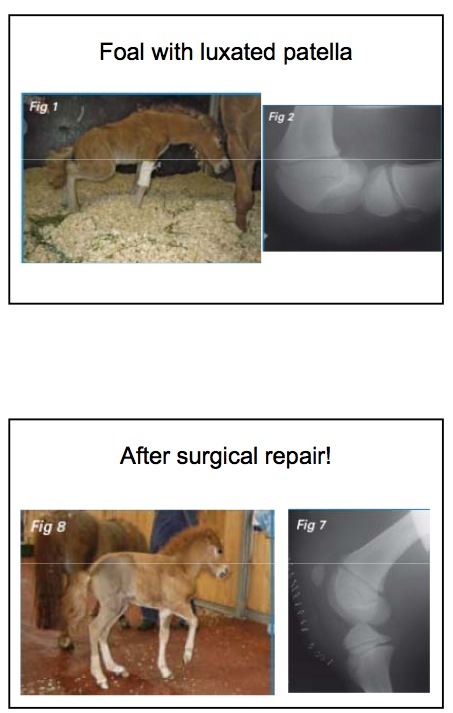
(Patellar luxation in horses)
- how common compared to dogs?
- almmost always occurs in what direction?
Associated with hypoplasia of what?
(Patellar luxations are rare in other species)
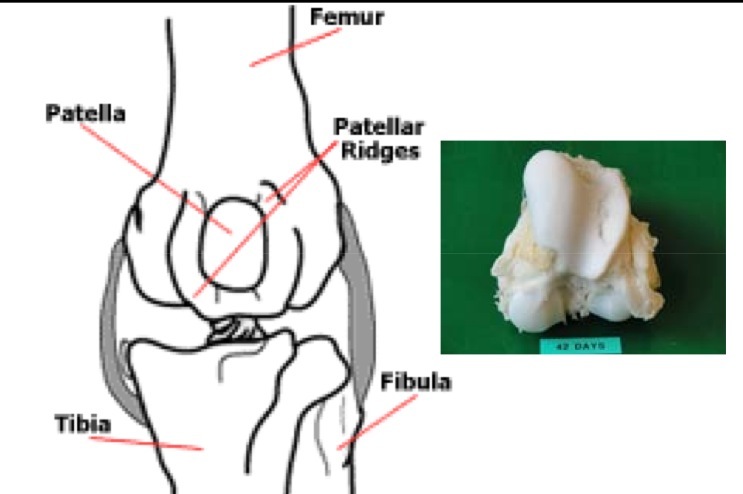
- less
- lateral
lateral ridge of femoral trochlea
(Hip Dysplasia)
- in what animals?
- Acetabular dysplasia may be more accurate
- how acquired?
- rapid growth rate
- May be a manifestation of what?
- obvious at birth?
- Large dogs; less common in cattle; rare in other species (exception is Norwegian Dole horse)
- Inherited (polygenic), with modification by environment
- osteochondrosis
- No - Normal at birth; Definitive radiographic evidence may not occur until after one year of age; earlier in severe disease.
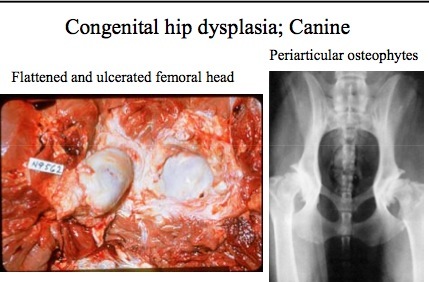
(Hip Dysplasia)
- Initial microscopic lesions may be seen as early as when?
- Earliest radiographic abnormality (present by 7 weeks of age) is what?
- Acetabulum becomes shallow, distorted and wide
- Drift of capital femoral epiphysis with remodeling of what?
- 30 days
- retarded development of craniodorsal acetabular rim
- femoral neck
(Hip Dyslplasia)
- Degenerative changes may be present by when?
- what may develop over time (osteoarthrosis)?
- Lesions?
- 5-8 months
- Advanced degenerative joint disease
- Osteophytes
Cartilage ulceration
Eburnation of bone
Distortion of acetabulum, head, and neck of femur

(Hip Dyspaisa in Cattle)
- how acquired?
- sex pre?
- genetics?
- Herefords and other beef breeds
- Pathologic changes similar to those in dogs
- inheritied
- only males
- Recessive and sex limited inheritance
(Arthrogryposis)
- what is it?
- cause?
- Link between arthrogryposis and lesions caused by what?
- what appears to be critically important to the development of arthrogryposis?
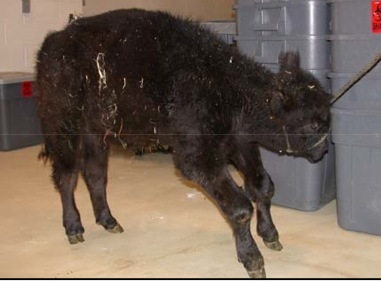
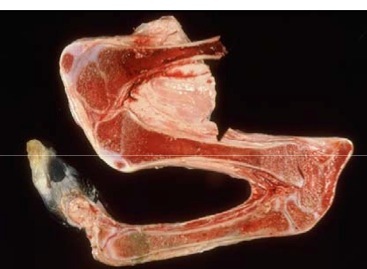
- Persistent flexure or contracture of a joint
(May involve only one or two limbs)
- unclear
- arrest or delay of neural tube closure (dysraphism)
- Loss of motion of fetus during development
(Cleft palate, arthrogryposis, scoliosis, kyphosis, torticollis)
(II. Degenerative Diseases of Joints)
(A. Synovial (diarthrodial/movable) joints)
(Degenerative joint disease (osteoarthrosis/itis))
- how common?
- driven by inflammation?
- Joint fluid initially normal
- Chronicity leads to what?
- Any insult that produces structural injury to joint cartilage or subchondral bone or that is associated with prolonged or repetitive abnormal joint function
- common
- no
- joint deterioration
(II. Degenerative Diseases of Joints)
(Degenerative Joint Disease)
(primary anthropathies)
- cause?
(secondary arthropathies)
- secondary to what?
- unknown
Examples in animals:
Ringbone, spavin, and navicular disease Arthropathy of canine shoulder
Arthropathy of the bovine stifle
- known cause
Examples in animals
Osteochondrosis Previous trauma
(Degenerative Joint Disease)
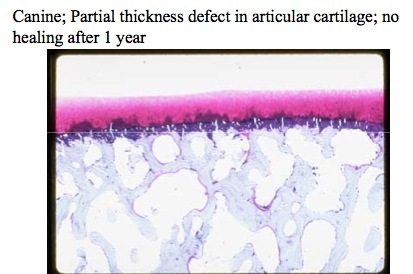
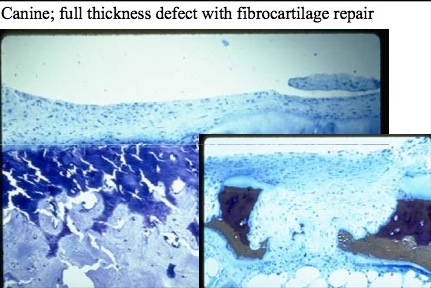
- Which joints usually the first to show degenerative changes and are most severely affected
- In individual joints, what areas of catilage are most vulnerable?
- Larger
- the areas of cartilage that bear the most stress are the most vulnerable
(Degenerative Joint Disease)
(Lesions)
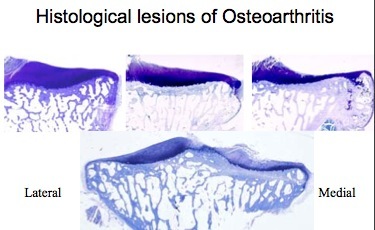
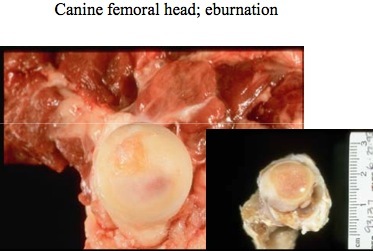
- Fibrillation, clefting, and loss of articular cartilage
- Increased thickness of what?
- Osteophytes - which is what?
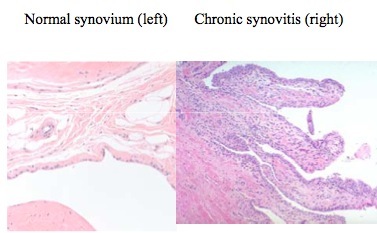
- Thickened joint capsule (fibrous tissue) with synovial proliferation
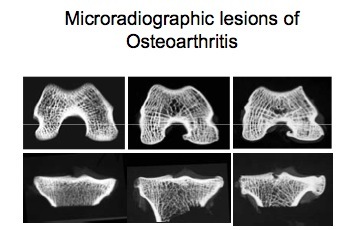
- subchondral bone (eburnation)
- (increased size of joint)
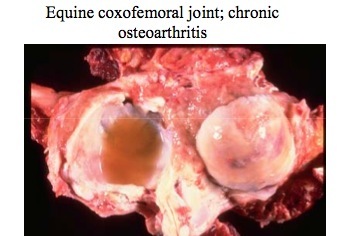
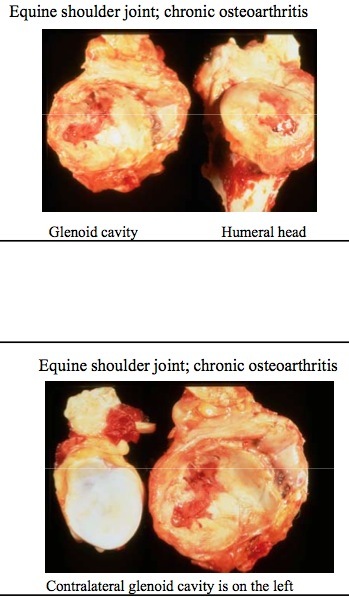
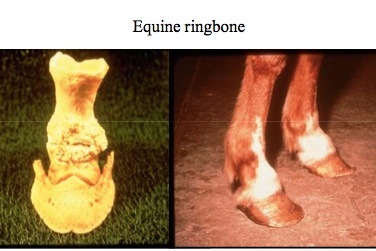
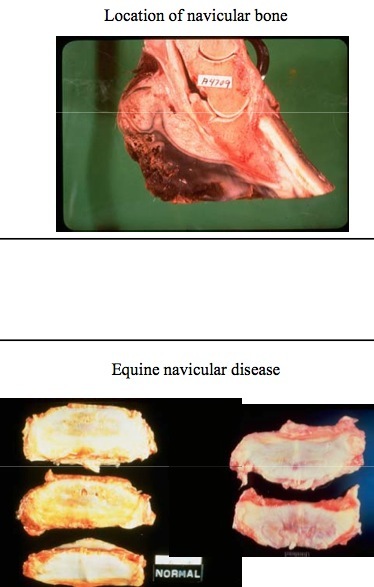
(1. Ringbone, spavin, navicular disease)
1. common disorders of what
2. All develop where?
3. Ringbone involves what joint?
4. Bone spavin involves what joint?
5. Navicular disease centered in what bones?
- horses
- at site of high or sustained mechanical loading
- interphalangeal joints (high ringbone proximal; low ringbone distal)
- intertarsal joints
- navicular bones
Ringbone, spavin, navicular disease
1-3. What are the Common pathological findings in all 3 conditions?
– Full thickness necrosis of cartilage covering
bone surfaces at sites of sustained
compression
– Remodeling of subjacent subchondral bone
– Penetration of cartilage by granulation tissue arising from remodeling response in the subchondral bone
(Ringbone, spavin, navicular disease)
- may Fibrous or bony joint union may occur?
- May be initiated by repeated episodes of minor trauma and mechanical stresses from faulty conformation

(2. Arthropathy of Canine Shoulder)
1. Common in what age dog?
2. bilateral lesions, develop slowly
3. What area of the humeral head?
4. Cartilage ulceration, eburnation of bone, thickeningof joint capsule, and villous proliferation of synovium
5. osteophytes
6. dogs bear how much weight on forelegs?
7. Lesion in same location as OC; pathogenesis different
- (80%) in middle-aged and old dogs
- posterior central articular area
- 65-70%
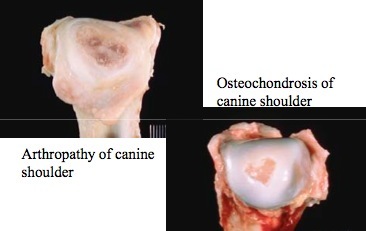
(Arthropathy of Bovine Stifle)
- in what?
inherited in what?
- see what in mature cows?
- bi or unilateral?
- cartilage degeneration, bone eburnation, and oseophyte development
- most severe where?
- dairy cow
holsteins and jerseys
- lameness and muscle atrophy
- bi
- medial aspect of distal femur
(II. Degenerative Diseases of Joints)
(Catilaginous Joints)
(1. Intervertebral Disk Degeneration)
1. nucleus pulposus (remnant of notochord)
2. annulus fibrosus (lamellated fibrous ring)
3. What are the most common cause of spinal pain, paresis, and paraplegia in dogs?
4. affected animals are usually what age/sex?
- prolapsed disks
- males, 3-6 yrs
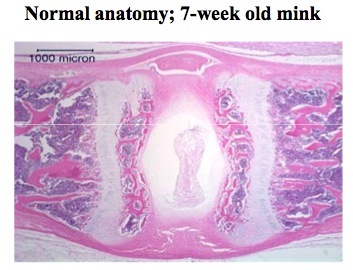
case at 31:52!
(II. Degenerative Diseases of Joints)
(Catilaginous Joints)
(1. Intervertebral Disk Degeneration) cont
1. In chondrodystrophoid breeds (dachsund, Pekingese), nucleus pulposus degenerates and replaced by what?
This change increases likelihood that what will occur?
what also degenerates?
Prolapses caused by complete rupture of what?
- cartilaginous tissue (1 year of age)
protrusion
Annulus fibrosus
annulus fibrosus and are usually massive
(II. Degenerative Diseases of Joints)
(Catilaginous Joints)
(1. Intervertebral Disk Degeneration) cont
1. In nonchondrodystrophoid breeds, initial changes occur when?
consist of fissures in what?
- After middle age, what happens to the nucleus?
- get prolapses associated with what?
- later in life
annulus fibrosus (nucleus pulposus normal)
- nucleus is toughened by deposition of collagen, followed by degeneration and necrosis
- partial rupture of annulus and bulging of dorsal surface disk
(II. Degenerative Diseases of Joints)
(Catilaginous Joints)
(1. Intervertebral Disk Degeneration) cont
1. Spinal pain, paresis, and paraplegia
2. What breed 10-12X more likely to get?
- daschunds (also beagles, cockers, and Pekingnese)
(II. Degenerative Diseases of Joints)
(Catilaginous Joints)
(1. Intervertebral Disk Degeneration) cont
1. Most displacements occur in what direction?
2. Most disc disease involves what regions of spine (by 3-4x)?
(thoracic spine)
- less mobile than other parts of vertebral column
- conjugal ligaments connect heads of ribs
- dorsally (dorsal part of annulus fibrosus is thinner than the ventral)
- thoracolumbar and cervical



-
01 - Respiratory System28
-
02 - Respiratory system (cont)17
-
02 - Developmental Abnormalties8
-
04 - Developmental Abnormalities (cont)28
-
05 - Developmental Abnormalities (cont)28
-
01 - Resp Antmy & Histo - dfns mchnsms11
-
02 - path of upper - path of lar and phar9
-
03 - Path of treachea and lung9
-
04 - ROVIRA21
-
04 - ROVIRA - COW12
-
05 - Hypothryoidism & Hyperthyroidism (ERIK)17
-
06 - Hyperadrenocorticism9
-
07 - Diabetes Mellitus9
-
08 - Primary Hyperparathryoidism7
-
09 - Pancreatic Endocrine Neoplasia11
-
03-01 - path of lung12
-
03-02- pleuradogscats9
-
BONE-0127
-
BONE-0227
-
BONE-0320
-
BONE-0435
-
BONE-0522
-
BONE-0631
-
BONE-06.51



