Describe Diastole; how many distinct phases it has? and its proportion to each beat?
Ventricular relaxation- fills with blood
last 2/3 of each beat
split into 4 distinct phases
describe systole
Ventricular contraction- generates pressure then ejects blood out
lasts 1/3 ofeach beat
split into 3 distinct phases
what are the stages of the cardiac cycle?
- Atrial systole- DISATOLE
- Isovolumetric contraction- SYSTOLE
- rapid ejection- SYSTOle
- Slow ejection- SYSTOLE
- Isovolumetric relaxation- DIASTOLE
- Rapid paasive filling- DIASTOLE
- Slow pssive filling- DIASTOLE
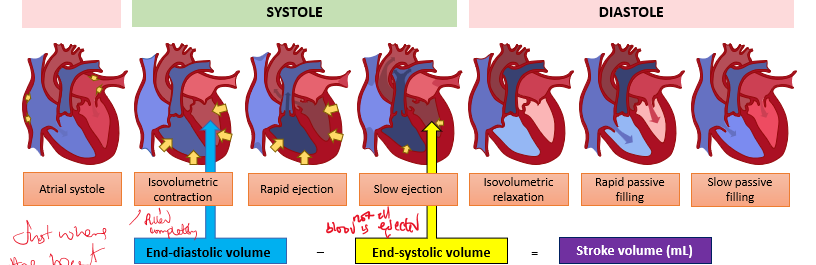
how can stroke volume and ejection fraction be calculated?
SV- end-diastolic volume minus End-systolic volume
ejection fraction= Stoke volume/End diastolic volume
Describe what happens in the 1st stage of cardiac cycle
Atrial systole
- P- wave on ECG shows start of atrial systole
- atria full form passive filling by pressure gradient
- Atria cintract to top up volume of blood already in ventricles
- there could be a 4th abnormal heart sound caused by pulmonary embolism, tricuspid incompetence and congestive heart failure
explain the features and what happens in ISOVOLUMETRIC CONTRACTION
- ECG- marked by QRS complex; shows ventricular depolarisation
- AV valves shut (interval between closure of AV valves and opening of semi lunar valves)
- isometric contraction of ventricles as semilunar valves are also shut.
- ist heart sound heard by CLOSURE of AV valves and associated vibrations
what are the features and what happens in rapid ejection stage of the cardiac cycle?
- Opening of BOTH semi lunar valves
- pressure in ventricles build up and start to go above aortic and pulmonary artery pressure
- after load overcome;
- ISOTONIC contraction as blood rushes out of ventricles
- NO heart sound for this phase
what are the features and event of the 4th stage of the cardiac cycle?
REDUCED EJECTION
- Marks end of systole
- reduced pressure gradient means that semilunar valves BEGIN to close;
- blood flow from ventricles decrease, volume also decreases at a slower rate
- pressure in ventricles start to fall
explain the features and events of the 5th stage of the cardiac cycle
ISOVOLUMETRIC RELAXATION
- Both semiluar valves shut
- AV valves are also shut unitl ventricular pressure falls below atrial pressure
- atrial pressure start to rise
- dichrotic notch- aortic wall relaxes; causing reboud pressure against aortic valve
- 2nd heart sound is heard by closure of semi lunar valves
describe the events and features of RAPID passive filling (cardiac cycle stage)
- electrical quiescene- flat ECG line
- AV valves open; blood flow into ventricles
- atria doesnt contract
- abnormal 3rd heart sound may be heard of there’s hypertension or mitral incompetence. this signifies turbulent ventricular filling
Describe the events and features of the LAST stage of the cardiac cycle
REDUCED PASSIVE FILLING
- this is called diastasis
- ventricular volume fill more slowly
- ventricle fill quite well WITHOUT atrai contraction
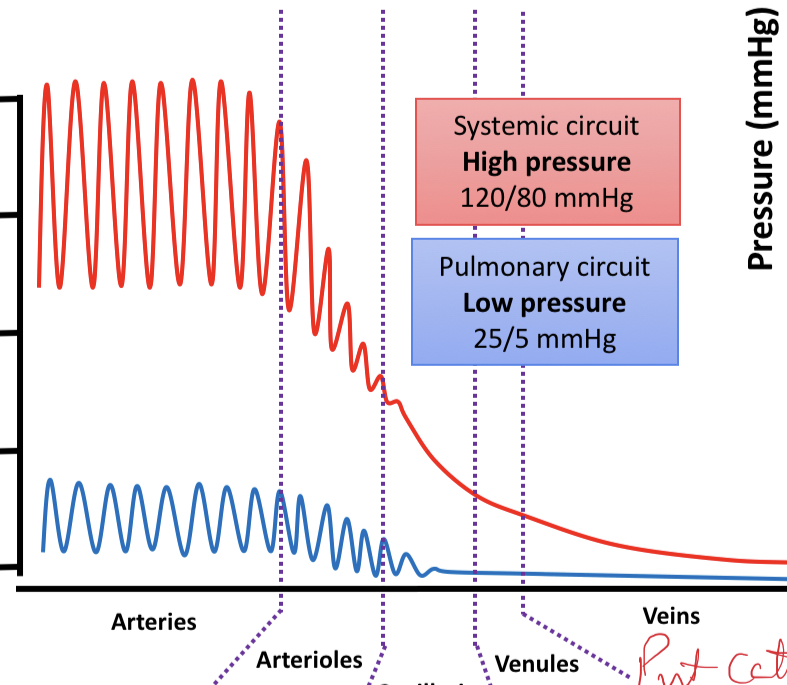
contrast the volume of blood and patterns of pressure in the right and left ventricles
same volume of blood
same PATTERN of pressure changes
HOWEVER; left ventricle has higher systole pressure of 120mm/Hg. right = 25mm/Hg
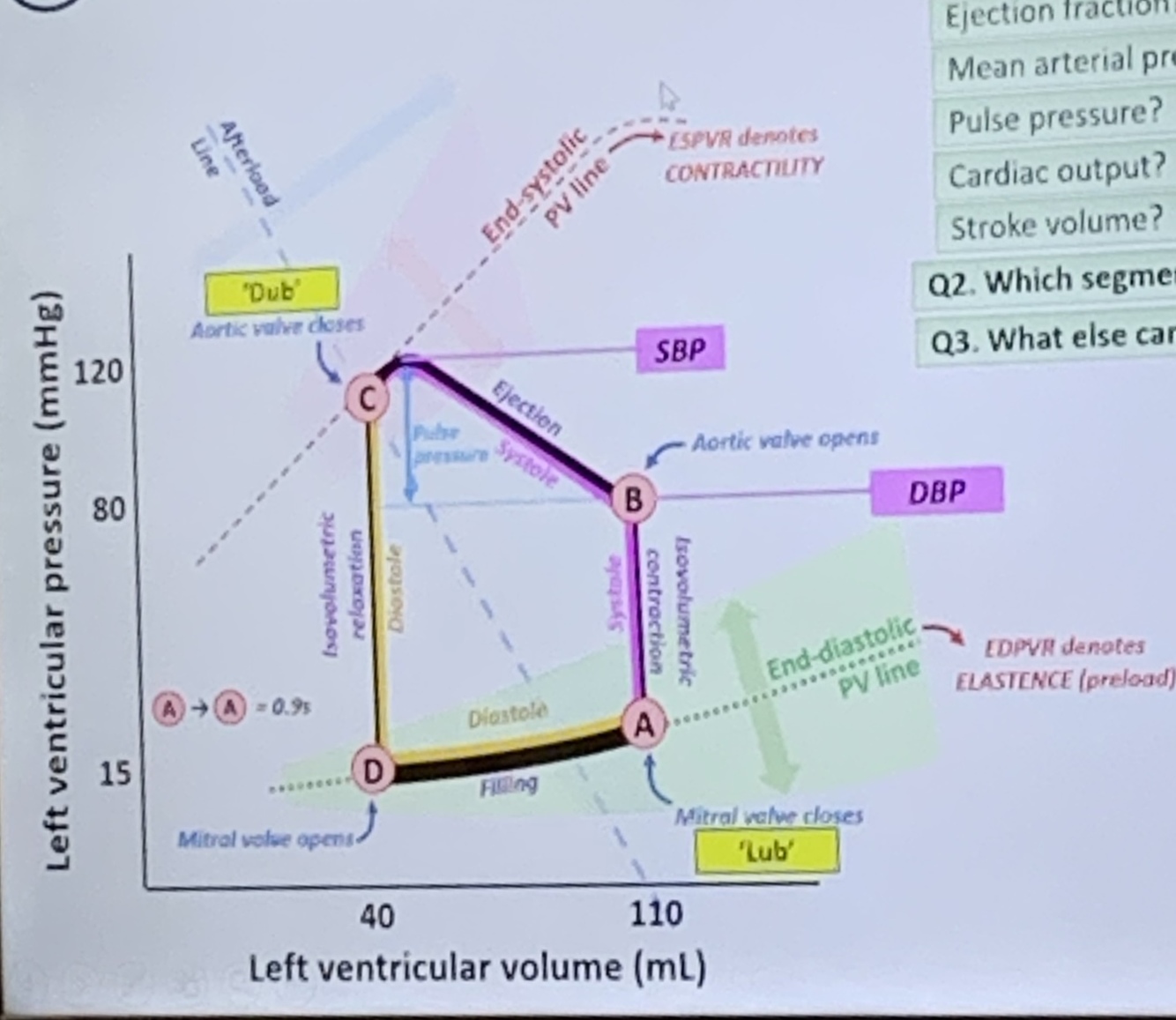
Draw and label a pressure volume loop. label axis; label signifcant points and cardiac cycle stages
when does pre load occur and after load occur
Pre-load at “a”
after load is just after “b”- rapid ejection occurs due to overcoming after load
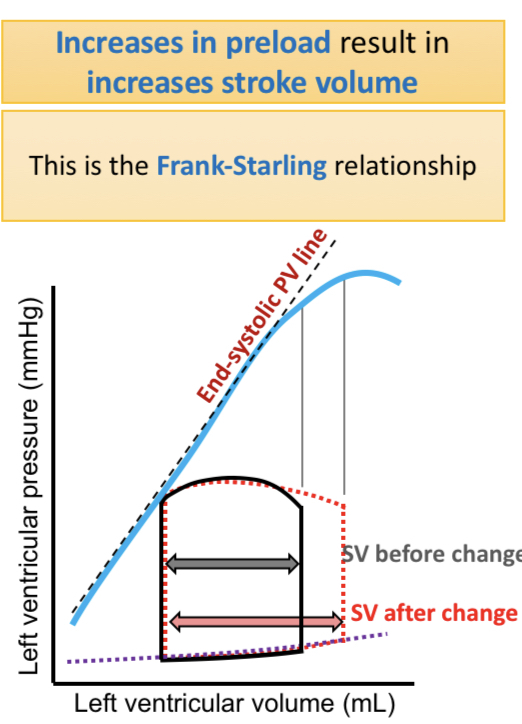
how does increase in pre-load affect the presure volume loop
higher pre-load means there’s higher stroke volum.
higher left ventricle volume pumped out but pressures stays relatively the same
How does increases in After load affect the pressure volume loop
lower stroke volume; have to wotk harder to overcome aortic pressure. hence point B is higher (pressure).
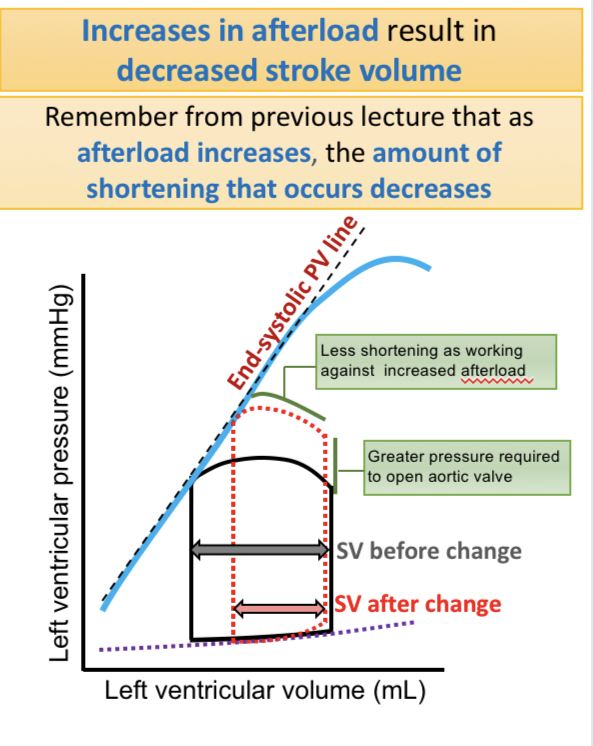
apart from pre load and after load? what ELSE affects stroke volume?
explain how and what causes it? How is it measured?
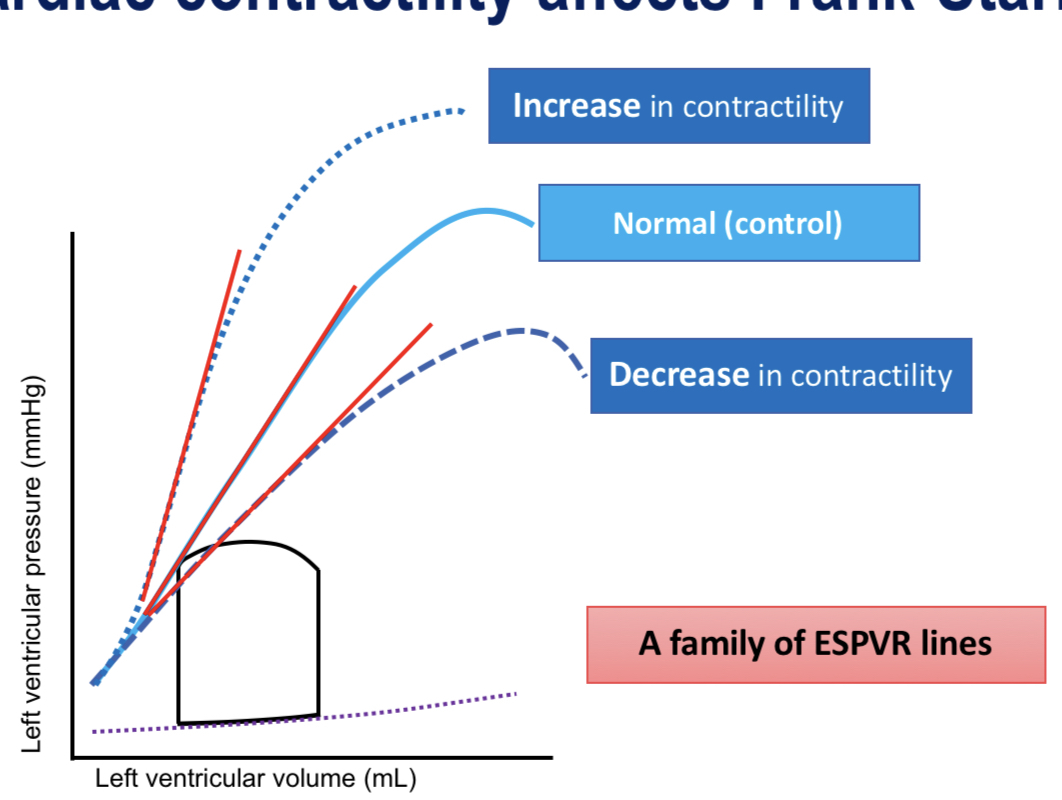
CONTRACTILITY- strength of heart contraction (CAPABILTIY)
increased by sympathetic stimulation
measured by ejection fraction
how does contractitlity affect frank sterling relationship?
higher gradient for active force.
which is the longest phase in cardiac cycle?
reduced passive filling
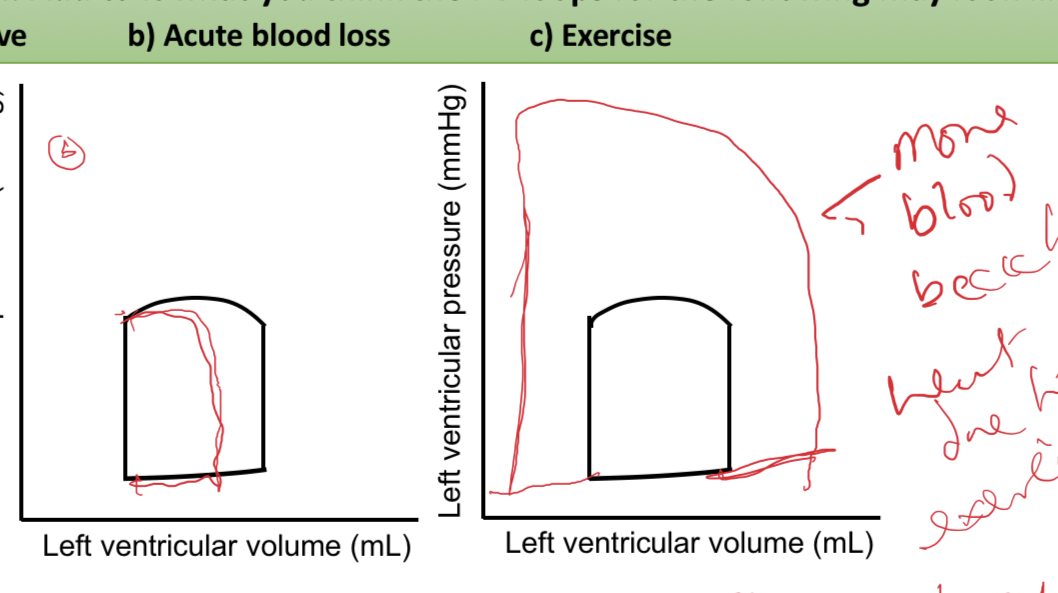
how does acute blood loss and exercise affect pressure volume loop
acute blood loss- less venous retunr, less stroke volume
exercise- more venous return but higher pressure in aorta to overcome but can oversome it
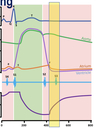
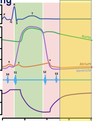
What phase of the cardiac cycle does this image represent
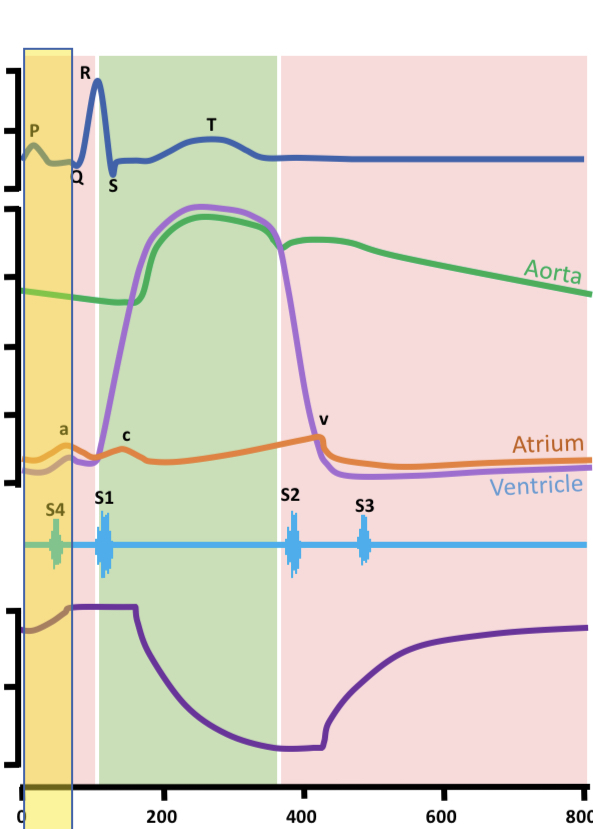
Atrial systole (DIASTOLE)
What phase of the cardiac cycle does this image represent
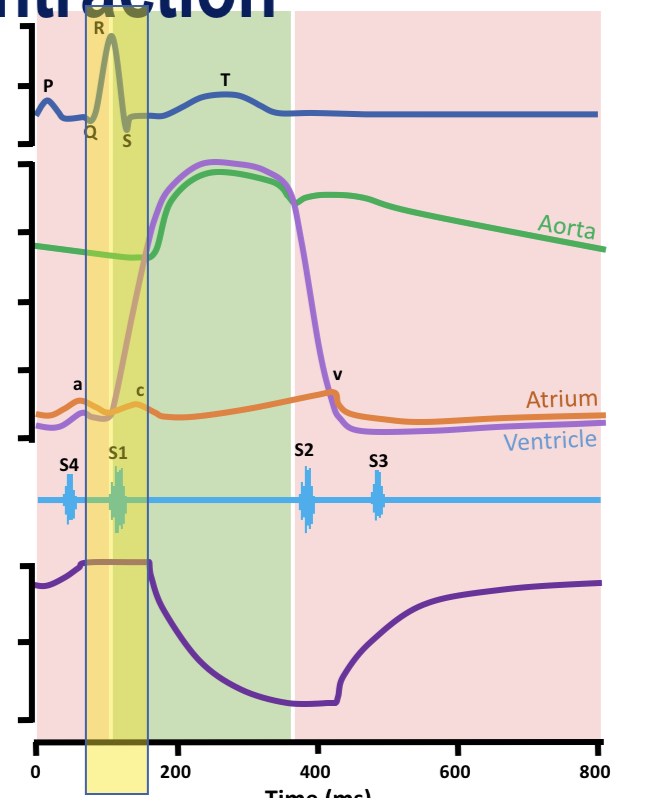
ISOVOLUMETRIC CONTRACTION
What phase of the cardiac cycle does this image represent?
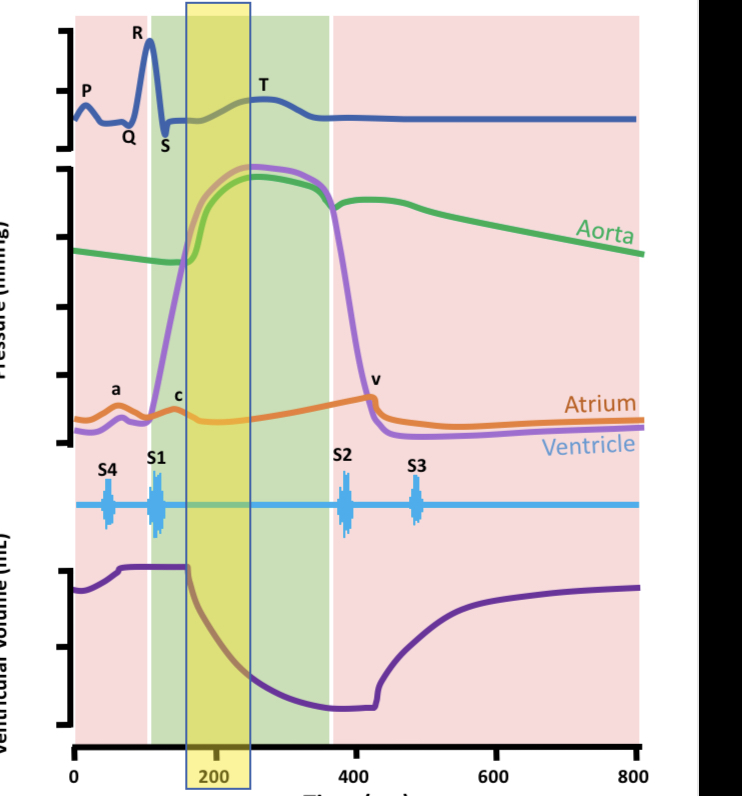
RAPID EJECTION
What phase of the cardiac cycle does this image represent
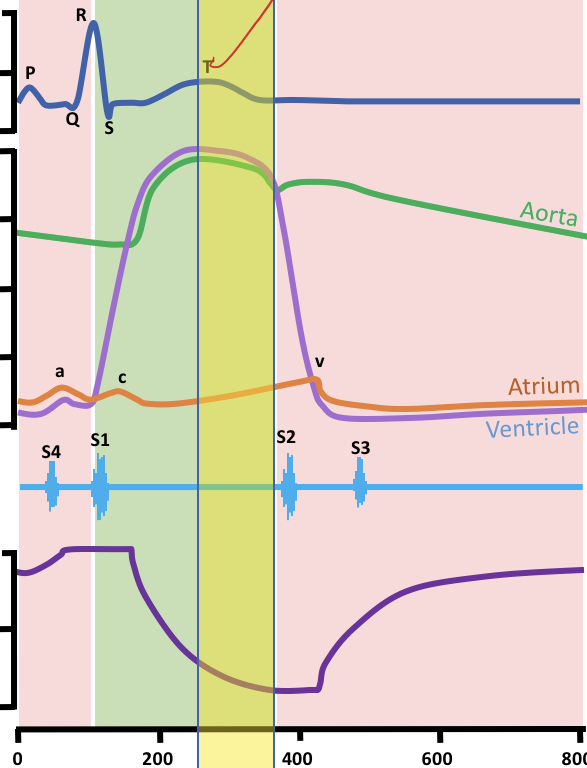
Reduced ejection
T- represents repolarisation
What phase of the cardiac cycle does this image represent
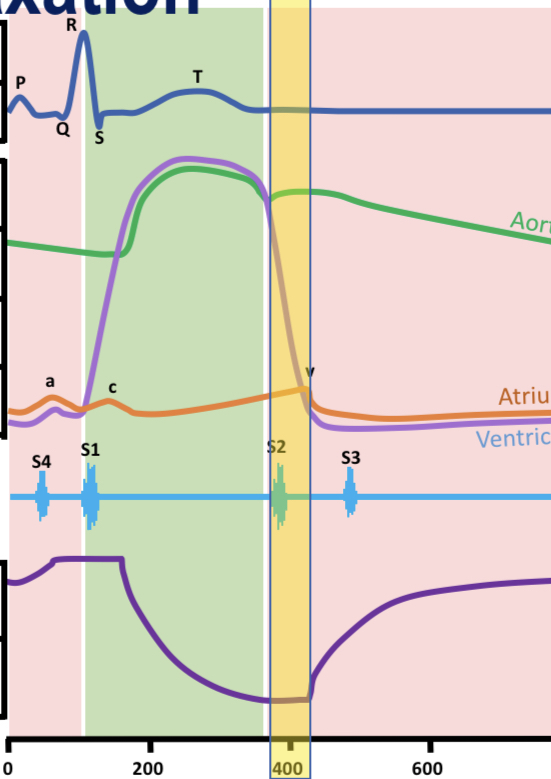
ISOVOLUMETRIC RELAXATION

-
Action Potentials25
-
CNS34
-
PNS20
-
Cranial Nerves14
-
Neurones19
-
Neurotransmitters24
-
Pharmacological basics9
-
Autonomic nervous system18
-
Practical- Neurophysiology5
-
Cardiovascular mechanics29
-
CARDIAC CYCLE26
-
Structure and function of airways23
-
Ventilation and gas exchange33
-
Microcirculation35
-
Cardio respiratory mechanics50
-
Control of Heart function51
-
Control of lung function32
-
Pulmonary Function Test11
-
ECG48
-
Cardiovascular disorder76
-
COPD vs Asthma26
-
Psychiatry disorders20
-
Mental Health Overview24
-
Introduction to dermatology72
-
Pituitary gland44
-
THYROID glands44
-
Adrenal Gland41
-
Calcium phosphate regulation42
-
Glucose Homeostasis33
-
Diabetes Mellitus47
-
Reproductive organs- male and female86
-
Endocrinology diagnostic techniques11
-
Sex Hormones during life57
-
Microstructure and contraction41
-
Bone and soft tissue47
-
Connective tissues and Rheumatology intro44
-
Bone injury and healing35
-
Osteoarthritis and osteoporosis18
-
Clinical skills principles20
-
Heptobiliary system73
-
Upper GI tract48
-
Genitourinary system and urinalysis52
-
Pancreas and Small bowel56
-
Obstructive jaundice16
-
GFR and Renal clearance19
-
Large bowel44
-
Regulation of Gut function38
-
Ions, minerals and vitamins34
-
Pancreatitis33
-
Liver Failure46
-
Urological disorders55
-
GI cancers80
-
Introduction to the Upper Limbs7
-
Bones of the Upper Limb16



