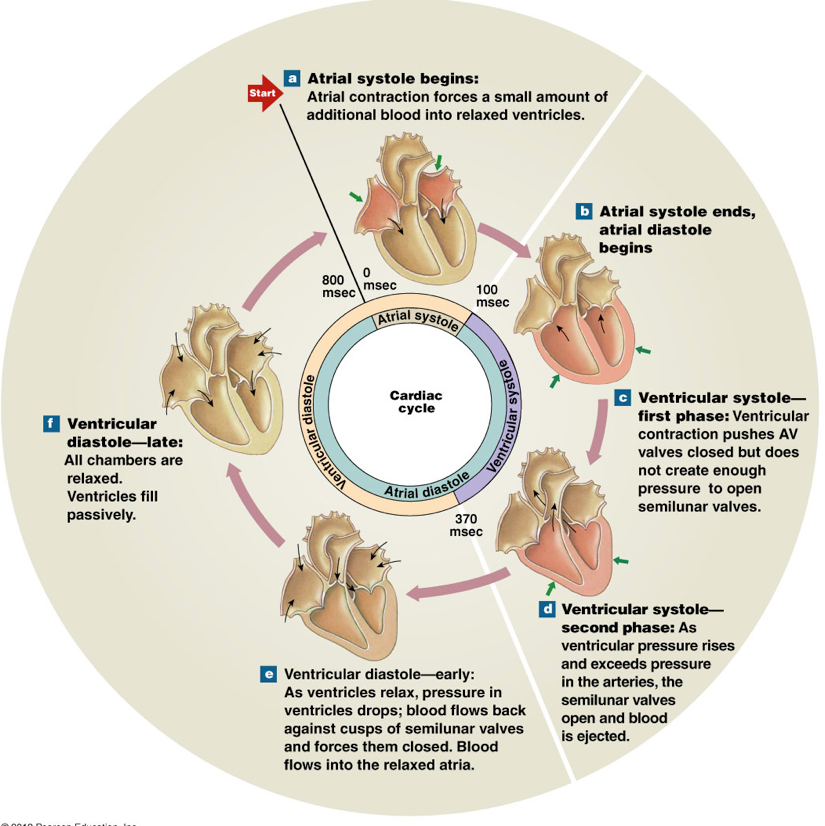
Timing of Systole and diastole
- Atrial systole- squeezes the last bit of blood into the ventricle
- Atrial diastole begins
- Ventricular systole first phase
- contraction force pushes AV valves closed but not enough force to open semilunar valves
- Ventricular systole second phase
- pressure rises to exceed pressure of the arteries and semilunar valves open and blood is ejected
- Ventricular diastole, early
- ventricles relax, pressure drops, blood flows back agains semilunar valves, closing them.
- blood flows into the relaxed atria
- Ventricular diastole, late
- all chambers are relaxed, ventricles fill passively
What are the three major events of ventricular diastole?
- Early diastole: pressure dropping and semilunar valves closing. Pressure less than arteries but more than atria.
- Late diastole: Pressure drops below atri, AV valve opens. Rapid ventricular filling passively
- Atrial systole: atrial contraction tops off the last bit of blood into ventricle
What is the approximate End Diastolic Volume?
about 120 ml in ventricles
What are the two major events of systole?
- First phase
- isovolumetric contraction, pressure increase, valves closed.
- pressure rises until ventricular pressure exceeds aortic pressure and valve opens
- Second phase
- Semilunar valves open
- rapid ejection followed by reduced ejection as ventricular pressure falls
Normal intracardiac pressures of PA
Systolic: 15-30 mmHg
Diastolic: 3-12 mmHg
Normal intracardiac pressure RA
0-8 mmHg
nickel
Normal intracardiac pressures RV
Systolic: 15-28 mmHg
End-Diastolic: 0-8 mmHg
Quarter/nickel
Normal Intracardiac pressures Aorta
Systolic: 96-140 mmHg
Diastolic: 60-90 mmHg
Normal intracardiac pressure LA
4-12 mmHg
dime
Normal intracardiac pressures LV
Systole: 90-140 mmHg
Diastole: 4-12 mmHg
1.25/dime
Normal intracardiac pressure in Pulmonary Vein
about 9 mmHg
dime
Heart Sounds
S1
“Lubb”
closure of AV valves
Heart Sounds
S2
“dubb”
closure of semilunar valves
Heart Sounds
S3
rapid passive filling
*not normally heard in adults; may be heard in small children or endurance athletes
Heart Sounds
S4
atrial systole
normally not heard in adults
Murmur
gurgling sound as blood moves through damaged valves
bruit
abnormal sound as blood runs past and obstruction through arteries
Factors that affect cardiac output
CO = SV x HR
Heart rate
Stroke volume: Preload, contractility, afterload
inotropic
related to strength of contraction
chronotropic
related to speed of contractions
How does the Autonomic nervous system alter HR?
- Sympathetic:
- NE/Epi
- Beta 1 receptors
- positive chronotropic effect
- Parasympathetic:
- Acetylcholine
- M2 receptor
- negative chronotropic effect
What are the two main mechanisms for altering stroke volume?
Intrinsic regulation
Autonomic regulation
Intrinsic regulation of stroke volume
- Frank-Starling law of the heart
- increased stretch of myocytes increases strength of contraction
- by more optimally lining up the myosin and actin so more can “grab” hold
- increased stretch created by increase in venous return and EDV
Autonomic regulation of stroke volume
- Contractility
- increased strength of contraction due to increased amount of cytosolic calcium (primarily SNS)
- NE increases Ca++

-
Fluids25
-
Cells15
-
Molecular Biology24
-
Cell membrane36
-
Membrane potentials24
-
Skeletal muscle23
-
Innate Immunity20
-
Smooth muscle8
-
Adaptime immunity10
-
CNS 160
-
CNS 237
-
ANS40
-
CNS 326
-
Cardiac Introduction21
-
Cardiac Electrical22
-
Cardiac Mechanical27
-
Blood Vessels25
-
Renal- GFR and Clearance19
-
Renal- Transport Processes20
-
Urine concentration/fluid regulation17
-
Acid/Base balance by Kidneys28
-
Pancreas30
-
Endocrine Concepts28
-
Endocrine Hormones39
-
Blood39
-
Pulm: Ventilation38
-
Pulm: Blood flow12
-
Mechanics of breathing25
-
Gas Transport35
-
Liver22
-
Hormones14



