what is vision
the conscious perception of information from the eye –> processed in the occopital cortex (mammals)
visual system is part of the CNS which gives organisms the ability to process info that is contained in visible light
why is vision assessment limited in vet med and how can it be assessed
because of interference of behaviour
- observation, unfamiliar environment
- ability to track (silent movement, cotton balls)
- visual placing (small animal)
- menace response (other reasons for failure)
what is the visual field
total area in which objects can be seen in the peripheral vision as you focus your eyes on a central point
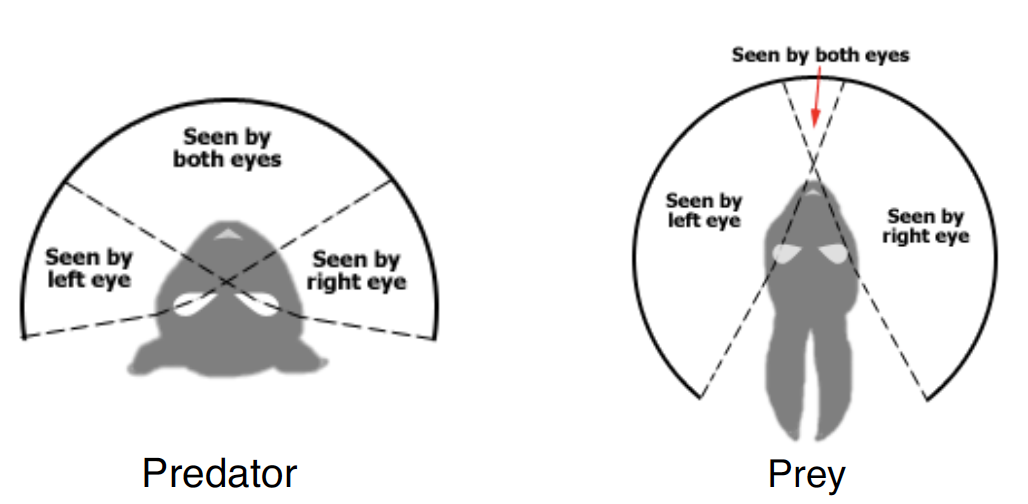
what is the cross over at the optic chiasm between different species
humans 50%
cats 65%
dogs 75%
horses 80%
birds and fish 100%
what is the cross over at the optic chiasm related to
inversely related to binocular vision
what is the pupillary light relfex pathway
- retina
- optic nerve (CN II) = afferent
- optic chiasm
- optic tract
- pretectal nucleus
- parasympathetic nucleus of CN III = efferent
- bilateral pupil constriction
what is central (cortical) blindness
also known as amaurosis
blindness without apparent lesion of eyes
involves processing system
where are the lesions in central (cortical) blindness
lateral geniculate nucleus
optic radiation
occipital cortex
what are the clinical signs of central (cortical) blindness
- normal PLR
- absent menace response
- blind
what is peripheral (subcortical) blindness
involves collection/distribution system
where are the possible sites for lesions in peripheral (subcortical) blindness
- eye
- optic nerves
- optic chiasm
- optic tract
what are the clinical signs of peripheral (subcortical) blindness
- absent PLR
- absent menace response
- blind
what is the pathway of the dazzle reflex
reflex –> no cortical involvement
- retina
- optic nerve (CN II) = afferent
- optic chiasm
- optic tract
- pretecta nucleus
- facial nerve nuclei CN VII = efferent
- bilateral blinking
what is the menace response pathway (10)
response cortical involvement
- retina
- optic nerve (CN II) = afferent
- optic chiasm
- optic tract
- lateral geniculate nucleus
- optic cortex
- motor cortex
- pontine nucleus
- cerebellum
- facial nerve nuclei CN VII = efferent
what is the innervation of the extraocular muscles
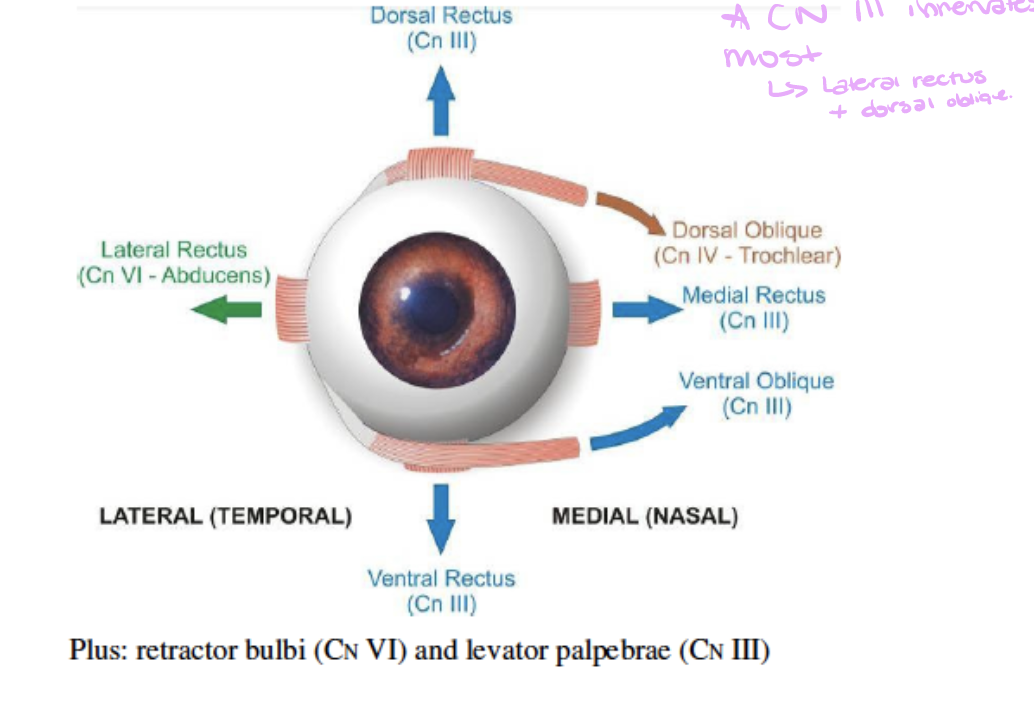
what does the oculomotor nerve innervate
GSE: dorsal rectus, medial rectus, ventral rectus, ventral oblique, levator palpebrae
GVE: parasympathetic for pupil
what does the trochlear nerve innervate
GSE: dorsal oblique
what does the abducent nerve innervate
GSE: lateral rectus
retractor bulbi muscle in the eye

-
Intro to the CNS14
-
Brain Anatomy79
-
Embryology of CNS44
-
Cellular Anatomy of CNS82
-
Blood Supply to the CNS & CSF71
-
Introduction to Advanced Imaging19
-
Vertebral Column 147
-
Vertebral Column 243
-
Vertebral Column 347
-
Vertebral Column 415
-
Overview of Spinal Cord Segments & Nerve Roots64
-
Vertebral Column + Spinal Cord16
-
Local Functions of the Spinal Cord Segmental Spinal Reflexes38
-
Eyeball Dissection15
-
Sensory Inputs & Motor Outputs of Brain: Distal Spinal Cord Function43
-
Special Senses Practical21
-
Peripheral Sensory Systems23
-
Intro to Animal Welfare28
-
Anatomy of Ear52
-
Special Senses40
-
Structure of Eyeball97
-
Cranial Nerve Function & Testing33
-
Functions of Cerebellum & Brainstem37
-
Pain - Physiology to Pharmacology31
-
Pain Pharmacology & Epidural Anaesthesia8
-
Autonomic Nervous System65
-
Pharmacological Principles of General Anaesthetics, Sedative, Tranquilizers & Mood Altering Drugs2
-
Neuroendocrinology44
-
Animal Pain and Ethical Implications20
-
Regulation of Motor Control & Anatomy of Limbic System54
-
Tissue Injury + Repair 162
-
Epilepsy + Pharmacology of Antiepileptic Drugs83
-
Brain Dissection14
-
CNS Histology7
-
MRI + CT Practical11
-
Vertebral Column Practical45
-
Spinal Reflexes SDL48
-
Eyeball Histology29
-
Brain MRI Atlas33
-
Visual Senses27
-
Central Visual Pathways & Perceived Visual Field19
-
Visual Senses COPY26
-
Vestibular System & Control of Posture33



