what are the diagnositc imaging options of the vertebral column
- radiography
- computed tomography (CT)
- magnetic resonance imaging (MRI)
- nuclear scintigraphy
- ultrasound
what are the most radiographic views taken of the vertebral column
- lateral view
- ventrodorsal view
what are the labelled parts
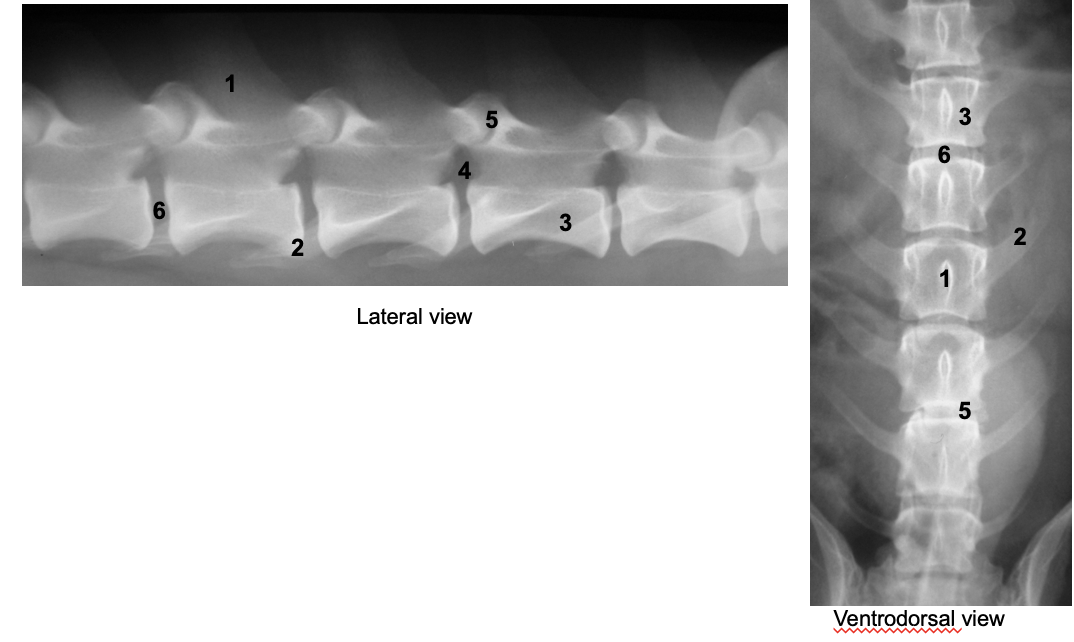
- dorsal spinous process
- transverse processes
- vertebral body
- invertebral foramen
- articular facets
- intervertebral disc space
what are the drawbacks of radiographs
superimposition
the dorsal spinous processes can be seen in lateral view but are superimposed in ventrodrosal
transverse processes can be seen in ventrodorsal view but less in lateral
not good for soft tissue –> invertebral disc space appears dark or radiolucent gap, cant see cord
what is a myelogram
injection of contrast medium into vertebral canal (subarachnoid space)
outlines spinal cord
where can the constrast medium for myelogram be injected
- cisterna magna –> occipital crest of skull, dorsal spinous process of axis, transverse processes or wings of atlas, needle is introduced midline
- lumbar region –> cranial to dorsal spinous process of L6
what is the bone window
CT image produced can be altered to enhance the appearance of different tissue types
bone window setting is commonly used for vertebral column
what are the structures shown
- dorsal spinous process
- transverse processes
- vertebral body
- intervertebral foramen
- articular facets
why is CT useful
for visualizing boney components –> appear white
no superimposition
brain or soft tissue windows can be used to assess the brain and spinal cord
what are the structures shown and what scan is this
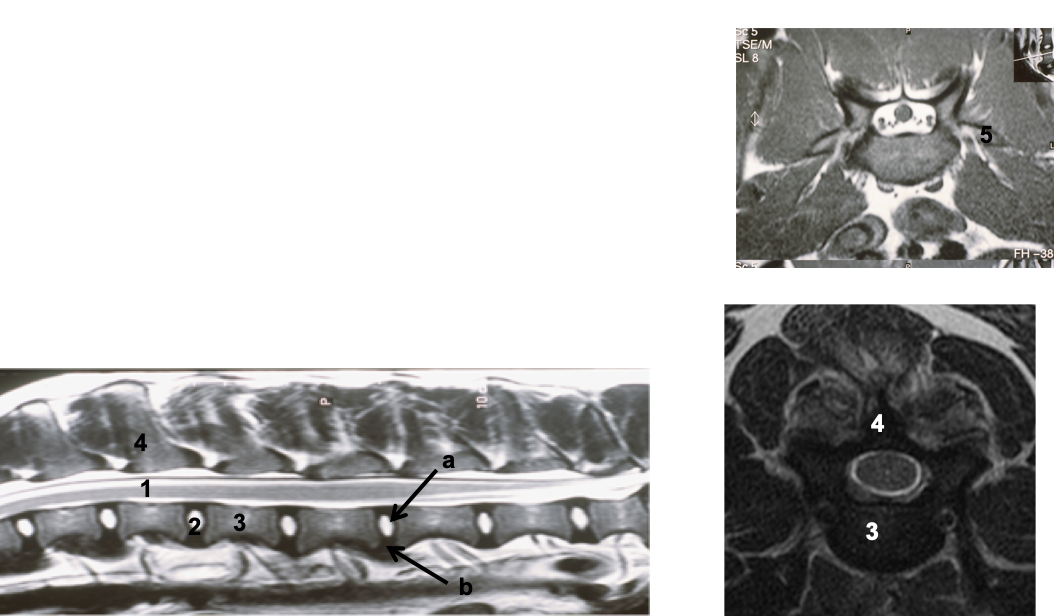
- spinal cord
- intervertebral disc space (nucleus pulposus = a, annulus fibrosus = b)
- vertebral body
- dorsal spinous process
- transverse processes
what is seen on T2 weighted imaged
- CSF appears white or hyperintense
- intervertebral discs can be distinguished from each other
- nucleus pulposus is fluid = white or hyperintense
- annulus fibrosus appears dark or hypointense
- boney features = dark or hypointense
identify the structures
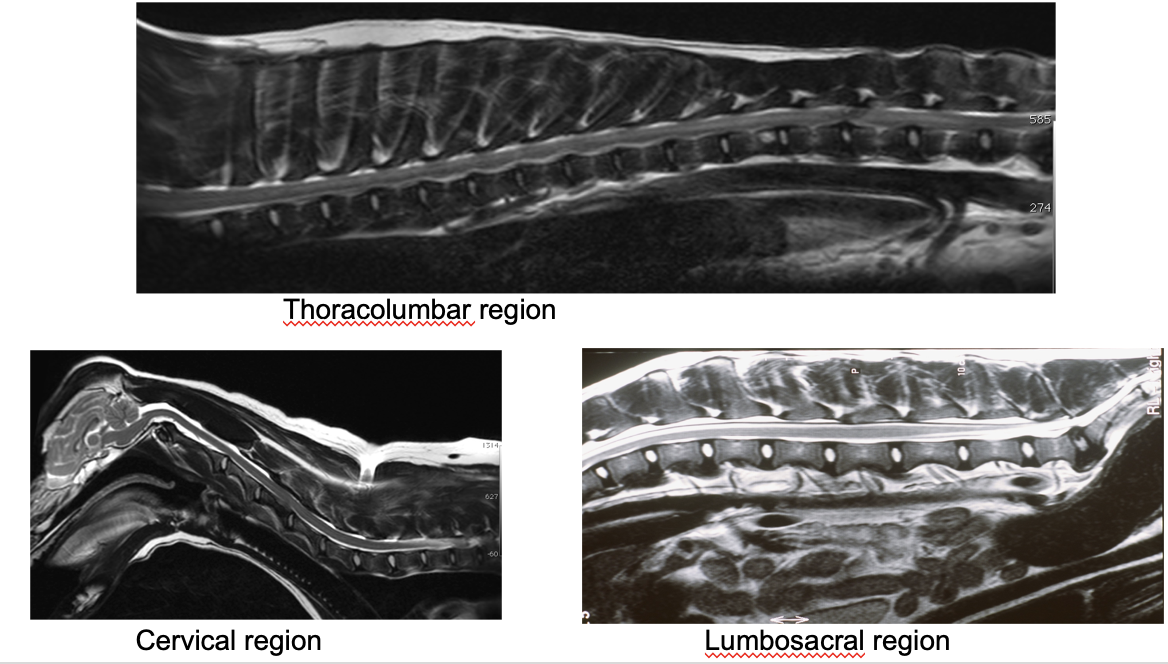
what is nuclear scintigraphy
injection of bone seeking agent tagged with radioisotope (gamma emitter)
gamma camera
localization of functional/metabolic changes rather than physical ones
common in equine
how is ultrasound useful to view vertebral column
cannot penetrate bone
not used to image vertebral column
examine soft tissue structures
what structures are seen on ultrasound
- vertebral body –> long axis taken from ventrolateral aspect of vertebral column
- intervertebral disc space –> located between adjacent bodies
very limited for imaging of column and unlikely used

-
Intro to the CNS14
-
Brain Anatomy79
-
Embryology of CNS44
-
Cellular Anatomy of CNS82
-
Blood Supply to the CNS & CSF71
-
Introduction to Advanced Imaging19
-
Vertebral Column 147
-
Vertebral Column 243
-
Vertebral Column 347
-
Vertebral Column 415
-
Overview of Spinal Cord Segments & Nerve Roots64
-
Vertebral Column + Spinal Cord16
-
Local Functions of the Spinal Cord Segmental Spinal Reflexes38
-
Eyeball Dissection15
-
Sensory Inputs & Motor Outputs of Brain: Distal Spinal Cord Function43
-
Special Senses Practical21
-
Peripheral Sensory Systems23
-
Intro to Animal Welfare28
-
Anatomy of Ear52
-
Special Senses40
-
Structure of Eyeball97
-
Cranial Nerve Function & Testing33
-
Functions of Cerebellum & Brainstem37
-
Pain - Physiology to Pharmacology31
-
Pain Pharmacology & Epidural Anaesthesia8
-
Autonomic Nervous System65
-
Pharmacological Principles of General Anaesthetics, Sedative, Tranquilizers & Mood Altering Drugs2
-
Neuroendocrinology44
-
Animal Pain and Ethical Implications20
-
Regulation of Motor Control & Anatomy of Limbic System54
-
Tissue Injury + Repair 162
-
Epilepsy + Pharmacology of Antiepileptic Drugs83
-
Brain Dissection14
-
CNS Histology7
-
MRI + CT Practical11
-
Vertebral Column Practical45
-
Spinal Reflexes SDL48
-
Eyeball Histology29
-
Brain MRI Atlas33
-
Visual Senses27
-
Central Visual Pathways & Perceived Visual Field19
-
Visual Senses COPY26
-
Vestibular System & Control of Posture33



