what are the regions of the vertebral column
- cervical
- thoracic
- lumbar
- sacral
- caudal or coccygeal
what is the vertebral formula of the dog
C7 T13 L7 S3 CC variable
what boundary does the thoracic region form
the dorsal boundary of the thoracic cavity
what boundary does the lumbar region form
dorsal boundary of the abdominal cavity
what boundary does the sacral region form
dorsal boundary of the pelvic cavity
what are species exceptions to 7 cervical vertebrae
2 toed sloth = 6 cervical vertebrae
manatee = 6 cervical vertebrae
3 toed sloth = 9 cervical vertebrae
what is the functions of the cervical region
- support of the head
- movement of the head
- protection of ventral neck structures
- muscle attachment
what are the features of cervical vertebrae
- dorsal spinous and transverse processes short
- transverse processes have ventral projection –> attachment of ventral neck muscles (hypaxial muscles)
- transverse foramen –> passage of vertebral A & V
why do cervical vertebra have short dorsal spinous and trasnverse processes
to allow large range of movement
what features of cervical vertebrae allow for large amount of mobility
no large projections
articular facets are relatively flat which allows for greater movement at the synovial joints between the vertebrae
all except 1st and 2nd cervical vertebrae
what is the first cervical vertebra called
atlas –> bears weight of the head
how does C1 differ from other cervical vertebra
vertebral arch but doesn’t have a vertical body
no dorsal spinous process
2 large transverse processes called wings (palpable)
how does C1 develop
the cranial section of the sclerotome remains assocaited with the caudal section rather than separating –> C1 develops from only caudal section of sclerotome (no vertebral body, but arch)
what is the second cervical vertebra called
axis
how is C2 different
- C2 has 2 vertebral bodies –> produces boney projection at cranial aspect called dens
- small transverse processes
- prominant dorsal spinous process (palpable and visible on radiograph)
how does the dens of C2 develop
develops from 2 cranial sections and 1 caudal sections of sclerotome
dens represents vertebral body of C1 that is associated with C2 instead
what vertebrae is this
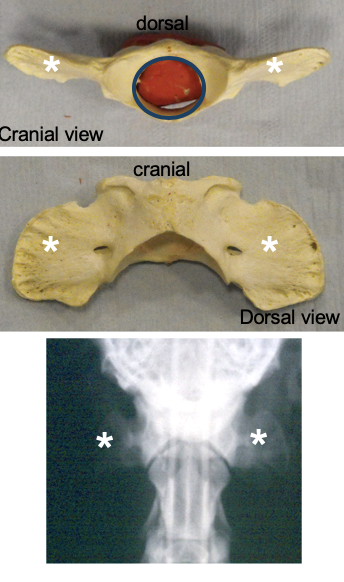
C1
what vertebrae is this
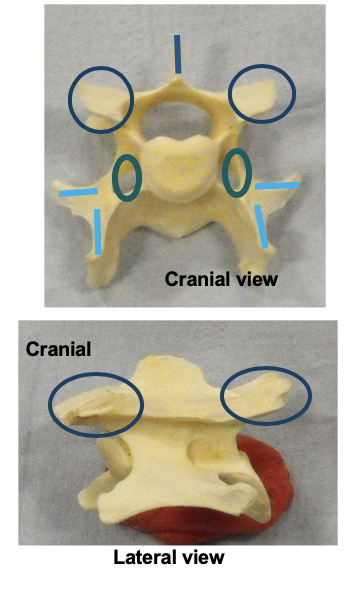
cervical
what vertebrae is this
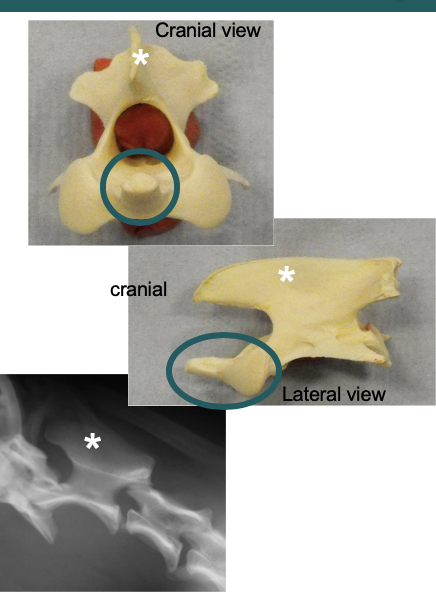
C2
what does the number of thoracic vertebrae correspond with
number of pairs of ribs
dog = 13
horse = 18
what are the functions of the thoracic vertebrae (4)
- articulates with ribs (little lateral movement –> only flexion and extension)
- forms dorsal boundary of thoracic cavity
- protection of thoracic cavity
- muscle attachement (vertebral columnn, body wall and extrinsic forelimb muscles)
what vertebrae is this
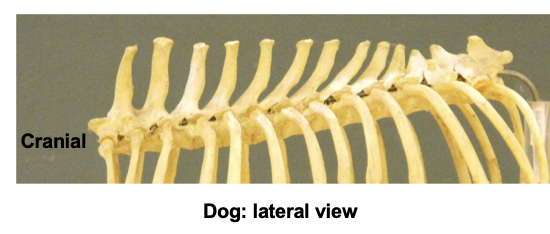
thoracic
what are the typical features of thoracic vertebrae
- short vertebral body
- long dorsal spinous processes (large and caudally arranged –> attachment of the epaxial muscles)
- small/short transverse processes to accomodate space for ribs
- costal fovea –> presence of ribs
what are the costal fovae of the thoracic vertebrae
flattened areas located on each side of vertebral bodiy at the cranial and caudal notches
provide smooth surface that articulates with the head of corresponding rib



-
Intro to the CNS14
-
Brain Anatomy79
-
Embryology of CNS44
-
Cellular Anatomy of CNS82
-
Blood Supply to the CNS & CSF71
-
Introduction to Advanced Imaging19
-
Vertebral Column 147
-
Vertebral Column 243
-
Vertebral Column 347
-
Vertebral Column 415
-
Overview of Spinal Cord Segments & Nerve Roots64
-
Vertebral Column + Spinal Cord16
-
Local Functions of the Spinal Cord Segmental Spinal Reflexes38
-
Eyeball Dissection15
-
Sensory Inputs & Motor Outputs of Brain: Distal Spinal Cord Function43
-
Special Senses Practical21
-
Peripheral Sensory Systems23
-
Intro to Animal Welfare28
-
Anatomy of Ear52
-
Special Senses40
-
Structure of Eyeball97
-
Cranial Nerve Function & Testing33
-
Functions of Cerebellum & Brainstem37
-
Pain - Physiology to Pharmacology31
-
Pain Pharmacology & Epidural Anaesthesia8
-
Autonomic Nervous System65
-
Pharmacological Principles of General Anaesthetics, Sedative, Tranquilizers & Mood Altering Drugs2
-
Neuroendocrinology44
-
Animal Pain and Ethical Implications20
-
Regulation of Motor Control & Anatomy of Limbic System54
-
Tissue Injury + Repair 162
-
Epilepsy + Pharmacology of Antiepileptic Drugs83
-
Brain Dissection14
-
CNS Histology7
-
MRI + CT Practical11
-
Vertebral Column Practical45
-
Spinal Reflexes SDL48
-
Eyeball Histology29
-
Brain MRI Atlas33
-
Visual Senses27
-
Central Visual Pathways & Perceived Visual Field19
-
Visual Senses COPY26
-
Vestibular System & Control of Posture33



